

From 0.7 tonnes to 135 tonnes: China’s farmed caviar production expanded dramatically between 2006 and 2018, according to FAO GLOBEFISH’s 2019 account. Then came a different kind of change. During pandemic restrictions, restaurants turned towards 30 g takeaway tins, a shift documented by EUMOFA in 2021. Its 2025 report captured another break: no EU imports from Russia in 2023 or 2024 in a category covering caviar and substitutes.
These are three distinct stories: more production, smaller packs and interrupted trade. Understanding the market starts with keeping them separate.
- China’s historical production growth is clear; farmed sturgeon counts do not reveal the species mix of finished caviar.
- The Russian import figures combine sturgeon caviar with other roe products.
- A documented sales channel shows how caviar reaches customers, not its share of the global market.
The strongest evidence for caviar market trends
| Trend | Evidence | Source | Years |
|---|---|---|---|
| Chinese caviar production | 0.7 tonnes to 135 tonnes | FAO GLOBEFISH | 2006 to 2018 |
| Chinese caviar exports | 0.6 tonnes to 93 tonnes | FAO GLOBEFISH | 2006 to 2017 |
| Russian supplies to the EU | 54 tonnes to none recorded; caviar and substitutes combined | EUMOFA, Eurostat-COMEXT | 2022 to 2024 |
| Takeaway packaging | Shift towards 30 g tins during pandemic restrictions | EUMOFA | 2021 report |
Read each row on its own terms. Chinese production and exports measure quantities at different stages of the supply chain. The Russian series covers more than sturgeon caviar. The packaging evidence records a commercial response, rather than a change in market size.
Production: China’s expansion, and the species question
China’s historical expansion is substantial. FAO’s 2019 account recorded farmed caviar production rising from 0.7 tonnes in 2006 to 135 tonnes in 2018, while exports climbed from 0.6 tonnes in 2006 to 93 tonnes in 2017. Those dates matter: the figures describe that period, rather than China’s output in 2026.
The same account puts hybrids at 80% of China’s farmed sturgeon, Siberian sturgeon at 10%, and Amur sturgeon and others at 10%. These are proportions of farmed fish. They cannot tell us whether hybrids supply 80% of Chinese caviar, because fish numbers and harvested roe are different measurements.
One documented Chinese hybrid pairs a female kaluga, Huso dauricus under its CITES name, with a male Amur sturgeon, Acipenser schrenckii. Elsewhere, EUMOFA’s 2023 review documents Siberian and Russian sturgeon farming in Italy, Poland and Bulgaria, and white sturgeon farming in Italy.
For professionals tracking the species mix, the decisive evidence is comparable, dated caviar output by species. A longer list of farmed species tells you what is being raised. It does not tell you which species are gaining a larger share of finished roe production.
Trade: follow the shipments, then ask where they go
A shipment records movement, not necessarily a meal. EUMOFA’s 2021 study reported US caviar imports of 69 tonnes in 2019 and 65 tonnes in 2020. It also identified Japan, the United Kingdom and the UAE among destination markets. For the UAE, it used mirrored statistics: other countries’ reported exports, rather than the UAE’s own import returns.
That distinction is especially useful when assessing claims about “new markets”. Shipments establish a trade relationship; they may be consumed at the destination or redistributed. Growing local consumption needs its own evidence.
The interruption in Russian supplies to the EU is clear. EUMOFA’s 2025 report records 54 tonnes of caviar and caviar substitutes imported from Russia in 2022, followed by none in 2023 or 2024. The combined category leaves the precise tonnage of sturgeon caviar within that change unresolved.
The same reporting connects social media attention with caviar bumps, small portions eaten from the hand, and casual pairings such as potato crisps.
EU sanctions have banned imports of Russian caviar and caviar substitutes since April 2022, under Regulation (EU) 2022/576. The rule changed; attributing every subsequent shift in global sourcing to sanctions requires further evidence. See sanctions and origin rules.
Products and channels: the move to smaller tins
From large tins to small takeaway portions: during pandemic restrictions, restaurants turned from 120 g (about 4.2 oz) and 250 g (about 8.8 oz) tins towards 30 g (about 1 oz) tins for takeaway meals. EUMOFA documented this response to disrupted food service, rather than an annual decline in average pack size continuing afterwards.
Track pack size separately from product format. More small tins can mean more individual purchases with no increase in the weight of roe sold. A change in food service orders can likewise reshape packaging demand while leaving the underlying product unchanged.
Pressed and pasteurised caviar already appear in the OECD’s 2008 fish products dictionary. Their arrival in a particular range need not signal innovation. For pressed, dried and pasteurised products, the cited sources provide no comparable volume series showing a recent change in market share.
Online selling is easier to document than its global importance. In its June 2026 prospectus, Kaluga Queen’s legal entity describes using e-commerce and social media alongside restaurants, hotels and supermarkets in China. This is a company account of its distribution strategy, useful for understanding its channels but distinct from an independent market census.
Consumption: restaurant tables and home delivery
Operators interviewed by Modern Retail in October 2023 were developing home delivery alongside their restaurant business. Caviar Russe’s Edward Panchernikov described a pandemic shift towards online orders. Other interviewees discussed gift buying and a younger audience. These observations illuminate individual businesses and their customers, rather than measuring global consumption.
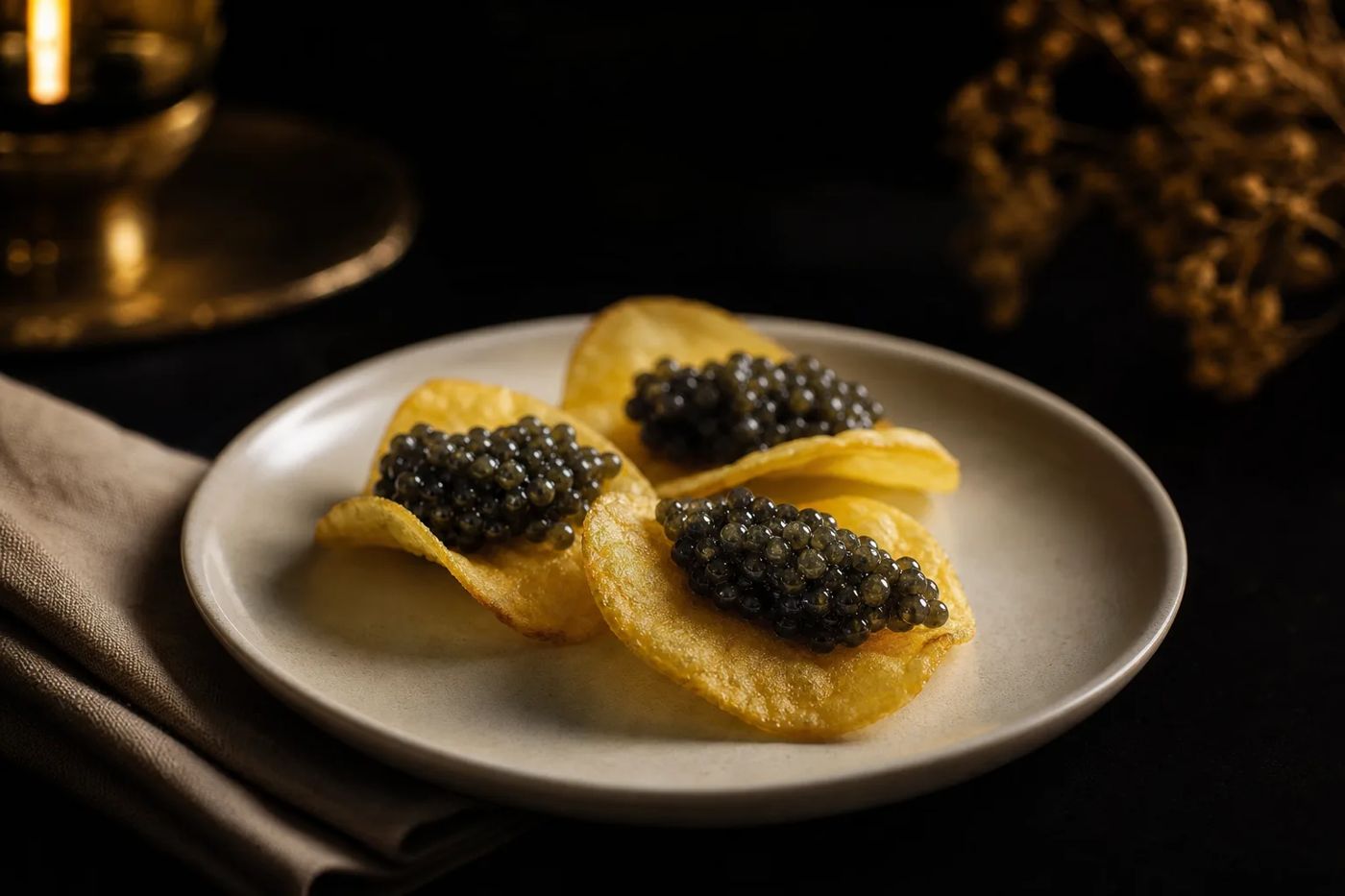
The same reporting connects social media attention with caviar bumps, small portions eaten from the hand, and casual pairings such as potato crisps. Here the visible change is in presentation: caviar appearing in a more informal setting. The reporting does not quantify extra grams consumed because of a video. Viral serving trends explores that cultural strand, including pairings with fried food.
China’s domestic restaurant and retail channels are documented in the prospectus; a nationwide change in eating habits would require broader evidence. Japan and the UAE also deserve a longer perspective. Both appeared in EUMOFA’s earlier trade analysis, so their presence in current marketing is no reason to label them emerging markets.
Conservation and ethics: look behind the claim
Certification is one way producers distinguish their caviar. Friend of the Sea stated in January 2025 that Caviar de Neuvic obtained its certification in 2023. That establishes the certification, while a market-wide rise in certified caviar sales would need separate sales evidence.
Non-lethal collection is also marketed as an ethical distinction, and it has a history beyond current marketing. A 2014 commercial announcement for Vivace described collecting eggs from living sturgeon by stripping, then treating the eggs. It documents how the process was presented commercially; it does not establish its present market share or longer-term welfare outcomes.
For procurement, ask three direct questions about certification: what does it cover, who audited it, and does the relevant operation remain within scope? Assess no-kill claims separately. Ask about immediate survival, repeated handling, subsequent reproduction and monitored welfare. Survival after collection is one part of an ethical assessment, not its conclusion.
Legal farming has not removed the need to scrutinise supply chains. WWF’s July 2024 regional report documents evidence of sturgeon trafficking from 2016 to 2023 in Bulgaria, Romania and Ukraine. A larger farmed market is no reason to assume illegal trade has disappeared.
What the data cannot show
Start with the measure, not the headline. Caviar production, live sturgeon production, cross-border trade and final consumption describe different things. Before using a growth claim, record its variable, unit, geographical coverage, years and reporting method. Without those details, a percentage offers little practical value.
CITES warns that importer and exporter reports can differ because of timing, permits issued versus quantities actually traded, missing reports and other reporting differences. Re-exports can count the same roe again, so adding every reported international movement cannot give a reliable estimate of world output.
The June 2026 prospectus reproduces commissioned CIC estimates placing global caviar sales at 389.6 tonnes in 2020 and 808.4 tonnes in 2025. It gives China’s 2025 sales volume as 436.8 tonnes, described there as 54.0% of global output. These are commissioned industry estimates, not an independent FAO production series.
The text uses both “sales volume” and “output”. Retain its terminology and check the underlying method before combining these figures with official statistics or treating a forecast as a measured harvest.
For a genuinely comparable update, request net roe weight rather than consignment counts, a consistent product definition, and the same treatment of returns and re-exports in both years. Establish whether a channel figure counts orders, customers or grams sold. For restaurant figures, distinguish purchases from meals actually served.
A useful monitoring file keeps separate series for production, direct exports, re-exports, destination imports, pack sizes and sales channels. Update each when comparable observations arrive, rather than splicing a recent company estimate onto an older government series: reading production statistics explains the methodological checks.
Where to go next
- Caviar Industry: explore the wider industry reference pages.
- The Global Caviar Industry: see how production, processing and distribution fit together.
Sources
-
FAO GLOBEFISH. Chinese sturgeon and caviar industry. Published 30 September 2019.
https://www.fao.org/in-action/globefish/news-events/news/news-detail/Chinese-sturgeon-and-caviar-industry/en -
European Market Observatory for Fisheries and Aquaculture Products, European Commission. The caviar market: production, trade and consumption in and outside the EU. 2021 edition.
https://eumofa.eu/documents/20124/55247/2021%2B-%2BThe%2BCaviar%2BMarket.pdf/04e7de02-bdc8-d0e2-96cb-59c730436b78 -
European Market Observatory for Fisheries and Aquaculture Products, European Commission. The EU fish market. 2025 edition, official report hosted by Spain’s Ministry of Agriculture, Fisheries and Food.
https://www.mapa.gob.es/dam/mapa/contenido/pesca/actualizaciones/eufoma/the-eu-fish-market_2025_en.pdf -
European Market Observatory for Fisheries and Aquaculture Products, European Commission. Sturgeon meat and other by-products of caviar: production, trade and consumption in and outside the EU. 2023 edition; manuscript completed January 2023.
https://eumofa.eu/documents/20178/432372/Sturgeon%2Bmeat.pdf/5e78102f-670e-bae9-521a-a2d764e59aa3 -
Council of the European Union. Council Regulation (EU) 2022/1904 of 6 October 2022 amending Regulation (EU) No 833/2014. Original 2022 instrument, Annex VI replacing Annex XXI.
https://eur-lex.europa.eu/eli/reg/2022/1904/oj/eng -
Organisation for Economic Co-operation and Development. Multilingual Dictionary of Fish and Fish Products. 2008 edition, entry “Caviar, caviare”.
https://www.oecd.org/content/dam/oecd/en/publications/reports/2008/10/multilingual-dictionary-of-fish-and-fish-products_g1gh94d9/9789264056473-en-fr.pdf -
Hangzhou Qiandaohu Xunlong Sci-tech Co., Ltd. Global Offering Prospectus. 22 June 2026, industry overview and business sections; includes commissioned CIC estimates.
https://www1.hkexnews.hk/listedco/listconews/sehk/2026/0622/2026062200025.pdf -
Modern Retail, Gabriela Barkho. Caviar’s growing popularity is introducing a new generation to the once-stuffy food. Original reporting, 11 October 2023.
https://www.modernretail.co/operations/caviars-growing-popularity-is-introducing-a-new-generation-to-the-once-stuffy-food/ -
Friend of the Sea. Caviar de Neuvic: A Pioneer in Sustainable Caviar Production, Recognised by Friend of the Sea. Certifier’s announcement, 31 January 2025.
https://friendofthesea.org/fr/caviar-de-neuvic-a-pioneer-in-sustainable-caviar-production-recognised-by-friend-of-the-sea/ -
Hasselkus PR Social Media & Public Relations. Neu: VIVACE, viva acipenser, Lasst Störe leben? Es lebe der Stör. Commercial press release, 26 February 2014, distributed through openPR.
https://www.openpr.de/news/779913/Neu-VIVACE-viva-acipenser-Lasst-Stoere-leben-Es-lebe-der-Stoer.html -
WWF Central and Eastern Europe. Updated evidence for sturgeon trafficking (2016 to 2023). July 2024 edition.
https://www.wwfcee.org/pdf_collections/49/Poaching%20of%20sturgeon_en_low-res_final.pdf -
CITES and UNEP-WCMC. CITES Wildlife TradeView: Frequently asked questions. Undated online guidance, checked November 2026.
https://tradeview.cites.org/en/faqs -
Liu, X. et al. The complete mitochondrial genome of the hybrid sturgeon of Huso dauricus (female) x Acipenser schrenckii (male). Mitochondrial DNA Part B, volume 2, issue 1, 2017.
https://pmc.ncbi.nlm.nih.gov/articles/PMC7800027/
The piece was researched through official market reports, trade-method guidance, a regulatory instrument, a company filing, original interviews and explicitly attributed certification and commercial statements.
Last checked: November 2026