
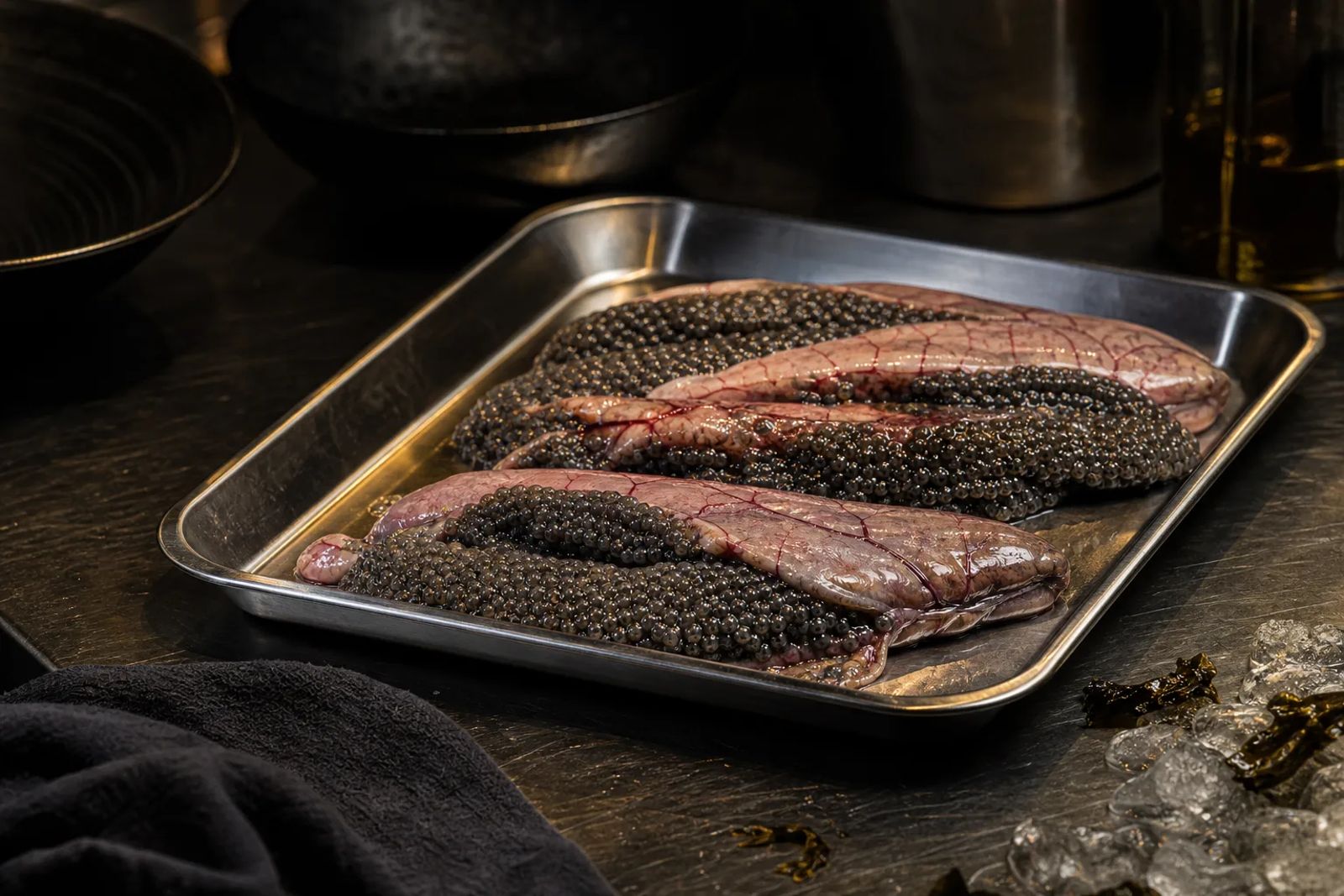
Caviar harvesting takes two distinct paths: conventional harvest kills the female sturgeon and removes her ovaries; live collection recovers the eggs while keeping her alive. Both begin with selecting a female whose eggs have reached the right stage of development.
Before caviar becomes loose, salted beads, the eggs sit attached to tissue inside the ovaries. Conventional harvesting removes them with that supporting tissue still attached. Live collection usually takes place after ovulation, once the eggs have been released from their surrounding follicles.
How caviar is harvested, step by step
The conventional harvest moves from selecting the fish to delivering intact roe into a clean processing area. The sequence below explains that journey, not a procedure for an untrained operator. Effective stunning and hygienic separation are skilled work for trained, competent staff.
-
Choose fish by egg development, not age alone. For conventional caviar, farmers seek well-developed eggs before ovulation, rather than immature eggs or eggs already deteriorating. Farmers use ultrasound to assess the ovaries and may examine a small egg sample to judge ripeness; checking egg ripeness explains that decision.
-
Move selected fish into pre-harvest holding. Purging holds fish in clean water to reduce unwanted flavours. Documented production systems also withhold feed. EUMOFA describes separate tanks supplied with fresh, colder water; this is not a universal fasting prescription. The harvesting guide sets this preparation within the wider handling process.
-
Keep handling to a minimum. Staff move selected females towards the harvest station while controlling crowding, water quality and exposure to air. WOAH recommends minimal handling, suitable water conditions and the shortest possible time out of water whenever air exposure is necessary.
-
Stun, then complete slaughter before recovery. Stunning makes the fish unconscious. If the stun is reversible, killing must follow before consciousness returns. Bleeding, the controlled draining of blood, can form part of slaughter. WOAH recommends checking that stunning has worked and keeping a backup system available; humane stunning examines the methods in detail.
-
Remove the ovaries carefully. After death, trained staff open the body cavity and lift out the organs containing the eggs. The roe is still attached to ovarian tissue. The aim is to recover intact roe while preventing contamination from the digestive tract.
-
Transfer the roe into clean processing. The ovaries pass into the area where eggs will be separated from their supporting tissue. The handover remains part of the food hygiene system, with clean equipment, protected containers and controlled chilling.
Live collection by stripping
Stripping recovers ovulated eggs through controlled manual pressure on the female’s abdomen. In documented caviar production, hormonal treatment induces ovulation, and the female is retained rather than slaughtered for her meat.
Codex CXS 291-2010 permits ovulated eggs from aquacultured sturgeons. Where hormones are used, they must be approved by the competent authority. The standard also addresses drug residues and withdrawal periods: the intervals required before treated animals or their products enter the food chain. These eggs need different handling, explored in no-kill collection.
Live collection using surgery
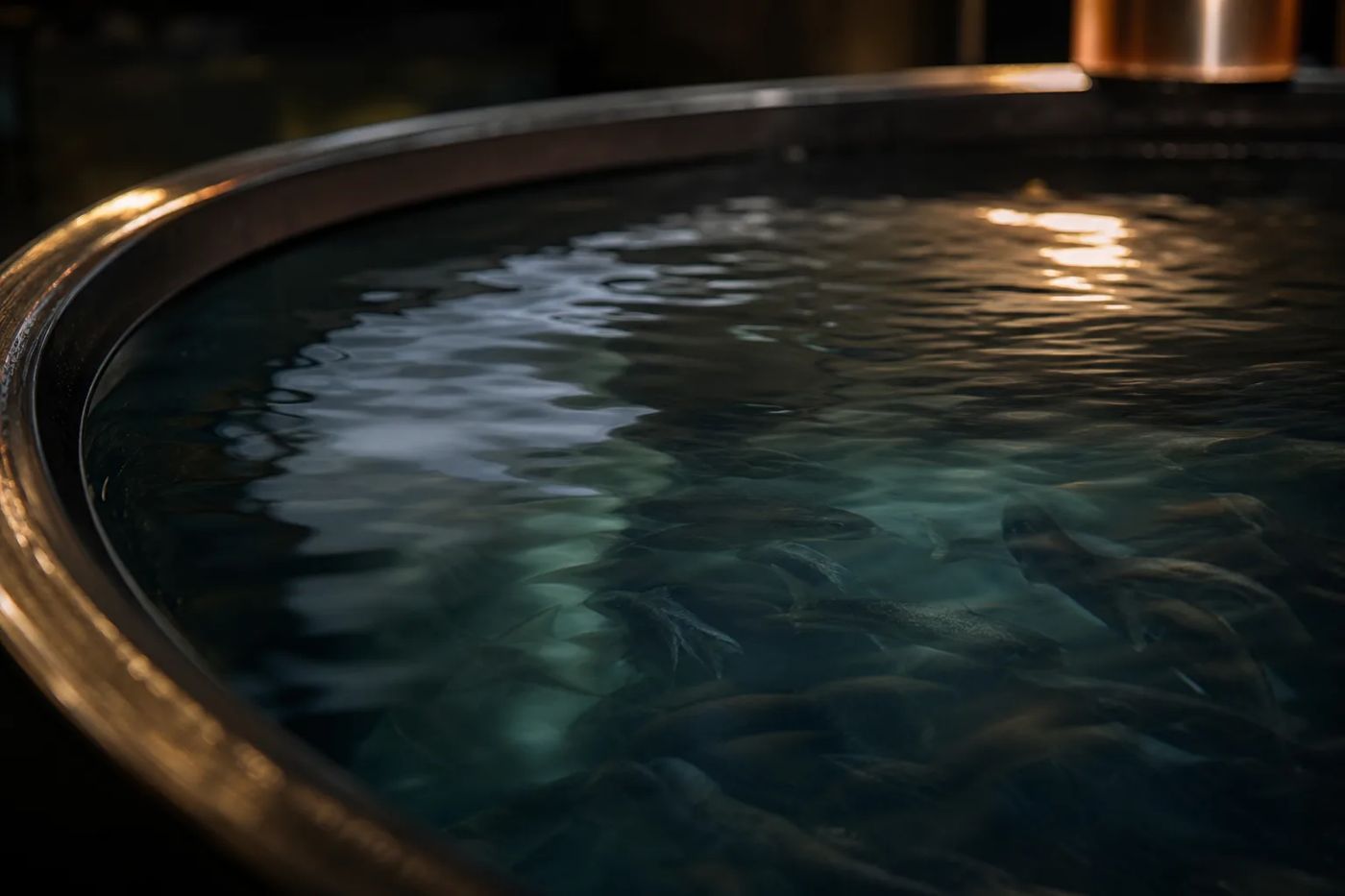
Surgical collection involves an incision, not simply external massage. FAO’s hatchery manual describes two approaches: a small oviduct incision followed by stripping, and a larger abdominal operation under general anaesthesia, after which the wound is closed.
The manual concerns hatchery egg collection. It documents the techniques, but does not establish how widely they are used for edible caviar. Assessing a surgical live-collection claim requires the actual method, the anaesthetic arrangements and the recovery care, not the label alone.
Hygiene, chilling and why speed matters
Harvest brings together a live animal, its external surfaces and exposed food. Hands, equipment, water and work surfaces must not carry contamination from fish handling and gutting into the exposed roe.
The ethical tension is between killing a fish and keeping her alive for repeated intervention.
EU Regulation 853/2004 requires fresh fishery products in storage and transport to be kept at a temperature approaching that of melting ice. That requirement concerns the fresh product, not every room in the facility or the temperature at which living sturgeon should be held.
Prompt transfer supports that temperature control and reduces avoidable exposure before processing. Quality also depends on the eggs themselves and what happens next: the University of Florida identifies ripeness, processing and storage protocols as determinants. Speed alone cannot preserve quality or compensate for damaged or unsuitable eggs.
The cited sources establish neither a universal harvest duration nor a single maximum interval from stunning to processing. Each farm needs controls suited to its operation. A pleasant smell and neat-looking roe cannot establish microbiological safety.
Which rules govern the harvest?
Food hygiene law protects the product. Slaughter welfare law protects the animal. Legal compliance and good welfare are distinct: food-safety compliance does not prove good welfare. The table sets out binding requirements; international recommendations, such as WOAH’s, have a different status.
| Where | Rule relevant to harvesting | Legal source | Checked |
|---|---|---|---|
| EU | Hygiene procedures, cold-chain control and specific fishery-product requirements. | Regulations 852/2004 and 853/2004. | November 2026 |
| Great Britain | Assimilated hygiene legislation applies as amended; do not treat every EU amendment as automatically applicable. | Assimilated Regulations 852/2004 and 853/2004; FSA guidance. | November 2026 |
| Northern Ireland | EU food hygiene rules continue under the Windsor Framework. | Regulations 852/2004 and 853/2004; FSA guidance. | November 2026 |
| United States | Processors analyse hazards and implement a written HACCP plan where reasonably likely hazards are identified. Sanitation controls also apply. | 21 CFR 123.6 and 123.11. | November 2026 |
| EU | For fish, only Article 3(1) applies: avoid avoidable pain, distress and suffering. Detailed stunning provisions do not apply to fish. | Regulation 1099/2009, Article 1(1). | November 2026 |
| England | WATOK 2015 adds no detailed fish-specific stunning methods; general protection against avoidable suffering remains relevant. | SI 2015/1782; Defra welfare assessment. | November 2026 |
| Switzerland | The FSVO-hosted ordinance text requires prior stunning and permits gutting instead of bleeding after stunning. | Animal Protection Ordinance, Articles 178, 179 and 179d; FSVO English translation; check the current consolidation. | November 2026 |
HACCP means hazard analysis and critical control points. In practice, it means identifying significant food safety hazards, setting controls and checking that those controls work. FDA’s seafood guidance helps US processors apply the rules, but is not itself binding; the binding requirements sit in the regulation itself.

What changes between large and small operations?
A larger harvest changes the equipment and the organisation of work, not the biological sequence. FAO’s seafood quality guidance explicitly applies HACCP principles both to large companies with complicated processing lines and to small enterprises with simpler production.
Stunning offers a concrete example of how capacity shapes the work. WOAH describes manual percussive stunning as practicable for limited numbers of similarly sized fish, while electrical equipment can accommodate larger numbers. Electrical settings must suit the species and system. These capacity differences do not tell you which method any particular sturgeon farm uses, large or small.
The records that travel with the eggs
The roe needs an identity before it reaches the processing room. A useful handover record links the incoming fish and roe batch to the processing records through farm or supplier identity, species, harvest date, batch identification and relevant treatment history. Staff should not have to reconstruct origin after the eggs arrive.
For US processors, 21 CFR 123.9 specifies the processor’s name and location, the date and time of the recorded activity, and the operator’s signature or initials. Where appropriate, records must also include product identity and production code. Monitoring records must contain actual observations, with corrective actions documented when controls fail.
Codex also requires species and lot markings on each primary container of non-retail caviar. That later identification relies on preserving batch identity through harvest and processing. The next stage is covered in making caviar.
How the rest of the fish is used
A conventional harvest can yield meat as well as roe. The University of Florida describes sturgeon meat being sold fresh, frozen or smoked, giving the fish a role beyond its eggs. These are documented uses, but not every farm is guaranteed an outlet for every part.
The wider subject is explored in using the whole fish. Edible meat needs its own hygienic, controlled chain. Protecting it remains a separate responsibility from protecting the roe.
Welfare is about more than survival
The ethical tension is between killing a fish and keeping her alive for repeated intervention. Survival alone cannot resolve it. WOAH recommends stunning before killing, while a 2024 narrative review of caviar production argues that both slaughter and live collection need scrutiny of handling, pain, anaesthesia and recovery.
Live collection offers the possibility of retaining a female for further reproductive cycles. Assessing that possibility means looking beyond immediate survival to longer-term welfare. The review identifies gaps in evidence about mature sturgeons and repeated procedures; it provides no comparative trial establishing one harvest route as universally better.
Sturgeon welfare and ethics examines those positions alongside the available evidence. The evidence gaps concern the effects on the fish; the ethical judgement also depends on how a reader weighs killing against repeated intervention. Neither a harvest label nor survival alone amounts to a welfare assessment.
Sources
-
University of Florida IFAS Extension. Technically Speaking, What Is Sturgeon Caviar? FA194, June 2016, reviewed February 2025. Sections on egg development, conventional collection, ovulated eggs and meat use. Source.
-
EUMOFA, European Commission. The caviar market: production, trade, and consumption in and outside the EU. 2021 edition, section 1.1.1. Copy hosted by FEAP. Source.
-
FAO. Chebanov, M. S. and Galich, E. V., Sturgeon Hatchery Manual. FAO Fisheries and Aquaculture Technical Paper 558, reprinted 2013. Source.
-
FAO and WHO, Codex Alimentarius Commission. Standard for Sturgeon Caviar, CXS 291-2010, amended 2013, 2018 and 2024; the Codex register shows a further modification in 2026, so use the latest official text. Canonical document.
-
WOAH. Aquatic Animal Health Code, chapter 7.3, “Welfare aspects of stunning and killing of farmed fish for human consumption”. 2024 edition, dated 2 July 2024. Source.
-
European Union. Regulation (EC) No 852/2004 on the hygiene of foodstuffs. Consolidated text dated 24 March 2021. Source.
-
European Union. Regulation (EC) No 853/2004 laying down specific hygiene rules for food of animal origin. Consolidated text indexed as 7 May 2026; Annex III, Section VIII. Source.
-
Food Standards Agency. General food law and Applying for approval of a meat or food establishment. Web editions checked November 2026, distinguishing Great Britain and Northern Ireland. General food law; establishment approval.
-
United States, electronic Code of Federal Regulations. 21 CFR Part 123: Fish and Fishery Products. Current web text checked November 2026, particularly sections 123.6 to 123.11. Source.
-
US Food and Drug Administration. Fish and Fishery Products Hazards and Controls Guidance. June 2022 edition, official guidance landing page checked November 2026. Source.
-
European Union. Council Regulation (EC) No 1099/2009 on the protection of animals at the time of killing. Consolidated text dated 6 August 2026, Articles 1(1) and 3(1). Source.
-
UK Government and Defra. The Welfare of Animals at the Time of Killing (England) Regulations 2015, SI 2015/1782, original instrument; and Review of the Welfare of Animals at the Time of Killing (England) Regulations 2015, 2021, paragraphs 211 to 212. Instrument; review.
-
Swiss Federal Food Safety and Veterinary Office. Animal Protection Ordinance of 23 April 2008, SR 455.1. FSVO-hosted English translation; current consolidation date not given. Source.
-
FAO. Assurance of seafood quality. FAO Fisheries Technical Paper 334, 1994, chapter on the HACCP system. Source.
-
Frontiers in Animal Science. Dying for a canape: the welfare implications associated with both traditional and “ethical” production of caviar from sturgeon. Peer-reviewed review, 2024, DOI 10.3389/fanim.2024.1432765. Source.
This piece was researched using official standards, legislation, government guidance, technical manuals and a peer-reviewed welfare review, keeping hatchery procedures distinct from documented food production.
Last checked: November 2026