
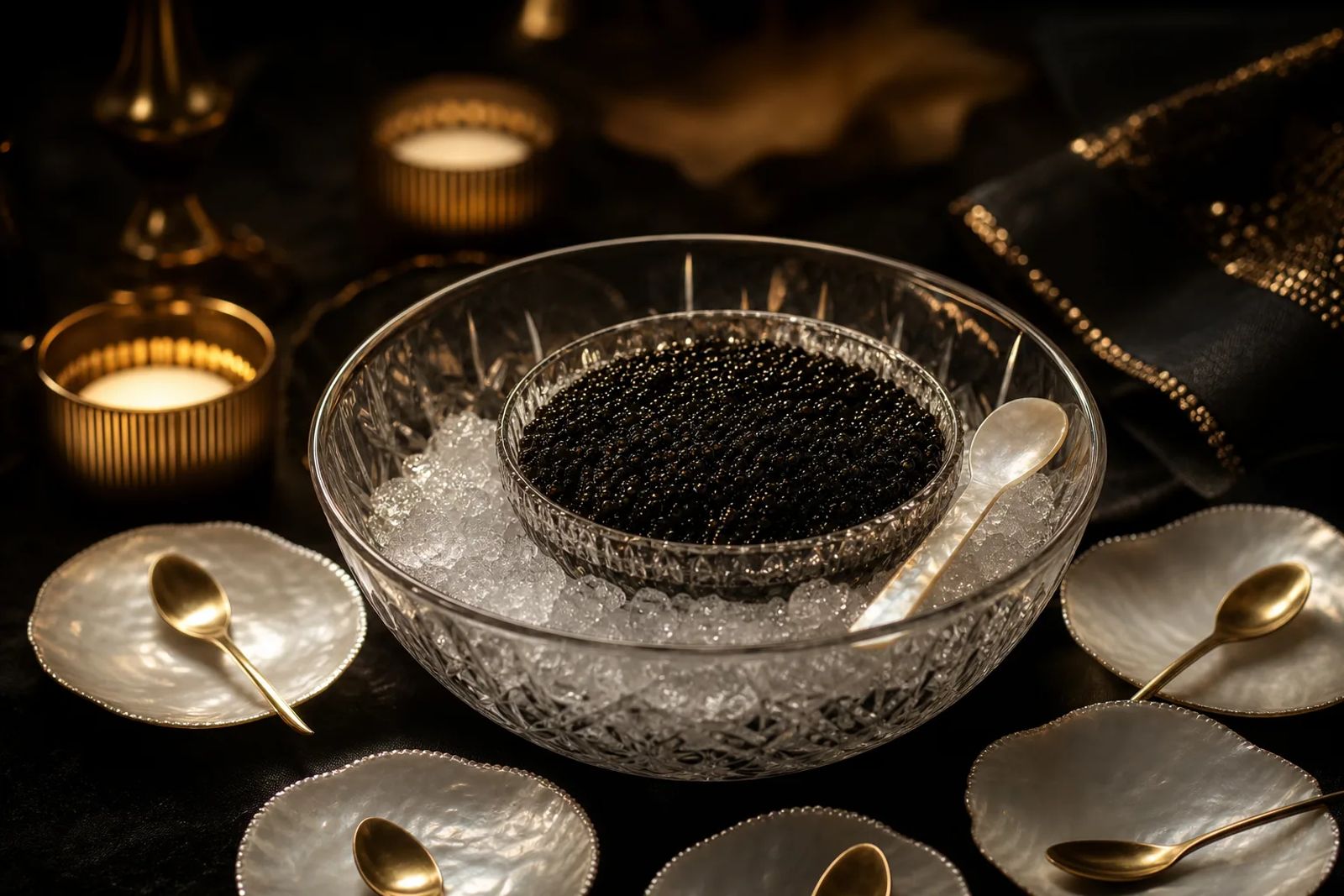
Caviar in a silver timbale, surrounded by ice, with blinis: that was Auguste Escoffier’s prescription. Chopped onion met with his strong disapproval. Yet cooks were serving it anyway. Even in the instructions of a great French culinary authority, caviar came with a difference of opinion.
The useful lesson is simple. Protect the roe, share considerately and follow the service in front of you. Good caviar manners make the table more inviting, not more intimidating.
Where caviar etiquette comes from
Russian restaurant service and French professional cookery offer examples of caviar etiquette. Neither supplies a single international code, and a chef’s favourite accompaniment is not automatically a rule of good manners. For the wider introduction, start with caviar for beginners.
Escoffier’s instructions appear in A Guide to Modern Cookery, in its revised English edition reproduced in a 1920 impression. He also allows caviar to be served in its original container rather than a silver timbale.
These are professional culinary instructions, rather than a portrait of every French household. For the traditions themselves, see classic Russian and French service. At the table, distinguish between a method that protects the roe, meaning fish eggs, and a convention that simply signals formality.
Which rules still matter?
Use the spoon provided. The Culinary Institute of America’s teaching material recommends nonreactive utensils, including mother-of-pearl, horn, bone, glass and plastic. Mother-of-pearl is a traditional choice, with several perfectly suitable alternatives.
That recommendation does not mean every metal spoon necessarily spoils caviar. The material question, particularly silver, is explored in why not use a silver spoon?. Over dinner, leave other guests’ cutlery alone: inspecting it or announcing that the service is wrong helps nobody enjoy the food.
A manageable spoonful is enough. Etiquette Scholar describes using a small spoon to transfer caviar onto toast, without establishing a universal maximum mouthful. Indeed, chef Bonnie Morales, interviewed for KitchenAid, encourages diners not to ration themselves down to a few individual eggs.
Handle the tin gently. The aim is to keep the beads intact. Lift out a spoonful and place it on bread rather than flattening it. The Caviar Guy similarly advises scooping without stirring or mashing. “Do not stir” and “do not spread it like jam” are handling instructions, not tests of social standing.
Keep the service cold. Both Escoffier and the Culinary Institute of America specify service over ice. The ice bowl does a job beyond looking handsome: it keeps the shared container chilled while conversation continues. Leave it in that setting rather than passing it around. Before service, follow the producer’s storage instructions.
Beyond those courtesies, relax. Nobody needs to count eggs, adopt a prescribed facial expression or demonstrate expertise. For guidance on the tasting itself, turn to how to taste caviar.
Must you eat caviar plain?
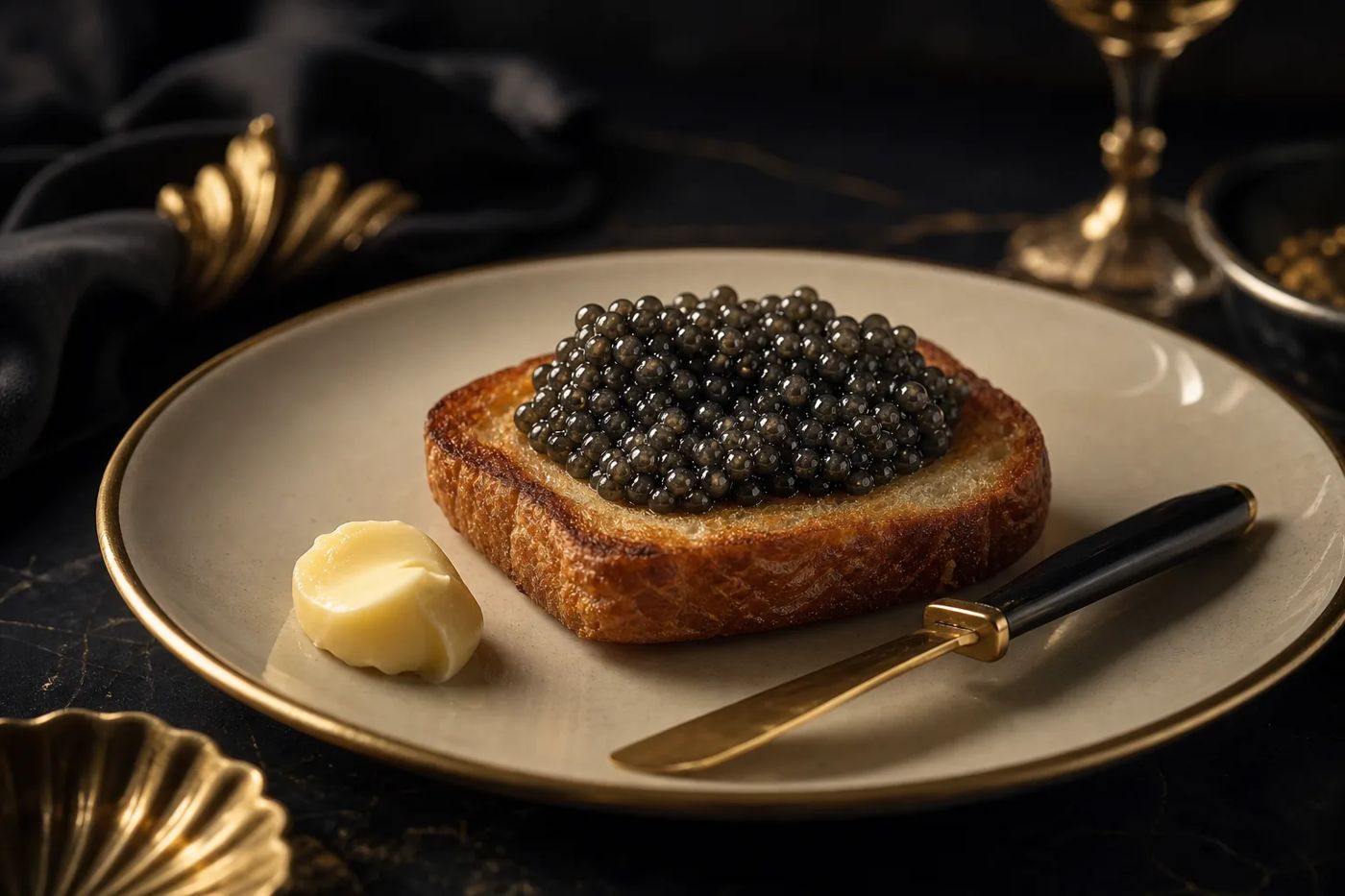
No. Toast, butter and enriched breads all have their advocates. Etiquette Scholar explicitly includes toast and an optional garnish in its instructions, while Morales recommends butter and enriched breads. Eating caviar with an accompaniment is entirely compatible with good manners.
Try a little plain if you are curious, then enjoy the accompaniments you prefer. First put a small amount on your own plate before combining it with anything else. That keeps the shared service separate and leaves everyone else free to choose differently.
Caviar on fried chicken is a culinary choice, not an etiquette offence.
If someone asks how you like it, offer a preference rather than a prohibition. “I like the first taste on its own” leaves room for another diner’s buttered toast. “You must never put anything with caviar” turns a personal pleasure into an unnecessary correction.
At a restaurant: ask, then follow the service
“How do you recommend we enjoy this?” is a useful opening question. Let the server explain whether the caviar is a shared course, an individual tasting or part of a composed dish. Each presentation has its own rhythm; it need not come with the same ritual.
Questions about species and origin show interest. Try “Which sturgeon species is this, or is it a hybrid?” and “Where was the roe produced?” A hybrid is a cross between two species. Ask about the fish and the roe’s origin separately from the brand.
With a shared tin, agree who is sharing before anyone begins, then give everyone a first helping. Use the communal spoon to move caviar to your plate or food, never to your mouth. Keep utensils used for accompaniments out of the tin.
When each guest has an individual serving, let the staff portion it. If the kitchen has already assembled the dish, eat it as presented unless you need an adjustment. Caviar dining today explains how these different formats fit into a meal.
As a guest: take your share, not everyone’s
Begin with a modest helping and wait until everyone has been offered some before returning for more. At someone’s home, the host’s invitation and the number of people sharing are your best guides.
Fairness matters more than a fixed allowance measured in spoonfuls. If the host encourages generous helpings, accept without apologising for enjoying them. If the tin is there to garnish a dish, do not turn it into a separate course.
Hosts can settle the question by inviting everyone to have a spoonful each before another round. Provide separate tasting spoons for guests eating caviar plain. Make declining as easy as accepting, too. Nobody should have to defend not wanting caviar.

Five cultural settings, not five national rule books
These examples show the range of caviar hospitality, from restaurant menus to family memories. They describe particular tables, rather than rules for whole countries.
Russia: blinis, sour cream and drinks are a familiar combination in documented restaurant practice. A published Belmond Grand Hotel Europe menu in St Petersburg pairs caviar with blinis, toast, potatoes, sour cream and chopped eggs, with vodka or wine alongside.
Family traditions can be less ceremonial. Morales, whose parents emigrated from what is now Belarus, recalls festive Russian-speaking family gatherings with caviar on buttered white bread. Her memory offers a personal glimpse of that hospitality.
Iran: toast, onion, chopped egg, lemon and iced vodka accompanied one memorable lesson in caviar service. In her memoir, published in Weber in 2008, Kathleen M. Herndon recalls a hotel waiter in Isfahan teaching her this way of eating caviar in 1975. It is an account of formal hospitality in one setting, rather than a national prescription about alcohol or accompaniments.
France: cold service, blinis and restraint with garnishes define Escoffier’s influential professional approach. His dislike of onion was a culinary judgement. It gives a guest no reason to correct a host who offers it.
Japan: caviar can belong within Japanese cooking, rather than arrive in a reproduction of European service. Michelin’s inspectors describe Kanda in Tokyo combining fugu, caviar and sesame tofu. That is a chef’s interpretation, not a distinct nationwide etiquette.
United States: formal service and casual combinations can sit on the same menu. COQODAQ offers a classic caviar service with milk toast, crème fraîche and chives, alongside chicken nuggets topped with caviar. Its published menu neatly illustrates that coexistence without defining how all Americans eat.
Modern habits: bumps, fried food and drinks
A caviar bump is a small helping placed on the hand between the thumb and index finger, then eaten from the hand. The Specialty Food Association reported the habit in restaurants and at gatherings in 2022, including a New York operator serving it with sake.
It is an optional presentation, not an initiation ceremony. Ask for a spoon if you prefer one, and do not improvise a bump from a communal tin without the host’s agreement. The caviar bump examines the habit and its claims more closely.
Caviar on fried chicken is a culinary choice, not an etiquette offence. A plain spoonful can offer a useful comparison if that interests you. Enjoying a prepared bite, however, requires no demonstration that you would also appreciate the roe alone.
Vodka is optional as well. The Belmond menu offers alternatives, and the sake example shows another contemporary pairing. Neither makes a drink compulsory. Choose something you enjoy, including a non-alcoholic drink; must caviar be served with vodka? explores the pairing question separately.
If you make a mistake
Put it right quietly. If you pick up the wrong spoon, ask for a clean utensil. If you misunderstand the sharing arrangement, offer the next helping to someone else. A long apology, or a correction delivered across the table, only makes people uncomfortable.
Sources
-
Auguste Escoffier, William Heinemann. A Guide to Modern Cookery. New and revised edition, January 1909; impression January 1920. Section 326, “Caviare and Blinis”. Digitised by Project Gutenberg, 2023. Read the digitised edition.
-
Culinary Institute of America. Caviar. Undated teaching presentation, publicly hosted in a June 2025 directory. “Serving Caviar” slide. Read the presentation.
-
Etiquette Scholar. “Caviar Etiquette”. Undated online edition, retrieved November 2026. Read the guidance.
-
The Caviar Guy. “How to Serve Caviar (Utensils & Temperature)”. Undated online edition, retrieved November 2026. Commercial service guidance, used as an attributed example of handling advice. Read the guidance.
-
KitchenAid, Kae Lani Palmisano. “Rethinking the Culture of Caviar”. Undated online edition, retrieved November 2026. Interview with chef Bonnie Morales. Read the interview.
-
Belmond Grand Hotel Europe. Caviar Bar menu. Undated published English-language PDF, retrieved November 2026. Used as documentary evidence of a service format, not confirmation of the current menu. Read the published menu.
-
Weber State University, Kathleen M. Herndon. “Black Pearls”. Weber, volume 25.1, autumn 2008. Personal essay recalling an Isfahan hotel meal in 1975. Read the essay.
-
MICHELIN Guide. “Must-Try Dishes in Tokyo, According to MICHELIN Guide Inspectors”. 5 December 2023. “Fugu caviar”, Kanda. Read the inspectors’ account.
-
COQODAQ. “Menus”. Undated live online edition, retrieved November 2026. Classic caviar service and caviar-topped chicken nuggets. Read the restaurant menu.
-
Specialty Food Association. “Caviar ‘Bumps’ in Vogue”. 16 June 2022. Trade-news report summarising contemporary reporting in The New York Times. Read the report.
This piece compares historical culinary instructions, professional teaching material, published restaurant menus and attributed personal accounts, with editorial recommendations distinguished from documented customs.
Last checked: November 2026