
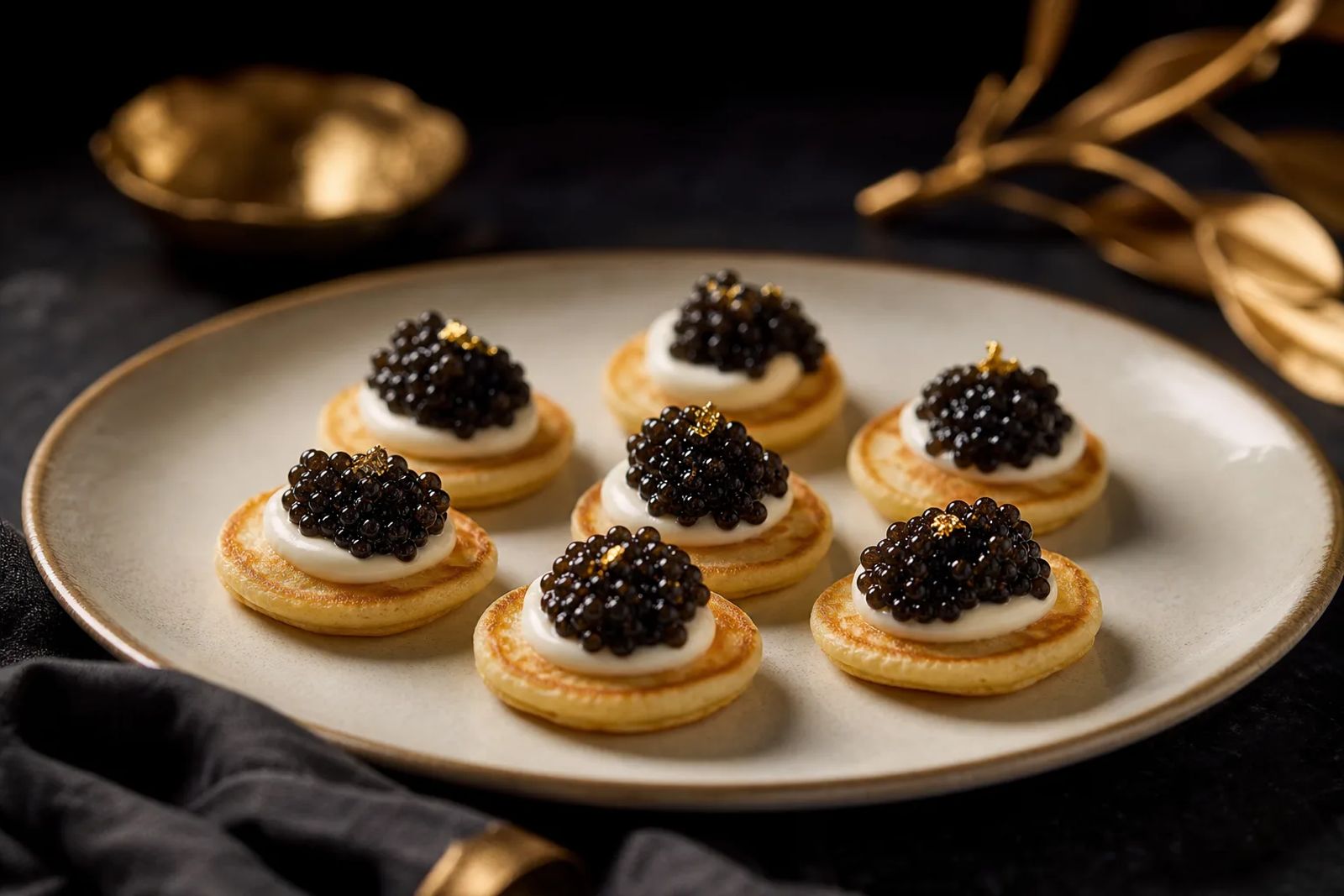
Richard Corrigan's published blini service lists 100 g sour cream with 35 g caviar. The telling detail is how it arrives: the cream comes alongside. Each mouthful can have its own balance, with the roe still at the centre.
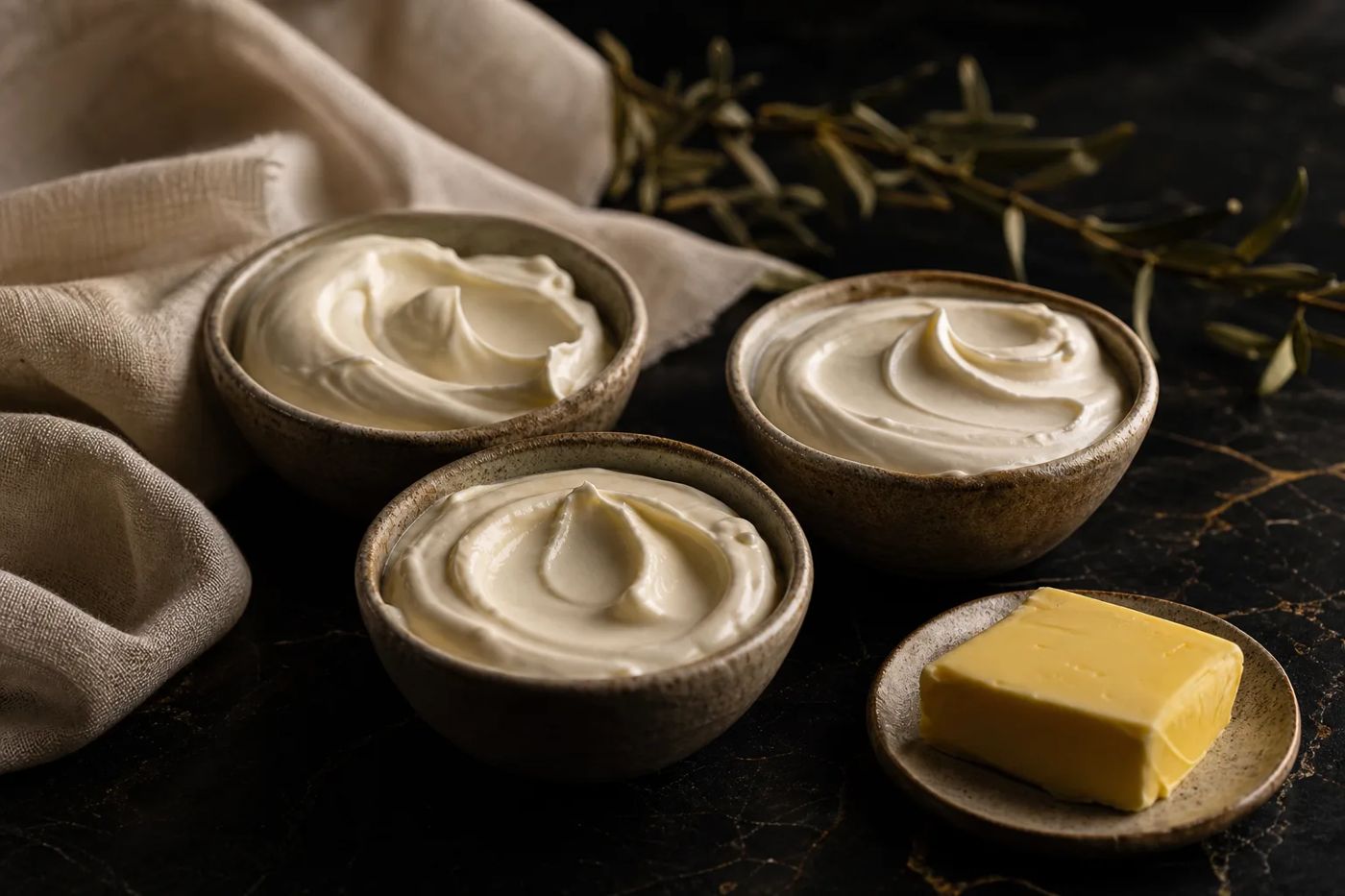
For a spoonable accompaniment, crème fraîche is a good starting point. For bread, unsalted butter is the simplest choice. Smetana and sour cream can work just as well, but look beyond the name: fat content, sharpness and thickness determine what each brings to the bite.
What crème fraîche, smetana, sour cream and butter actually are
Crème fraîche, smetana and sour cream belong to the cream family. Butter is concentrated milk fat held in a different structure. Culturing means adding selected microorganisms to ferment the dairy; it describes the process, not how sour the finished product will taste.
The definitions below apply in the places listed, rather than worldwide. All percentages are milk fat by weight, and a minimum is not a typical value.
| Product | Definition | Fat | Where | Source |
|---|---|---|---|---|
| Crème fraîche, not light | French cream category | At least 30% | France | Decree 80-313, Article 2 |
| Sour cream, plain | Cream soured by lactic-acid-producing bacteria | At least 18% | United States | 21 CFR 131.160 |
| Smetana | Cultured cream with specified starters | At least 10% | Russia | GOST 31452-2012, section 3.1 |
| Butter | Milk-fat spread | 80% to below 90% | European Union | Regulation 1308/2013, Annex VII |
| Butter | Made exclusively from milk, cream or both | At least 80% | United States | 21 USC 321a |
France
French labels deserve a closer look. Decree 80-313 also recognises crème légère, with at least 12% but less than 30% milk fat. Fraîche refers to processing and packing conditions, rather than simply to thickness, so the English culinary meaning does not map neatly onto every French label.
United States
In the US, plain sour cream must also have titratable acidity of at least 0.5%, calculated as lactic acid. This measures neutralisable acid in the laboratory, rather than predicting precisely how sharp a spoonful will taste. The standard makes separate provisions for products containing bulky flavourings or sweeteners.
Permitted ingredients in US sour cream can improve texture or prevent separation. A cream that stands firmly on the spoon need not be especially high in fat. Read the nutrition declaration and ingredients together: texture alone cannot tell the whole story.
Russia and the Eurasian Economic Union
The Russian specification names lactococci, or a mixture of lactococci and thermophilic lactic streptococci, as starter organisms. That places smetana in the same broad family as cultured sour cream, although the Russian and American documents set different requirements.
In the Eurasian Economic Union, Technical Regulation TR CU 033/2013 legally defines smetana as containing at least 10% milk fat. GOST 31452-2012 is a voluntary interstate standard. For an imported pot, check whether it declares conformity to that standard rather than expecting a fixed composition from the name alone.
United Kingdom
For UK cream terminology, the Dairy UK and Provision Trade Federation code sets crème fraîche at not less than 25% milk fat. This is industry guidance, not legislation; the code expressly states that it does not alter the law.
In England, the Spreadable Fats (Marketing Standards) and the Milk and Milk Products (Protection of Designations) (England) Regulations 2008 provide for enforcement of dairy naming and composition rules. They cover England only. Scotland, Wales and Northern Ireland have their own rules, described by GOV.UK as similar.
European Union
The EU butter category also limits water to 16% and dry non-fat milk material to 2%. These figures define composition. They do not rank butter for caviar service or tell you which will best suit a particular roe.
Why dairy works with caviar
Mildness gives caviar room. Great British Chefs recommends mild, creamy accompaniments for precisely that reason. Caviar House, a seller, describes the gentle acidity of thick crème fraîche as a contrast to brininess. That contrast is a pairing judgement, not a chemical removal of salt.
Richness and acidity are separate choices. Butter gives you a fat-rich base without necessarily adding the sourness of cultured cream. Cultured cream brings both richness and tang, in a balance that depends on the product in front of you.
Taste the caviar alone, then taste the dairy separately before assembling a mouthful. Choose the accompaniment that leaves the roe recognisable. The highest fat percentage is not automatically the best partner.
How much dairy to use
Begin with a thin smear of butter on bread or a small dab of cultured cream beneath the roe. Taste, then add more if the mouthful needs it. There is no compulsory dairy-to-caviar ratio; this is a practical starting point rather than a tested recipe quantity.
If the aim is to compare caviars, keep the dairy modest. A large spoonful can turn the cream into the main event. Put extra alongside so that each person can adjust the balance without overwhelming the first bite.
Treat Corrigan's quantities as a recipe total. Follow blinis for the pancake itself, then judge the garnish at the table.
Unsalted, salted and cultured butter
Start with unsalted butter. It leaves the seasoning to the caviar. Salted butter can still work, but taste the combination before committing: another salted ingredient changes the balance. For the background, see salt in caviar.
Cultured butter brings flavour from cream that has undergone fermentation, rather than relying only on fresh cream flavour. Cultured and unsalted describe different things. One concerns fermentation; the other concerns added salt. Read both descriptions when choosing a butter.
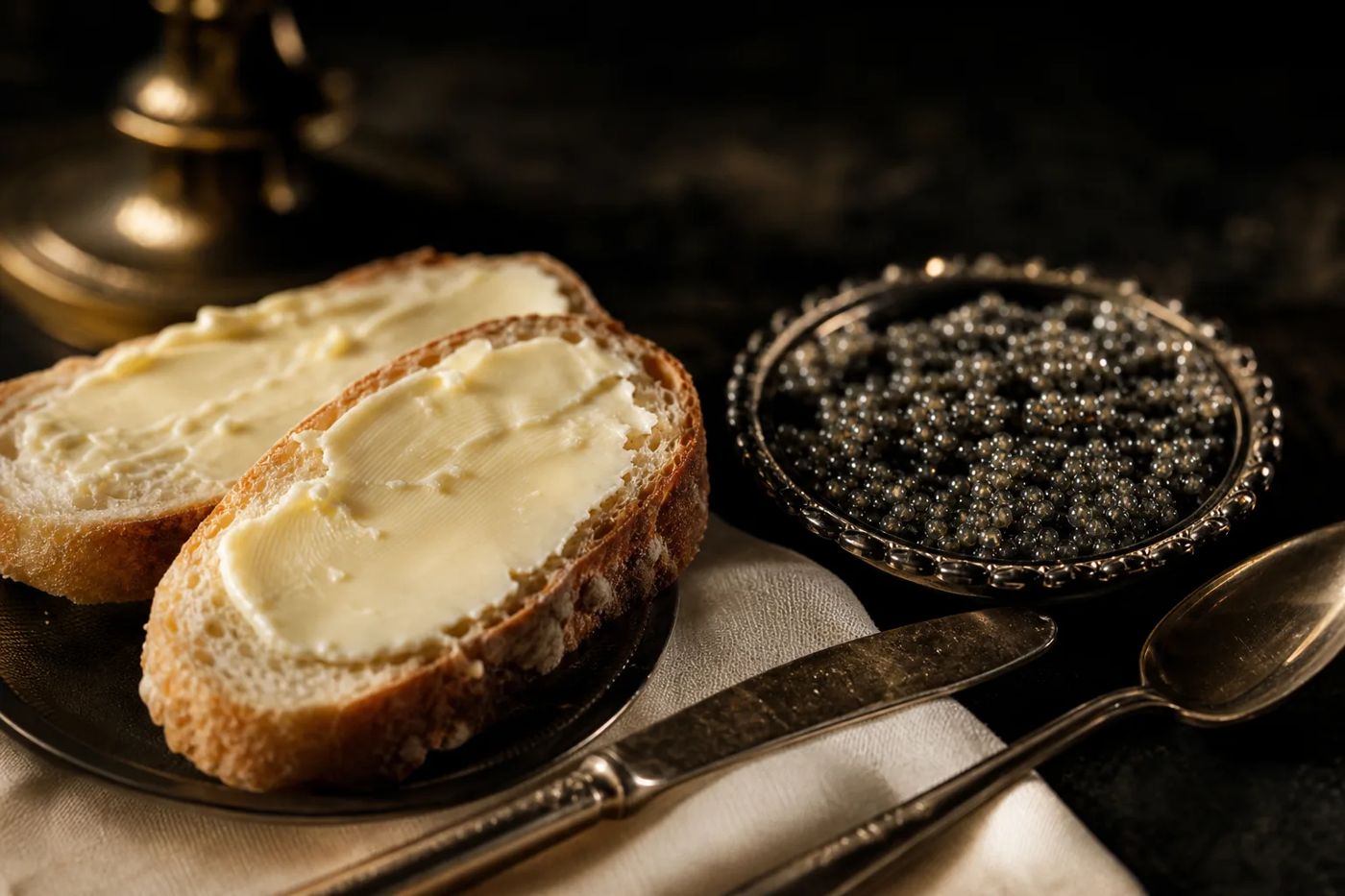
For Russian-style bread-and-butter service, keep the bread plain and the butter layer modest. Russian and French service explains the cultural setting, while toast, brioche and Melba toast helps with choosing the base. Here, the focus is the dairy rather than another bread recipe.
A cream that stands firmly on the spoon need not be especially high in fat.
Spreading butter beneath caviar is different from making a caviar compound butter. The method in using leftover caviar deliberately distributes roe through the butter, rather than keeping the beads as a separate topping.
Substitutes and what to expect
Choose a plain, unsweetened substitute and taste it before putting it beneath the caviar. These alternatives offer different textures and flavours, so adjust the quantity rather than expecting an identical replacement.
Mascarpone: use it for a dense dairy base rather than a distinctly soured cream. Spread a particularly thin layer. Do not add lemon automatically; taste the assembled mouthful before deciding whether it needs acidity.
Thick yoghurt: check both its tang and its ability to hold a small mound. Choose plain yoghurt, and use less if it tastes markedly sharper than your cream. Thickness alone does not promise the same balance.
Plant-based creams: look for an unsweetened product intended for savoury use. Check for coconut, oat or nut flavours that might intrude alongside the roe. Replacing the dairy does not make a caviar dish vegan, and anyone avoiding allergens should check the full ingredients.
Serving temperature and handling
Serve cultured cream cold and spoonable. Butter should be just soft enough to spread, not melted. Put out a small portion at a time rather than warming the whole container to change its texture.
For storage, follow the dairy producer's instructions and the date on the pack, including any shorter period after opening. In England, Wales and Northern Ireland, the Food Standards Agency recommends a fridge at 5°C (41°F) or below and keeping chilled foods out for the shortest possible time.
That figure is refrigeration guidance, rather than a prescribed tasting temperature for every dairy product. Use a clean utensil for each accompaniment. Keep the dairy and caviar separate until you assemble the bite.
Making crème fraîche at home
Home culturing calls for controlled conditions, not cream left somewhere warm until it thickens. Utah State University Extension in the US publishes a cultured-cream procedure with a measured acidity endpoint. Follow the complete instructions, rather than borrowing only the incubation temperature.
The method heats whipping cream to 85°C to 93°C (185°F to 200°F), holds it there for 2 to 5 minutes while stirring, then cools it before the starter is added. It specifies clean, sanitised jars and incubation at 42.3°C (108°F) until the cream reaches pH 4.6 or below.
The pH endpoint and the US sour-cream standard's titratable-acidity percentage are different measurements. If you cannot control the process and measure its endpoint, choose commercially prepared crème fraîche for caviar service. Do not improvise a countertop fermentation.
Where to go next
- Accompaniments and Pairings: compare dairy with other supporting ingredients before choosing your service.
- Classic Caviar Service: Russian and French Styles: see how bread, dairy and roe fit into contrasting service traditions.
Sources
- French Republic, Légifrance. Décret n° 80-313 du 23 avril 1980 relatif aux crèmes de lait destinées à la consommation. Decree of 1980, amended text displayed in the retrieved July 2026 version.
- US Food and Drug Administration. 21 CFR § 131.160, Sour cream. Electronic Code of Federal Regulations, online edition retrieved November 2026.
- US Department of Agriculture, Agricultural Marketing Service. USDA Specifications for Sour Cream and Acidified Sour Cream. Edition dated 5 June 2000.
- Interstate Council for Standardisation, Metrology and Certification. GOST 31452-2012, Smetana: technical specifications. Standard of 2012, reproduced text retrieved November 2026.
- Rosstandart. Register of standards associated with the milk and dairy products technical regulation. Live register, November 2026.
- European Parliament and Council. Regulation (EU) No 1308/2013. 2013 text, Annex VII, Part VII and Appendix II.
- United States Congress. 21 USC § 321a, “Butter” defined. Statutory text reproduced by Cornell Legal Information Institute, online edition retrieved November 2026.
- UK Department for Environment, Food and Rural Affairs. Food standards: labelling and composition. Online guidance edition retrieved November 2026, particularly “Milk products”.
- Dairy UK and Provision Trade Federation. Cream compositional standards code. December 2018 PDF.
- Great British Chefs. What to serve with caviar. Online edition retrieved November 2026.
- Richard Corrigan, Great British Chefs. Ossetra caviar with blinis and sour cream. First published 2015.
- Caviar House. Crème fraîche: accompaniment to caviar and salmon. Producer and retailer description, online edition retrieved November 2026.
- US Dairy Export Council. Butter. Industry technical description, online edition retrieved November 2026.
- Food Standards Agency. Storing chilled foods at incorrect temperatures. Research report, online edition retrieved November 2026.
- Food Standards Agency, GOV.UK. How to chill, freeze and defrost food safely. Published 2017, online edition retrieved November 2026.
- Utah State University Extension. Cultured cream. Online method, edition retrieved November 2026.
This piece was researched using dairy legislation and standards, official storage guidance, university extension instructions and attributed culinary advice; no tasting or recipe testing was undertaken.
Last checked: November 2026