
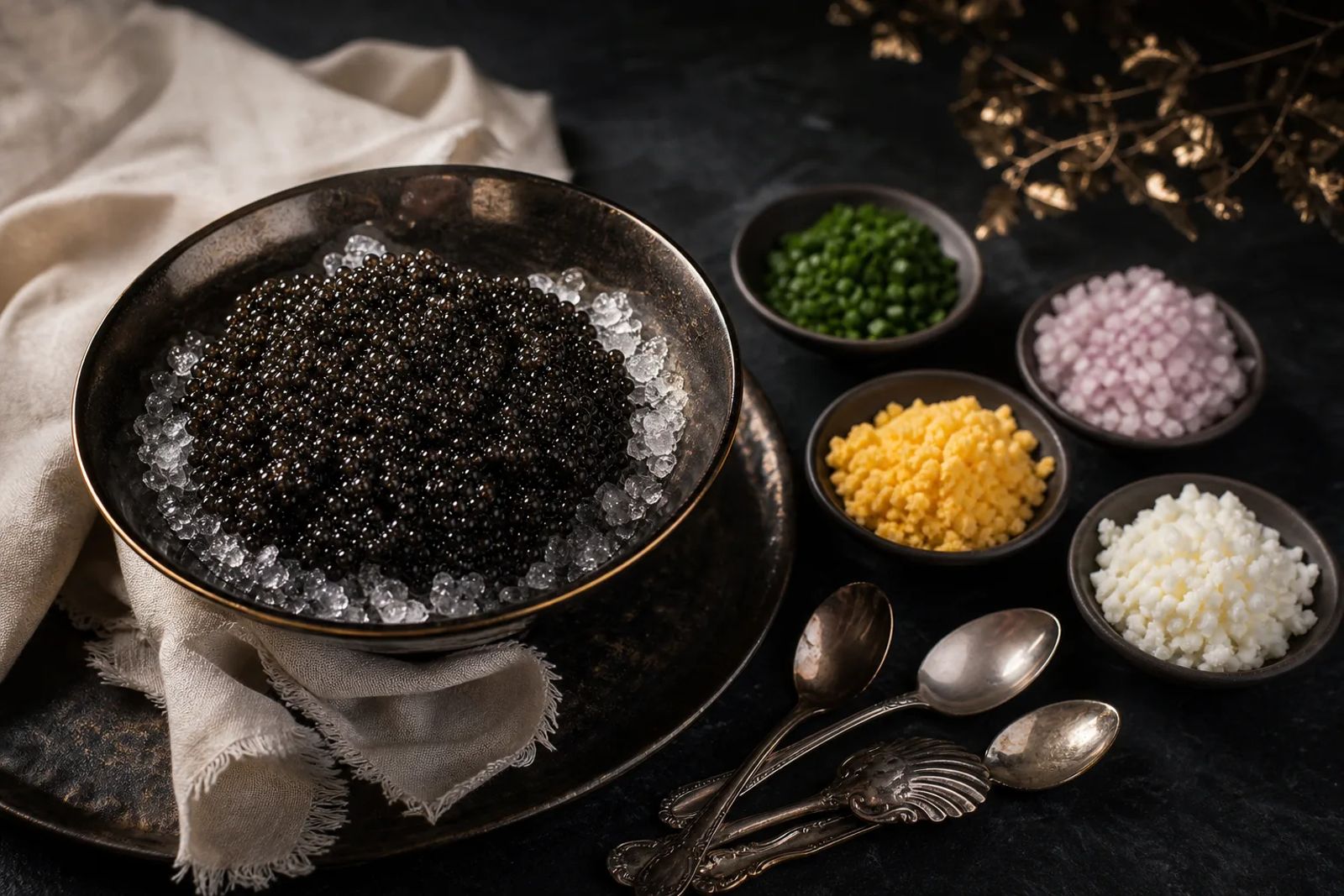
White and yellow egg, finely cut chives, a dish of chopped shallot: the classic caviar garnish tray puts colour and choice beside the roe. Chef Thomas Wenger’s account of continental service keeps the yolk and white separate. That small detail matters. Each guest can build a mouthful rather than inherit someone else’s mixture.
The familiar set uses hard-boiled egg, chives and shallot or onion, with optional lemon or capers. Taste the roe plain first. Then add only what makes the next bite better.
What belongs on the classic garnish tray
There is no single, fixed tray. Wenger names chopped shallots, separate egg yolk and white, parsley, lemon and toast. Le Chef’s Wife describes a similar spread with chives, red onion and capers. Both show the range within restaurant service.
The useful distinction is between the base and the garnish. Bread or blinis carry the bite; egg, herbs and onion let you adjust it. They need not become a blanket over the caviar. Keeping white and yolk apart gives guests control over the proportions and preserves the clean white and yellow colours on the tray.
The complete set has no documented birthplace. Nor is there documentation for the claim that it was invented to stretch portions or disguise lesser caviar. Wenger records a service convention; its wider context belongs in classic Russian and French service.
When garnishes help, and when they get in the way
A plain spoonful and a composed bite offer different pleasures. Chef Terrance Brennan prefers simpler service, arguing that traditional extras dilute caviar’s subtle flavour. His preference makes a strong case for tasting the roe alone, without making egg an improper accompaniment.
Other cooks build fuller combinations deliberately. Julia Sullivan’s published Poppy’s Caviar pairs paddlefish or sturgeon caviar with sour cream, chives, shallot and lemon among other ingredients. Anya von Bremzen’s published egg recipe brings together salmon roe, egg, chives and lemon. These are composed dishes, rather than prescriptions for how much garnish each species needs.
Choose by the mouthful, not by a trade name. With a quiet, delicate-tasting roe, begin without raw onion or lemon. For a fuller canapé, try a little egg and a few chive pieces first. Compare it with a plain bite. If you can describe the onion but no longer notice the roe, use less onion.
Prepare eggs, chives and shallots with care
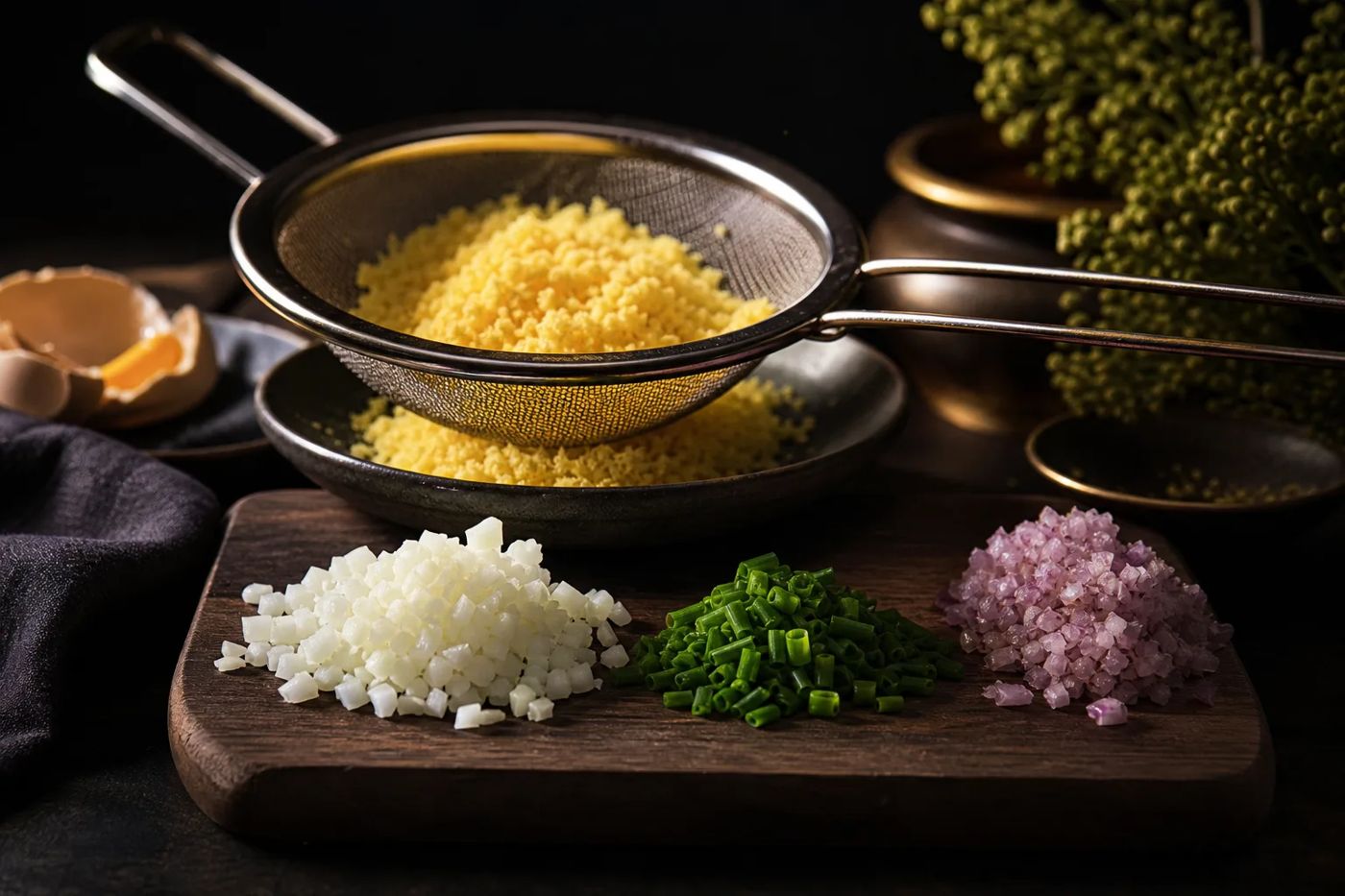
Keep the components fine, dry and separate. The method below combines published egg-cooking and garnish techniques, starting with 50 g peeled hard-boiled egg, 5 g chives and 15 g peeled shallot. These are suggested working quantities for separate dishes, not a fixed ratio to the amount of caviar.
Set out a saucepan, a bowl of clean iced water, a knife, chopping board, fine sieve, spoon and four small serving dishes. Egg garnish contains egg; caviar and other fish roe contain fish. Keep utensils separate if someone needs to avoid either.
-
Cook the egg until firm. Great British Chefs gives 10 minutes for a large, room-temperature egg lowered gently into already boiling water. Start timing on immersion. This timing is not for an egg straight from the fridge; whichever method you choose, both white and yolk must be fully set.
-
Cool, peel and divide. Transfer the egg to the iced water, an option in the same cookery guide. Once it is cool enough to handle, peel it, remove any shell fragments and pat dry. Weigh the 50 g portion after peeling, then separate its white and yolk.
-
Prepare white and yolk separately. Finely chop the white with a knife. For a finer yellow garnish, press the yolk through a clean fine sieve with the back of a spoon, as chef Mark Tafoya does in his caviar recipe. Place each in its own dish. Add no salt.
-
Cut the chives. Wash and dry the 5 g of chives. Align a small bundle and slice across it with a sharp knife, or snip with clean scissors. Small pieces are easier to portion than long strands: a guest should be able to take a few without dragging a whole tuft onto the bite.
-
Mince and rinse the shallot. Cut the 15 g of shallot into fine dice rather than recognisable chunks. Rinsing is used by some cooks, including in NYT Cooking’s caviar pie recipe, which rinses chopped shallot under cool water before serving. Place it in a fine sieve under cold drinking water, drain thoroughly and blot dry before transferring to its dish. No soaking time is needed.
-
Cover and chill. Keep everything separate until serving. In the US, the FDA advises setting a household refrigerator to 4°C (40°F) or below. Refrigerate cooked egg promptly. Follow the roe producer’s storage instructions, which may specify a colder temperature, and leave the garnishes out of the roe until the bite is assembled.
Set out a choice, not a compulsory topping
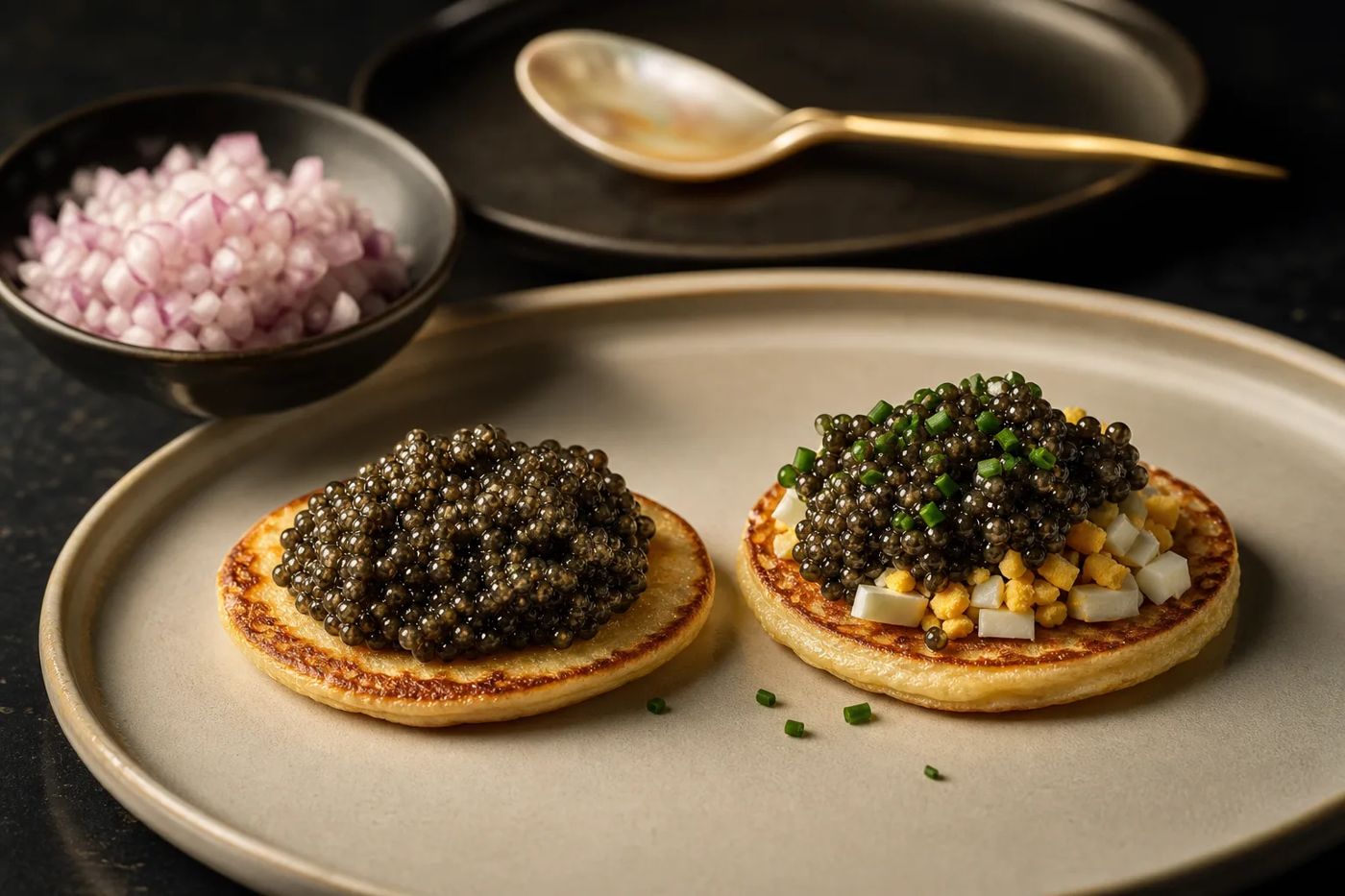
Small bowls, each with its own small spoon, make a better service than one large bowl of mixed egg and onion. Keep the caviar separate and chilled according to its producer’s instructions. Guests can then assemble each bite immediately before eating. Leave a little space between the bowls to help prevent shallot being carried into the egg.
Build in this order: base, a little egg if wanted, caviar, then a few chive pieces. Let shallot be a separate choice rather than the automatic final layer. Chives and shallot need not share every bite. Nor does a tray need capers, parsley and lemon simply to look complete.
For a group, serve small amounts and keep a covered reserve refrigerated. Replace the dishes instead of continually topping them up. If the aim is a dish built around eggs, turn to scrambled eggs with caviar or devilled eggs with caviar. Loose garnish serves a different purpose from an egg-based recipe.
Should you offer lemon?
Yes, if guests want the choice. Lemon is an option, not a correction every caviar needs. Le Chef’s Wife includes wedges in the traditional spread while recommending a first taste without additional condiments. Brennan favours greater simplicity; Sullivan deliberately includes lemon in a much fuller accompaniment.
If you can describe the onion but no longer notice the roe, use less onion.
Keep lemon beside the garnish tray and test it on one assembled bite. Never squeeze it over the shared caviar. Anyone who enjoys the added acidity can have it without changing everyone else’s portion. The disagreement is best settled one mouthful at a time, not across the whole tin.
Keep the egg garnish safe
Cooked egg garnish is chilled ready-to-eat food, not a shelf-stable decoration. Wash hands and clean utensils before preparation, keep it away from raw foods, and chill promptly after cooking and cooling. Neither a pleasant smell nor a tidy appearance tells you that it is safe.
UK: the Food Standards Agency’s general leftovers advice is to cool and refrigerate cooked food within one to two hours and eat it within 48 hours. Use that as the straightforward home plan for prepared egg garnish. This is general cooked-food advice, rather than a special seven-day allowance for hard-boiled eggs.
US: the FDA advises using refrigerated hard cooked eggs, peeled or in their shells, within one week. That period does not establish how long finely chopped garnish will keep. Cooked eggs should spend no more than two hours outside refrigeration, or one hour above 32°C (90°F), under FDA guidance. USDA FSIS also lists one week for refrigerated hard cooked eggs.
EU example, Germany: the Federal Institute for Risk Assessment says both yolk and white should solidify. It also notes that shell damage, cooling method and storage affect keeping time. Its discussion of longer storage concerns hard-boiled eggs in their shells; those timings should not be applied to peeled, finely chopped garnish.
Australia: FSANZ’s food-business guidance counts all time between 5°C (41°F) and 60°C (140°F), including preparation and display. Its two-hour/four-hour rule allows food out for less than two hours to be refrigerated again. Between two and four hours, it may still be used or sold but must not return to the fridge. Beyond four hours, discard it. This is Australian business guidance, distinct from the US household rule.
Where to go next
- Accompaniments and Pairings: choose supporting foods without crowding the plate.
- Caviar on Its Own: Why Purists Skip the Garnish: explore the pleasures of tasting without additions.
Sources
- Chef’s Pencil, Thomas Wenger. How to Serve Caviar. Web article, 2011. Source.
- Le Chef’s Wife. How to serve Caviar. Undated web edition retrieved in 2026. Source.
- Terrance Brennan. The Best Way to Serve Caviar (And Why Simpler Is Better). Undated web edition retrieved in 2026. Source.
- Williams Sonoma, recipe courtesy of Julia Sullivan. Poppy’s Caviar. Undated web recipe retrieved in 2026. Source.
- Los Angeles Times, adapted from Anya von Bremzen’s Please to the Table. Eggs stuffed with caviar. Archive recipe, 20 February 2008. Source.
- Great British Chefs. How to Boil an Egg. Undated web edition retrieved in 2026. Source.
- The Gilded Fork, Mark Tafoya. Cucumber Cups with Caviar & Champagne Onions. Web recipe, publication year not established in the retrieved extract; retrieved in 2026. Source.
- South China Morning Post, Susan Jung. Truc: roe deal. Search-retrieved article extract, publication year not established in the retrieved extract; retrieved in 2026. Source.
- Food Standards Agency, GOV.UK. How to chill, freeze and defrost food safely. Current web edition, originally published 2017; retrieved in 2026. Source.
- US Food and Drug Administration. What You Need to Know About Egg Safety. Current consumer web guidance retrieved in 2026. Source.
- US Department of Agriculture, Food Safety and Inspection Service. Kitchen Companion: Your Safe Food Handbook. Government-hosted edition, publication year not established in the retrieved extract; retrieved in 2026. Source.
- German Federal Institute for Risk Assessment, BfR. Frequently Asked Questions about Easter Eggs. Current web edition retrieved in 2026. Source.
- Food Standards Australia New Zealand. 2-hour / 4-hour rule. Current Australian food-business guidance retrieved in 2026. Source.
This piece was researched by comparing published culinary guidance and chef recipes with national food-safety advice, distinguishing documented techniques from editorial serving suggestions.
Last checked: November 2026