
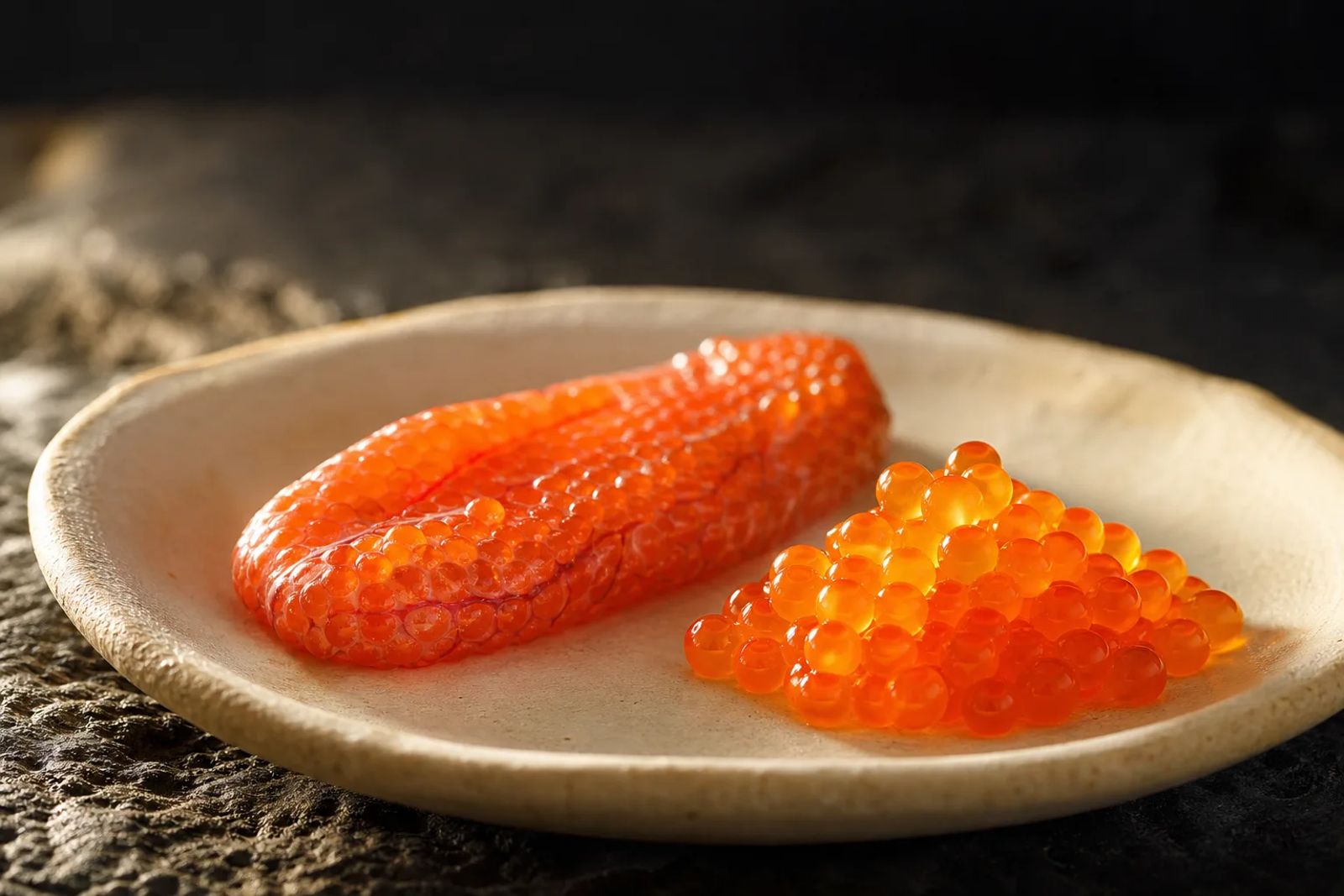
Yellow-gold to dark amber, firm enough to slice or grate: mullet bottarga is fish roe, just as surely as a spoonful of salted salmon beads. The same broad family of foods takes in smoked cod roe, Japanese herring roe and smooth spreads. Sturgeon caviar is only part of the story.
Fish roe means the eggs or egg masses of female fish, whether still enclosed in the ovary or separated into individual eggs. What happens next determines much of what reaches the plate.
- A whole roe sac and loose beads can come from the same fish. Their form reflects preparation, not a different species.
- Soft roe is milt from male fish, not eggs.
- Read the fish name and ingredients. Colour, seasoning and the word “caviar” tell only part of the story.
What fish roe actually is
Roe can arrive as a whole sac or a collection of separate eggs. Both begin in the ovaries of a female fish, where the eggs develop. Fishmongers may sell these egg masses with their enclosing membranes intact, often called sacs or skeins. Processors may instead remove the membranes and separate the eggs.
“Roe” describes both that biological material and, in everyday food language, the products made from it.
Soft roe is something else. Also called milt, it is male reproductive material, including sperm and associated tissue. It is eaten too, but it is not fish eggs. The other fish roe hub maps these different foods; this guide gives you the distinctions that make menus and labels easier to read.
The main forms of fish roe
Start with the form. Loose eggs behave differently from an intact sac, while dried roe works more like a seasoning than a spoonful of beads. The fish matters, but so does what has been done to its eggs.
| Form | Example roe | Preparation | Typical use |
|---|---|---|---|
| Loose beads | Salted salmon roe | Eggs separated, rinsed and salted | Rice topping or garnish |
| Whole sacs | Sujiko | Salmon or trout ovaries salted intact | Served with rice |
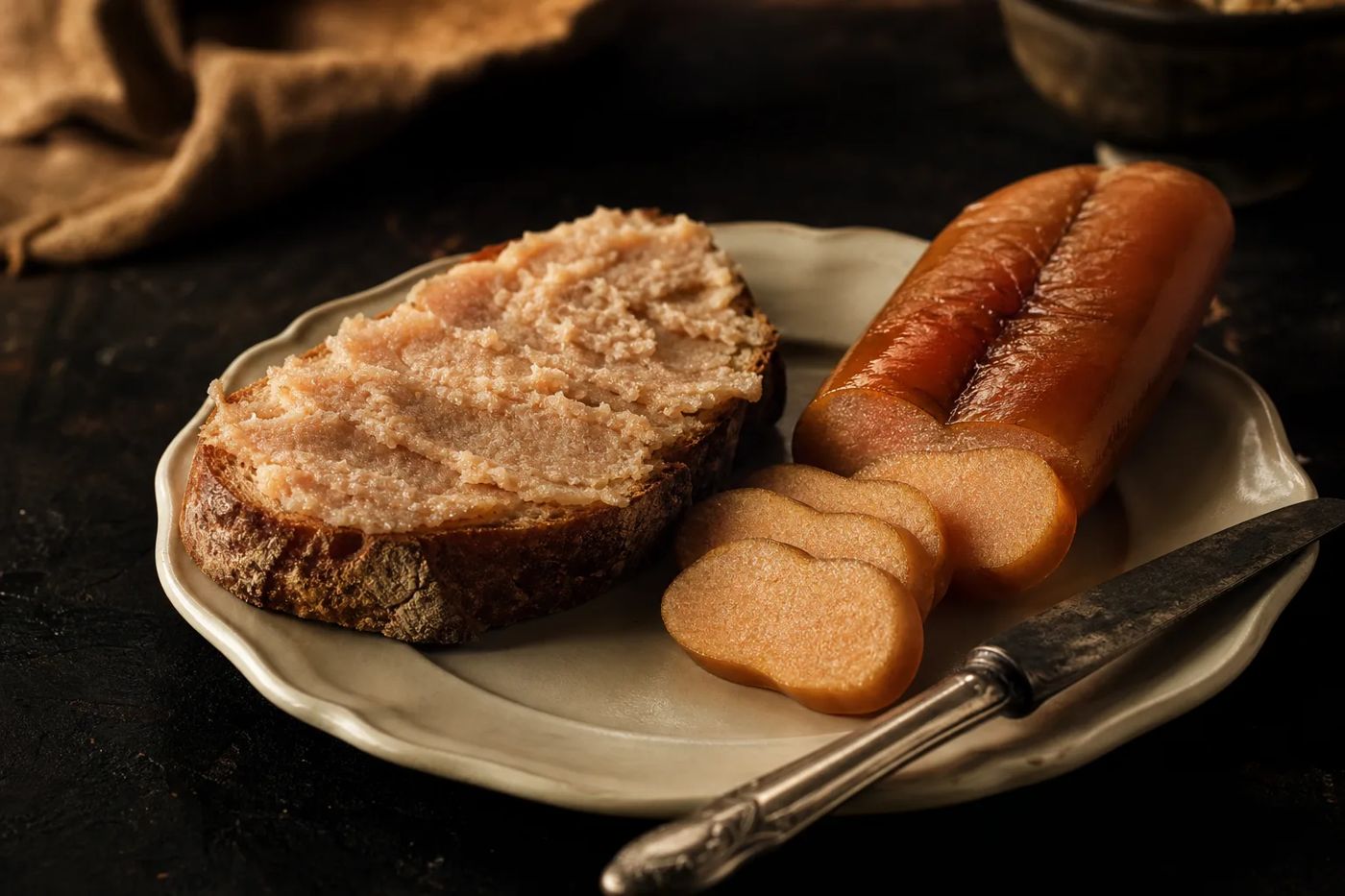
| Pastes and spreads | Scandinavian cod roe spread | Salted roe blended, sometimes after smoking | Spread on bread |
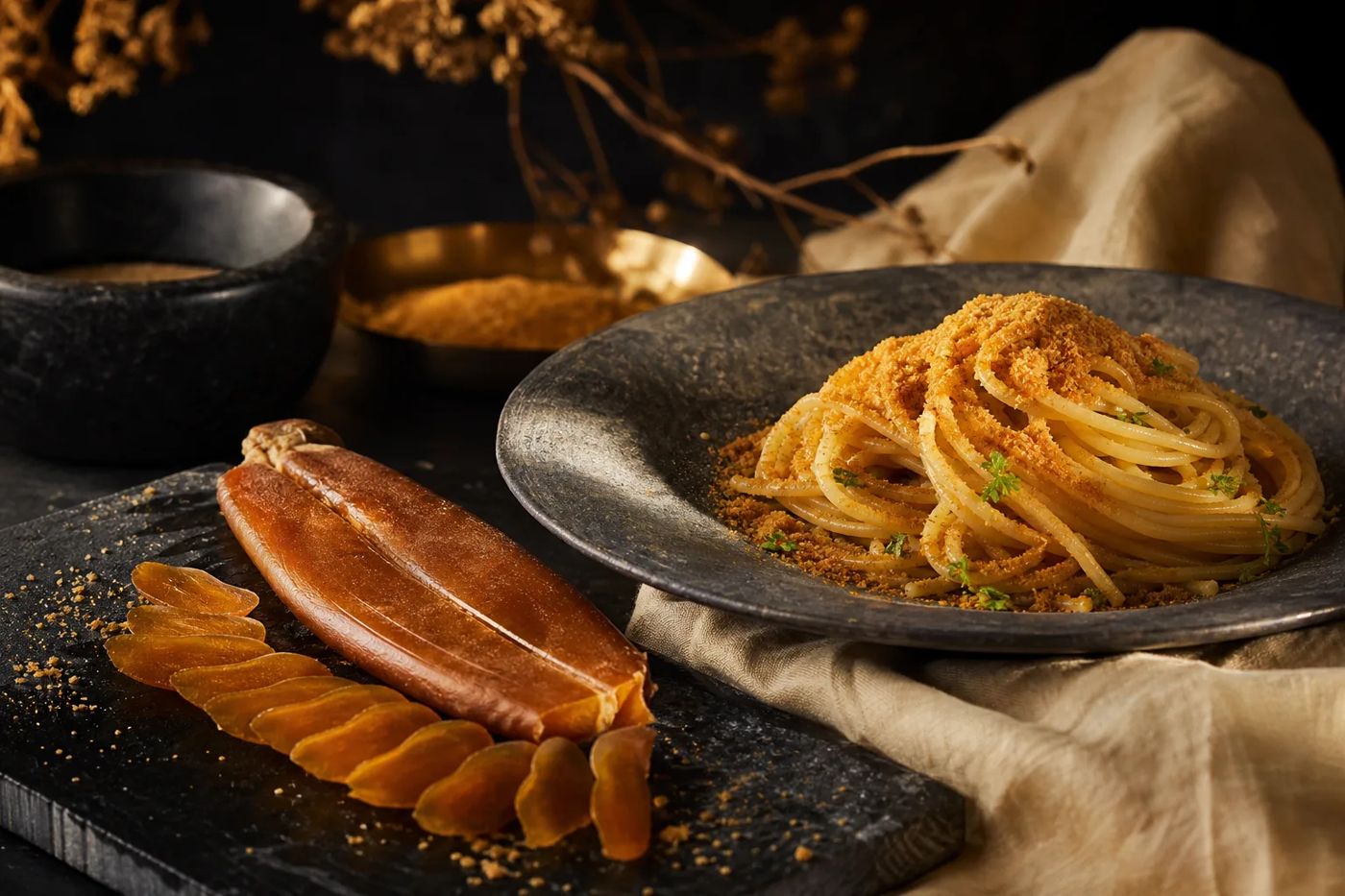
| Pressed and dried | Mullet bottarga | Whole sacs salted, dried and pressed | Thinly sliced or grated |
| Smoked | Smoked cod roe | Sacs salted and smoked | Sliced or used in spreads |
These styles overlap. Smoking can precede blending; drying does not require eggs to be separated. The table describes finished product styles rather than home preparation methods. For a clear contrast, compare salted salmon roe: The Complete Guide) with cured mullet roe: loose beads on one side, a firm whole-sac product on the other.
Which fish provide edible roe?
Salmon and trout
The distinction between sujiko and ikura is a distinction of preparation. Japan’s Ministry of Agriculture, Forestry and Fisheries identifies sujiko as salted salmon or trout ovaries, and shio-ikura as eggs preserved in brine. Soy sauce seasoning creates another familiar style of ikura.
Salmon and trout belong to the salmonid family, and their roe is sold both as separate eggs and in intact sacs. “Salmon roe” broadly identifies the source; “ikura” points to a Japanese product style. The name alone does not specify the seasoning or salt content of every salmon roe product.
Small marine roes
Tobiko is flying fish roe, familiar in Japanese sushi preparations. Capelin and lumpfish also supply edible roe. These are distinct fish sources, not different names for the same product.
Processors can salt, flavour or colour the eggs, so a bright bead tells you less than the ingredient list. Read both the fish name and what has been added. The guide to natural roe colours separates the fish’s own colouring from colours introduced during manufacture, rather than relying on appearance to identify the species.
Cod and its relatives
Cod roe can be a whole sac, a cooked product, smoked roe or a spread. In Scandinavia, it becomes a salted spread sold in tubes, in smoked and unsmoked versions. Even when a local name includes kaviar, this is a different food from loose beads.
Tarako, the Japanese salted roe, comes from Alaska pollock. Karashi-mentaiko is pollock roe with spicy seasoning. English translations sometimes shorten both foods to “cod roe”. Look for the actual fish name: a convenient translation can conceal a distinction between species.
Herring
Kazunoko is herring roe, and it need not be a heap of loose eggs. It may be salted and then seasoned. Japan’s agriculture ministry documents mame kazunoko, a Fukushima dish combining herring roe with soybeans, as a New Year food.
Here, roe is part of a complete dish rather than simply a garnish. That matters when reading a menu: the name may reveal more about the recipe and the occasion than about how the eggs were processed.
Mullet
Firm, pressed and ready to slice or grate, bottarga shows how far roe can travel from the loose bead. Mullet roe is particularly associated with salted, dried whole sacs. Italian bottarga is a familiar example, made by preserving and pressing the intact sacs. Its finished colour can range from yellow-gold to dark amber.
The name does not always mean mullet: tuna bottarga exists too. Even with a familiar culinary name, check the fish before deciding how to use the roe.
European freshwater roes
Salted carp roe becomes a spread or salad in Romania’s salată de icre de crap, combined with oil and other ingredients. It belongs to Europe’s freshwater roe traditions, rather than being sturgeon caviar under another name.
Vendace supplies another example, with an important geographical distinction. The Swedish product Kalix Löjrom comes specifically from vendace caught in the brackish waters of the Bothnian Bay, not simply from any freshwater lake. Its official single document lists rinsing, whisking, sieving, drying, salting and cleaning of the roe. The fish’s name and the product’s origin each tell part of the story.
How preparation changes fish roe
Salt, drying and smoke help turn fish eggs into very different foods. Salting may mean applying dry salt directly or immersing roe in brine, a saltwater solution. Japan’s agriculture ministry describes dry salting as strongly dehydrating, while brining allows more even salt penetration. Curing is the broader preservation process; it does not, by itself, mean a product is ready to eat.
Drying removes water and concentrates the roe into something firm enough to slice or grate. Smoking adds its own processing step and flavour. Other roe is cooked or canned. These treatments explain the range: separate eggs, dense slabs and smooth spreads all sit under the same broad name.
Colouring and flavouring change the product, not the species. Codex’s food category description for roe products explicitly includes salting, spicing and dyeing. Read the ingredients to see where the roe ends and added oil, sugar, seasoning or colour begins. For products intended to take the place of loose caviar beads, see caviar substitutes compared.
Processors can salt, flavour or colour the eggs, so a bright bead tells you less than the ingredient list.
Choose the form for the job. Use separate eggs for a topping, an intact sac for a dish built around it, a spread for bread, or dried roe for grating. That is a better starting point than treating everything called roe as interchangeable.
When can other roe be called caviar?
The answer depends on the authority and the purpose: a food standard, labelling guidance and a customs classification do different jobs.
Codex CXS 291-2010 covers salted roe of the sturgeon family Acipenseridae only. It is an international reference standard, not automatically national law. US FDA guidance CPG 540.150 says unqualified “caviar” should mean salted sturgeon roe. Other roe may be called, for example, “whitefish caviar”, with the fish name in substantially the same size and prominence. The guidance also calls for a prominent declaration of artificial colour when used.
EU and UK customs distinguish caviar under 1604 31 00 from caviar substitutes under 1604 32 00. Those are tariff classifications, rather than a general rule for wording on a shop label.
In the EU, Article 7 of Regulation (EU) No 1169/2011 prohibits misleading food information. Great Britain applies corresponding assimilated provisions, while EU food information rules generally apply in Northern Ireland. For the fuller explanation of how these naming systems fit together, see caviar versus roe.
A short food safety check
Start with the label: is the roe ready to eat, or does it require cooking? Follow its storage instructions and use-by date. Smell and appearance cannot establish safety.
In the UK, the FSA and Food Standards Scotland advise pregnant people and people with weakened immune systems to avoid ready-to-eat cold-smoked or cured fish unless thoroughly cooked, because of Listeria risk. Older adults are advised to take extra care.
In the US, FDA advice for higher-risk consumers is to avoid refrigerated smoked seafood unless it is in a cooked dish; canned and shelf-stable versions are distinguished. EFSA identifies ready-to-eat fish as a possible Listeria source and advises keeping refrigerators cold. Follow the product’s label instructions too.
Parasite controls depend on the product and jurisdiction. US FDA guidance distinguishes eggs removed from the sac and rinsed from unrinsed eggs or intact sacs. Elsewhere, requirements must be assessed for the particular product and processing method. Light salting does not establish that a raw sac is safe, and not every jar of roe needs home freezing.
Roe also counts as fish for allergy purposes. For personal advice during pregnancy or about a weakened immune system, ask your midwife or doctor.
Sources
- International Journal of Gastronomy and Food Science. Roe gastronomy, volume 32, article 100712, 2023. Biological structure, culinary forms and the breadth of roe cookery. Publisher record.
- International Journal of Food Science & Technology. Choung and colleagues, Fish milt and roe-derived functional proteins and peptides: composition, bioactivities, and applications, 2024. Distinction between milt and roe. Journal record.
- FAO GLOBEFISH. Marie Christine Monfort, Fish Roes in Europe: Supply and Demand Conditions, November 2002. Historical processing and culinary descriptions, not current market statistics. Retrieved report.
- Torry Research Station, reproduced by FAO. A. McK. Bannerman, Processing Cod Roes, Torry Advisory Note No. 18; FAO digital accompanying notes, 2001. Original publication year is not stated in the retrieved edition. Used for processing descriptions, not home-preservation instructions. Contents and edition notes; processing text.
- Japan Ministry of Agriculture, Forestry and Fisheries. Salted foods, Traditional Foods in Japan, undated live edition, accessed 2026. Sujiko, ikura, tarako, karashi-mentaiko and salting methods. Official account.
- Japan Ministry of Agriculture, Forestry and Fisheries. Mame Kazunoko, Our Regional Cuisines, undated live edition, accessed 2026. Herring roe, soybeans and New Year use in Fukushima. Official account.
- FAO/WHO Codex Alimentarius. General Standard for Food Additives: food category 09.3.3, caviar and other fish roe products, live database, accessed 2026. Salting, seasoning, colouring and product examples.
- FAO/WHO Codex Alimentarius. Standard for Sturgeon Caviar, CXS 291-2010, adopted 2010, amended 2013, 2018 and 2024 in the PDF checked. Sections 1 and 2.1 establish its scope. The official register lists it as last modified in 2026.
- US Food and Drug Administration. CPG Sec. 540.150: Caviar, Use of Term, Labeling, October 1989, current posted guidance accessed 2026. FDA guidance.
- European Commission. Commission Implementing Regulation (EU) 2025/1926, 22 September 2025, Combined Nomenclature applicable in 2026, heading 1604. Official Journal text.
- UK Government. Request for Input: Indicative Long List of US Products, 2025. Official commodity descriptions for 16043100 and 16043200. Published list.
- UK Government and Food Standards Agency. Packaging and labelling: legal requirements for food businesses, live guidance accessed 2026. Official guidance.
- European Commission. Kalix Löjrom: published single document, Official Journal C 164, 4 May 2021. Raw material, geographical area and processing. Official document.
- European Commission. Salată tradițională cu icre de crap: published specification, Official Journal C 222, 11 June 2021. Retrieved as a reproduction of the original Official Journal. Retrieved document.
- Food Standards Agency and Food Standards Scotland. The FSA and FSS remind higher-risk consumers on the risks of listeria associated with eating cold-smoked and cured fish, updated 2 December 2024. Official advice.
- US Food and Drug Administration. Selecting and Serving Fresh and Frozen Seafood Safely, live consumer guidance accessed 2026. FDA advice.
- European Food Safety Authority. Listeria, live topic guidance accessed 2026. EFSA guidance.
- US Food and Drug Administration. Fish and Fishery Products Hazards and Controls Guidance, June 2022 edition, chapter 5, “Parasites”. FDA chapter.
- Food Standards Scotland. Freezing fish and fishery products, live business guidance accessed 2026. Product-dependent freezing requirements and exemptions. Official guidance.
- Fukuoka Prefecture. Fukuya Mentaiko Factory, official visitor information, 2026 edition. An example of the English description “seasoned cod roe”, compared with MAFF’s Alaska pollock identification. Official page.
This piece was researched using official food standards, government guidance, published product specifications and scientific literature, with older technical accounts used only for established preparation styles.
Last checked: November 2026