
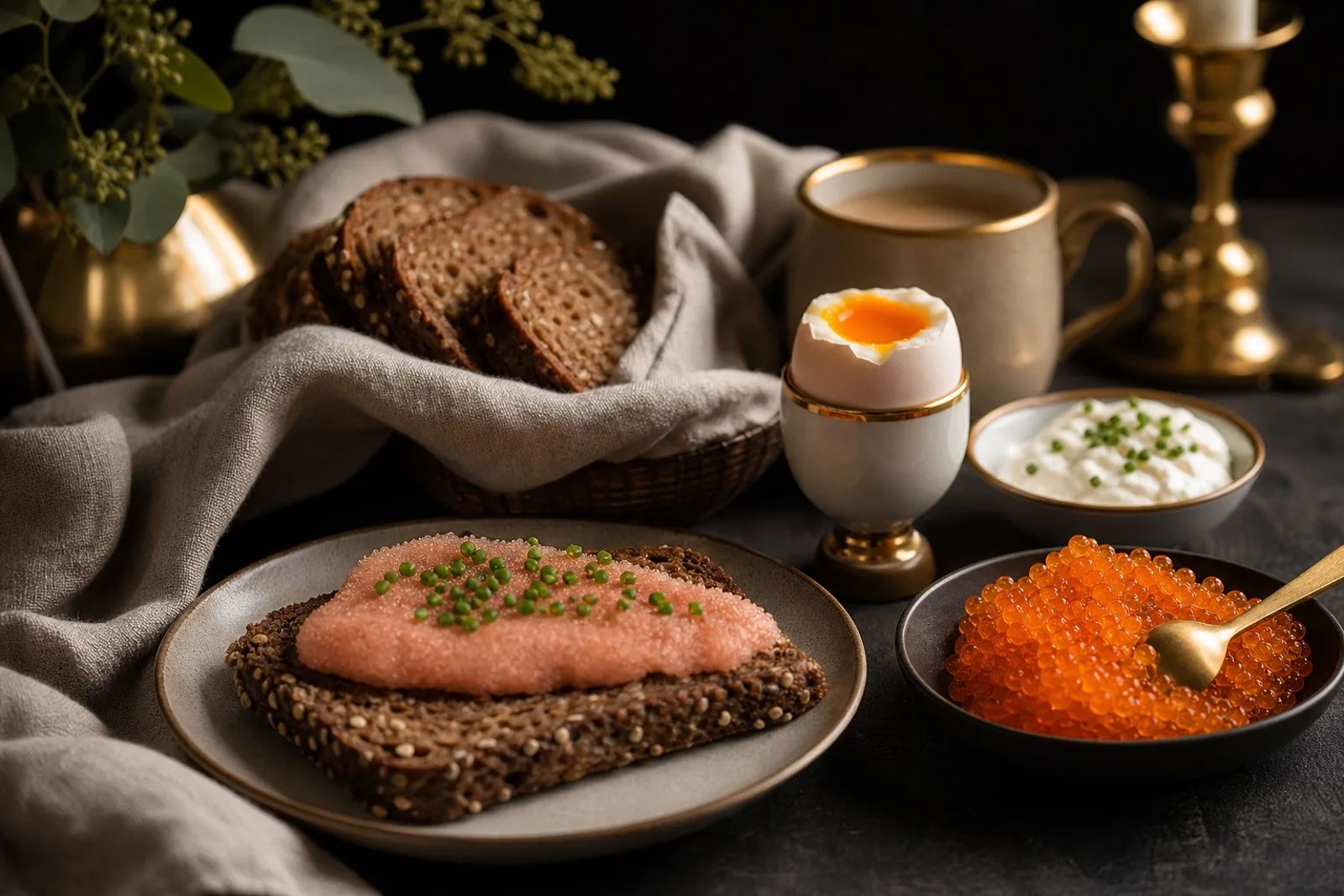
Cold lumpfish roe, warm potatoes and crème fraîche: Arla’s Danish culinary reference captures Nordic roe eating in one vivid serving. Elsewhere, the eggs might arrive in a Swedish breakfast tube, beside a freshly fried Finnish blini or cooked as part of a Norwegian cod meal. Sturgeon is only one part of the story.
The key is what happens to the eggs. Roe simply means fish eggs; they may remain visibly separate, become a spread or be cooked inside their enclosing sacs. This country by country guide follows those differences through everyday spreads, festive starters and seasonal meals. The wider caviar around the world hub sets them alongside other regional traditions.
The words are part of the culture
A Swedish breakfast reference to kaviar may mean a sandwich spread, not loose sturgeon eggs. In Swedish food writing, rom is the general word for roe, while kaviar also names the familiar spread. Sjömatsfrämjandet, the Swedish seafood information organisation, describes salted or smoked roe, most often in tubes, as a sandwich topping.
Danish makes the breadth of the word especially clear. Den Danske Ordbog defines kaviar as salted sturgeon roe, but also records salted, coloured roe from other fish, including lumpfish and capelin. Rogn appears in names such as stenbiderrogn, lumpfish roe, and torskerogn, cod roe. Read the fish name: it tells you something the broader term cannot.
Norwegian uses the corresponding forms rogn and kaviar, with dictionary usage and food descriptions likewise depending on context. Finnish recipes use mäti for roe, specifying the fish in compounds or accompanying words. Martat, the Finnish home economics organisation, uses kirjolohen mäti for rainbow trout roe and mateenmäti for burbot roe.
Sweden: breakfast tubes and festive vendace roe
Swedish breakfast kaviar is made to spread. Orkla describes its tube range as a breakfast food, distinguishing the original style from milder versions and mixtures with egg or fresh cheese. Swedish seafood guidance puts these preparations among sandwich toppings. The tube yields a spread; löjrom keeps its beads separate.
Löjrom tells another Swedish story: vendace roe served as distinct eggs. Kalix Löjrom is a protected designation of origin, not a general name for all Swedish vendace roe. The Swedish Board of Agriculture’s Smaka Sverige account links the protected product to the northern Gulf of Bothnia and processing knowledge passed down locally.
At the festive table, contemporary recipes offer a clear picture of how it can be served. Kalixlöjrom.se presents roe on hard-boiled egg with crème fraîche for Christmas, and blini with sour cream, red onion and dill for New Year. These are celebration dishes from a named source, rather than a compulsory menu followed by every Swedish household.
For the geographical distinction, read vendace roe and its protected name; for ways of serving it, explore Swedish roe dishes.
Finland: roe with blini and winter meals
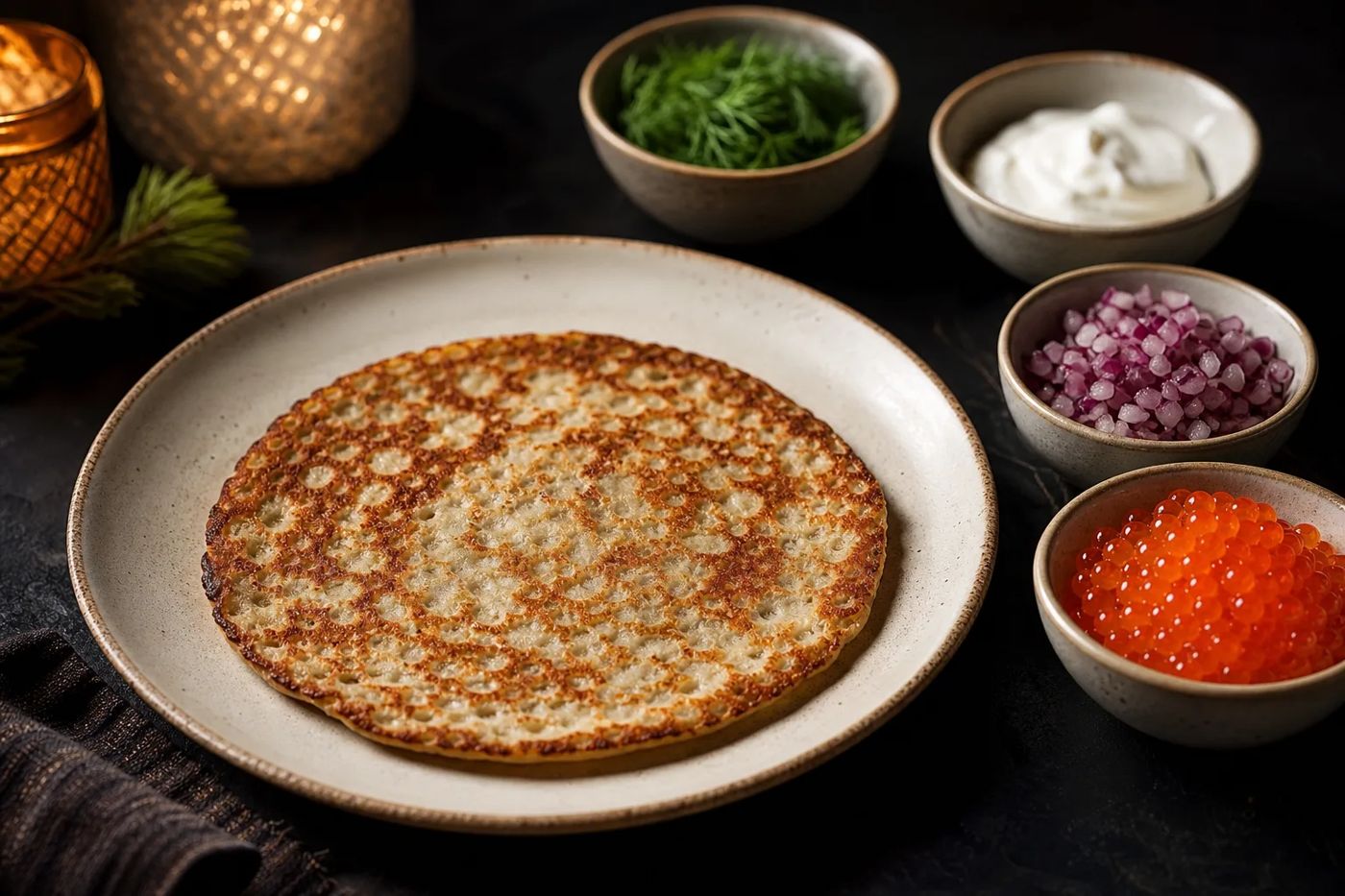
A hot, freshly fried pancake meets cool roe toppings in Martat’s Finnish blini serving. Its recipe starts with a yeast batter containing buckwheat and wheat flour, then names roe, chopped onion and smetana, a rich soured cream, as traditional accompaniments. That contrast in temperature is central to this serving.
Martat also documents burbot roe with onion, smetana and dill, served on toast or with blini. Serve them mixed, or offer the salted roe and accompaniments separately for guests to assemble themselves.
Rainbow trout roe appears in another Finnish preparation. Martat’s Christmas-tagged roe dip combines it with red onion, dill, chives, smetana and cream cheese, with blini or small rye bread rounds suggested alongside. The recipe is evidence of a contemporary home-cooking convention, rather than grounds for calling every orange roe preparation an ancient Finnish custom.
Martat places its blini recipe under both winter and Christmas themes, giving the dish a seasonal setting in Finnish home cooking, not a fixed roe harvest calendar. The season for eating blini need not match the catching season of the fish supplying the eggs, particularly when preserved roe is used.
Norway: spread on bread, roe with skrei
Norwegian tube kaviar belongs on bread, but its ingredients need not match those of a Swedish tube. A current Norwegian manufacturer describes lightly smoked, sugar-salted cod roe mixed with rapeseed oil and other ingredients. Its suggested uses are straightforward: spread it on bread alone, or add toppings such as egg, cheese or avocado.
The manufacturer’s foodservice catalogue also places it on breakfast buffets, reinforcing its everyday role. Species can vary, however. Another Norwegian supplier’s product sheet lists roe from both cod and saithe. The tube tells you the style of preparation and how it is eaten; check the ingredients to learn which fish supplied the roe.
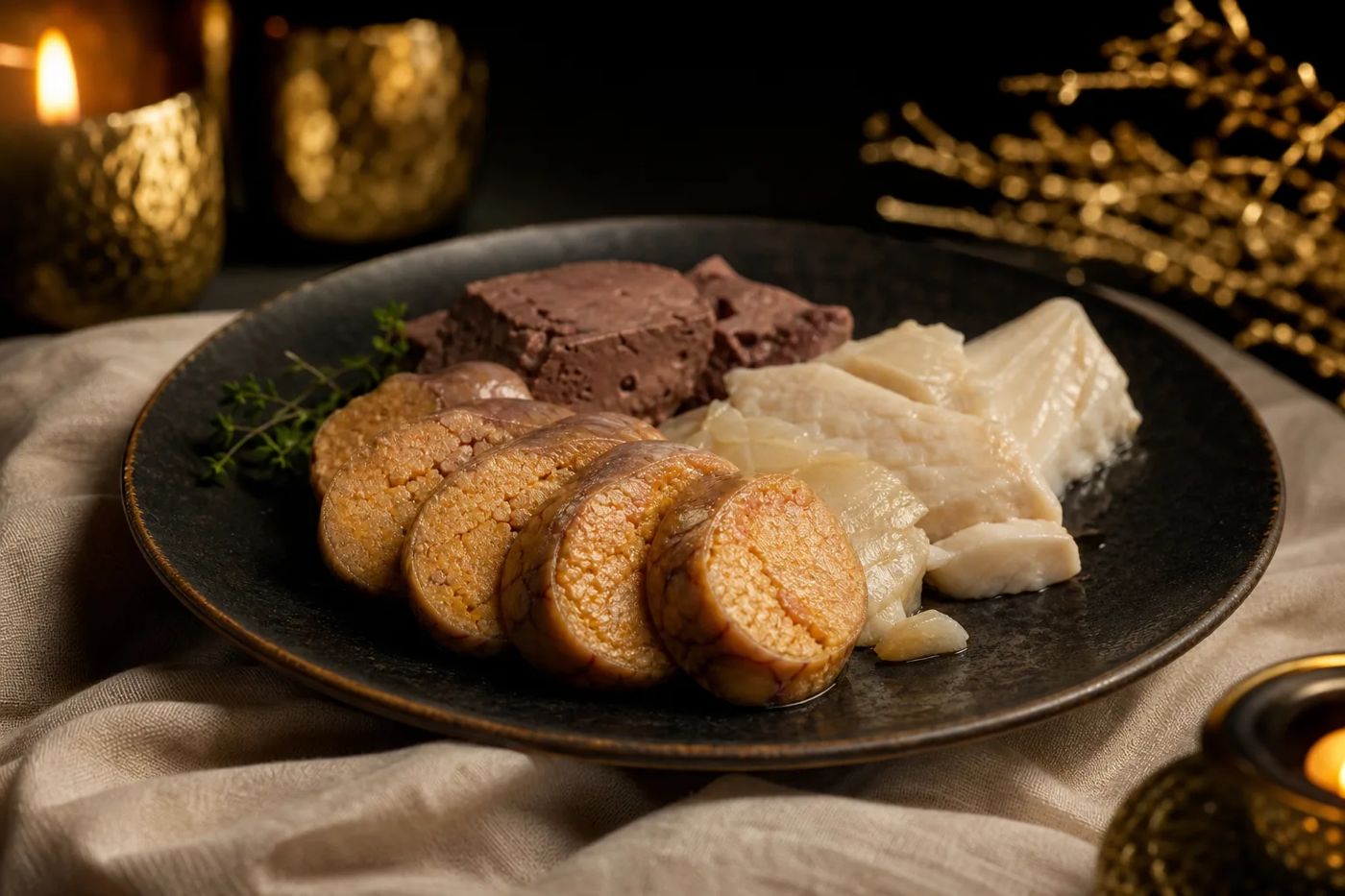
Skreimølje brings roe to the table in a very different form. Store norske leksikon describes this meal of spawning cod, liver and roe, explaining its connection with using the fish’s by-products. Here, cooked roe is part of a substantial fish meal, rather than a cold garnish. The coastal food network Smak av kysten places the traditional meal between January and March. Cod roe preparations explores the different forms more fully.
Denmark: lumpfish roe as a spring arrival
Stenbiderrogn announces early spring in Denmark, though its arrival shifts with the weather. The Danish fishmongers’ association describes a seasonal food without one dependable start date. Arla’s culinary reference gives its familiar companions: toast or blini, chopped red onion and crème fraîche, sometimes with chives or chervil.
A hot, freshly fried pancake meets cool roe toppings in Martat’s Finnish blini serving.
Arla also documents cold lumpfish roe with warm potatoes and crème fraîche, bringing the contrast in temperature to the fore. Its description distinguishes the naturally pale red eggs from the red or black roe sold in jars, which has been coloured. A preserved garnish can therefore look quite different from the fresh seasonal food.
That springtime tradition describes a way of eating, not current fishing permission or the origin of the roe. During 2026, Denmark prohibited commercial lumpfish fishing by Danish vessels, with an exception for unavoidable bycatch in unsorted landings.
A separate order, No. 237 of 2 February 2026, banned recreational lumpfish fishing for the year. DTU Aqua also documented authorised research fishing. These rules were checked in November 2026.
A Danish serving of stenbiderrogn does not, by itself, establish that the roe was Danish-caught. Check origin separately from the dish’s cultural setting; dyed and natural lumpfish roe explains the product distinction.
Iceland: a roe fishery and a food history
Iceland’s lumpfish connection has a distinct fishing calendar. The Marine and Freshwater Research Institute describes a female lumpfish fishery directed primarily at roe, generally operating from March until August. Those months describe fishing activity, rather than an Icelandic equivalent of Denmark’s springtime blini custom.
The local food history is documented in its own right. Matarauður Íslands, the Icelandic food heritage project, records coastal lumpfish harvesting and the making of caviar from its roe. Its account also describes using other parts of the fish. The eggs belong within that broader history of seasonal gathering and household food use, not in isolation from the rest of the catch.
Reading a menu or label
Start with the fish name, then the preparation: a smoked spread, salted separate eggs or cooked roe. A national word such as kaviar cannot tell you the species, preparation and serving style on its own.
Under Harmonized System heading 1604, caviar and caviar substitutes made from other fish eggs are classified separately. This governs customs classification, not which words may appear on consumer labels. Norway and Iceland use the same international heading in their own tariffs. For the table, identify the fish and how its roe is prepared.
A short timeline
| Date | Documented development |
|---|---|
| 1952 | Mills dates the launch of its Norwegian tube kaviar to this year, according to the company. |
| 1954 | Kalles dates its Swedish launch to this year in the brand’s own history. |
| 12 November 2010 | The European Commission adopted Regulation (EU) No 1025/2010, registering Kalix Löjrom as a protected designation of origin. |
These are milestones in products and protection, rather than starting dates for Nordic roe eating. The traditions reach beyond the tube and the protected name into meals, seasons and everyday vocabulary. For the language beyond the breakfast table, caviar words and idioms follows those words into other settings.
Sources
-
Sjömatsfrämjandet. Tillagningsguide, section “Rom och kaviar”. Undated online edition.
https://sjomatsframjandet.se/content/files/products/svensk-fisk-tillagningsguide-webb.pdf -
Det Danske Sprog- og Litteraturselskab. Den Danske Ordbog, entry “kaviar”. Continuously updated online edition, consulted 2026.
https://www.ordnet.dk/ddo/ordbog/kaviar -
Det Norske Akademi for Språk og Litteratur. Det Norske Akademis ordbok, entry “kaviar”. Continuously updated online edition, consulted 2026.
https://naob.no/ordbok/kaviaren -
Martat. Blinit. Current online recipe, publication date not established.
https://www.martat.fi/reseptit/blinit/ -
Martat. Mätidippi. Current online recipe, publication date not established.
https://www.martat.fi/reseptit/matidippi/ -
Orkla Foodsolutions Sverige. Kalles för professionella kök. Current online brand description, undated.
https://www.orklafoodsolutions.se/varumarken/kalles/ -
Smaka Sverige. Kalix Löjrom: En produkts immateriella värde. Current online article, undated.
https://smakasverige.se/fordjupning/skyddad-eu-beteckning/kalix-lojrom-en-produkts-immateriella-varde -
Kalixlöjrom.se. Kalixlöjrom: havets guld från Bottenviken, recipe summaries. Online version retrieved in 2026.
https://kalixlojrom.se/ -
Mills. Mills Original kaviar. Current manufacturer’s product description and ingredient declaration, undated.
https://mills.no/mills/produkt/original-kaviar/ -
Mills. Mills MPP Produktkatalog 2026. 2026 edition.
https://mills.no/content/uploads/sites/12/2026/02/Mills-MPP-Produktkatalog-2026_web.pdf -
Unil AS, through Matinfo. Kaviar kuvert 12g, supplier product sheet, print date 21 May 2026; marked discontinued. Used only as a documented formulation example.
-
Store norske leksikon. Skreimølje. Current online edition, revision date not established.
https://snl.no/skreim%C3%B8lje -
Smak av kysten. Torsk hele året. Current online edition, undated.
https://smakavkysten.no/torskhelearet/ -
Danmarks Fiskehandlere. Danmarks store fiskemagasin, spring 2023, section “Stenbiderrogn”.
https://fiskehandlerne.dk/wp-content/uploads/sites/6/2023/03/K2_Fiskemagasin_12_Foraar-2023.pdf -
Arla, Karolines Køkken. Stenbidderrogn. Online culinary reference, 23 February 2026.
https://www.arla.dk/opskrifter/leksikon/ravarer/stenbidderrogn/ -
Landbrugs- og Fiskeristyrelsen. Straksregulering nr. 6, 2026: Om forbud af erhvervsmæssig fiskeri af stenbider. Issued 22 December 2025, applicable during 2026.
https://www.retsinformation.dk/api/pdf/254729 -
DTU Aqua, Fiskepleje. Indberet mærkede stenbidere til DTU Aqua. 2026 online notice concerning authorised research fishing.
-
Marine and Freshwater Research Institute, Iceland. Lumpfish. Technical report, 26 March 2026.
https://www.hafogvatn.is/static/extras/images/48-lumpfish_techreport_en_mar2026.html -
Matarauður Íslands. Seasonal food. Current online food heritage account, undated.
https://mataraudur.is/en/bragd-arfur/arstidabundin-oflun-faedu/ -
Kalles. Kalles historielektion: allt du behöver veta. Current company history, undated.
https://www.kalles.se/om-kalles/historielektion/ -
European Commission. Commission Regulation (EU) No 1025/2010 of 12 November 2010 entering a name in the register of protected designations of origin and protected geographical indications (Kalix Löjrom (PDO)). Original Official Journal text, published 13 November 2010.
https://eur-lex.europa.eu/eli/reg/2010/1025/oj/eng/pdf
The piece was researched through national culinary references, dictionaries, fisheries research, official legislation and explicitly attributed company accounts, separating documented serving examples from claims about national custom.
Last checked: November 2026