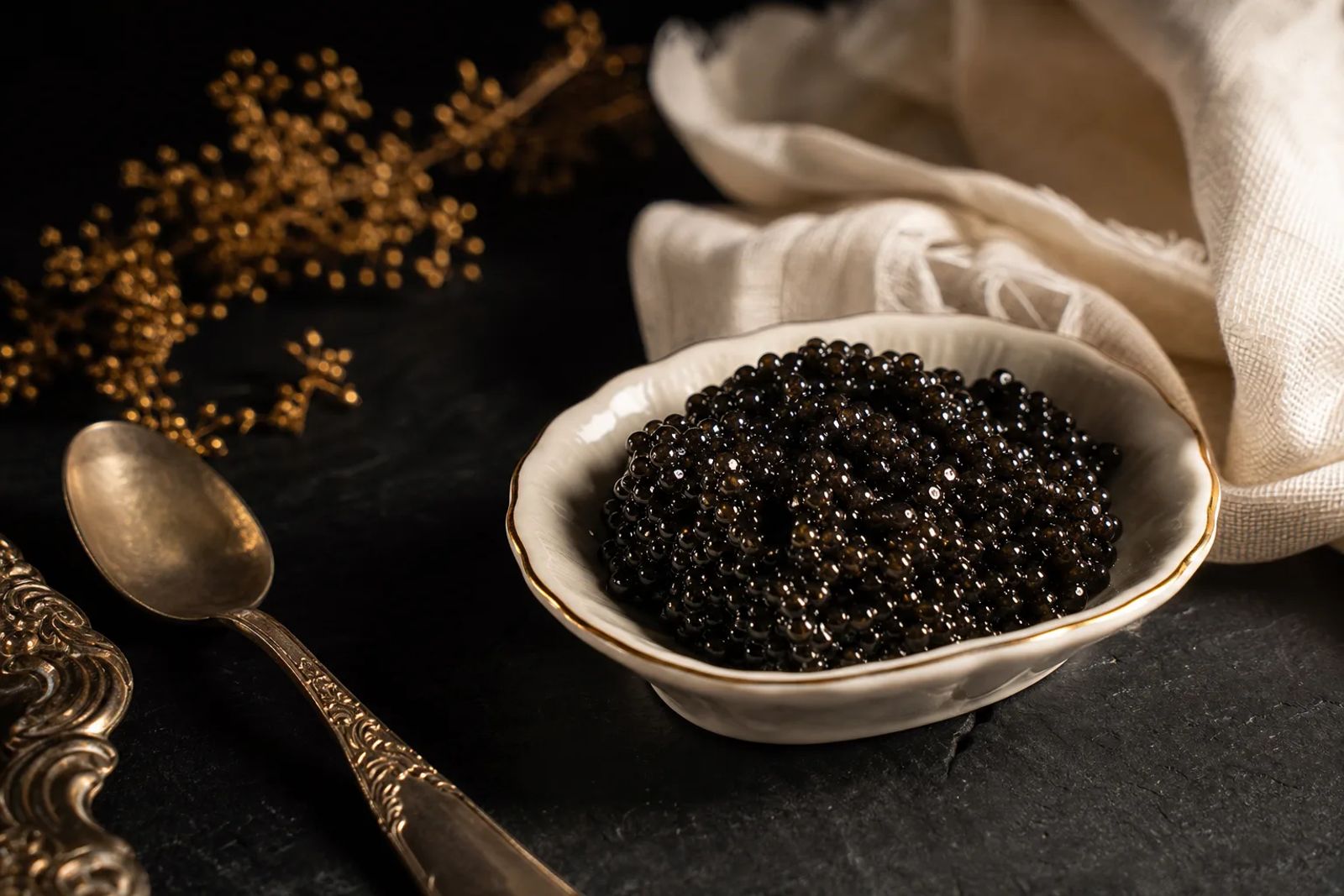
Siberian sturgeon caviar is the salted roe, or fish eggs, of Acipenser baerii, a freshwater sturgeon native to northern Asia. Farms value its adaptability and relatively early maturation, but its success in aquaculture contrasts sharply with its Critically Endangered status in the wild.
Species fact box
| Field | Record |
|---|---|
| Common and trade names | Siberian sturgeon; Siberian caviar; baerii caviar. 2 |
| Scientific name | Acipenser baerii Brandt, 1869, as used by CITES. 2,7 |
| CITES listing and code | Appendix II; BAE. 7 |
| IUCN status | Critically Endangered, 2022 update. 5 |
| Native range | Siberian river basins, including the Ob, Yenisei and Lena; Lake Baikal and its tributaries. 2,3 |
| First farm harvest | Not documented as a range tied to farm conditions. |
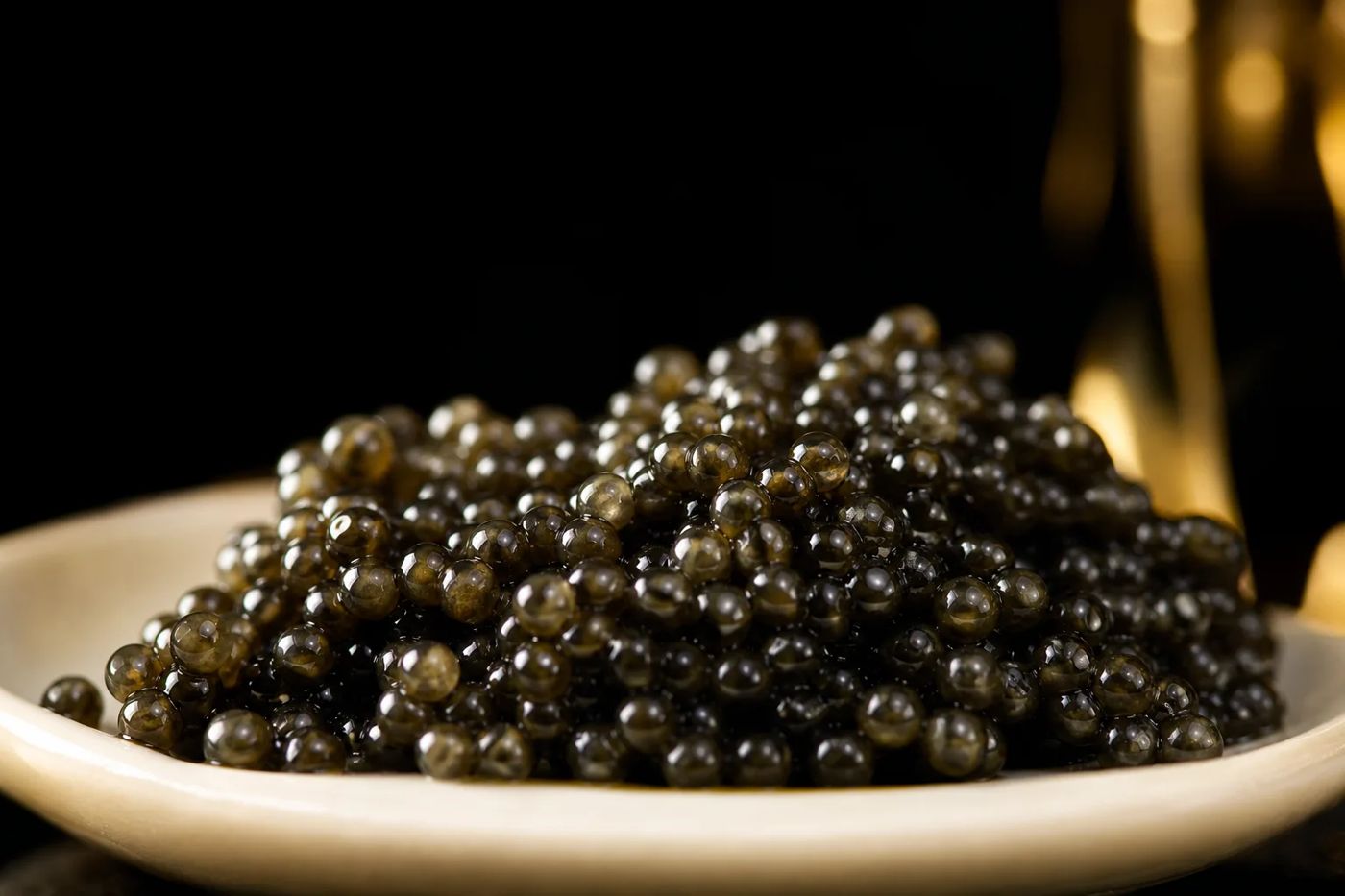
| Egg diameter | 2.4 to 3.0 mm, before processing; size varies and does not identify the species on its own. 4 |
| Colour range | Not documented. |
| Documented farming countries | China, Italy, Poland, Bulgaria, Belgium and France; documented examples, not a ranking. 1,11 |
| Wild trade | CITES Appendix II controls international trade. Russian domestic harvest permissions are not documented as of November 2026. 7,14 |
The fish behind Siberian sturgeon caviar
The word “Siberian” identifies the fish, not necessarily the country where the roe was produced. A French-farmed Acipenser baerii is still Siberian sturgeon, just as a Chinese-farmed fish of the same species is; the country of origin must be read separately from the species name.
Its native waters include large river systems and the Lake Baikal catchment, rather than the Caspian Sea associated with several classic caviar species. This geographical distinction helps explain why the name should not be treated as another spelling of Ossetra. The sturgeon species hub places it alongside its relatives.
Taxonomic treatments have recognised the Baikal form as Acipenser baerii baicalensis; the Aquitaine specification uses Acipenser baerii baerii. These are subspecies-level names, not two grades of caviar.
Proposals published in 2025 would reorganise sturgeon genera, so alternative scientific combinations may appear in newer literature. At their October 2025 meeting, the IUCN Sturgeon Specialist Group and World Sturgeon Conservation Society rejected the proposed taxonomy but recommended dissolving Huso into Acipenser. This page retains CITES names.
Why farms favour this species
FAO's cultured-species account traces farming to the former USSR in the 1970s and describes the species as notably adaptable. It also records the arrival in France of fish descended from River Lena stock through scientific co-operation. That history matters because today's farming distribution is not the fish's natural distribution.
More favourable growing conditions bring reproductive development forward. EUMOFA's 2021 market study gives captive maturity at 6 to 8 years; FAO describes females reaching puberty at about 7 years in generally temperate conditions. These are maturity observations, not a guarantee that every female is ready for caviar collection on a particular birthday.
Caviar production requires eggs at the appropriate developmental stage, not merely a fish of sufficient size. Ultrasound and assessment of ovarian development help producers decide which females are ready. Temperature, individual growth and the farm's production decisions affect the practical timetable; see how long sturgeon take to produce caviar.
Earlier maturation means fewer years of rearing before production can begin. In EUMOFA's comparison, Siberian sturgeon reaches captive maturity earlier than Russian sturgeon, the species commonly associated with Ossetra. That is a production distinction, not a quality grade.

How widespread is its farming?
The documented countries in the fact box establish its international reach, but not a global league table. FAO's species account warns that some national production is reported under a broad sturgeon category rather than by individual species. Fish production also includes meat: tonnes of sturgeon cannot simply be converted into tonnes of caviar.
A CITES label provides traceability, not independent proof of what the container holds.
A current worldwide share of farmed caviar attributable specifically to Acipenser baerii is not documented in the comparable figures cited. It is therefore described as an important, widely farmed species, not as the species that most people eat.
What Siberian sturgeon caviar is known for
Its relatively small eggs are a useful starting point for comparison. UF/IFAS, the University of Florida's agricultural extension service, gives a smaller biological egg-size range for Siberian sturgeon than for Russian sturgeon or beluga. These measurements describe eggs assessed for reproductive work, not a universal grading standard for processed caviar.
For texture, the published Caviar d'Aquitaine specification offers a more precise description than general marketing language. It describes eggs that separate easily, with younger caviar tending to be firm and older caviar softer. It also notes that pasteurisation, a heat treatment, can make the egg membrane slightly perceptible.
France's INAO, the national origin and quality institute, describes the Aquitaine product as having less pronounced salty notes than other caviars. This is an attributed description of that specified product, not evidence that every Siberian caviar tastes identical. For a focused comparison of the two species, read Siberian versus Ossetra.
Relevant comparison factors include farm provenance, processing method, maturation and species identity. A species name helps establish identity, but it does not tell you whether the caviar has been pasteurised or how long it has matured. Those details make a sensory description more useful than an unexplained word such as “Royal” or “Reserve”.
Why Caviar d'Aquitaine has a PGI
Caviar d'Aquitaine is an EU protected geographical indication, or PGI. Commission Implementing Regulation (EU) 2025/342, dated 13 February 2025, was published on 18 February 2025 and entered into force on 10 March 2025. Publication and entry into force are different dates.
The specification names Acipenser baerii baerii and unovulated eggs, meaning eggs collected before their release from the ovarian follicles. Species identity is only part of the requirement: production is tied to a defined area of south-western France and prescribed methods. INAO explains that egg collection and processing take place continuously on the same site over a short period.
Not every Siberian caviar is Caviar d'Aquitaine, and not every French caviar qualifies. The name identifies compliance with a geographical and production specification, not a separate sturgeon species. The dedicated Caviar d'Aquitaine guide explains the scheme in detail.
EU GI protection applies in Northern Ireland as well as the EU. Great Britain has its own GI scheme, and separate protection there for this name is not documented. The EU registration should not be described as automatically establishing Great Britain protection.
Reading BAE and hybrid labels
BAE is the CITES species code for Acipenser baerii. On a caviar label, read it alongside the source code, which identifies wild or captive origin, as well as the country of origin, relevant year, plant details and lot identification. On repacked caviar, the original country and the repacker's country are separate information; a European repacking address does not establish where the fish was farmed.
Siberian sturgeon also appears in hybrids, fish produced by crossing different species. In CITES Resolution Conf. 12.7 (Rev. CoP17), Annex 1 contains the labelling guidelines and Annex 2 gives the species codes. A CITES hybrid code puts the male parent's code first, then “x” and the female's. Codex Annex A and some farms use the reverse order.
If BAE is the first parent code, the male parent is Siberian sturgeon; if it is second, the female parent is Siberian sturgeon. A hybrid is not a mixture of finished caviars. The guide to Ossetra and Siberian hybrids covers those crosses.
EU Regulation 865/2006, Article 66, covers caviar marking and domestic sales; other markets: caviar law. For US imports, exports and re-exports, 50 CFR 23.71 also requires the male parent code first. Separately, FDA Compliance Policy Guide 540.150 applies unqualified caviar to salted sturgeon roe; other roe should name the fish with equal prominence and declare added artificial colour. The FDA guide is nonbinding. A CITES label provides traceability, not independent proof of what the container holds.
The wild fish needs separate protection
The 2022 IUCN update moved Siberian sturgeon from Endangered to Critically Endangered. That assessment concerns extinction risk in the wild, not the number of fish held on farms. Commercial availability therefore cannot be used as evidence that native populations have recovered.
Russia's Federal Agency for Fisheries reported releases of juvenile Siberian sturgeon from the Yenisei and Ob populations in March 2025. Restocking activity does not itself establish that commercial wild harvest is permitted. Current basin-specific Russian harvest permissions are not documented.
Appendix II is an international-trade control, not a declaration that wild fishing is lawful everywhere. Anyone evaluating a wild-origin claim needs the applicable domestic harvest rules and international-trade documentation, rather than relying on the species name alone.
Sources
-
FAO. Acipenser baerii, Cultured Aquatic Species Fact Sheets, CD-ROM edition, 2009. Historical background, production systems, maturity and statistical reporting limitations. FAO species account.
-
FAO. Chebanov, M. S. and Galich, E. V. Sturgeon Hatchery Manual, Fisheries and Aquaculture Technical Paper 558, reprinted 2013. Species accounts and assessment of reproductive development. FAO manual.
-
University of Florida, IFAS Extension. Chapman, F. A. and Van Eenennaam, J. P. Sturgeon Aquaculture: Specialized Techniques: Determining the Stage of Sexual Maturity in Female Sturgeon for Artificial Spawning: The Egg Polarization Index or PI, FA153, 2007, reviewed August 2025. UF/IFAS publication.
-
IUCN. Changes in the IUCN Red List categories of threatened species, Red List version 2022-1, Table 7, 2022. The Siberian sturgeon entry records the change from EN to CR. IUCN category-change table.
-
European Commission, EUMOFA. The caviar market: Production, trade and consumption in and outside the EU, 2021 edition. Section 1.1 provides the captive-maturity comparison. EUMOFA report.
-
CITES. Conservation of and trade in sturgeons and paddlefish, Resolution Conf. 12.7 (Rev. CoP17), 2016, Annexes 1 and 2. Retrieved through a US federal rulemaking attachment. Resolution text.
-
European Commission, Directorate-General for Environment. EU Wildlife Trade Reference Guide, Annex XIV, updated October 2026. Explains Article 66 marking requirements, original packing and repacking. Caviar labelling guidance.
-
United States, Electronic Code of Federal Regulations. 50 CFR 23.71: How can I trade internationally in sturgeon caviar?, live edition retrieved November 2026, especially paragraphs (b) and (c). Current federal provision.
-
European Commission. Commission Implementing Regulation (EU) 2025/342 of 13 February 2025, Official Journal publication dated 18 February 2025, Articles 1 and 2. Registration regulation.
-
European Commission. Single document: Caviar d'Aquitaine, PGI-FR-03054, published in Official Journal C/2024/6592, 31 October 2024. Sections 3.2 and 5 cover product identity, texture and the geographical connection. Published single document.
-
INAO. Caviar d'Aquitaine registered as a PGI, 2025. Official explanation of production practices and sensory characteristics. INAO account.
-
Defra. Protected geographical food and drink names: UK GI schemes, live guidance retrieved November 2026; and Protected geographical food and drink names, live register retrieved November 2026. Scheme guidance and register.
-
Russian Federal Agency for Fisheries. Росрыболовство планирует начать искусственное воспроизводство омуля и муксуна в реке Енисей, 14 March 2025. Includes information about releases of juvenile Siberian sturgeon. Agency announcement.
-
World Sturgeon Conservation Society. Bronzi, P. IUCN SSG summary report, 13 November 2025, reporting the joint meeting of 22 October 2025. Taxonomy meeting report.
-
US Food and Drug Administration. Compliance Policy Guide Sec. 540.150: Caviar, Use of Term, Labeling, October 1989.
The piece was researched using the supplied shared overview.
Last checked: November 2026