
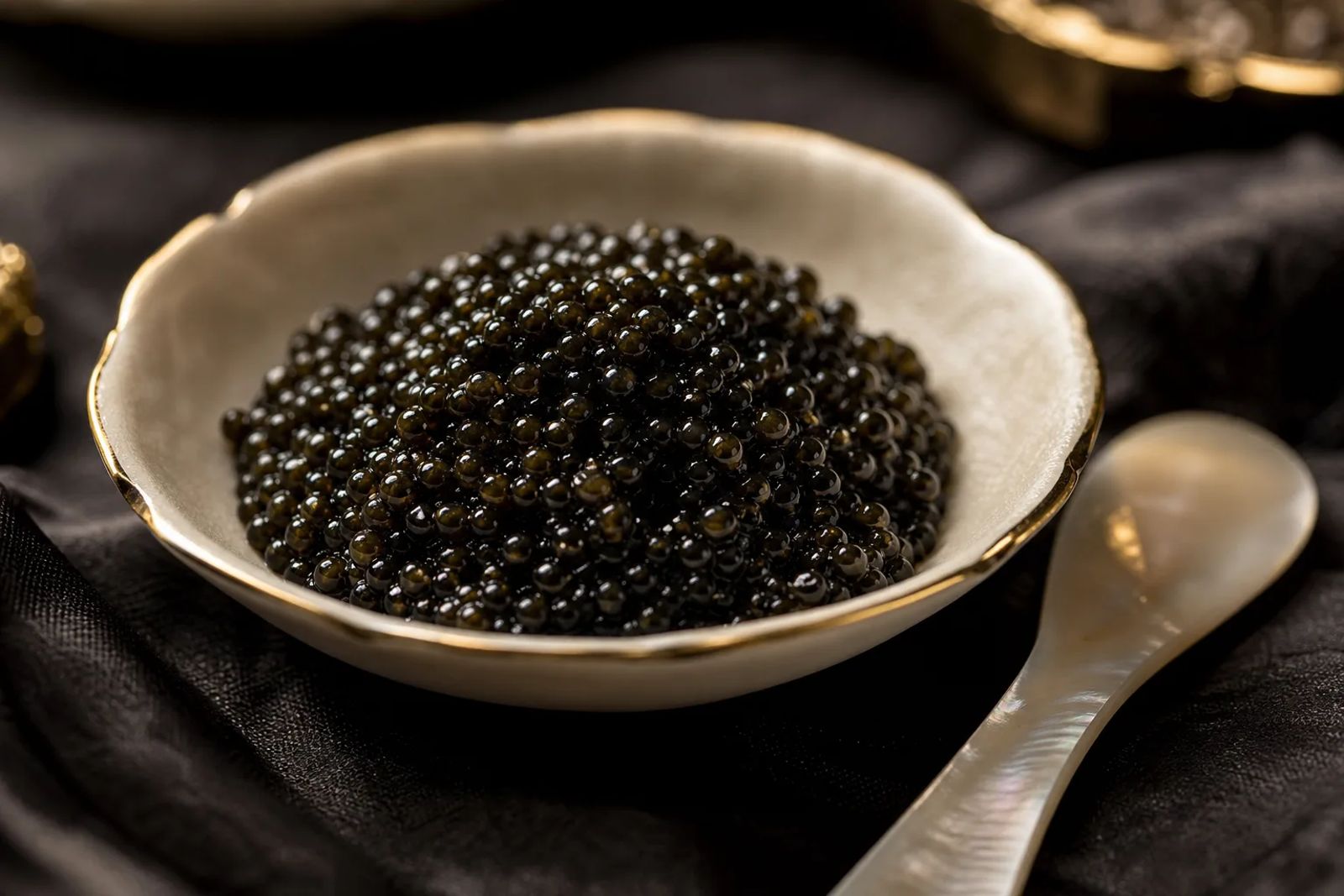
Dark brown or golden amber: Ossetra’s colour catches the eye, but cannot identify the species behind it. Research links inherited pigmentation differences to gold and black roe. Russian sturgeon, Acipenser gueldenstaedtii, produces this caviar, though Codex also recognises Ossetra from Persian sturgeon. “Golden” and “Imperial” are sellers’ selections, not separate species or universally defined grades.
Russian sturgeon fact box
| Field | Fact |
|---|---|
| Common and trade names | Russian sturgeon; Danube sturgeon; Ossetra, Oscietra, Osetra |
| Scientific name | Acipenser gueldenstaedtii; proposed 2025 combination: Huso gueldenstaedtii; historical synonyms not documented |
| CITES | Appendix II; species code GUE |
| IUCN status | Critically Endangered (2022) |
| Native range | Caspian, Black and Azov sea basins, including the Danube |
| Farm age at first harvest | Not documented for a specified farming system |
| Egg diameter | 3.2 to 3.8 mm; biological reference range, not a finished-product specification |
| Egg colour | Dark brown to golden amber; appearance alone cannot identify species |
| Documented farming countries | China, Italy, Poland, Bulgaria, Belgium; illustrative examples |
| Wild trade | Restricted; jurisdiction-specific rules below, checked November 2026 |
The farming countries listed are documented examples rather than a complete census of producers. The egg diameter comes from a university aquaculture reference describing eggs used to assess reproductive readiness. It is not a guaranteed measurement of the salted beads in a particular tin.
Which fish is Ossetra caviar?
Ossetra, Oscietra and Osetra are different spellings, not different qualities of caviar. They are associated with Russian осётр, meaning sturgeon. A molecular labelling study traces Osetra and Ossetra to that word and records Oscietra on products. None of these spellings identifies a species, origin or quality level.
Codex CXS 291-2010 explicitly associates Ossetra with both Acipenser gueldenstaedtii and Acipenser persicus. The shared name therefore has a place in an international food standard, although Codex does not automatically become binding national law. The disputed relationship between the two fishes is explored in Persian sturgeon and the Ossetra name and the Ossetra Name).
The scientific name has also been contested. Brownstein and Near proposed Huso gueldenstaedtii in 2025, without specialist endorsement. At their October 2025 workshop, the IUCN Sturgeon Specialist Group and World Sturgeon Conservation Society declined to support the revision, citing weaknesses in its evidence. This article retains Acipenser gueldenstaedtii, the CITES name used in trade documentation.
Danube and Russian stocks: one species
Danube sturgeon is Russian sturgeon with a geographical common name. It is not a separate caviar species. The fish’s native range spans the Caspian Sea, Black Sea and Sea of Azov and their rivers. Anadromous fish feed at sea, then enter freshwater to reproduce. In the Danube, spring migrants spawn that season; autumn migrants can overwinter before spawning.
Genetic studies reveal geographical population differences within the species. In 2009, researchers comparing Azov, Caspian and Black Sea populations with nuclear and mitochondrial markers found population structure. A 2014 comparison of mitochondrial control-region sequences across the basins did not support sharply separated evolutionary lineages and called for further nuclear-marker analysis.
These findings do not make the stocks interchangeable for conservation. The Iron Gates dams have cut the Danube population off from historical spawning habitat, and the Danube conservation programme describes its remaining abundance as very low. Caspian stocks are depleted too. The 2022 global reassessment reporting records the species as Critically Endangered.
Fishing bans and export restrictions operate separately. Romania introduced an indefinite prohibition on wild sturgeon fishing and selling wild sturgeon products in 2021. Bulgaria’s environment ministry reports an indefinite fishing ban effective from 1 January 2026. Check CITES export quotas for the relevant country, source and year alongside any domestic fishing restrictions.
A label is a traceability declaration, not independent proof of its contents.
Danube sturgeon conservation follows the river’s recovery work and continuing threats. Farming elsewhere does not demonstrate recovery of the original wild populations.
Size, maturity and farm production
Russian sturgeon can reach an imposing size. The Danube region’s migratory-fish reference gives figures of up to 2.4 m and 110 kg, with wild males maturing at 8 to 13 years and females at 12 to 16 years. These are regional biological reference figures, not a timetable for every fish or a prediction of its caviar.
On farms, the schedule can differ. Producer Antonius describes Russian sturgeon females taking 8 to 10 years to mature sufficiently for caviar production. Its account offers a production timescale, rather than a controlled comparison with wild fish. Published evidence does not establish a universal first-harvest age under specified water temperatures and husbandry conditions. For related fish, start with sturgeon species.
Why Ossetra colour, flavour and texture vary
Golden roe has a genetic story. A 2024 whole-genome study compared 62 Russian sturgeons producing gold or black caviar and identified candidate regions and genes associated with pigmentation. Dark brown, bronze and golden amber remain useful descriptions of what is on the spoon, rather than separate biological categories.
Individual variation matters more than the familiar claim that older fish always produce paler roe. The study does not establish that a particular feed, river or age inevitably produces golden eggs, nor does it allow a spoonful’s appearance to reveal the fish’s genotype, age or growing conditions. When comparing tins, record the colour itself. Do not use it as a shortcut to provenance.
Descriptions of flavour and texture belong to particular production and selection practices. Producer Acipenser describes its Ossetra as firm-grained and more tangy in flavour, with brown colour and golden highlights. That gives a concrete picture of its product; salting and processing also shape the caviar that reaches the spoon.
Golden and Imperial Ossetra
Imperial can tell you about a seller’s selection. It cannot tell you the species. Neither Golden nor Imperial is a species name or a legal grade established by Codex. Royal Caviar, for example, uses Imperial for a selection of particularly light, golden-brown Ossetra grains. Other sellers need not use the word in the same way.
The name can cross species boundaries altogether. Caspian Tradition describes its Imperial Gold as a Chinese hybrid of Kaluga, Huso dauricus, and Amur sturgeon, Acipenser schrenckii, rather than Russian sturgeon. It does not identify which is the male parent or the female parent. Ask separately for the species, colour selection, bead size and texture. Imperial alone answers none of those questions reliably.
Golden eggs do not establish that the parent fish was albino. The pigmentation study examined gold and black caviar populations; it did not establish a rule equating gold eggs with albino adults. See Imperial, Royal and Reserve trade names for help interpreting selection language, and request separate evidence whenever albinism is claimed.
What the label must show behind the word Ossetra
Start with the species code: GUE identifies Russian sturgeon; PER identifies Persian sturgeon. Under the CITES labelling convention, a hybrid carries two parental codes separated by x, with the male parent first and the female parent second. For a Russian and Siberian cross, establish that parental direction rather than inferring it from the order of names in a seller’s prose.
The non-reusable label also records source, country of origin, year, and registered plant and lot information. Repacked caviar has different fields. Pay particular attention to origin: the country where roe was repacked is not necessarily the country it came from. Use the CITES caviar code to read the fields, and Russian sturgeon hybrids when an Ossetra offering is explicitly a cross.
A label is a traceability declaration, not independent proof of its contents. In a study of 40 caviar products sold online in China, researchers using mitochondrial COI and cytochrome b sequencing found mismatches between some declared and detected identities. The methods traced maternal ancestry. They could not establish both parents of hybrids or reliably distinguish every closely related species in the Russian-sturgeon complex.
Import and naming rules in brief
In the EU, the Commission’s wildlife-trade guide describes non-reusable caviar labels for both domestic and international trade, implemented through Regulation (EC) No 865/2006. Wildlife permits and food naming are separate requirements. A code does not replace consumer information, and customs classification does not determine the retail name.
For entry into Great Britain, UK government guidance describes an exemption for up to 125 g of caviar per person, carried as a personal effect in individually marked containers bearing CITES labels. Check Northern Ireland’s rules separately. Its guidance also warns that posting caviar requires permits regardless of quantity. Food controls apply too; see caviar law.
In the US, 50 CFR 23.71 governs international trade in sturgeon and paddlefish caviar and its labels. The FDA’s nonbinding CPG 540.150 advises that unqualified caviar means salted sturgeon roe. Other roe should name the fish in the same type size as the word caviar. The guidance also addresses declarations of added artificial colour. Neither framework turns Golden or Imperial into a species identification.
Sources
-
FAO and WHO, Codex Alimentarius. Standard for Sturgeon Caviar, CXS 291-2010, adopted in 2010, amended in 2013, 2018, 2024 and 2026. Sections 2 and 7 distinguish product identity, usual names and hybrid naming.
-
European Commission. EU Wildlife Trade Reference Guide, Annex XIV: Caviar labelling, online edition, undated. Describes original and repackaging labels and references CITES Resolution Conf. 12.7 (Rev. CoP17), Annexes 1 and 2.
-
University of Florida, IFAS Extension. FA153, Sturgeon Aquaculture: Specialized Techniques, reviewed August 2025 according to the supplied sheet. The egg-size passage gives Russian sturgeon eggs as 3.2 to 3.8 mm.
-
EUMOFA, European Commission. The caviar market: production, trade, and consumption in and outside the EU, 2021 edition. Its species-by-country table corroborates Russian sturgeon farming in the four EU countries retained from the supplied overview sheet.
-
World Sturgeon Conservation Society, reporting the IUCN Sturgeon Specialist Group workshop. IUCN SSG summary report, 13 November 2025, reporting the meeting of 22 October 2025.
-
Timoshkina and colleagues, Genetika. Intraspecific genetic polymorphism of Russian sturgeon Acipencer gueldenstaedtii, 2009, volume 45, issue 9. English abstract describes nuclear and mitochondrial comparisons of three geographical populations.
-
Research article indexed by PubMed. Molecular analysis of phylogeographic subspecies in three Ponto-Caspian sturgeon species, 2014. Abstract reports the mitochondrial method, geographical comparison and limitations.
-
Danube Sturgeons conservation programme. Russian Sturgeon, undated species account. Covers migrations, former distribution, habitat obstruction and depleted abundance.
-
EU Strategy for the Danube Region, Water Quality Priority Area. Fish Migration, undated retrieved PDF. Russian sturgeon account gives size, wild maturity and migration information.
-
WWF Central and Eastern Europe. Conservation Success! Fishing for Wild Sturgeon and Selling Wild Sturgeon Products Banned Indefinitely in Romania, 2021 announcement.
-
Bulgarian Ministry of Environment and Water. An indefinite national ban on fishing for sturgeon species has been introduced in the Bulgarian section of the Danube River and the Black Sea, 10 December 2025. States an effective date of 1 January 2026.
-
CITES Secretariat. Export quotas, 2026 listings. Retrieved results include Appendix II Russian sturgeon and a zero quota for wild Caspian caviar.
-
Antonius Caviar. Antonius Caviar_Start_ENG_PL.pdf, undated producer brochure hosted by a trade-show organiser. Provides the attributed farm-maturity account.
-
Aquaculture, research article. Whole-genome resequencing of Russian sturgeon (Acipenser gueldenstaedtii) reveals selection signatures associated with caviar color, volume 582, 15 March 2024, article 740545.
-
Acipenser, producer statement. Company website, undated. Its Ossetra description supplies the attributed colour, texture and flavour language.
-
Royal Caviar, seller statement. Caviar types, undated. The Imperial subsection describes selection of light, golden-brown grains.
-
Caspian Tradition. Imperial Gold, undated seller description of hybrid parent species, claimed origin and selection;
-
Zhang and colleagues, Food Control, January 2022, volume 131, article 108370, DOI 10.1016/j.foodcont.2021.108370. Forty product survey and molecular labelling assessment.
-
UK Government. Check if you need a CITES permit to import or export endangered species, current online guidance. Includes the individually marked, personal-luggage caviar exemption.
-
Department of Agriculture, Environment and Rural Affairs, Northern Ireland. Summary of personal food import restrictions, current online guidance. Includes caviar carried personally and sent by post.
-
United States, Electronic Code of Federal Regulations. 50 CFR 23.71: How can I trade internationally in sturgeon caviar?, current online edition. Covers international trade, labels, parental-code order and repacking.
-
US Food and Drug Administration. CPG Sec 540.150: Caviar, Use of Term, Labeling, October 1989 guidance, current retrieved page.
The article was researched against official standards and guidance, population-genetics research, conservation reports and explicitly attributed producer descriptions, with the supplied overview sheet retained for its covered fields.
Last checked: November 2026