
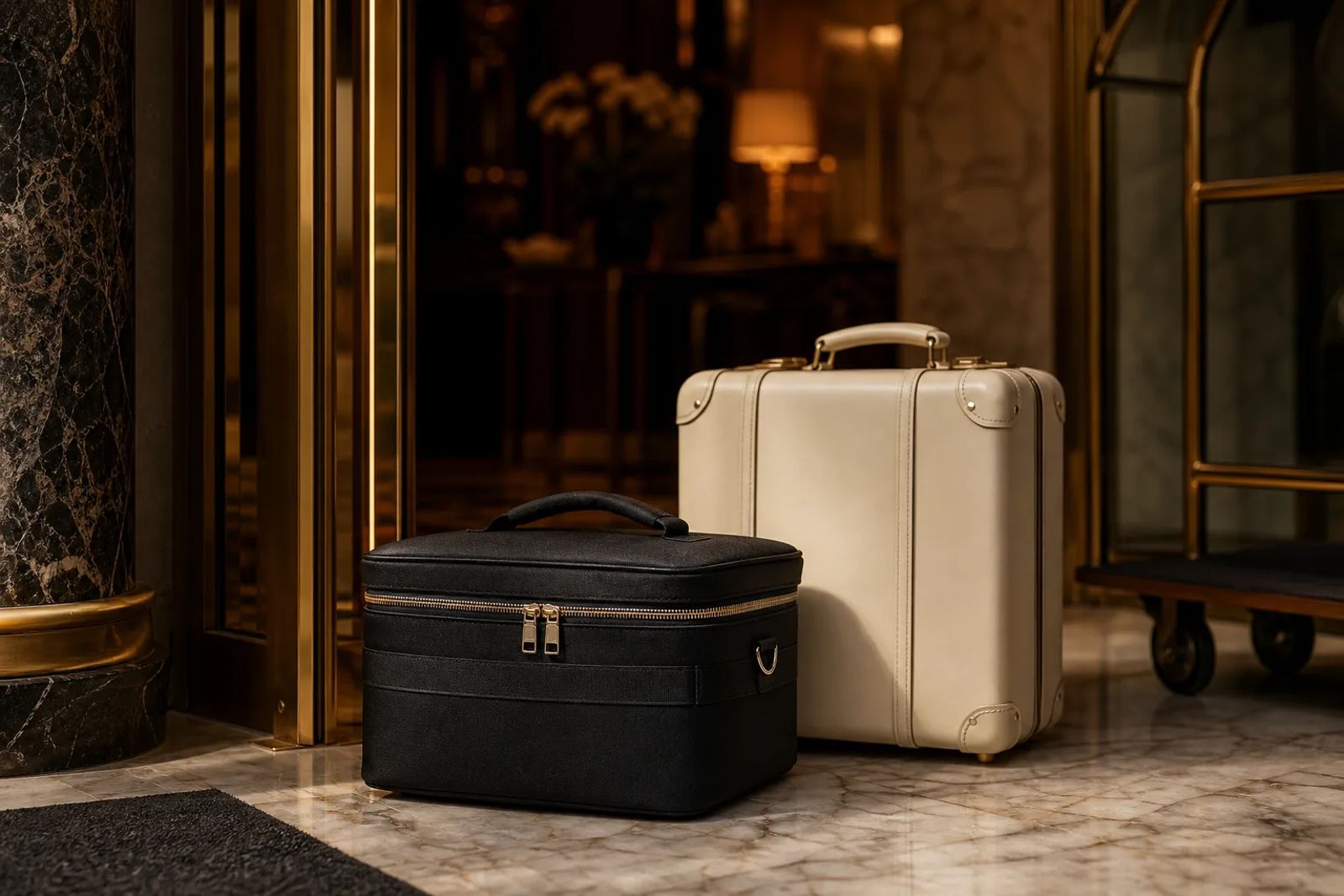
A tin of caviar has to stay cold through queues, transfers and the final drive, while clearing three separate checks: airport security, wildlife trade rules and food import rules. Passing one does not settle the others.
Keep it continuously chilled, in its original sealed container inside an insulated bag or box. Follow its labelled storage temperature and check every border and security checkpoint before departure.
- Keep labels readable and receipts accessible. A CITES label supports traceability; it does not verify the contents.
- Check that security will accept your cooling packs as well as your caviar.
- Plan cold protection for transfers, queues and the final drive, not just the flight.
Pack it cold: a numbered method
Start with the producer's storage instructions. For caviar labelled for chilled storage, a practical target is 2°C to 4°C (36°F to 39°F), unless the label specifies otherwise.
Codex CXS 291-2010 gives that same range for packaging, storage and retail, with a separate wholesale storage and transport range of -4°C to 0°C (25°F to 32°F). These are international reference provisions, not a universal household transport law.
- Chill before packing. Transfer already refrigerated caviar into a pre-cooled insulated bag or rigid cool box just before leaving. Insulation slows warming; it cannot be relied upon to chill a warm tin.
- Keep the original seal. Leave the container unopened, protect it from crushing and stand it upright inside a leakproof outer bag. Keep the original food and CITES labels attached and visible for inspection.
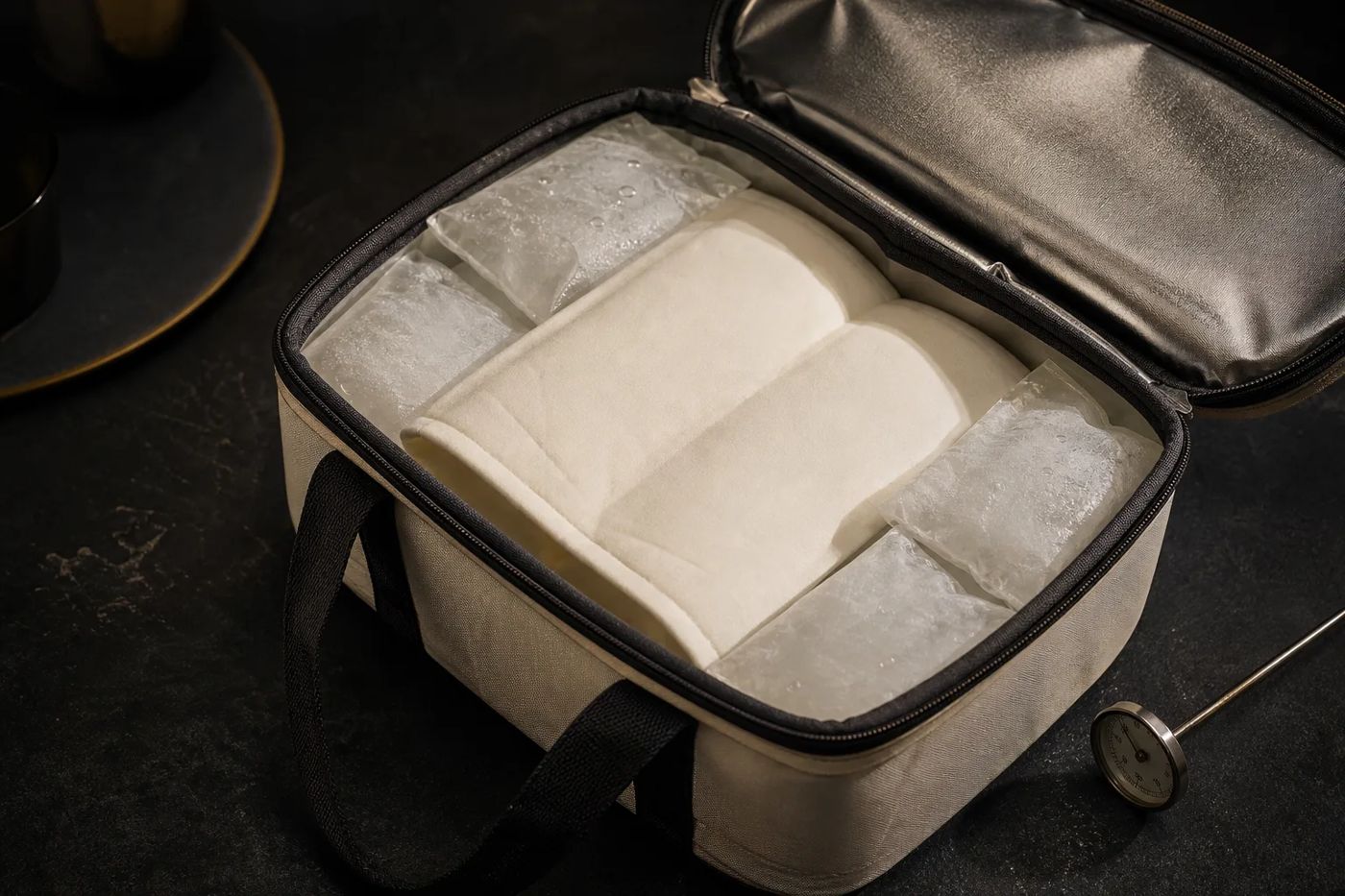
- Surround it with coolant. Arrange ice or frozen gel packs around the contents, not only underneath. Before flying, establish which coolant the departure airport, transfer airports and airline will accept.
- Prevent freezing. Where necessary, put a thin insulating separator between the tin and very cold packs. Do not freeze chilled caviar to make transport easier.
- Measure the temperature. Place a thermometer beside the unopened caviar. Check against the practical target above, or the producer's range where its instructions differ.
- Close and protect. Fill empty space so the contents cannot slide. Keep the bag shaded and open it sparingly. Pack drinks separately if you will reach for them repeatedly.
See storing caviar for the broader principles. This method applies chilled-food guidance; it is not a tested guarantee of any particular bag's performance.
Airport security: the tin and the coolant
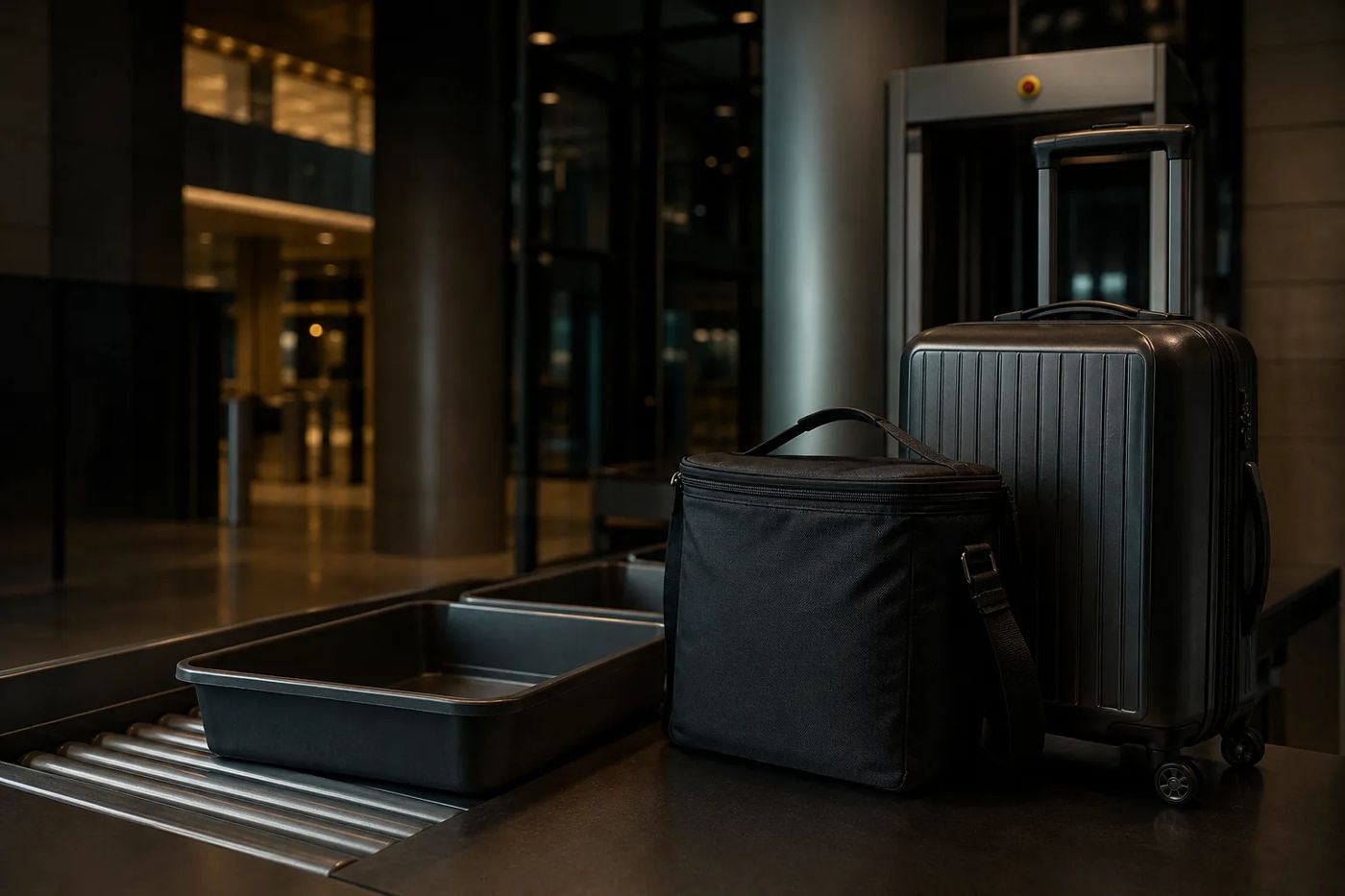
Visible eggs do not automatically make caviar a solid food at security. There is no consistent caviar-specific classification. Ask the departure airport about the unopened product, its container capacity and its coolant, and check any transfer screening too.
Keep the two key allowances separate: a 100 ml security container limit is not a 100 g food allowance, and neither is the 125 g wildlife allowance. Never decant caviar into an unlabelled container to meet either rule.
UK Department for Transport guidance says liquid rules now vary by airport, and frozen food or ice packs cannot usually pass in hand luggage. The US takes a different approach. FAA guidance, referring to TSA screening, says liquid or gel packs above 100 ml must be frozen solid at screening. Partially thawed packs do not qualify for that exception.
Hand luggage gives you more control when security and the airline accept the complete packing arrangement. Checked baggage removes some cabin liquid restrictions, but the hold is not a refrigerator. Pack for handling, delays and the entire journey rather than counting on cold air outside the aircraft.
Dry ice is not the default
Dry ice brings a freezing risk that chilled caviar does not need. An accepted gel-pack arrangement is the safer choice; obtain approval before choosing dry ice.
IATA's 2026 table and current US FAA guidance describe an allowance of up to 2.5 kg (5.5 lb) of dry ice per person for qualifying perishables. Airline approval is required, and the packaging must release carbon dioxide. Checked packages must identify the dry ice and its quantity. Never seal dry ice inside an airtight cooler.
Airlines can impose further conditions. Delta requires the package to state the contents being cooled and prohibits wet-ice shipments in passenger baggage.
Border checks: what the personal allowance covers
The CITES personal effects exemption can cover up to 125 g per person of Appendix II caviar where it has been adopted nationally. The caviar must travel with the person, in individually marked containers bearing CITES labels.
That exemption does not cover Appendix I species, commercial consignments or ordinary online orders arriving by courier. Food import restrictions still apply. Read when the 125 g exemption applies before relying on it.
Beluga needs particular attention. In September and October 2005, the US suspended permit exempt trade in beluga sturgeon caviar originating in the Caspian and Black Sea basins. According to USFWS, beluga caviar cannot currently be imported into or exported from the United States in any quantity, including as personal effects. The special rule contains specific exceptions, but the personal allowance alone does not authorise import. See the US beluga rule.
Wildlife rules govern the caviar's trade status, food rules govern its admissibility, and airport security governs what can pass screening. Check each separately: a CITES allowance does not override a food restriction or clear a gel pack for the cabin.
Visible eggs do not automatically make caviar a solid food at security.
The table summarises personal use, not commercial import permissions. Where an entry calls for a check because no current official answer was found, obtain confirmation rather than assuming there are no restrictions.
| Where | Personal baggage rule | Authority | Checked |
|---|---|---|---|
| EU | Conditional 125 g CITES exemption. Most third-country fishery products: 20 kg limit. Confirm gel screening with the departure airport. | European Commission; Regulations 865/2006 and 2019/2122 | November 2026 |
| Great Britain | Fishery products from most non-EU countries: up to 20 kg per person, subject to applicable restrictions. GOV.UK CITES guidance allows 125 g per person in individually marked containers, but its food import page says caviar needs a CITES permit. Check both, plus stricter species controls and destination requirements. Airport liquid limits vary. | GOV.UK | November 2026 |
| Northern Ireland | Separate food import arrangements apply. DAERA lists up to 20 kg of fishery products per person arriving from non-EU countries. Appropriately labelled, eligible sturgeon caviar may qualify for the separate 125 g CITES personal effects exemption. Check the route, species restrictions and airport security. | GOV.UK directs travellers to separate NI guidance | November 2026 |
| US | Conditional 125 g exemption. Most personal seafood is admissible, subject to wildlife and origin restrictions. The frozen-pack screening rule above applies. | USFWS; CBP; FAA | November 2026 |
| Switzerland | Up to 125 g of qualifying caviar per person without a CITES permit, in unopened containers carried as personal effects. Allowances cannot be combined for one larger container. Generally 20 kg of fishery products or one whole fish from other third countries. Standard liquids limit: 100 ml; Zurich has airport-specific changes. | FSVO; FOCA | November 2026 |
| UAE | Confirm the personal caviar exemption and fish limit with MOCCAE. Dubai Airports limits liquid-rich foods and gels to 100 ml containers within the liquids allowance. | MOCCAE; Dubai Airports | November 2026 |
| China | Customs prohibits carried aquatic animal products except specified dried, cooked or fermented products. Do not assume chilled caviar qualifies. International liquids: 100 ml; domestic rules are stricter. Confirm the CITES exemption with China Customs. | Shanghai Customs; CAAC | November 2026 |
| Japan | METI documents a 125 g Appendix II personal-use caviar exemption. Confirm the current fish-product limit and gel-pack screening with the authorities. | METI, 2019 notice | November 2026 |
| Russia | Confirm the CITES personal allowance, fish-product limit and gel-pack screening with the Russian authorities before packing. | Russian customs authority | November 2026 |
| Australia | Conditional labelled 125 g exemption. Declare food and check caviar-specific biosecurity conditions in BICON. Confirm gel screening with the airport. | DCCEEW; DAFF | November 2026 |
Declare caviar wherever the arrival form asks about food, animal products or wildlife. Present permits when required, and keep receipts, origin information and documents within reach. Declaring a prohibited product does not make it admissible.
For unresolved routes, consult country-by-country customs rules before booking transport.
Long journeys and road trips
Plan around temperature, not a promised number of hours. No authority guidance gives a universal time that caviar will last in an insulated bag. It must stay within its required range throughout the journey. Allow for missed connections, and arrange replacement coolant or dependable refrigeration before setting off.
USDA's general consumer guidance says to discard perishable food left at room temperature for more than two hours, or one hour when the surroundings exceed 32°C (90°F). Treat this as an outer safety limit, not a caviar travel window. A colder product label still governs storage.
For a road trip, a car fridge can provide active cooling. Check its actual temperature with a thermometer rather than trusting the display alone. Pre-cool it, secure it according to its instructions and establish whether it stays powered when the engine stops. Have an insulated backup ready for stops.
Keep the cooler shaded and away from heat sources. Do not leave it in a parked car while you eat or explore. If the plan depends on a hotel fridge, confirm suitable refrigeration in advance: a minibar cannot simply be assumed to hold the labelled range.
On arrival, refrigerate first
The caviar goes into the fridge before the rest of the luggage is unpacked. Make sure the fridge operates within the producer's stated range. If you have monitored the journey, record the arrival temperature, and retain the original use-by date. Transport does not restart shelf life.
A cold reading at the destination cannot tell you what happened during an unknown warm interval. If refrigeration failed beyond the applicable safety guidance, discard the caviar. Do not taste it to decide. An intact seal, pleasant smell or normal appearance cannot establish safety.
Follow home storage guidance for fridge placement and handling after arrival. If the journey cannot reliably maintain the cold chain, arrange specialist chilled delivery instead, using the checks in safe online caviar delivery.
Sources
- FAO and WHO, Codex Alimentarius. Standard for Sturgeon Caviar, CXS 291-2010, section 2.3, retrieved November 2026.
- Food Standards Agency. Keeping food safe on a picnic, live guidance, retrieved 2026. Official PDF.
- Food Standards Agency. Camping food safety, 20 July 2020. Guidance.
- US Department of Agriculture, Food Safety and Inspection Service. Is it safe to consume perishable food that has been left out at room temperature?, live knowledge article, retrieved 2026. Guidance.
- UK Department for Transport. Hand luggage restrictions at UK airports: Overview, live guidance, retrieved 2026. Guidance.
- US Federal Aviation Administration. PackSafe: Dry Ice, updated 25 January 2024, live page retrieved 2026. Guidance.
- International Air Transport Association. Dangerous Goods Regulations, 62nd edition, Table 2.3.A, 2021. This retrieved edition is historical; the dry-ice conditions were also checked against the live FAA guidance. Passenger baggage table.
- Delta Air Lines. Baggage restrictions and restricted items, “Dry & Wet Ice”, live policy, retrieved 2026. Airline policy.
- European Commission. EU Wildlife Trade Reference Guide, section 4.4.2, personal and household effects, live edition retrieved 2026. Reference guide.
- European Commission. Personal imports, live guidance identifying Commission Delegated Regulation (EU) 2019/2122 as the applicable instrument, retrieved 2026. Guidance.
- UK Government. Bringing food into Great Britain: Meat, dairy, fish and animal products and Overview, live guidance retrieved 2026. Food restrictions; territorial scope.
- UK Government. Check if you need a CITES permit to import or export endangered species, live guidance retrieved 2026. CITES guidance.
- US Fish and Wildlife Service. Personal Effects Exemption for Caviar, notice dated 12 September 2008; and Caviar & Passengers, undated fact sheet. Notice; passenger fact sheet.
- US Customs and Border Protection. Importing Seafood, article 000001110, published 6 April 2026. Guidance.
- United States, Code of Federal Regulations. 50 CFR 17.44(y), beluga sturgeon special rule, live text reproduced by Cornell Legal Information Institute, retrieved 2026. Regulation.
- Swiss Federal Food Safety and Veterinary Office. Lebensmittel im privaten Reiseverkehr, live guidance retrieved 2026. Personal food imports.
- Swiss Federal Office of Civil Aviation. Liquids, live guidance including the Zurich Airport change effective 26 June 2026. Security guidance.
- UAE Ministry of Climate Change and Environment. Digital Services User Guide: Import of a species listed in CITES Appendices, undated edition retrieved 2026, page 21. Official guide.
- Dubai Airports. Departures prohibited items: DWC, live airport guidance retrieved 2026. Security table.
- Shanghai Municipal Government, information attributed to Shanghai Customs. Can I bring pet food to China?, 27 April 2026, containing the prohibited carried and mailed animal-products list. Customs information.
- Civil Aviation Administration of China. 航空旅行常识, aviation travel guidance, 16 March 2023, live page retrieved 2026. Official guidance.
- Japan Ministry of Economy, Trade and Industry. Import Notice 2019 No. 26, amendment concerning Appendix II caviar, 2019. Official notice.
- Australian Department of Climate Change, Energy, the Environment and Water. Travellers and online shoppers, live guidance retrieved 2026. Wildlife-trade guidance.
- Australian Department of Agriculture, Fisheries and Forestry. Bringing or mailing goods to Australia, live guidance retrieved 2026. Biosecurity guidance.
This piece was researched from official food-safety, aviation, customs and wildlife-trade sources, with an airline policy used to illustrate carrier-specific conditions.
Last checked: November 2026