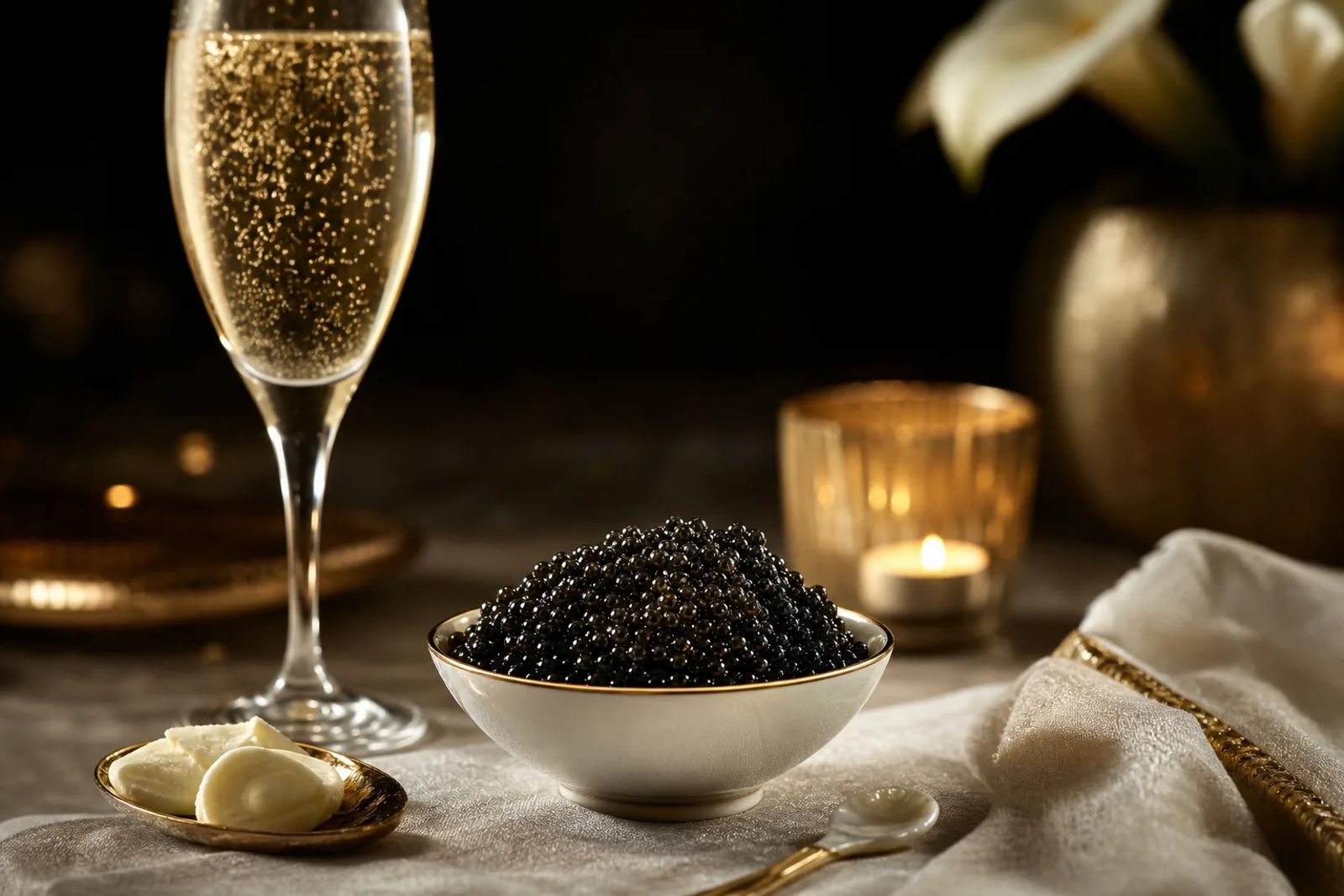
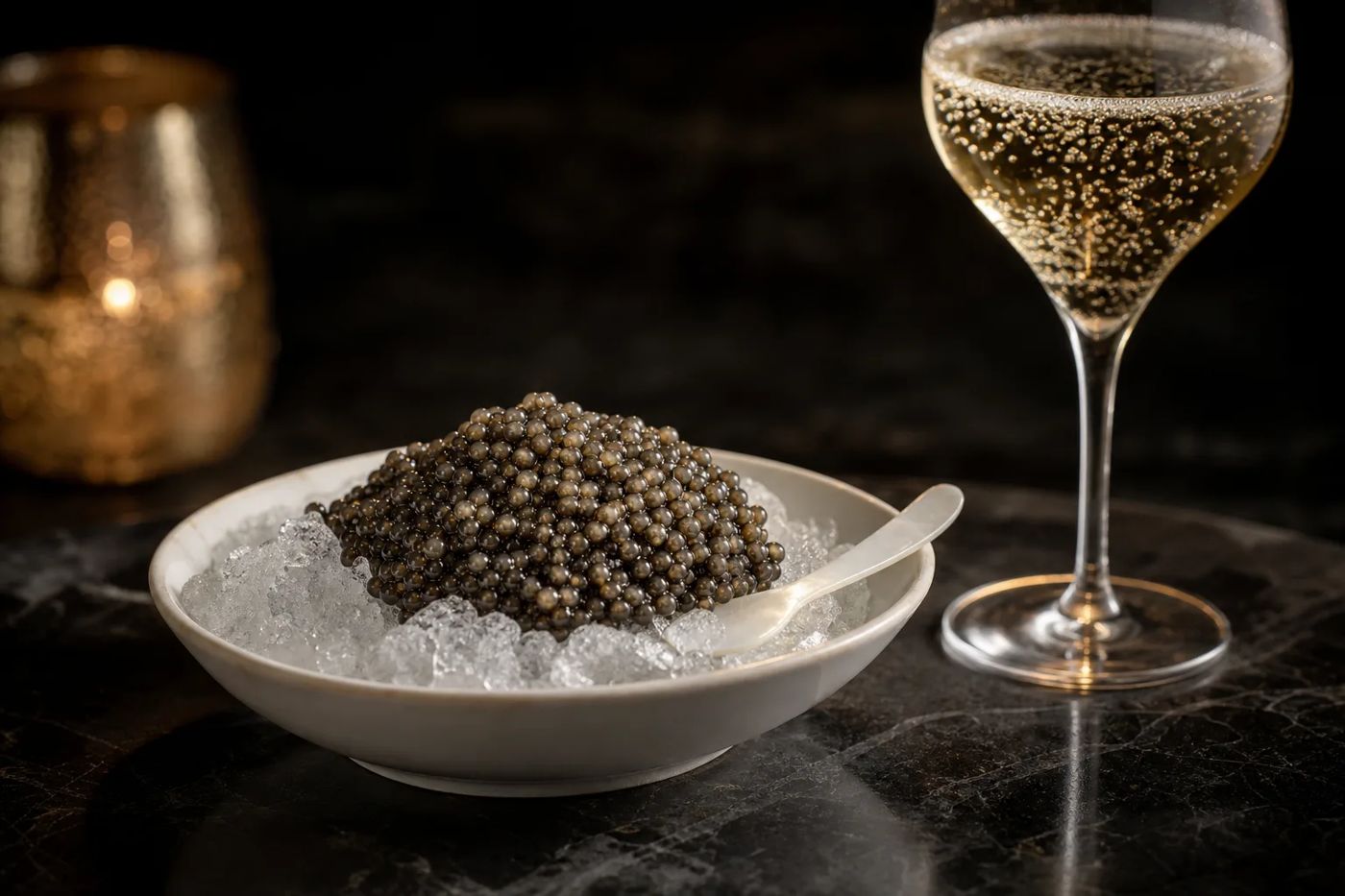
Briny richness, crisp acidity, delicate bubbles: sommelier Perrine Prieur, quoted in Veranda, captures the appeal of caviar with blanc de blancs. The pleasure lies in the contrast. Salted roe meets a fresh, sparkling wine, with neither trying to taste like the other.
For a first pairing, choose a brut blanc de blancs or another dry traditional method sparkling wine. Then let the accompaniments, and your preference for crisp or richer styles, guide the next bottle.
- Extra dry is sweeter than brut under EU sparkling wine labelling rules.
- Blanc de blancs describes the grapes, not the sugar content.
- Chill the wine separately from the caviar: they do not share a serving temperature.
Why caviar and Champagne work together
Salt changes the way wine tastes. WSET, the Wine & Spirit Education Trust, explains that it can make wine seem sweeter and soften its perceived acidity or bitterness. A sparkling wine that tastes sharply acidic on its own may feel gentler after a salty mouthful of caviar.
The bubbles bring another kind of contrast: a lively texture alongside the roe's richness. Prieur's recommendation puts freshness at the centre of the pairing, rather than asking the wine to reproduce the caviar's flavour.
“Cutting through fat” and “cleansing the palate” are shorthand for that drinking experience. They do not describe a demonstrated removal of oil or a resetting of taste receptors. The useful test is simpler: alternate caviar and wine, and notice whether both retain their character.
Dry Champagne is a good starting point, not the only possible pleasure. WSET explicitly includes sweet wine with salty food among contrasting pairings. Sweetness and salt can coexist; the way salt affects wine does not establish one ideal match for every caviar.
Read the sweetness term first
“Extra dry” is sweeter than brut. That is the label distinction most worth remembering before choosing a bottle.
For sparkling wine labels in the EU and Northern Ireland, Commission Delegated Regulation (EU) 2019/33, Article 47 and Annex III, Part A, define sweetness terms by sugar content. Great Britain has its own version of the regulation; check its current text. These are legal category descriptions, rather than measurements for an individual bottle.
- Brut nature: less than 3 g of sugar per litre, with no sugar added after secondary fermentation.
- Extra brut: 0 to 6 g per litre.
- Brut: less than 12 g per litre.
- Extra dry: 12 to 17 g per litre.
- Sec: 17 to 32 g per litre.
- Demi-sec: 32 to 50 g per litre.
- Doux: more than 50 g per litre.
Article 47 allows a tolerance of up to 3 g per litre between the indicated and measured sugar content, and requires one term where two categories could apply. The ranges therefore overlap: brut is not legally defined as starting at 6 g per litre.
Nor does “brut nature” necessarily mean sugar-free. Ask for the sweetness category alongside the wine's style. Blanc de blancs can carry different sweetness terms, so those words alone will not tell you how dry the wine is.
Which styles do the experts recommend?
A crisp blanc de blancs is the clearest starting point in the expert recommendations. Blanc de blancs means white wine made from white grapes; in Champagne, Chardonnay is the familiar example.
Keep grape style, age and sweetness separate when reading a label. Non-vintage refers to a wine without a single harvest year on the label, while vintage Champagne carries a year. Neither term is a sweetness category.
The recommendations offer two directions to explore: freshness that contrasts with the caviar, or a more developed wine with enough flavour to hold its own alongside it.
| Style | Sweetness category | Recommendation | Source |
|---|---|---|---|
| Blanc de blancs | Brut | Crisp acidity and delicate bubbles with briny richness | Perrine Prieur, in Veranda |
| Vintage blanc de blancs | Brut | For caviar served plain | Comité Champagne, Champagne from cellar to table |
| Young, crisp blanc de blancs | Not specified | A partner for caviar | Union des Maisons de Champagne |
More weight does not necessarily make a better match. The Union des Maisons de Champagne also considers a young, robust, Pinot-led wine, but finds the combination less successful in practice than in theory.
Sommelier Cara Patricia, interviewed by Wine Enthusiast, warns that full body, excessive oak or tannin can work badly with caviar. With white sturgeon caviar specifically, she avoids strong brioche and new-oak flavours that could overwhelm it. Her concern is the balance of that pairing, rather than mature Champagne as a whole.
Begin with a fresh brut rather than a strongly oak-marked wine. If older Champagne appeals, explore its developed character for its own sake: age alone does not promise a better match.
Champagne and other traditional method sparkling wines
Champagne is a protected designation of origin in the EU, not a generic name for sparkling wine. It must meet its geographical and production specification. Regulation (EU) 2024/1143, notably Article 26, protects registered geographical indications against misuse, imitation and evocation.
In Great Britain, Champagne appears on the UK protected wine names register, under the wine GI scheme based on assimilated Regulation (EU) No 1308/2013, as amended. Northern Ireland uses the EU GI system, so the legal framework differs across the UK.
The US retains a limited exception for certain pre-existing uses. Under 26 USC 5388(c), alongside 27 CFR 4.24, qualifying grandfathered labels may still use “Champagne” for non-French wine. Conditions include an appropriate true-origin indication and qualifying label approval before 10 March 2006.
A sparkling wine that tastes sharply acidic on its own may feel gentler after a salty mouthful of caviar.
There is plenty to explore beyond Champagne. French crémant, Spanish cava, Italian Franciacorta and Trento DOC, and traditional method English sparkling wine are separate options, not alternative names for it. They undergo their second fermentation in the bottle, the method WSET describes for Champagne and several other regions.
Choose among them by asking for brut, or your preferred sweetness category, and a fresh, restrained style. The shared method does not guarantee identical flavour. Taste each bottle with the caviar rather than expecting every wine from a region to behave alike.
Serve the wine well, keep the caviar cold
Serve Champagne at 8 to 10°C (46 to 50°F), the range recommended by Comité Champagne. Its service fact sheet suggests 30 minutes in a bucket containing water and ice, or a few hours in the refrigerator. Check the temperature: the clock is a guide, not a guarantee.
Keep the caviar on its own cold timetable. The wine's serving range is not a caviar storage or serving instruction. Refrigerate the roe according to its producer's validated directions until needed, then use a separate chilled service arrangement. Do not warm it to match the glass.
Comité Champagne recommends a tulip-shaped glass, widening in the middle and narrowing towards the rim. See glassware for both drinks. Pour modestly, leaving room to assess the wine's aroma as well as its bubbles.
Taste the caviar plain first. Then try it with any blini, toast or crème fraîche you intend to serve, changing one thing at a time. This makes the pairing easier to judge: does the wine suit the roe itself, or mainly what accompanies it?
For the food side of the table, classic caviar service covers the Russian and French approaches. To explore beyond sparkling wine, turn to white wine with caviar, or compare the wider choices in drinks with caviar.
Alcohol and pregnancy
Alcohol is optional. A pairing tradition is no reason to start drinking, and an alcohol-free choice deserves the same consideration as the food.
The UK Chief Medical Officers advise that, if you are pregnant or could become pregnant, the safest approach is not to drink alcohol at all. The US Dietary Guidelines for Americans, 2025 to 2030, also advise pregnant women to avoid alcohol completely.
Speak to a doctor or midwife about personal questions concerning pregnancy and alcohol. Offer an alcohol-free choice without asking anyone to explain their decision, and explore non-alcoholic pairings for ideas.
Sources
-
Veranda. How to Pair Wine and Caviar the Right Way, According to Sommeliers. 5 November 2025. Named expert testimony, including Perrine Prieur's recommendation of brut and blanc de blancs. Article.
-
Wine & Spirit Education Trust. Winter wine and food matching. 21 December 2020. Explains salt's effects on perceived sweetness, acidity and bitterness, including contrasting pairings with sweet wines. Article.
-
European Commission. Commission Delegated Regulation (EU) 2019/33, Article 47 and Annex III, Part A. Original Official Journal edition, 2019, retrieved through the UK legislation archive. Provides the sparkling wine sweetness categories and associated conditions. Official text.
-
Comité Champagne. Champagne from cellar to table. Undated English edition, online copy retrieved November 2026. Its food-pairing table recommends vintage brut blanc de blancs for caviar served plain. Guide.
-
Union des Maisons de Champagne. Bringing out the flavours in food. Undated online edition, retrieved November 2026. The caviar section recommends young, crisp blanc de blancs and questions the practical success of a robust, Pinot-led alternative. Article.
-
Wine Enthusiast, Amy Sherman. Beyond Bubbles: What to Drink with Caviar. Published 12 December 2019, checked November 2026. Includes sommelier Cara Patricia's advice about weight, oak, tannin and white sturgeon caviar. Article.
-
Comité Champagne. Foire aux questions. Undated online edition, retrieved November 2026. Includes the definition of blanc de blancs and the recommended wine serving temperature. FAQ.
-
European Parliament and Council. Regulation (EU) 2024/1143 on geographical indications for wine, spirit drinks and agricultural products. EUR-Lex indexed consolidation dated 18 March 2026. See the editorial verification flag below concerning access to the full consolidated text. EUR-Lex record. European Union Intellectual Property Office. Trade mark guidelines, version 1.3, 1 May 2025, identifies Article 26(1)(b) as the current evocation provision. Guidelines.
-
Department for Environment, Food & Rural Affairs. Champagne, protected wine name register entry, published 2021; Protected geographical food and drink names: UK GI schemes, live guidance; and UK Geographical Indications Scheme: Appeals that can be made to the First-tier Tribunal, 2021. Online versions retrieved November 2026. These document Champagne's registration, the territorial schemes and the underlying wine legislation. Register entry, scheme guidance, legislative framework.
-
United States Congress. 26 USC 5388: Designation of wines, preliminary online edition, 2026. Alcohol and Tobacco Tax and Trade Bureau. 27 CFR 4.24, current eCFR edition retrieved November 2026; Industry Circular 2006-1, 10 March 2006; and TTB Ruling 2008-1, 24 January 2008. The statute and later ruling establish the grandfathering position beyond the circular's original prospective wording. Statute, regulation, circular, ruling.
-
Wine & Spirit Education Trust. Sparkling wine styles explained: traditional, tank and pét-nat. Online edition, 2026. Describes bottle fermentation and traditional method regions, including crémant, cava, Franciacorta, Trento DOC and England. Article.
-
Comité Champagne. Serving Champagne. Undated service fact sheet, online copy retrieved November 2026. Gives 8 to 10°C, chilling methods and glass shape. Fact sheet.
-
UK Chief Medical Officers, Department of Health. UK Chief Medical Officers' Low Risk Drinking Guidelines. 2016 edition, pregnancy section. Guidelines.
-
US Department of Agriculture and US Department of Health and Human Services. Dietary Guidelines for Americans, 2025 to 2030. 2026 edition, page 5, “Limit Alcoholic Beverages”. Guidelines.
This piece was researched through official wine guidance, legislation and national health guidance, with pairing recommendations distinguished from evidence about taste perception; no first-hand tasting is claimed.
Last checked: November 2026