
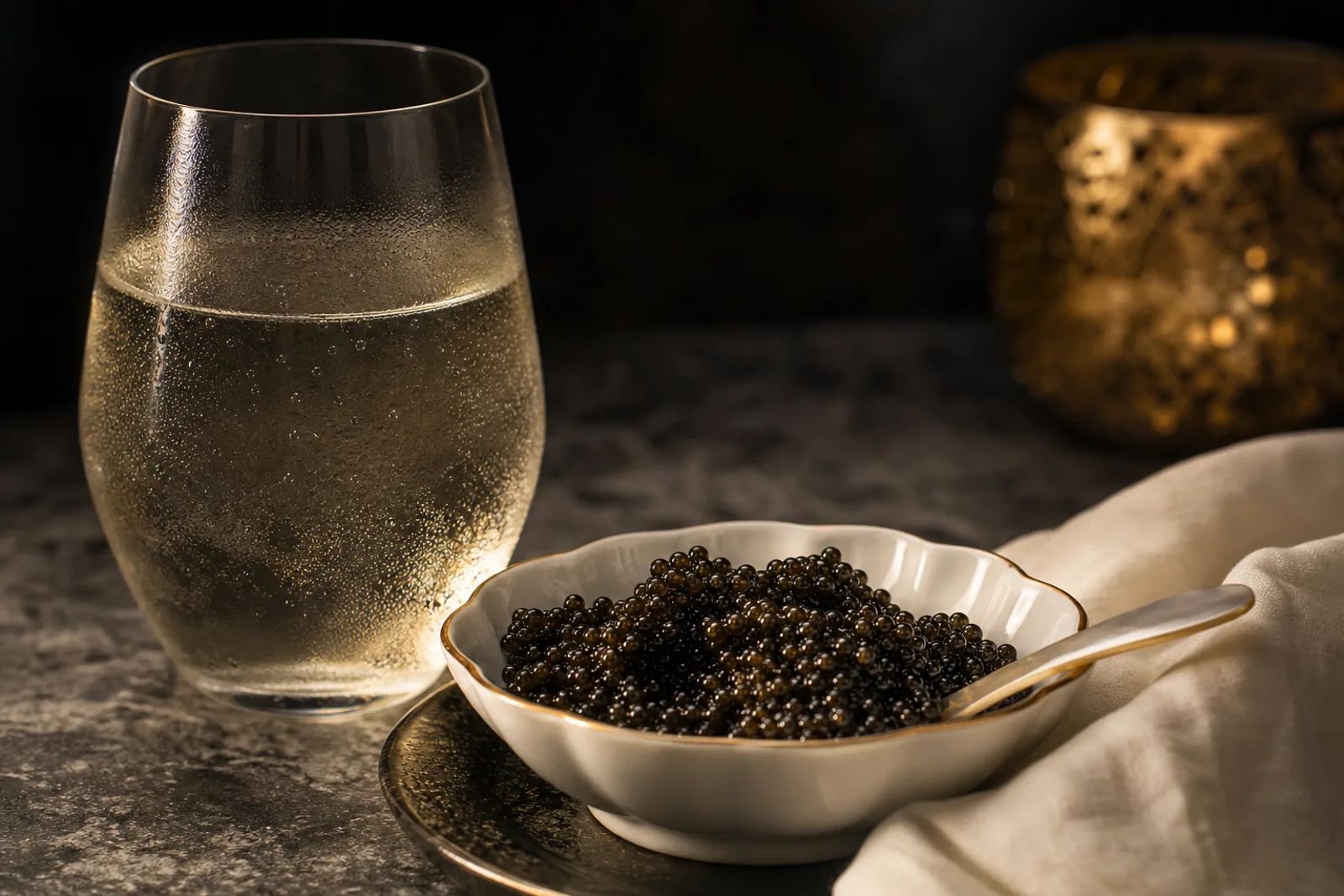
Chilled, lightly effervescent junmai daiginjo with caviar: that was the aperitif suggestion from Iori Kataoka, sake specialist and co-owner of Yuwa in Vancouver, in a 2023 Michelin Guide interview. It is an inviting starting point. The task is to find a sake that lets the roe hold your attention, rather than a bottle whose perfume takes over.
Choose by aroma, weight and serving temperature. The rice-polishing percentage tells you how the sake was made, not how well it will pair.
What sake is, and what its names mean
Sake is brewed, not distilled. In the brewing mash, koji, rice cultivated with a mould that supplies enzymes, converts rice starch into sugar while yeast ferments that sugar into alcohol. The two processes happen alongside one another.
The Japanese National Tax Agency's Labelling Standards for the Manufacturing Process and Quality of Sake, Notice No. 8 of 1989, govern the special designations below. The current published Japanese text lists amendments through June 2019. These names describe production and quality categories, rather than prescribing what to drink with caviar.
Start with seimai-buai, the rice-polishing ratio. It gives the weight of polished rice remaining as a percentage of the original brown-rice weight. At 60%, therefore, 60% remains; it does not mean 60% has been removed. Junmai means no added brewer's alcohol, not alcohol-free.
Ginjo requires rice polished to 60% or less and ginjo brewing; daiginjo requires 50% or less. Junmai ginjo and junmai daiginjo combine those requirements with no added brewer's alcohol. Honjozo permits brewer's alcohol and requires 70% or less. Plain junmai has no prescribed polishing threshold.
The remaining special designations, tokubetsu junmai and tokubetsu honjozo, require particularly good flavour and appearance explained through objective production details. When polishing is the stated explanation, 60% or less is required. Every special-designation sake requires at least 15% koji rice. Permitted added alcohol is limited too: for these categories, it cannot exceed 10% of polished-rice weight, calculated as alcohol at 95% strength.
The protected name is Japanese Sake
Nihonshu/Japanese Sake is Japan's geographical indication, or GI. The generic word sake is not.
Designated in December 2015, the GI covers qualifying sake produced in Japan using rice grown in Japan and rice koji made from rice grown in Japan. The NTA's specification also requires water collected in Japan. As of November 2026, the NTA lists protection in the EU, UK, India and, for labels, the US.
The designation establishes geographical origin, not suitability for a particular roe. Japanese sake does not require Japanese caviar either: their origins are separate choices. For the producing country rather than the pairing, see Japanese caviar.
Why caviar and sake can work together
Low acidity, umami and a smooth mouthfeel give sake its flexibility at the table. WSET's May 2025 guide, based on educator Natsuki Kikuya's teaching, identifies these qualities and explicitly includes caviar among the foods sake can accompany.
Umami means savouriness. Here, the appeal lies in supporting flavour and texture, rather than delivering wine's sharper refreshment. Balance is the useful test: after a sip, the roe should still be recognisable, its finish intact.
Kikuya cautions against claiming that sake matches everything. Kataoka's chilled, lightly effervescent junmai daiginjo offers a specific route into the pairing, not a reason to reach for every bottle labelled daiginjo.
Choosing a sake for caviar
Read the designation for the production rules, then ask about the sake itself. The recommendations below come from specialists describing particular uses; the class alone cannot guarantee the same character in every bottle.
| Sake class | Defining rule | Specialist guidance | Source |
|---|---|---|---|
| Junmai ginjo | No added alcohol; rice remaining 60% or less. | Hiromi Kiyama suggests it for rich egg and bacon dishes, rather than plain caviar. | NTA; The Splendid Table |
| Junmai daiginjo | No added alcohol; rice remaining 50% or less. | Kataoka suggests a chilled, lightly effervescent example with caviar. | NTA; Michelin Guide |
| Ginjo or daiginjo | Rice remaining 60% or 50% or less respectively; added alcohol permitted. | Chef Jennifer Bañagale names a junmai ginjo or daiginjo for sashimi, a related food pairing rather than a caviar recommendation. | NTA; Michelin Guide |
| Junmai | No added alcohol; no prescribed polishing threshold. | Kiyama includes junmai for rich egg dishes, avoiding excessive richness, sweetness or alcohol. | NTA; The Splendid Table |
Do not use a lower polishing ratio as a shortcut to a better match. Ask three more revealing questions. Is the sake restrained or highly aromatic? Light or broad? Does its finish stay balanced after the bite? The person serving it may be able to answer those questions even when the label gives you only a category.
Serving temperature changes the pairing
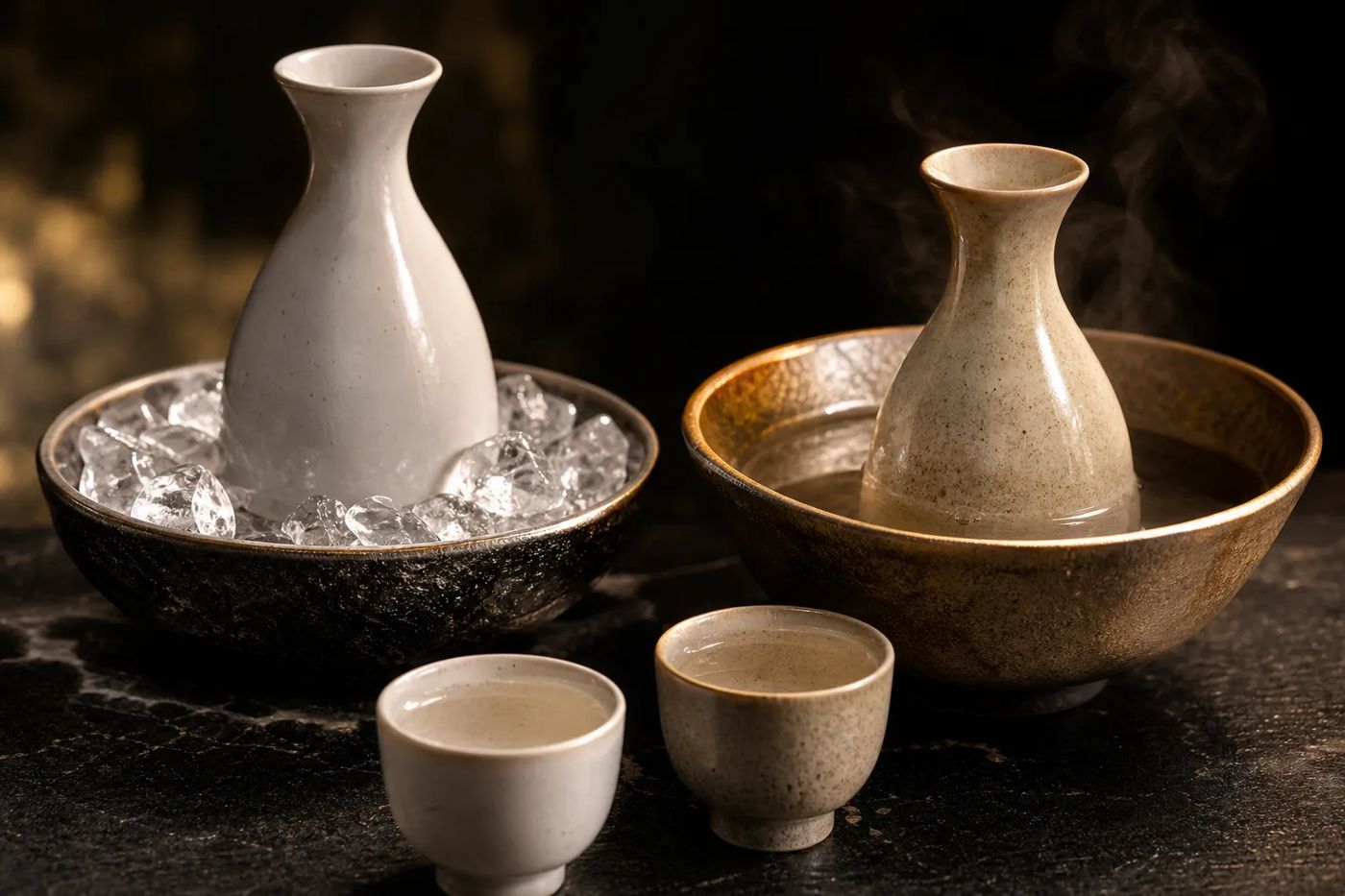
Begin chilled, then explore. The directly documented caviar recommendations here favour chilled or near-room-temperature sake: Kataoka's aperitif suggestion and sommelier Hiromi Kiyama's approach to dishes containing caviar. Warm sake remains an option, best tried as a deliberate comparison once the chilled match is established.
The Japan Sake and Shochu Makers Association gives three broad serving bands:
- Chilled: 8 to 15°C (46 to 59°F).
- Room temperature: 15 to 25°C (59 to 77°F).
- Warmed: 40 to 50°C (104 to 122°F).
These are temperatures for the drink, not storage conditions for caviar.
For fruity ginjo, the National Research Institute of Brewing recommends around 10°C (50°F). For warming mild, delicate sake, it suggests 35 to 40°C (95 to 104°F), with richer aged examples suited to warmer service. Temperature is a choice within a style, not a test of authenticity.
Balance is the useful test: after a sip, the roe should still be recognisable, its finish intact.
Keep the roe cold according to its producer's refrigerated storage and handling instructions. Do not let the dish warm alongside the sake while experimenting with the drink's temperature. For serving vessels, JSS notes that glass cups are often used for chilled sake; a small unmarked ceramic cup is another straightforward choice.
Sparkling sake is a style, not a grade
Bubbles tell you nothing by themselves about the ingredient and polishing designations above. JSS documents both bottle-fermented carbonation and carbonation introduced by adding carbon dioxide.
Nor does “sparkling” necessarily mean the lightly effervescent style Kataoka recommends. Ask about sweetness, aroma and the strength of the bubbles. Those details matter more to this pairing than fizz alone.
For a first comparison, choose a restrained sparkling sake and taste it beside a still sake with the same caviar. Does the carbonation draw your attention to more detail in the roe, or do the bubbles become the main sensation? Let that question guide the comparison.
What restaurant practice actually shows
Caviar, asparagus, truffle and sea urchin carbonara: this was the dish Kiyama described serving with sake in her interview with The Splendid Table, published on 22 July 2013. Her sake was chilled or close to room temperature. The example concerns a composed dish, with all those flavours in play, rather than a comparison using unaccompanied roe.
For a contemporary Japanese-restaurant example, consider chef Takanori Akiyama's Tsukimi in New York. Its website, checked in November 2026, says caviar sometimes appears in its courses and offers a seasonal sake pairing. Both belong to its dining format, although the website does not identify the sake served with a particular caviar course.
These examples show restaurant practice, not an ancient fixed Japanese pairing. Read Japanese roe culture for the broader traditions, or caviar sushi and hand rolls when the roe is part of a rice-based bite.
How to judge your own match
Taste the caviar first. Take a sip of sake, then return to the caviar. Keep the accompaniment unchanged: the point is to compare drinks, not different dishes.
Pay attention to what lingers. Does the sake's perfume persist over the roe? Does its sweetness feel balanced? Most simply, do you want another bite? These questions keep the focus on the pairing rather than the prestige of the designation.
To compare temperatures, divide the sake between two vessels and change only its temperature. Treat this as a practical tasting exercise, not a validated protocol; the still-versus-sparkling comparison above is likewise an exercise, rather than a reported tasting result.
If you prefer wine's acidity, turn to caviar and white wine. For the wider range of possibilities, see drinks with caviar.
A brief alcohol note
UK NHS advice is not to drink alcohol during pregnancy or when planning pregnancy. In the US, the CDC states that there is no known safe amount or safe time for drinking during pregnancy; sake is not an exception. For personal advice, speak to a doctor or midwife.
Sources
-
Japan National Tax Agency. Labelling Standards for the Manufacturing Process and Quality of Sake, Notice No. 8 of 22 November 1989, published Japanese text listing amendments through June 2019. Defines polishing ratio, special designations, koji proportion and the added-alcohol limit. Official standard.
-
Japan National Tax Agency, Sapporo Regional Taxation Bureau. Labeling Standards for the Manufacturing Process and Quality of Sake (Overview), Attachment 1 in the 2022 appraisal documentation. English overview of the eight special designations and their requirements. Official PDF.
-
Japan National Tax Agency. What is the Geographical Indications (GI) for Liquor Products in Japan?, March 2025 edition. Gives the Nihonshu/Japanese Sake designation date and ingredient-origin requirements. Official guide.
-
Japan National Tax Agency. Information on GIs protected in Japan, live register and international-protection tables, undated, retrieved November 2026. Lists Nihonshu/Japanese Sake under EU and United Kingdom protection. Official tables.
-
National Research Institute of Brewing. What is Sake?, Japanese Sake Essentials, undated web edition, retrieved November 2026. Explains rice, koji, yeast and fermentation. Research institute guide.
-
Wine & Spirit Education Trust. Beyond sushi: discover the full potential of sake pairing, 16 May 2025. Presents Natsuki Kikuya's pairing approach, including the rationale involving acidity, umami and mouthfeel. Educator guide.
-
Michelin Guide, Sophie Friedman. Why Sake is the Perfect Partner for Any Meal, 2023 web edition. Includes direct statements from Iori Kataoka and chef Jennifer Bañagale. Specialist interviews.
-
The Splendid Table, Lynne Rossetto Kasper interviewing Hiromi Kiyama. Bored with reds and whites? Pair sake with non-Japanese meals, 22 July 2013. Documents Kiyama's caviar-containing dish, serving approach and separate recommendations for rich egg dishes. Interview transcript.
-
Japan Sake and Shochu Makers Association. How to Serve Sake, undated web edition, retrieved November 2026. Gives serving-temperature bands and notes glass cups for chilled sake. Serving guide.
-
National Research Institute of Brewing. Pairings, Japanese Sake Essentials, undated web edition, retrieved November 2026. Recommends approximately 10°C for fruity ginjo and distinguishes warming temperatures by style. Pairing and temperature guide.
-
Japan Sake and Shochu Makers Association, Information Center. Sake list, public PDF hosted in the March 2024 directory. Its explanatory material identifies bottle-fermented and added-carbon-dioxide sparkling styles. Public PDF.
-
Tsukimi. About; Reservations, restaurant website, 2026 web edition, retrieved November 2026. Documents chef Takanori Akiyama, occasional caviar courses and an optional seasonal sake pairing. Restaurant statements.
-
NHS. Drinking alcohol while pregnant, live guidance, retrieved November 2026. Advises against alcohol during pregnancy and when planning pregnancy. UK guidance.
-
US Centers for Disease Control and Prevention. About Alcohol Use During Pregnancy, 14 August 2026 edition. States that no safe amount or safe time for alcohol use during pregnancy is known. US guidance.
This article was researched through Japanese regulatory and brewing sources, drinks education, direct specialist interviews and documented restaurant statements; no original tasting was undertaken.
Last checked: November 2026