
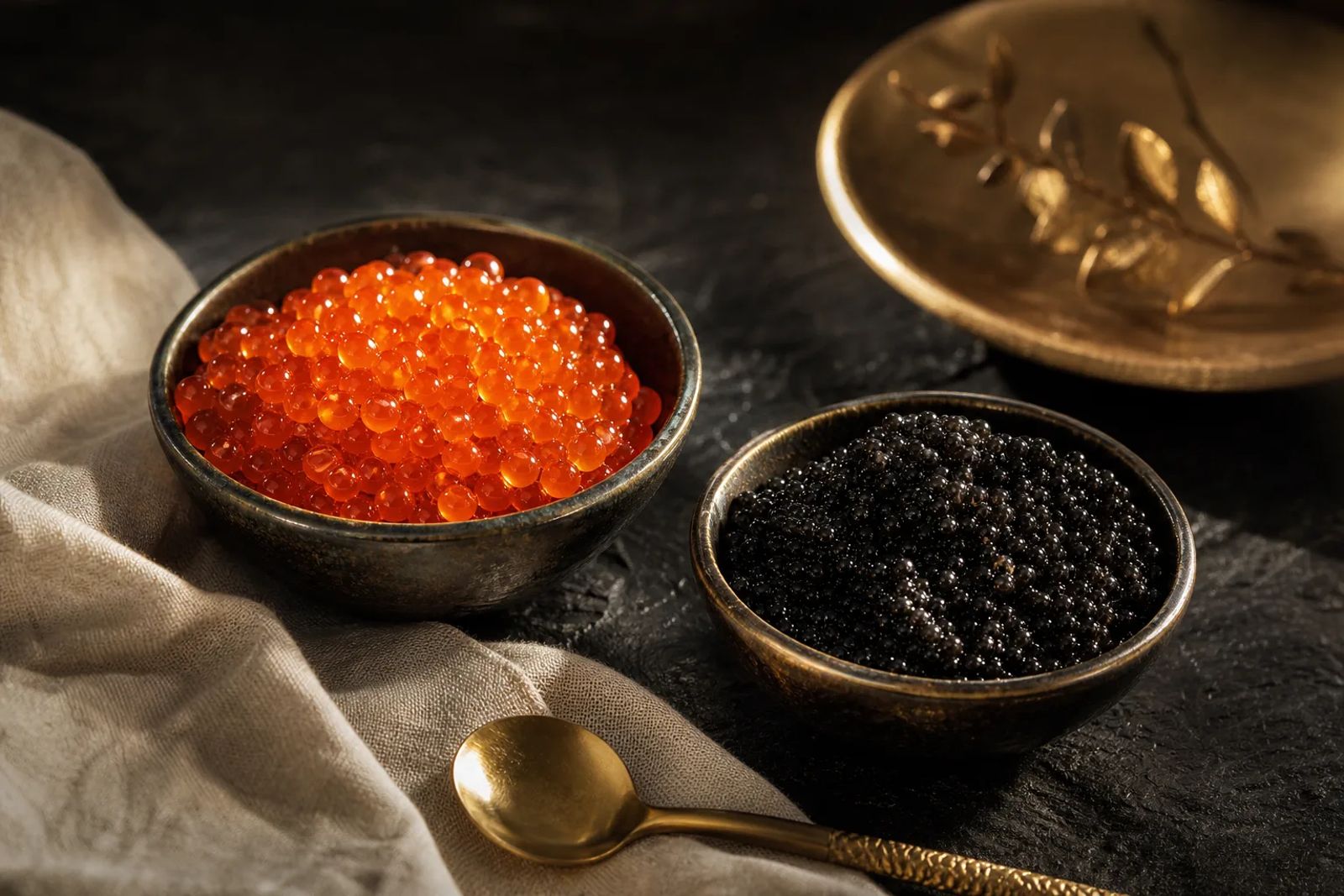
Bright orange roe from ocean trout, documented by Sydney Fish Market, is one local answer to imported sturgeon caviar. Local salmon roe offers another. Then there is Australia's native finger lime, a fruit filled with separate juice vesicles and known as citrus caviar. Across Australia and New Zealand, the pleasure begins with knowing which ingredient is on the spoon. At the border, it also means meeting each country's wildlife trade and biosecurity requirements.
Are sturgeon farmed in either country?
Neither country has an operating domestic sturgeon caviar industry described in the official material checked in November 2026. Australia's official record distinguishes a favourable import risk assessment from permission to import.
In May 2024, DAFF published its final Import of live sturgeon for aquaculture biosecurity import risk analysis. It recommended that imports could proceed with specified disease controls. It did not announce the start of a farming industry.
The implementation page, checked in November 2026, still says permit applications cannot be considered until prerequisite activities are completed and final import conditions appear in BICON, Australia's biosecurity import conditions system. The measures include disease-free source stocks, pre-export quarantine, testing, egg disinfection and post-arrival quarantine.
Australia's position is therefore more specific than a permanent ban on sturgeon farming. Importing live fish, securing environmental permission and establishing a farm are separate steps. A favourable risk assessment does not itself grant permission to import.
In New Zealand, MPI says an aquatic species can be imported only if an import health standard covers it. That document sets the biosecurity conditions. Ask MPI whether an authorised import pathway exists for live sturgeon for aquaculture.
For anyone choosing caviar, the practical point is simple: read an Australian or New Zealand business name alongside the product's actual origin. The business's address does not establish where its sturgeon were farmed.
Australia's local roes
Australia's salmon and trout roes deserve attention in their own right. Austrade documents their production in Victoria, while Yarra Valley Caviar identifies its farmed fish as Atlantic salmon (Salmo salar) and rainbow trout (Oncorhynchus mykiss).
A single producer can offer both local roe and imported sturgeon caviar. Yarra Valley Caviar describes exactly that arrangement, distinguishing its Victorian salmonid roe production from the caviar it sources from overseas farms. On a menu, the producer's name alone will not tell you which is being served.
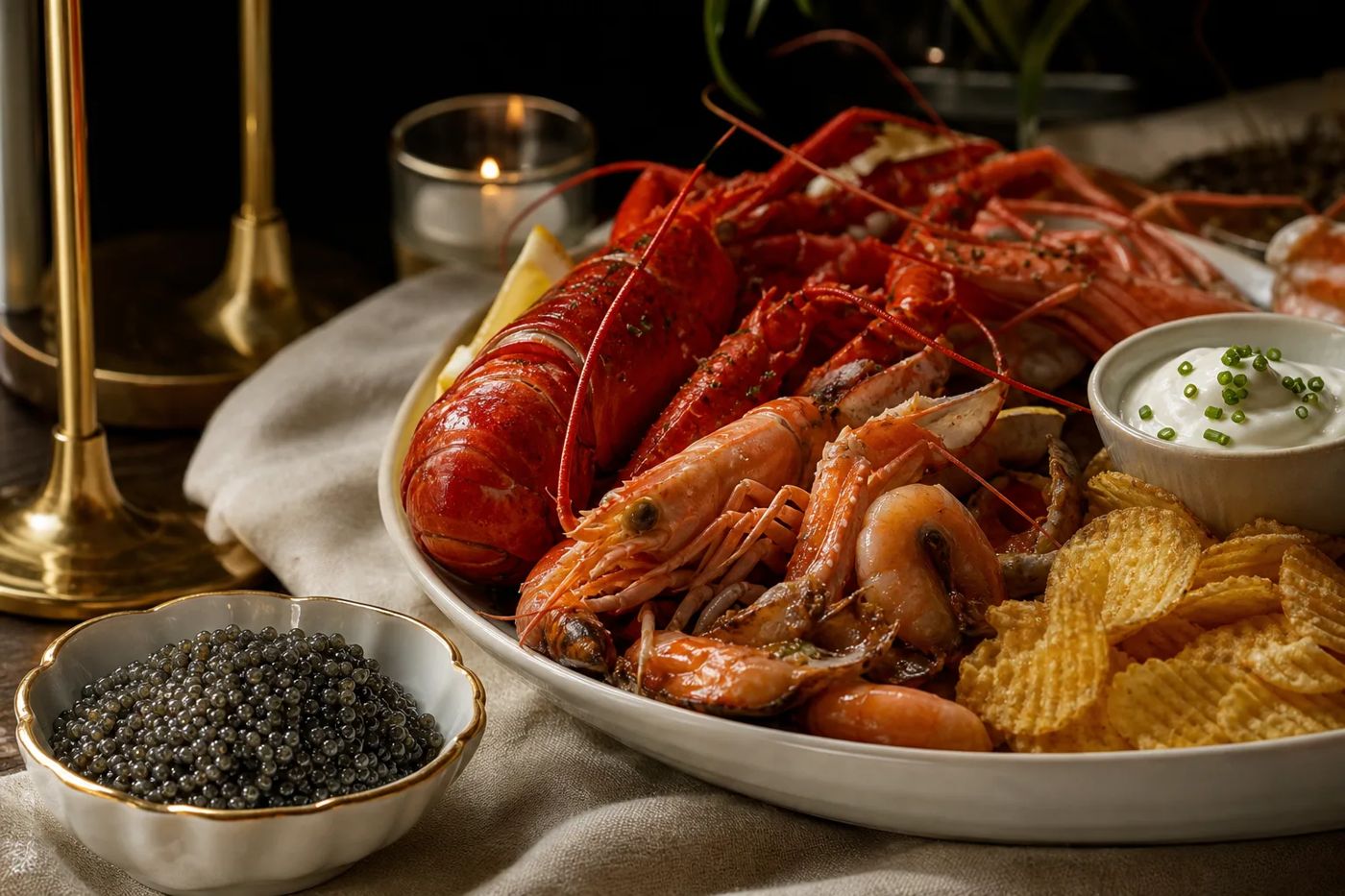
Crème fraîche, chives and potato crisps: Maria's Byron Bay Christmas menu gives caviar familiar companions alongside festive prawns and lobster.
Ocean trout needs a little decoding, too. Sydney Fish Market identifies it as rainbow trout reared in saltwater, rather than a separate species, and records the availability of its bright orange roe.
When exploring salmon roe or trout and steelhead roe, ask two direct questions: which fish supplied the eggs, and where was it farmed? Those answers tell you more than colour or the word caviar.
New Zealand's salmon roe
King salmon roe is New Zealand's documented local alternative to sturgeon caviar. Also called Chinook salmon roe, it comes from Oncorhynchus tshawytscha. Mt Cook Alpine Salmon identifies its Ikura Caviar as a New Zealand product. Here, ikura means prepared salmon eggs, not sturgeon roe.
Cuisine's November 2026 feature describes Mt Cook Alpine Salmon's approach as drawing on Japanese ikura techniques while expressing New Zealand ingredients. That combination gives the roe a more particular identity than “orange caviar”: the fish, its seasoning and the place of production each contribute to the story.
The words salmon caviar on a menu do not, by themselves, identify a country of production. Look for an explicit origin statement. Where a producer offers several products, distinguish its own local roe from anything imported and sold alongside it.
Finger lime: citrus, not roe
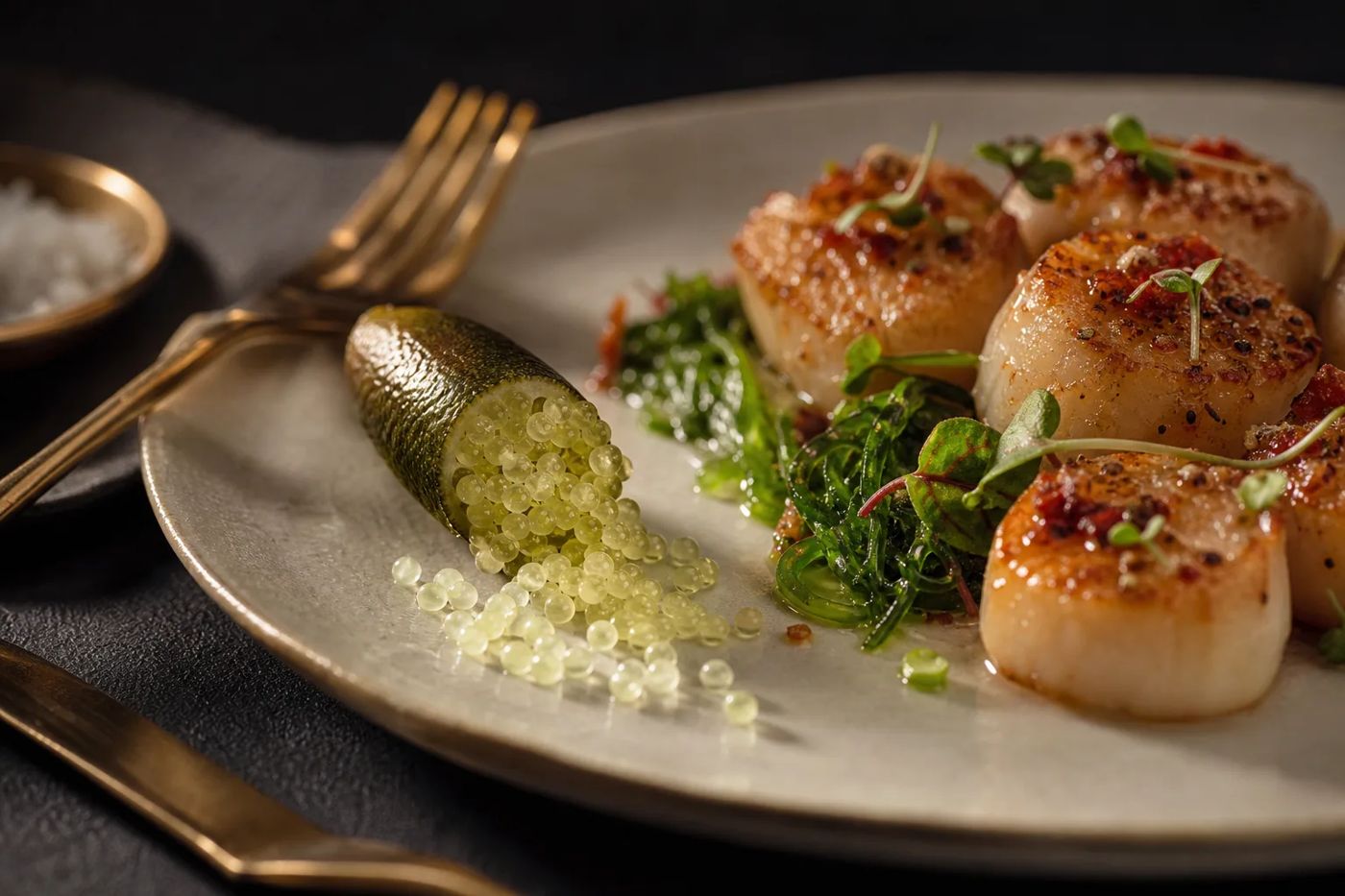
Finger lime brings citrus acidity to a dish, not the salt of cured fish eggs. Australia's native Citrus australasica, often called citrus caviar, is fruit; its small, separate juice vesicles explain the comparison with roe.
The NSW growing guide places its native range in the rainforests of south-east Queensland and northern New South Wales. The South Australian Native Foods Association documents its use with seafood, salads and desserts. The resemblance may inspire a garnish, but the ingredient brings a different flavour and function to the plate. For the distinction between fruit vesicles and manufactured pearls, see finger lime and truffle pearls.
Caviar at a summer Christmas
Crème fraîche, chives and potato crisps: Maria's Byron Bay Christmas menu gives caviar familiar companions alongside festive prawns and lobster. Named menus like this give the clearest picture of how caviar is served, rather than claims about a single national style. At 6HEAD in Australia, Christmas function material lists a caviar bite with crème fraîche and chives among oysters and prawns. One offers caviar with separate accompaniments; the other makes it a prepared bite.
In New Zealand, Urban List's Auckland Christmas dining guide describes Saint Alice serving seafood platters with caviar before a meat board and festive sides. Cuisine also presents Mt Cook's ikura among artisan ingredients for parties, giving local salmon roe its own place in celebratory cooking.
Christmas falls in summer in both countries. These examples show how caviar fits a seafood celebration; they do not establish it as a universal Christmas custom or show what households generally eat. Explore the caviar around the world hub for other regional dining traditions.
The accompaniments also make the differences between ingredients clear. Crème fraîche and crisps provide a contrasting base for cured fish eggs. Finger lime supplies citrus juice. A dish containing both roe and finger lime combines distinct ingredients, rather than repeating the same garnish.
What food names must tell you
Where a food name is required, it must be the prescribed name or a name or description sufficient to indicate the food's true nature. The shared Australia New Zealand Food Standards Code sets out this framework in Standard 1.2.2.
For readers, that means distinguishing sturgeon caviar from named salmon or trout roe, and both from finger lime fruit. A customs tariff code does not settle this consumer identification question. Nor does a restaurant's use of caviar as a descriptive flourish. Look for wording that identifies the ingredient itself.
Bringing caviar into Australia or New Zealand
The familiar 125 g allowance concerns wildlife trade, not biosecurity clearance. Travellers must establish both whether wildlife rules allow the caviar to travel and whether biosecurity rules allow that particular food to enter.
CITES, the international wildlife trade convention, recommends an exemption for up to 125 g of caviar per person from Appendix II species, in individually marked containers carrying CITES labels. It applies only where national law adopts it. Australia provides a conditional personal effects exemption limited to 125 g per person.
| Rule | Where it applies | Requirement | Official source | Checked |
|---|---|---|---|---|
| Wildlife personal effects | Australia | Up to 125 g per person, with personal-effects conditions and compliant container labels. | EPBC Regulations 2000, Schedule 4A; DCCEEW traveller guidance | November 2026 |
| Biosecurity clearance | Australia | Declare caviar as a fish product; check applicable BICON conditions before departure. | DAFF traveller guidance; BICON | November 2026 |
| Wildlife personal effects | New Zealand | As of 2026, TIES Act s30 gives no 125 g allowance; caviar bought abroad needs CITES papers. | DOC traveller guidance | November 2026 |
| Biosecurity clearance | New Zealand | Declare the food and obtain MPI clearance under applicable aquatic animal product conditions. | MPI traveller guidance; Aquatic Animal Products import health standard | November 2026 |
For biosecurity, species and processing matter, not just the culinary name on the jar. MPI's Aquatic Animal Products standard distinguishes salmonid from non-salmonid products, and its 2023 direction specifically addresses commercially packaged salmonid roe. Do not assume salmon roe and sturgeon caviar face identical requirements.
Australia also treats salmon roe separately in its import system. A BICON notice of 5 March 2026 required official certificates for retorted, or heat sterilised, salmon roe from 1 June 2026. A previous traveller's experience may concern a different product, different conditions or a different journey.
Before asking either country's authorities for advice, establish the species, processing method and origin. Keep the original packaging available for inspection. A CITES label provides traceability information; it does not verify the container's contents or remove food entry conditions.
For journeys through several countries, check departure and transit rules as well as those at the destination. The dedicated caviar travel allowance guide explains the conditional exemption; country-by-country customs rules cover the wider border questions.
Sources
-
Department of Agriculture, Fisheries and Forestry. Import of live sturgeon for aquaculture: Final biosecurity import risk analysis. Final report, May 2024. Official report.
-
Department of Agriculture, Fisheries and Forestry. Import of live sturgeon for aquaculture. Implementation guidance, undated webpage retrieved November 2026. Official guidance.
-
Ministry for Primary Industries. Steps to importing aquatic animals. Undated guidance retrieved November 2026. Official guidance.
-
Austrade. Freshwater pearls: Yarra Valley Caviar’s premium salmon roe debuts at Harrods. 26 April 2024. Producer reporting.
-
Yarra Valley Caviar. About Yarra Valley Caviar. Company statement, undated webpage retrieved November 2026. Production and sourcing statement.
-
Sydney Fish Market. Rainbow Trout (“Ocean Trout”). Species guide, undated webpage retrieved November 2026. Species guide.
-
Mt Cook Alpine Salmon. Gold at the Cuisine Artisan Awards!. Company announcement, 15 October 2026. Product announcement.
-
Monterey Bay Aquarium Seafood Watch. Chinook salmon. New Zealand marine net-pen recommendation, webpage retrieved November 2026. Species and production record.
-
Cuisine. Fiona Smith, Elegance & Ease. Issue 238, November 2026. Food feature.
-
NSW Department of Primary Industries. Australian native finger limes growing guide. Primefact 979, first edition, January 2010, hosted by NSW DPIRD. Growing guide.
-
South Australian Native Foods Association. Finger Lime. Undated reference page retrieved November 2026. Ingredient reference.
-
6HEAD. Christmas Function Packs: Sydney & Perth 2026. Restaurant menu material retrieved November 2026. Menu evidence.
-
Maria's Byron Bay. Christmas Menu Order Form. Undated restaurant menu retrieved November 2026. Menu evidence.
-
Urban List New Zealand. Where To Eat On Christmas Day In Auckland. Dining guide retrieved November 2026; the retrieved title retains a 2024 reference. Attributed dining report.
-
Food Standards Australia New Zealand. Australia New Zealand Food Standards Code: Standard 1.2.2, Information requirements: food identification. Compilation F2024C00726, 22 July 2024, listed as the latest version when retrieved. Official instrument record.
-
Food Standards Australia New Zealand. Food Standards Code legislation. Code index retrieved November 2026. Official Code index.
-
Department of Climate Change, Energy, the Environment and Water. Travellers and online shoppers. Undated wildlife trade guidance retrieved November 2026. Personal-effects guidance.
-
Australian Government. Environment Protection and Biodiversity Conservation Regulations 2000. Compilation dated 14 October 2024, Schedule 4A. Retrieved legislative compilation.
-
Department of Agriculture, Fisheries and Forestry. Bringing or mailing goods to Australia. Traveller guidance retrieved November 2026. Biosecurity guidance.
-
Ministry for Primary Industries. Bringing goods into New Zealand. Traveller guidance retrieved November 2026. Biosecurity guidance.
-
Ministry for Primary Industries. Aquatic Animal Products. Import health standard dated 23 December 2022, retrieved document incorporating subsequent guidance. Import health standard.
-
Ministry for Primary Industries. CTO 2023 046 [G]: Aquatic Animal Products, Salmonid Fish Roe. Direction under section 27 of the Biosecurity Act 1993, 2023. Official direction.
-
Department of Agriculture, Fisheries and Forestry, BICON. Changes to evidence requirements for retorted salmon roe (including caviar). Effective 5 March 2026. Official import alert.
-
Department of Conservation. TIES Act consultation discussion document. Personal and household effects consultation, 2019. Used only to distinguish a proposal from an established current exemption. Consultation document.
-
CITES. Conservation of and trade in sturgeons and paddlefish. Resolution Conf. 12.7, Rev. CoP17; copy retrieved from a US government regulatory docket. Retrieved resolution.
-
CITES. Personal and household effects. Resolution Conf. 13.7, Rev. CoP17, 2016.
This piece was researched through official import guidance, retrieved legislative records, documented producer statements and attributed dining examples, keeping proposals separate from permissions.
Last checked: November 2026