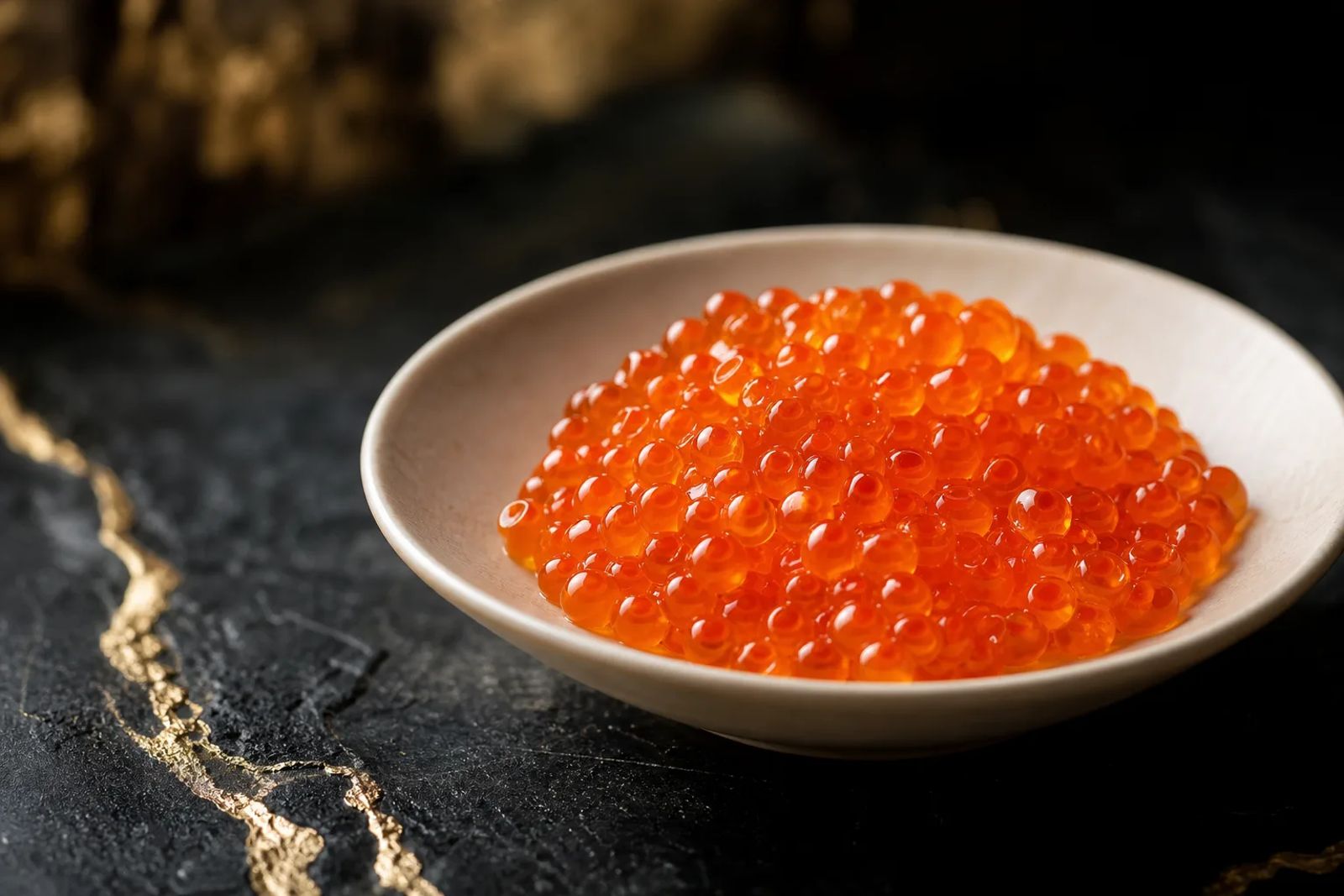
Firm beads, 4 to 5 mm across, with a lightly sweet flavour: that is how Browne Trading describes its Danish trout roe, which it calls milder than salmon roe. Orange is among the colours found in commercial trout roe, but the fish behind the bead deserves a closer look.
Trout roe is the eggs of trout, sold for further processing or prepared as salted, separate beads. Rainbow trout and steelhead belong to the same species, Oncorhynchus mykiss. Steelhead roe is therefore trout roe, not a separate kind of salmon roe.
Rainbow trout, steelhead and sea trout
Steelhead and rainbow trout are the same species living different lives. Steelhead is the migratory form of O. mykiss: it goes to sea, then returns to freshwater to spawn. Rainbow trout commonly means fish that remain in freshwater. Neither name tells you how the roe was cured.
“Sea trout” is less straightforward. Browne Trading’s product bearing that name is explicitly identified as farmed O. mykiss from Denmark, rather than brown trout roe. EUMOFA’s market study also records small production categories for sea trout and brook trout. Ask for the scientific name: trout names are not interchangeable. For related fish sold under different names, see char and whitefish roe.
Where farmed trout roe comes from
Finland, Denmark and France feature prominently in EU trout roe production. EUMOFA’s 2022 study, using 2020 data, names them as leading producers, with nearly all the roe coming from rainbow trout. Its 2025 report puts Denmark first by volume in 2023. These figures describe EU roe production in those years, rather than today’s worldwide ranking of trout farms.
The distinction between farming fish and producing roe matters. EUMOFA explicitly warns that substantial trout production does not necessarily mean substantial roe production. Its study found no comparable roe production data for countries outside the EU. Nor does a brand’s address establish where its fish were raised or its eggs collected.
What trout roe is known for
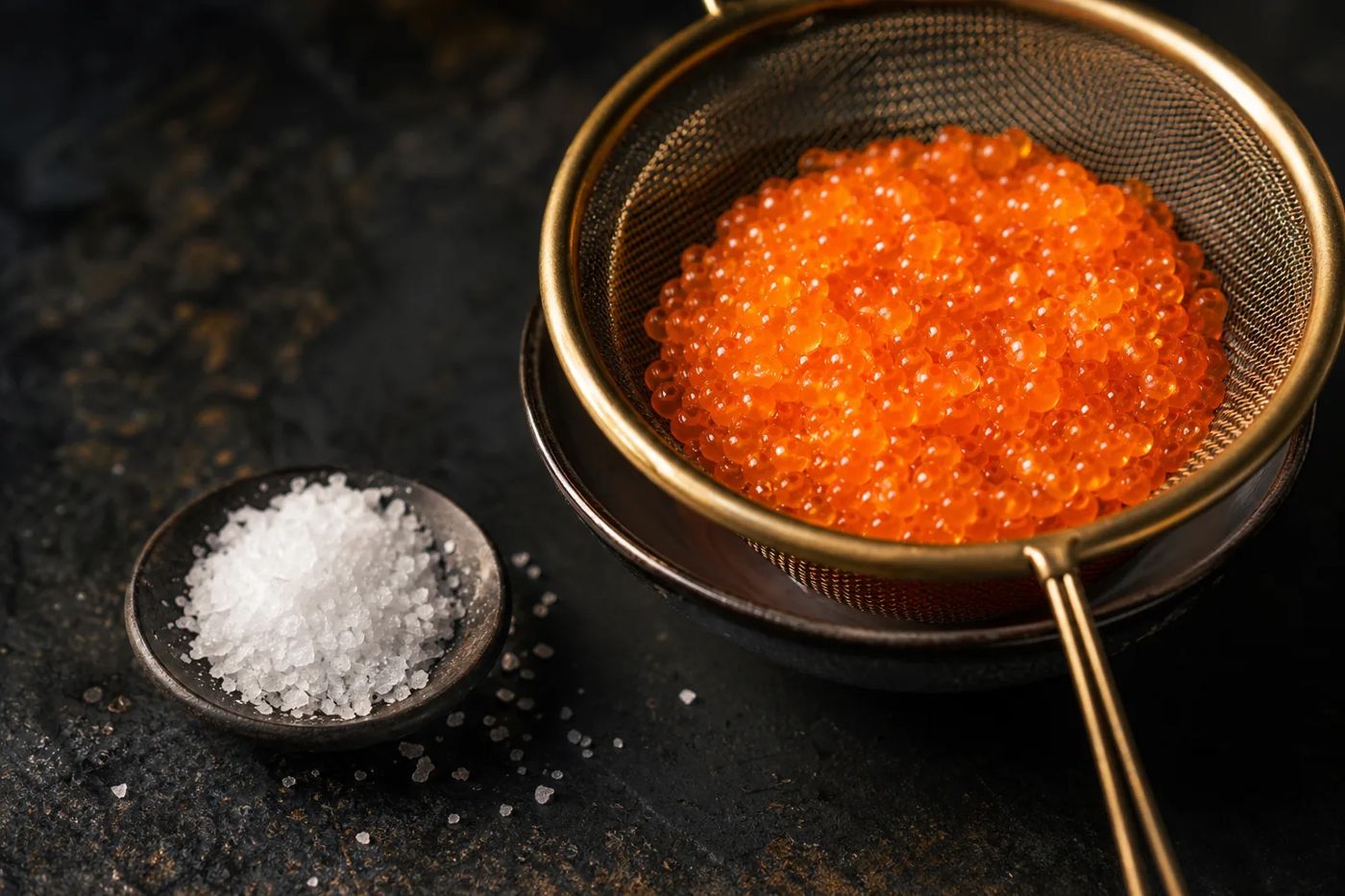
Distinct, translucent beads are the visual starting point. Commercial trout roe comes in orange and red-orange, but colour alone cannot identify the fish. Neither can bead size.
Browne Trading’s description above applies to its Danish O. mykiss product. FAO gives a broader biological egg diameter of 3 to 7 mm for rainbow trout. That species-profile range describes the eggs themselves, rather than guaranteeing the size of cured beads.
For flavour, compare individual products and their seasoning rather than expecting every trout roe to match Browne Trading’s description. The salmon roe guide: The Complete Guide) explores the salmon side in detail, while the salmon and trout roe hub maps the wider group.
Why feed affects trout roe colour
A trout egg’s colour can be shaped before spawning. Carotenoids, a group of pigments that includes astaxanthin and canthaxanthin, can pass from feed into the eggs.
In Harris’s 1984 experiment, three-year-old female rainbow trout received diets containing different amounts of canthaxanthin for three or six months before spawning. Egg colour increased with both the amount supplied and the feeding period: more pigment and longer feeding produced stronger colour.
A study published online in 2016 and in print in 2017 developed and validated an HPLC method, a laboratory separation technique, to measure astaxanthin and canthaxanthin in rainbow and brook trout eggs. It found greater accumulation of astaxanthin than canthaxanthin. The study examined pigments deposited in eggs, rather than colour added to harvested roe.
That distinction is essential when reading a label. Pigmentation through feed and colouring the finished food are separate processes with different legal controls. A redder bead cannot tell you which occurred. For the wider explanation, see roe colours.
The feed rules behind the colour
Feed limits govern what goes into the feed, not what may be added directly to roe. The US authorisations concern pigments used to enhance salmonid flesh colour; they do not permit direct colouring of harvested roe.
The table separates documented rules from current authorisation details that could not be fully confirmed. Checked November 2026.
| Jurisdiction | Feed rule | Authority |
|---|---|---|
| EU | Astaxanthin: 100 mg/kg; combined carotenoids: 100 mg/kg (2015 authorisation, to 10 September 2025). Canthaxanthin: 25 mg/kg (2003). Check the EU register for renewals. | Regulation 2015/1415; Directive 2003/7/EC |
| Great Britain | FSA register: astaxanthin authorised for fish. Current canthaxanthin conditions not documented. | FSA feedadd-260 |
| Northern Ireland | EU feed additive authorisations apply under the Windsor Framework. Check current entries. | Regulation (EC) No 1831/2003 |
| US | Astaxanthin and canthaxanthin each have an 80 mg/kg finished-feed limit under their respective provisions. These provisions do not give permission to combine both maxima. | 21 CFR 73.35 and 73.75 |
How it is cured and sold
Start with a simple question: is the roe ready to eat? Trout roe may be sold as raw material for processing or as prepared salted beads. AquaPri distinguishes raw trout roe from its ready-to-eat ikura product. As a separate example of salted roe, Lohikunta’s specification documents frozen, salted rainbow trout roe containing 97.5% roe and 2.5% salt. That formulation belongs to the product, rather than setting a recipe for the category.
Read the preparation as closely as the fish name. “Salted”, “smoked” and “pasteurised” describe different treatments. Pasteurisation uses heat to reduce microorganisms; it does not make chilled roe sterile. Attilus documents a pasteurised trout roe product containing salt and sorbic acid. For the separation, washing and salting stages, see the harvesting and curing guide.
Egg colour increased with both the amount supplied and the feeding period: more pigment and longer feeding produced stronger colour.
Keep chilled roe at the producer’s stated temperature. Follow its instructions for opening and thawing. FDA’s US home-refrigeration guidance is 4 °C (40 °F) or below. Freezing does not kill all harmful germs, and appearance cannot establish whether roe is safe.
Reading “trout caviar” on a label
“Trout caviar” names the fish; it does not claim that the eggs come from sturgeon. In the US, FDA’s nonbinding CPG 540.150 says unqualified “caviar” should describe salted sturgeon roe. Other roe may use the fish name with “caviar”, provided all the words appear in substantially the same size and prominence.
The same guidance calls for an ingredient list and, where permitted artificial colour is used, a prominent declaration. Separate US feed-colour provisions also set labelling requirements for salmonids fed these pigments. “Not dyed after harvest” does not remove those requirements: feed pigmentation and colouring after harvest remain distinct questions.
Beyond the label, customs rules make a separate distinction. EU customs classification places sturgeon caviar under Combined Nomenclature subheading 1604 31 00 and caviar substitutes under 1604 32 00. Those customs categories do not determine the retail name.
For retail food information in the EU, Regulation (EU) No 1169/2011 requires that it must not mislead. The applicable rules in Great Britain and Northern Ireland must be checked separately, as must those of Switzerland, the UAE, China, Japan, Russia and Australia.
Sources
-
Washington Department of Fish and Wildlife. Rainbow trout (Oncorhynchus mykiss). Undated online species account, retrieved 2026.
https://wdfw.wa.gov/species-habitats/species/oncorhynchus-mykiss -
FAO. Cultured aquatic species information: Oncorhynchus mykiss. Online species profile, retrieved 2026; publication date not established from the retrieved page.
https://www.fao.org/fishery/docs/DOCUMENT/aquaculture/CulturedSpecies/file/en/en_rainbowtrout.htm -
EUMOFA, European Commission. Salmon and trout roe. 2022 market study, including production data for 2016 to 2020.
https://eumofa.eu/documents/20124/35725/Salmon%2Band%2Btrout%2Broe.pdf/1e4a83b5-023a-b71f-6d2b-e5e4defef8b4 -
Browne Trading Company. Sea Trout Roe. Undated supplier description, retrieved 2026;
-
Lohikunta Oy. Product specifications: Salted rainbow trout roe, frozen (caviar style). Undated supplier specification, retrieved 2026.
https://lohikunta.fi/wp-content/uploads/Lohikunta-Finland-rainbowtrout_roe_frozen-product-spec.pdf -
Harris, L. E. Effects of a broodfish diet fortified with canthaxanthin on female fecundity and egg color. Aquaculture, volume 43, pages 179 to 183, 1984. Article retrieved within a NOAA-hosted document compilation.
https://repository.library.noaa.gov/view/noaa/37254/noaa_37254_DS1.pdf -
PubMed, US National Library of Medicine. HPLC Quantification of astaxanthin and canthaxanthin in Salmonidae eggs. Research article abstract, 2016, PMID 27615726.
https://pubmed.ncbi.nlm.nih.gov/27615726/ -
European Commission. Feed additives. Online regulatory overview and register gateway, retrieved 2026.
https://food.ec.europa.eu/food-safety/animal-feed/feed-additives_en -
European Commission. Commission Implementing Regulation (EU) 2015/1415 concerning the authorisation of astaxanthin as a feed additive for fish, crustaceans and ornamental fish. Original edition, 2015.
https://eur-lex.europa.eu/eli/reg_impl/2015/1415/oj -
European Commission. Commission Directive 2003/7/EC amending the conditions for authorisation of canthaxanthin in feedingstuffs. Original edition, 2003.
https://eur-lex.europa.eu/eli/dir/2003/7/oj/eng -
Food Standards Agency. Authorised Regulated Food and Feed Products for Great Britain: Astaxanthin [Fish, Crustacean], feedadd-260. Entry updated 1 April 2025, retrieved 2026.
https://data.food.gov.uk/regulated-products/feed_authorisations/feedadd-260 -
US Food and Drug Administration, eCFR. 21 CFR § 73.35: Astaxanthin. Current online text retrieved 2026.
https://www.ecfr.gov/current/title-21/chapter-I/subchapter-A/part-73/subpart-A/section-73.35 -
US Food and Drug Administration, eCFR. 21 CFR § 73.75: Canthaxanthin. Current online text retrieved 2026.
https://www.ecfr.gov/current/title-21/chapter-I/subchapter-A/part-73/subpart-A/section-73.75 -
US Food and Drug Administration. CPG Sec. 540.150: Caviar, Use of Term, Labeling. October 1989 edition, current online guidance retrieved 2026.
https://www.fda.gov/regulatory-information/search-fda-guidance-documents/cpg-sec-540150-caviar-use-term-labeling -
AquaPri. Trout caviar. Undated producer description, retrieved 2026.
https://www.aquapri.dk/our-products/trout-caviar -
Attilus. More details: Trout Roe. Undated product specification, retrieved 2026.
https://www.attiluskaviar.com/pages/more-details-trout-roe -
US Food and Drug Administration. Selecting and Serving Fresh and Frozen Seafood Safely. Current online consumer guidance, retrieved 2026.
https://www.fda.gov/food/buy-store-serve-safe-food/selecting-and-serving-fresh-and-frozen-seafood-safely
This piece was researched using fisheries authorities, official trade analysis, primary research, regulatory texts and explicitly attributed supplier specifications.
Last checked: November 2026