
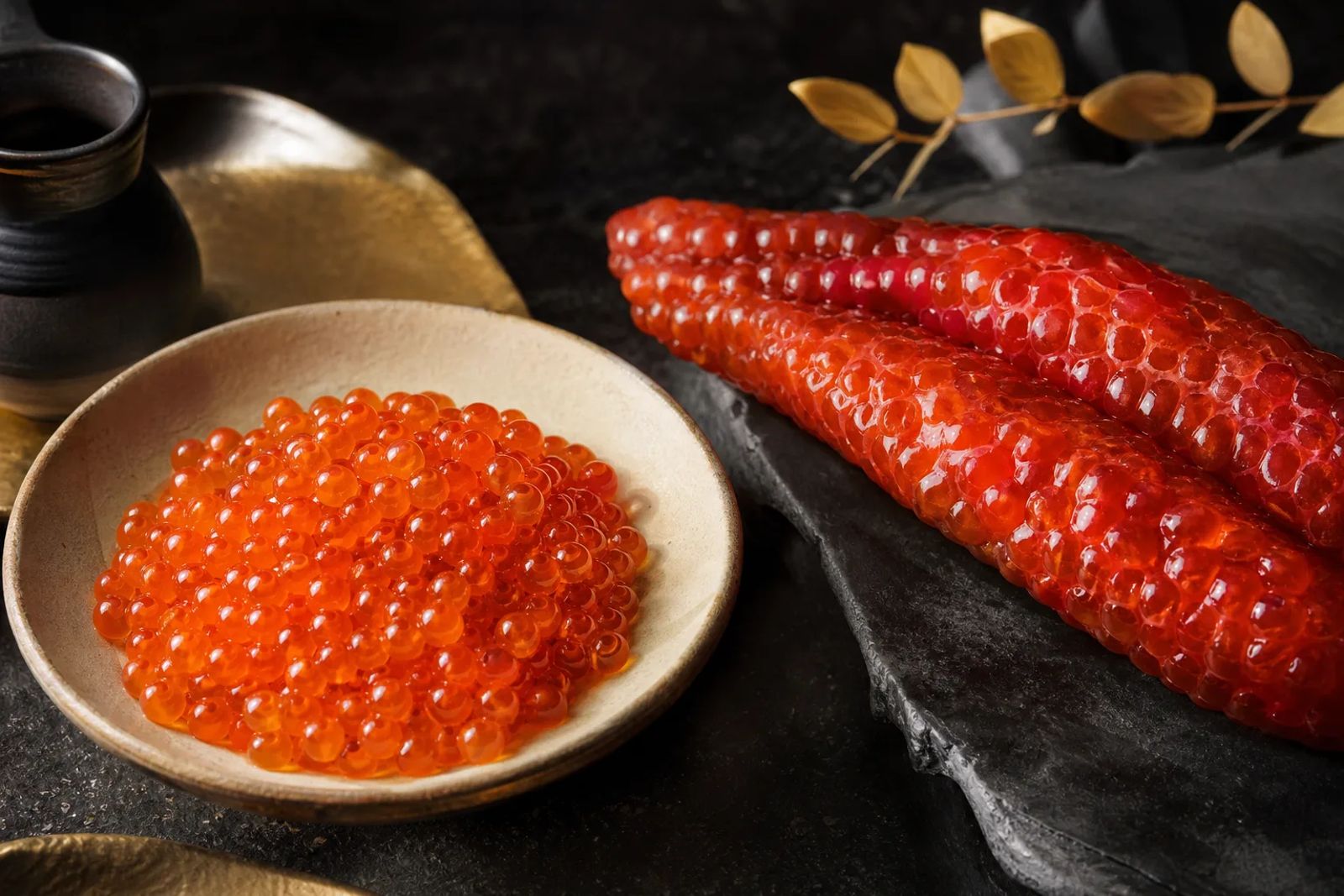
A thin ovarian membrane makes the difference between a spoonful of loose ikura beads and a connected piece of sujiko. That sac is also called a skein.
Both are salmon or trout roe. Ikura has been separated into individual eggs; sujiko retains the sac. In Japanese food shops, sujiko usually means a cured product, while fresh, uncured skeins are sold as nama sujiko.
Ikura vs sujiko: the membrane makes the difference
The names describe the roe’s presentation, not two different fish. Remove the surrounding membrane and you have ikura, with individual eggs which can be spooned over rice. Leave it intact and you have sujiko, the eggs held in a connected piece.
Structure is the defining distinction, rather than “ikura is soy-cured and sujiko is salted”. Both can be seasoned in several ways. The name alone tells you neither the curing recipe nor whether an unprocessed product is ready to eat.
Which fish supply the roe?
Neither name identifies a single species. Hokkaido Gyoren, the fisheries co-operative group, names autumn chum salmon as the main source of ikura in its account of the two products. Japan’s Ministry of Agriculture, Forestry and Fisheries (MAFF) describes the broader category as salmon and trout eggs.
Sujiko also comes from several salmon species. Processor E&E Foods, for example, lists king, sockeye and coho salmon among its raw materials. That is one producer’s range, rather than a complete list of the fish used throughout Japan.
To identify the fish, read the ingredient description or ask the supplier. The wider salmon and trout roe guide explains this family of foods; the complete ikura guide explores the separated form.
Curing and texture
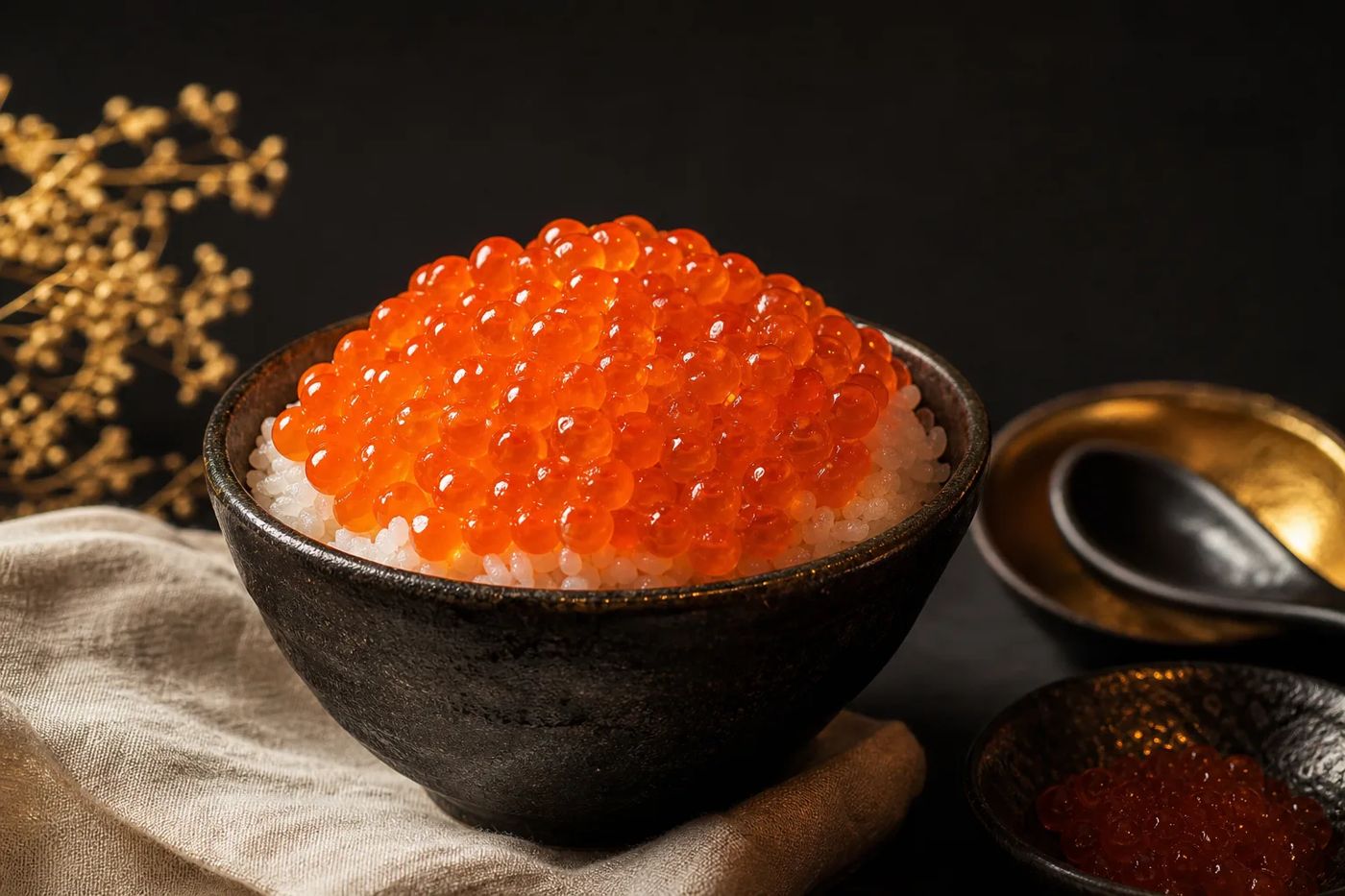
Ikura is commonly salt-cured or marinated in soy sauce. MAFF’s account of Hokkaido shoyu ikura, meaning soy-seasoned ikura, describes a preparation with soy sauce and sake. Household variations include mirin, a sweet rice seasoning, or dashi, Japanese stock.
Sujiko is usually salted with the skein intact, though soy-seasoned versions also exist. Fresh nama sujiko is a separate category from these processed foods, a distinction made explicitly by Hokkaido Gyoren.
In the mouth, the membrane matters most. Ikura gives you freely moving beads, with individual eggs bursting as they are eaten, as MAFF describes. With sujiko, eggs and membrane are eaten together in a connected morsel. The seasoning may vary; that structural contrast remains.
How they are used in Japanese food
Ikura comes into its own as a visible topping or filling. MAFF lists ikura don, a rice bowl topped with roe, alongside hand-rolled sushi and gunkan-maki, the nori-wrapped sushi boats that hold loose toppings. It also records bowls pairing ikura with salmon or sea urchin.
Cured sujiko is served in small pieces with rice or tucked inside onigiri, Japanese rice balls. These uses overlap: Tsukiji Outer Market’s food guide documents both ikura and sujiko onigiri.
Roe sacs can also be cooked. In NHK’s published chan-chan yaki recipe, contest entrant Shigeko Morioka cooks salmon roe sacs on a hotplate with salmon, vegetables and miso sauce. This is a pan-grilled example, not evidence that ready-cured sujiko is normally grilled.
Turning fresh sujiko into ikura at home
Start with fresh, uncured nama sujiko, and confirm with a reliable supplier that it is suitable for raw consumption and that appropriate parasite controls have been applied. Intact sacs and separated, rinsed eggs carry different parasite risks.
Salt and soy seasoning do not reliably kill Anisakis parasites. Japan’s health ministry recommends freezing to control them. Before serving the roe without cooking, follow its guidance or that of your local food authority.
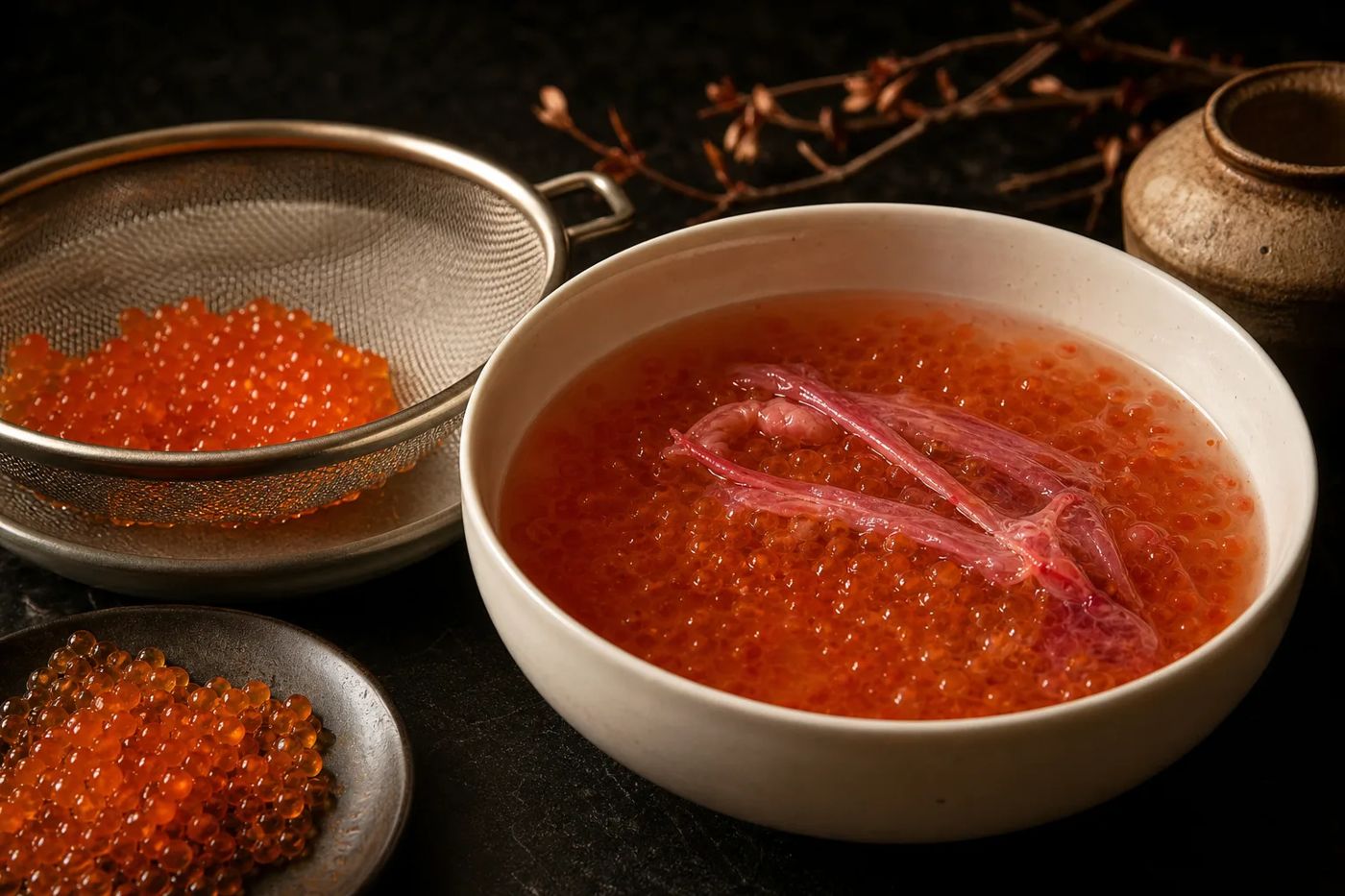
The preparation itself is gentle separation followed by seasoning. Loosen the eggs from the membrane in salted water, remove the remaining membrane, drain the beads and season them using a documented recipe. You are changing the form, not turning it into another species of roe.
html) for the processing background.
Ikura gives you freely moving beads, with individual eggs bursting as they are eaten, as MAFF describes.
Keep both forms refrigerated according to the producer’s instructions and use-by date, observing any colder temperature specified. FSA guidance for England, Wales and Northern Ireland recommends a fridge at 0 to 5°C (32 to 41°F).
Reading labels in Japan and abroad
In Japan, look for 生筋子 (nama sujiko) for fresh, uncured skeins, 塩筋子 (shio sujiko) for salted skeins, and いくら醤油漬け (ikura shoyu-zuke) for soy-seasoned beads. These describe preparation, not species. The Consumer Affairs Agency’s food-labelling guide requires a general name describing the food’s contents.
For EU retail labels, Regulation (EU) No 1169/2011 requires the legal name or, where none exists, a customary or descriptive name. Great Britain follows the same naming sequence under its assimilated version; Northern Ireland follows the EU regulation. A Japanese term should not leave the food’s nature unclear.
In the US, FDA’s nonbinding caviar-labelling guidance says salted non-sturgeon roe described as caviar should identify the fish, with the words substantially equal in size and prominence. It also addresses declaration of added colour. “Salmon caviar” can therefore describe salted salmon roe; “ikura” alone identifies neither the fish species nor the complete ingredients.
For the kitchen, look for a description that answers three questions: which fish, loose eggs or intact sac, and uncured, salted or soy-seasoned? Then check the actual ingredients. A preparation name cannot tell you everything that has been added.
Sources
-
Hokkaido Gyoren, Gyoren Hanbai. いくらと筋子(すじこ)の違いとは? メーカーさんに美味しく作る秘訣も聞いてみました! [What is the difference between ikura and sujiko?]. Undated web edition, retrieved November 2026.
https://www.gyoren.net/column/ikura/ikura-difference/ -
Ministry of Agriculture, Forestry and Fisheries, Hokkaido office. 北海道の歴史・食文化と関わりの深い水産物 [Seafood closely connected with Hokkaido’s history and food culture]. 2026 publication, section “いくら・筋子(サケ・マスの卵)”.
https://www.maff.go.jp/hokkaido/press/syokuryo/keikaku/attach/pdf/260126-1.pdf -
水産加工品図鑑 [Encyclopaedia of processed seafood]. 筋子 [Sujiko]. Web entry updated 24 April 2026.
https://k-zukan.jp/?p=2071 -
E&E Foods. Salmon Roe. Undated producer information, retrieved November 2026.
https://www.eefoods.com/page/salmon-roe/text/home -
Ministry of Agriculture, Forestry and Fisheries. いくら醤油漬け(いくらしょうゆづけ) [Soy-marinated ikura], にっぽん伝統食図鑑 [Encyclopaedia of Japanese traditional foods]. Undated web edition, retrieved November 2026.
https://www.maff.go.jp/j/keikaku/syokubunka/traditional-foods/menu/ikurasyouyuzuke.html -
Tsukiji Outer Market. 熟成の深み 筋子 [Sujiko: depth from maturation]. Food information article, 14 September 2021.
https://www.tsukiji.or.jp/sengyo/2021/09/p8682/ -
NHK, Minna no Kyō no Ryōri. Shigeko Morioka, ちゃんちゃん焼き [Chan-chan yaki]. Published recipe, 24 October 2007.
https://www.kyounoryouri.jp/recipe/4783_ちゃんちゃん焼き.html -
Food Standards Agency. How to chill, freeze and defrost food safely. Published 18 December 2017, web edition retrieved November 2026. Applies to England, Northern Ireland and Wales.
https://www.gov.uk/government/publications/how-to-chill-freeze-and-defrost-food-safely/how-to-chill-freeze-and-defrost-food-safely -
Ministry of Health, Labour and Welfare, Japan. アニサキス食中毒に関するQ&A [Questions and answers about Anisakis food poisoning]. Undated web edition, retrieved November 2026.
https://www.mhlw.go.jp/stf/seisakunitsuite/bunya/kenkou_iryou/shokuhin/syokuchu/05107.html -
Consumer Affairs Agency, Japan. 早わかり食品表示ガイド [Quick guide to food labelling], business edition, March 2023.
https://www.caa.go.jp/policies/policy/food_labeling/information/pamphlets/assets/food_labeling_cms202_230324_02.pdf -
European Parliament and Council. Regulation (EU) No 1169/2011 on the provision of food information to consumers. 2011, Article 17.
https://eur-lex.europa.eu/legal-content/en/ALL/?uri=CELEX%3A32011R1169 -
Department for Environment, Food and Rural Affairs and Food Standards Agency. Labelling guidance for prepacked for direct sale (PPDS) food products. 2021 web guidance, section 3.1, retrieved November 2026.
https://www.gov.uk/government/publications/labelling-guidance-for-prepacked-for-direct-sale-ppds-food-products/labelling-guidance-for-prepacked-for-direct-sale-ppds-food-products -
US Food and Drug Administration. CPG Sec. 540.150: Caviar, Use of Term, Labeling. October 1989 edition, retrieved November 2026.
https://www.fda.gov/regulatory-information/search-fda-guidance-documents/cpg-sec-540150-caviar-use-term-labeling
Research combined Japanese government food-culture publications, published cooking instructions, food-labelling guidance and attributed processor information; no tasting or recipe testing was undertaken.
Last checked: November 2026