
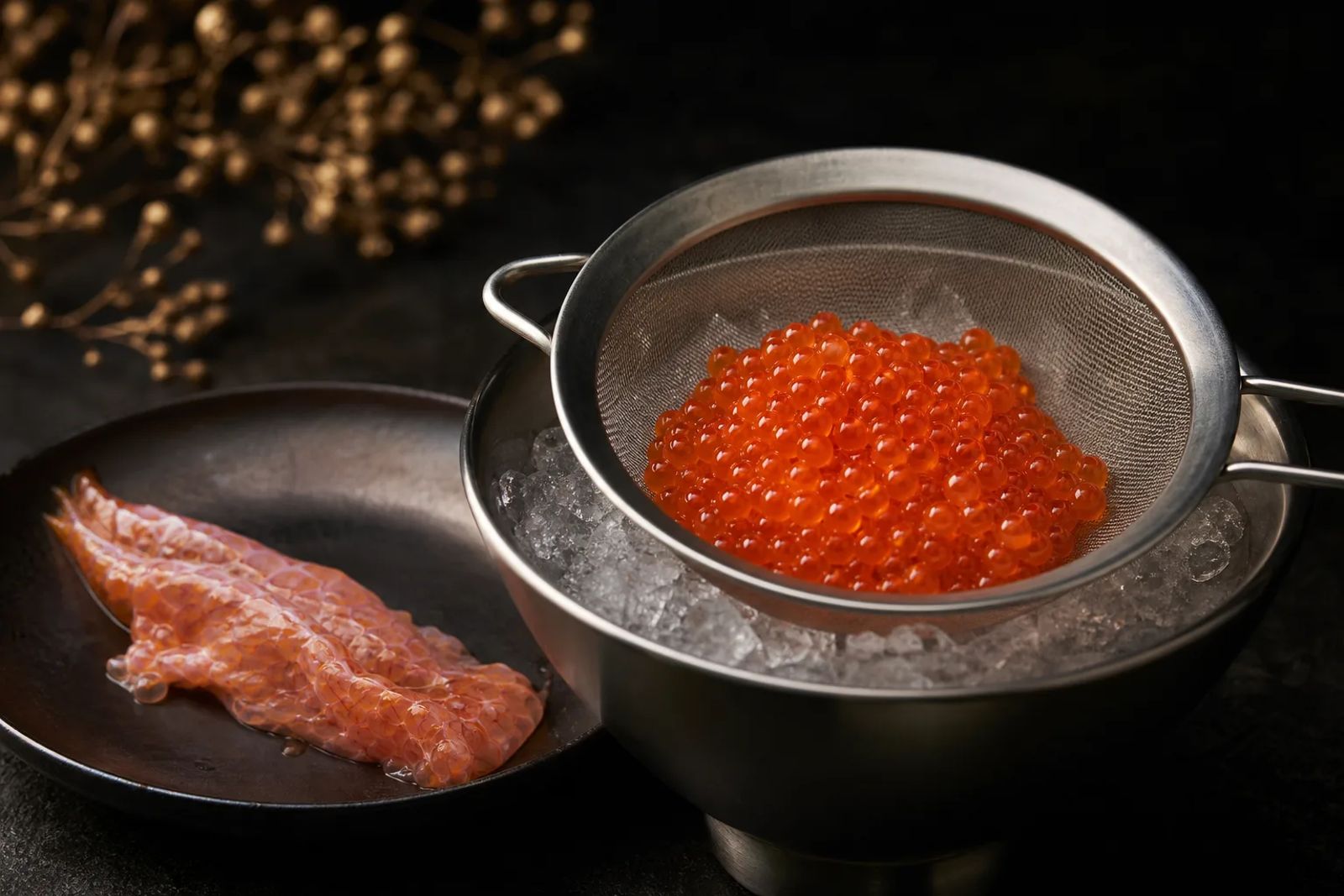
A clean sieve turns a membrane-bound salmon egg sac into loose beads. The touch matters: the University of Alaska Fairbanks describes gently working the eggs free, removing blood, tissue and membrane rather than forcing everything through.
Harvesting begins earlier, when the egg sacs, or skeins, are removed from female fish. They can be cured whole or separated, cleaned and salted. Brine, dry salt and soy-based seasoning each produce a different food. All depend on hygienic handling and a controlled cold chain.
Where salmon roe comes from
Most commercial salmon roe comes from wild Pacific salmon fisheries. EUMOFA's 2022 production study describes roe recovery alongside meat production, rather than fish being caught solely for their eggs. It also documents a smaller supply from farmed Atlantic salmon and a separate farmed trout roe industry.
The harvest follows the salmon runs. Processor E&E Foods gives May to November for its Alaska and British Columbia sourcing season; this is not a universal calendar for all salmon fisheries. A jar's packing date is not its fishing date.
For the wider family of products, start with salmon and trout roe. Here, the focus is the processing line, where quality control shapes the finished roe and food safety keeps it fit to eat.
From whole skeins to loose beads
The sequence below follows loose, salted eggs through commercial processing, rather than offering a home recipe. Factories adapt the order to their products, especially when raw skeins are frozen for processing later.
-
Recover the skeins. During gutting, workers lift out the membrane-bound egg sacs without deliberately breaking them. This can happen aboard a suitably equipped vessel or ashore. Alaska's roe-recovery guidance calls for cleanable surfaces, sanitation and protection from contamination.
-
Chill and sort. The recovered sacs are kept cold while roe technicians assess maturity, bruising and blood saturation. Sorting builds consistency into the batch; temperature control limits deterioration.
-
Separate the eggs. Ikura is the loose bead product, so the membrane must come away. The University of Alaska Fairbanks describes using a clean sieve with a gentle touch, removing blood, tissue and membrane fragments. Commercial processors may also use mechanical screens.
-
Clean and cure. Rinsing clears remaining membrane and debris. Salting establishes the intended flavour and composition, but the processor must control the finished product: the salt concentration in the surrounding brine is not necessarily the concentration inside the eggs.
-
Drain and grade. Excess liquid is removed and the batch assessed against the processor's specification. ASMI's industry report describes numbered commercial grades; these are not one universal grading system covering every producer and country.
-
Pack and preserve. Roe goes into bulk containers for later repacking or smaller retail packs. Some products are pasteurised, receiving a defined heat treatment to reduce target microorganisms. Others rely on freezing or a validated refrigerated shelf life.
How the cure changes the roe
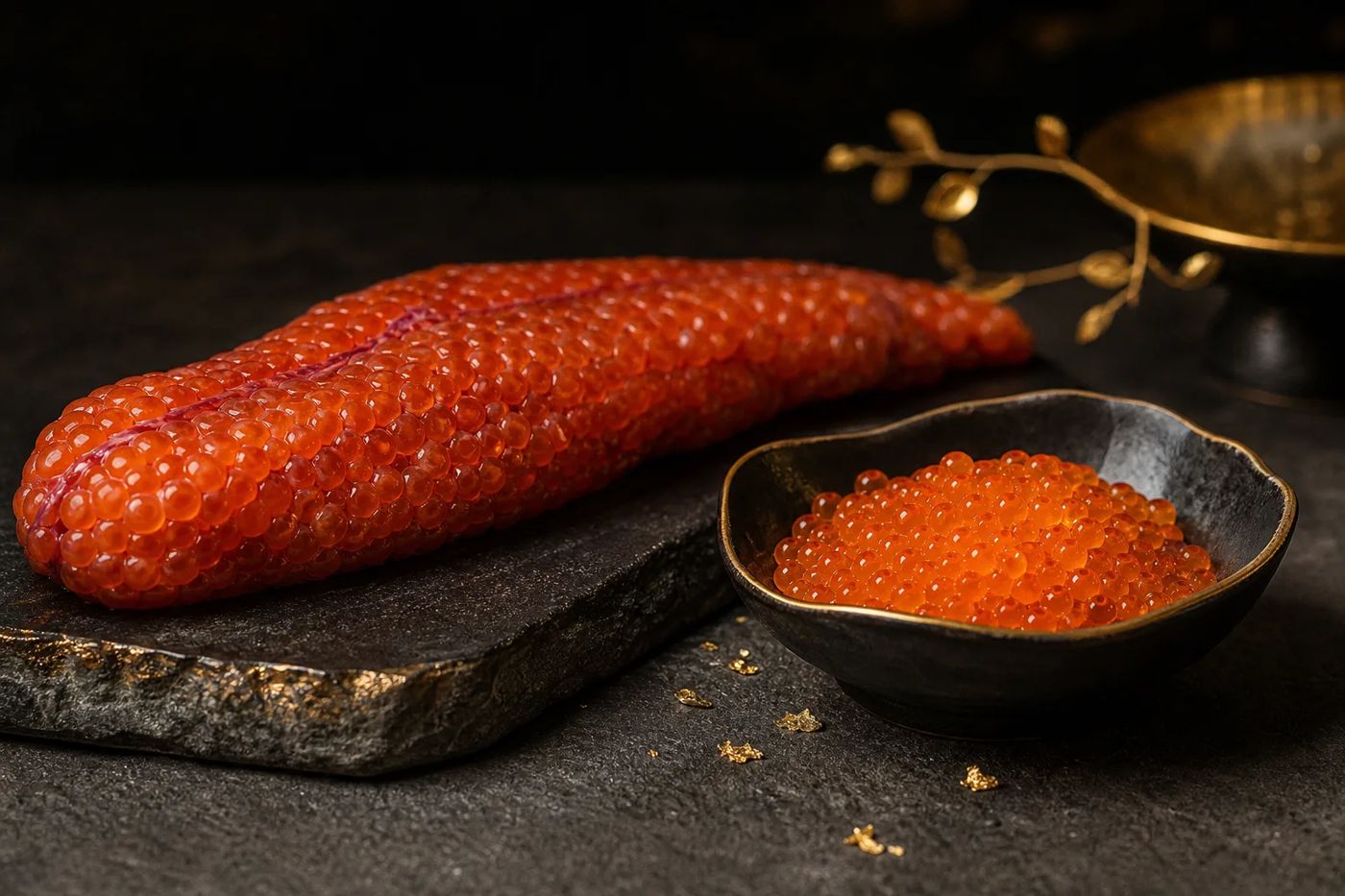
Brining immerses separated eggs in a prepared salt solution before draining. Japan's Ministry of Agriculture, Forestry and Fisheries distinguishes it from sprinkling salt directly onto the roe: immersion encourages more even salt penetration, while dry salting draws out water, creating concentrated brine around the eggs.
The salt level belongs to the finished product, not to a general recipe. A 1998 University of Alaska study of pink salmon ikura from one processing plant found an average of 3% salt, or 3 g per 100 g. That figure describes the roe studied at that plant.
Beyond salt levels, there are formal product standards to consider. Russia approved GOST 1629-2026 and GOST 18173-2026 for granular Pacific salmon roe. According to an official Russian fisheries research institute announcement of 15 July 2026, both take effect on 1 June 2027, with earlier use permitted.
Shoyu ikura brings soy-based seasoning into the cure. MAFF recognises salmon roe in soy sauce as a distinct prepared product. Its final salt content depends on the formulation, so the figure on the soy sauce bottle cannot tell you the salt content of the roe. Soy, and sometimes wheat, also changes the allergen information.
Sujiko keeps the eggs inside the skein during curing. Explore ikura versus sujiko for the structural differences, or follow homemade shoyu ikura for a kitchen method rather than adapting a factory process.
Why freezing is routine
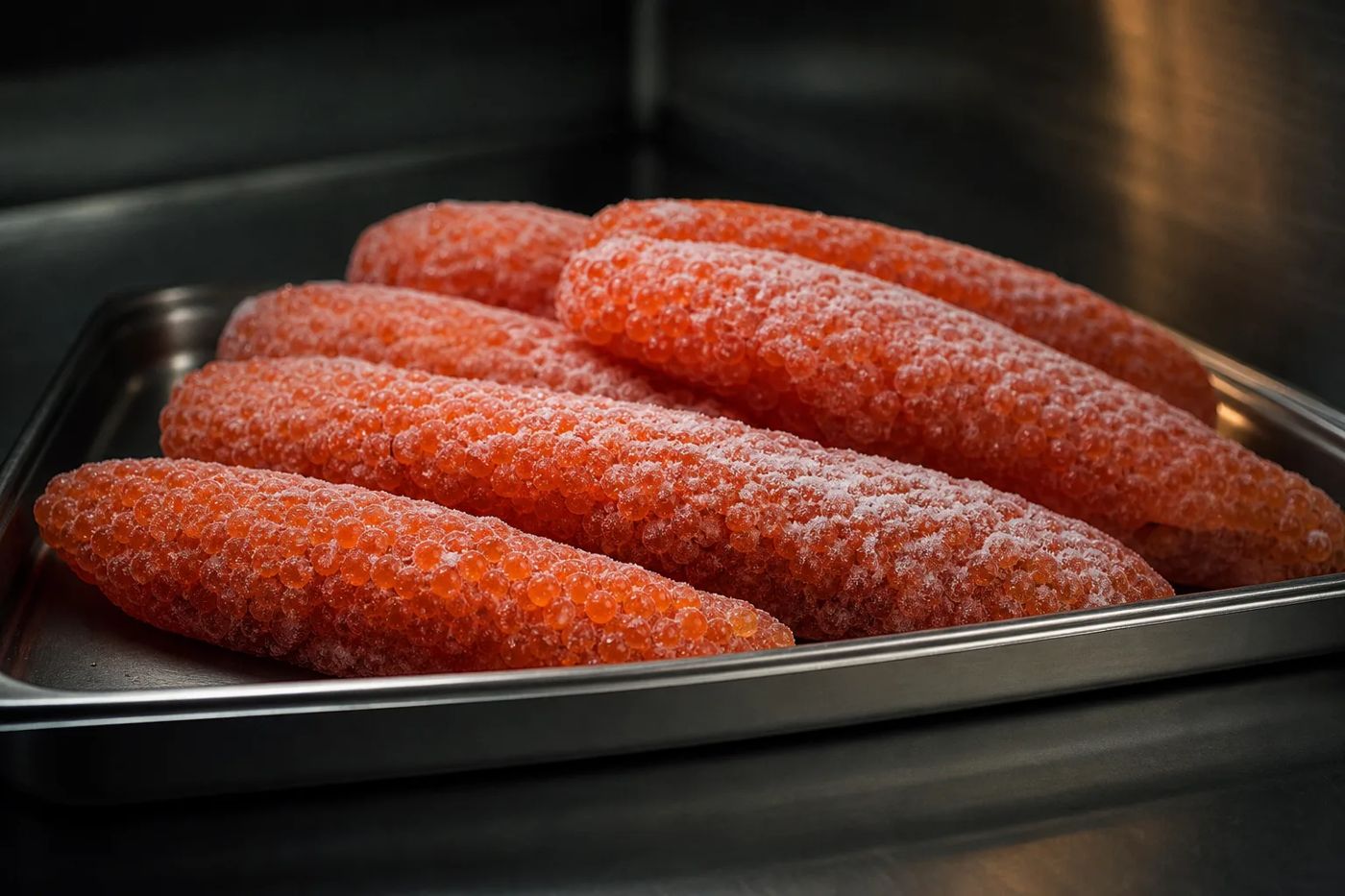
Freezing carries a seasonal harvest into year-round distribution. ASMI documents frozen ikura and sujiko, along with frozen unprocessed roe destined for secondary processors. It is a standard commercial route, not a sign of mishandling.
Salmon eggs have relatively substantial membranes that help them tolerate freezing, according to the University of Alaska. Their fats can still oxidise during storage, making handling important throughout. The university's household guidance does not establish an industrial shelf life, which depends on commercial packaging and validated processes.
Freezing for distribution also has a different job from freezing to destroy parasites. “Previously frozen” on a label tells you neither the treatment's time and temperature nor whether it was suitable for parasite destruction.
Parasite rules: loose eggs or whole skeins?
The decisive distinction is whether the eggs are clean and separate or still enclosed in tissue. FDA's seafood hazards guidance says parasites may occur in skeins but are generally not inside the eggs themselves. Removed, rinsed eggs are therefore treated differently from intact or unrinsed roe.
In the EU, Regulation (EC) No 853/2004, Annex III, Section VIII, covers raw fishery products and salted or marinated products whose treatment does not kill viable parasites. Where freezing is required, the prescribed treatments for parasites other than trematodes are -20°C (-4°F) throughout the product for at least 24 hours, or -35°C (-31°F) for at least 15 hours, subject to the regulation's exemptions.
Great Britain uses assimilated hygiene legislation; Northern Ireland follows the applicable EU framework. Each must be checked separately. The application of those rules to separated eggs and whole skeins is not documented, so the US exception cannot be carried across.
In the US, the 2026 FDA Food Code expressly exempts fish eggs removed from the skein and rinsed from its parasite-destruction requirement. For products that need treatment, options include -20°C (-4°F) for seven days, or freezing at -35°C (-31°F) until solid and holding at that temperature for 15 hours. The Food Code is a model, enforceable through the adopting jurisdiction's rules.
Salt cannot replace the cold chain
Light curing does not sterilise roe. Nor does frozen storage reliably eliminate bacteria: in the Alaska pink salmon study, freezing had little effect on microbial counts. A thawed batch still needs controlled handling.
FDA's seafood hazards guidance says parasites may occur in skeins but are generally not inside the eggs themselves.
Listeria control depends on clean equipment, separation of raw and ready-to-eat areas, and a shelf life supported by the product's safety assessment. For home storage in Scotland, Food Standards Scotland advises keeping chilled ready-to-eat foods at 5°C (41°F) or below. Follow any colder instruction on the pack, along with its use-by date and after-opening directions.
A sealed jar does not make roe shelf-stable. Reduced-oxygen packs also need controls against botulism. For the wider risks and guidance for vulnerable readers, see caviar food safety.
Additives depend on the destination market
Additive permission is specific to the market and product. In the EU, Regulation (EC) No 1333/2008 sets permissions and conditions, including those for food category 09.3, fish roe. Great Britain uses the FSA's official additive register under its assimilated legislation, while Northern Ireland generally follows EU rules. A current authorised additive and its conditions for salmon roe are not documented.
Japan's Food Sanitation Act permits sodium nitrite in ikura and sujiko below 0.0050 g/kg as nitrite, according to FFCR's 2026 use standards.
In the US, 21 CFR 172.175 authorises nitrite in specified smoked, cured fish products, rather than granting unrestricted use in salted salmon eggs. Russia's announced 2026 GOST revision refers additive compliance to the Eurasian rules in TR TS 029/2012. A GOST product specification does not confer worldwide additive permission.
What the finished pack should tell you
Read the product name and ingredient list together: separated salted eggs, whole skeins and soy seasoned roe describe different foods. Check the named fish, allergens, storage instructions, date marking and batch identifier.
Labelling requirements vary by market. The processor's address alone does not establish where the fish was caught or farmed.
Then ask three practical questions: was the roe frozen before or after curing, has it been pasteurised, and what storage and opening instructions apply to this pack? Those answers reveal more about its handling than a grade word standing alone.
Sources
- European Commission, EUMOFA. Salmon and trout roe: production, trade, and consumption. October 2022, especially sections 2 and 3. Report.
- E&E Foods. Salmon Roe. Undated producer account, retrieved November 2026. Production and seasonal information.
- Alaska Department of Environmental Conservation. Guide for Alaskan Salmon Roe Recovery Vessels. Undated online guidance, retrieved November 2026. Vessel guidance.
- Alaska Department of Labor and Workforce Development. At Sea Production Career. Undated occupational description, retrieved November 2026, “Roe Processing”. Roe technician duties.
- University of Alaska Fairbanks, Cooperative Extension Service. Salmon Roe Caviar. Online edition, undated, retrieved November 2026. Handling, separation and preservation.
- Japanese Ministry of Agriculture, Forestry and Fisheries. Salted foods. Traditional Foods in Japan, undated online edition, retrieved November 2026. Salting methods and roe products.
- University of Alaska Fairbanks researchers. Microbial evaluation of Alaska salmon caviar. Research article, 1998; PubMed record. Study abstract.
- McDowell Group for the Alaska Seafood Marketing Institute. Analyses of Specialty Alaska Seafood Products. November 2017, revised April 2018, “Roe Quality: Specifications and Ramifications”. Industry report.
- European Parliament and Council. Regulation (EC) No 853/2004 laying down specific hygiene rules for food of animal origin. Consolidated text retrieved: 9 May 2024, Annex III, Section VIII, Chapter III, Part D. Consolidated regulation.
- US Food and Drug Administration. Fish and Fishery Products Hazards and Controls Guidance. June 2022 edition, especially chapters 5, 12, 13 and 16. Guidance.
- US Food and Drug Administration. Food Code. 2026 edition, section 3-402.11 and preface. 2026 Food Code.
- Food Standards Agency. Freezing fish, fishery products and treatment for parasites. Published 11 January 2018; government publication page retrieved November 2026. Publication record.
- Food Standards Scotland. What is listeria? Undated online guidance, retrieved November 2026. Listeria and chilled-food handling.
- European Parliament and Council. Regulation (EC) No 1333/2008 on food additives. Consolidated text retrieved through search: 2 June 2024, Annex II. Regulation.
- Food Standards Agency. Guidance on using the Register of Food Additive Authorisations. Online guidance, retrieved November 2026; register framework effective 1 April 2025. GB register guidance.
- Japan Food Chemical Research Foundation. Japan's Specifications and Standards for Food Additives. Eighth edition, English translation of the 2007 edition, sodium nitrite use-standard table. Historical specifications.
- Japanese Consumer Affairs Agency. Food Additives. Current online reference page, retrieved November 2026; links to use standards and the tenth edition, published 2024. Official additive framework.
- US Code of Federal Regulations. 21 CFR 172.175: Sodium nitrite. eCFR text current to 2 November 2026. Authorised uses.
- Russian Institute of Standardisation. Digest No. 265, item reporting Rosstandart's revised salmon roe standards. July 2026. GOST revision announcement.
This piece was researched through government and university guidance, published research, an industry processing report and an explicitly attributed producer account.
Last checked: November 2026