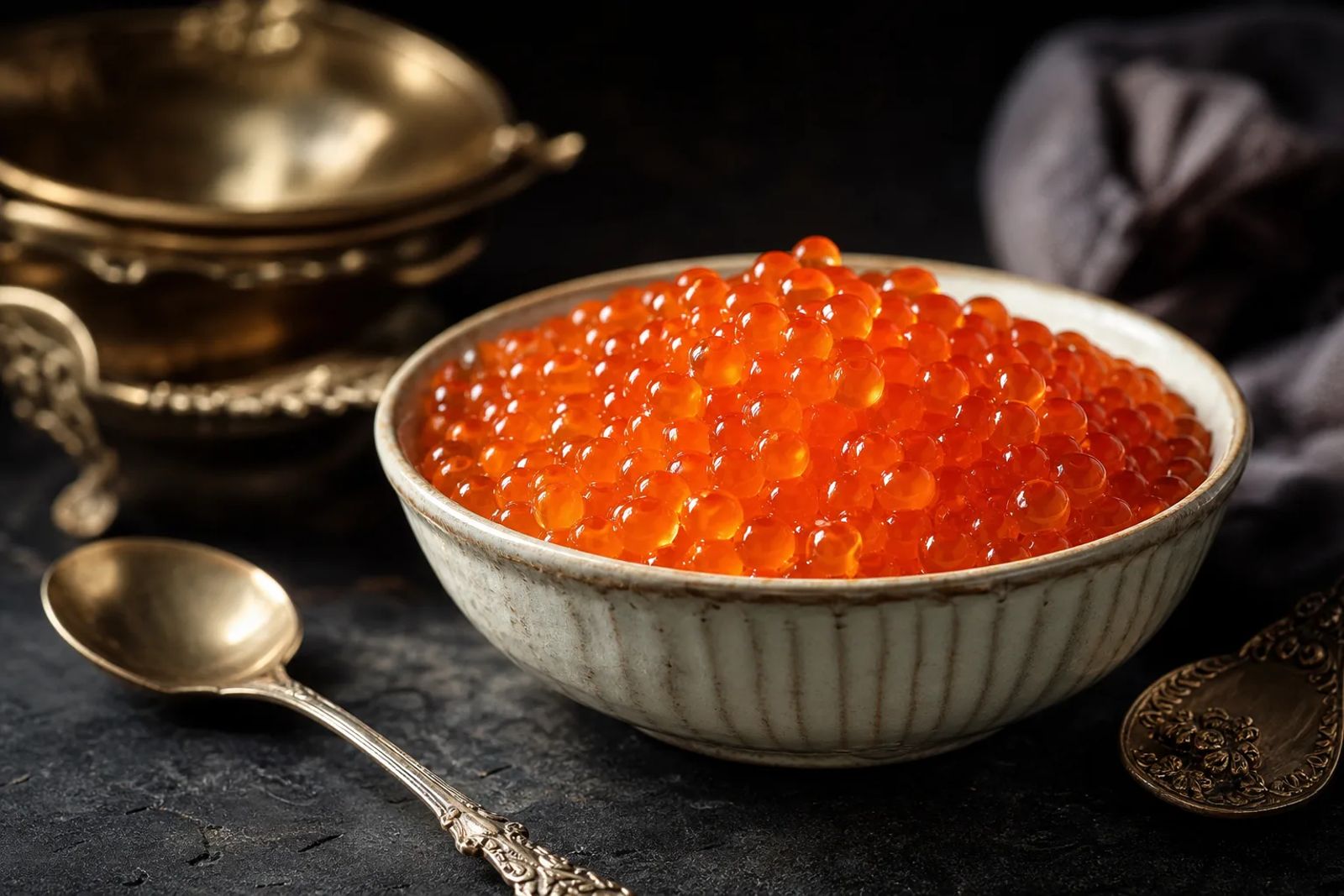
Large beads, pale red with strong orange overtones, and a characteristic pop: that is the Alaska Seafood Marketing Institute’s description of keta roe.
Keta roe comes from chum salmon, Oncorhynchus keta, and is usually sold as separated, cured beads. Those orange-red eggs are a familiar choice for ikura. But neither “ikura” nor “red caviar” tells you which salmon produced them.
Meet the fish
Chum, keta and dog salmon are the same fish, not different roe grades. The “dog” name comes from the conspicuous canine-like teeth males develop for spawning. It says nothing about the eggs.
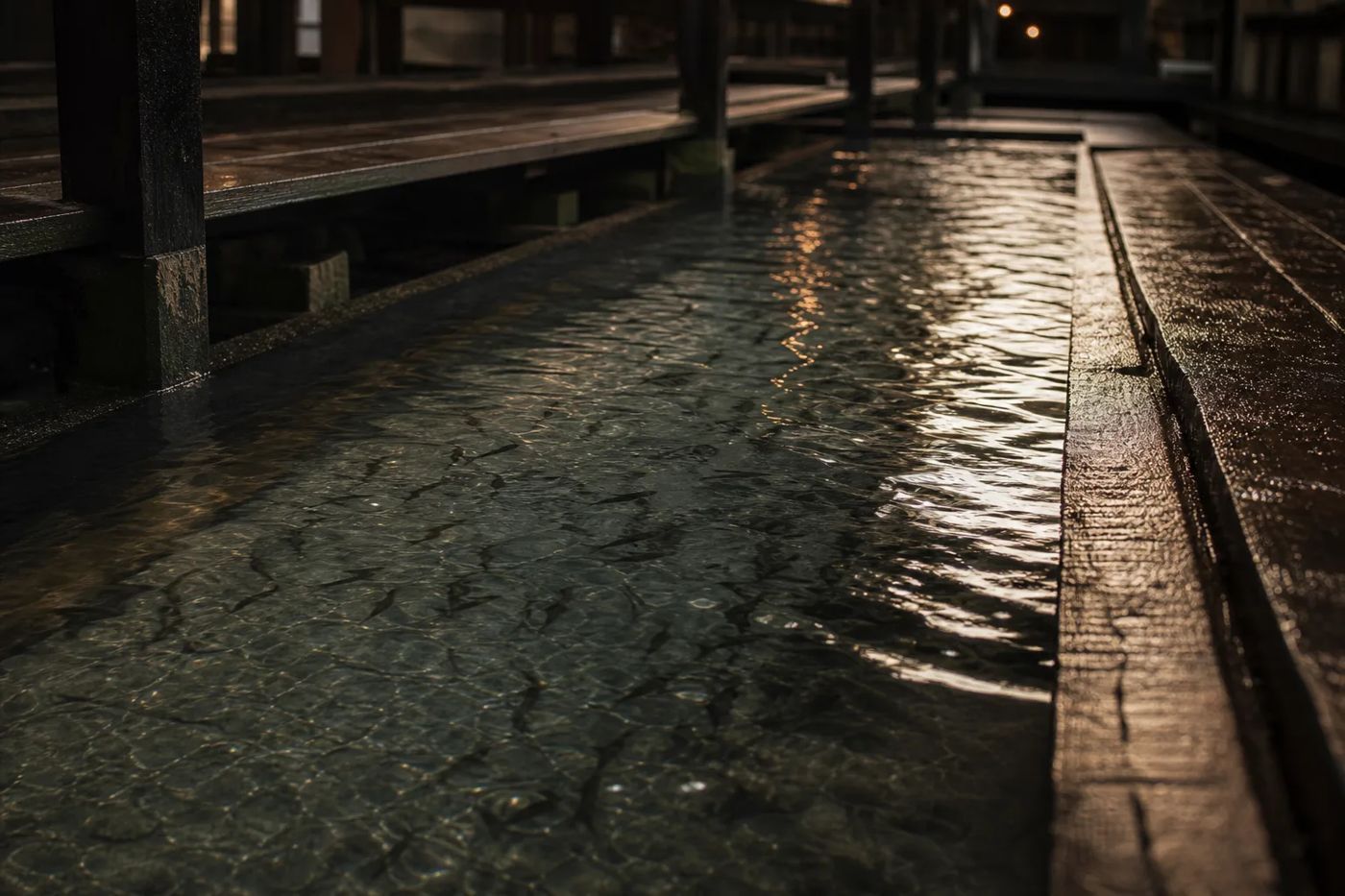
The species lives around the North Pacific rim, including Japan, the Russian Far East, Alaska and western North America. It grows at sea and returns to fresh water to reproduce: an anadromous life cycle. For understanding a roe’s origin, where the fish was caught matters more than the nationality of the business packing it.
Within salmon and trout roe, keta offers a useful introduction to salmon roe with large beads. For terminology and serving basics, turn to the complete ikura guide: The Complete Guide).
Big beads and a distinctive pop
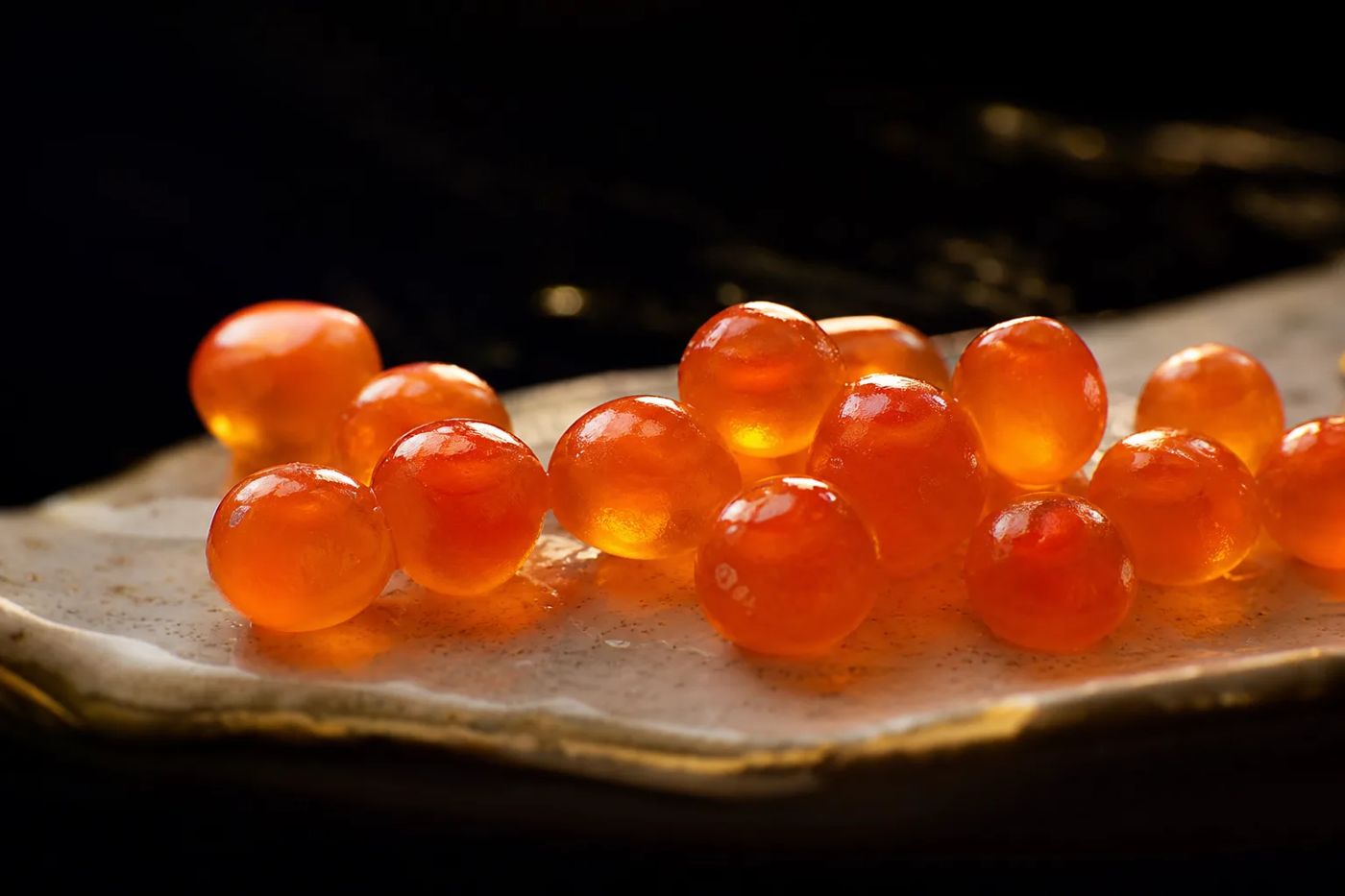
Size is keta’s calling card. The Alaska Seafood Marketing Institute, or ASMI, lists its roe at 5 mm and upwards in its commercial guide. This is a product specification, rather than a minimum diameter for every egg the species produces; the cited sources give no universal upper diameter.
ASMI’s keta fact sheet describes a thicker outer membrane than in other salmon species and a rich, deep flavour. These trade descriptions are not based on a tasting of every keta product.
Keta is not alone in the largest size category. ASMI also lists king salmon roe at 5 mm and upwards, while pink and sockeye roe have smaller beads in its commercial specifications. Large beads distinguish keta, but size is not a quality grade. Explore the differences in the salmon roe comparison.
Where it comes from
Alaska, the Russian Far East and Japan are important sources of chum salmon fisheries and roe. Catch statistics measure fish, not the quantity of finished ikura, so they cannot establish each country’s share of the roe market.
In the United States, NOAA reports about 47,000 tonnes of commercial chum landings in 2024. In Japan, the Fisheries Research and Education Agency documents a national programme of artificial hatching, juvenile releases and monitoring of returning adults. These hatchery-supported fisheries are distinct from farming fish throughout their lives.
NOAA’s 2025 draft assessment, drawing on North Pacific Anadromous Fish Commission data, records substantial chum hatchery releases in Russia, Japan and the United States. Releases help explain the supply system’s scale, although they do not establish that every fish caught was hatchery-born.
The harvest calendar follows local runs. ASMI describes Alaska keta roe harvesting as late summer, while its species sheet distinguishes summer and autumn runs. Frozen salted ikura is an established product form, so roe available outside the fishing season need not come from a recent harvest.
Stocks and management are local
How are chum salmon doing? It depends on the population. Checked in November 2026, NOAA’s account describes Alaska stocks as declining, stable or increasing, depending on the population, with none listed under the US Endangered Species Act. The picture remains specific to individual runs.
Alaska fisheries use escapement objectives: targets for the number of fish allowed through to spawn. Fishing openings are adjusted to the run. In Russia, regional anadromous-fish commissions set fishing volumes, dates and locations using scientific advice. Japan combines hatchery programmes with monitoring intended to improve survival and stabilise returns.
Parts of Japan have documented declines. A joint 2025 announcement by JAMSTEC, the Fisheries Research and Education Agency and the University of Tokyo reported that adult chum observations at the Tone River weir fell to zero in 2024, following a marked decline since 2013. That finding describes the river, rather than the entire Japanese stock.
Reading the label
Look for “chum salmon roe”, “keta salmon roe” or Oncorhynchus keta. On a menu, “ikura” identifies a style of salmon roe, not a guaranteed species. Ask which salmon the restaurant uses.
The “dog” name comes from the conspicuous canine-like teeth males develop for spawning.
In the US, FDA’s nonbinding Compliance Policy Guide 540.150 says unqualified “caviar” should mean salted sturgeon roe. Other fish roe may be called, for example, “salmon caviar”, with the fish name and “caviar” in substantially the same size and prominence. The guidance also calls for an ingredient list and prominent declaration of artificial colour when used.
In the EU, Regulation (EU) No 1169/2011 requires food information not to mislead and sets rules for the food’s legal, customary or descriptive name. Great Britain applies its assimilated version; Northern Ireland applies the EU regulation. Customs classifications are separate from these consumer-information rules and do not determine the complete wording of a retail label.
A clearly stated species is useful information, although not every cured roe product must carry its Latin name. If a pack says only “salmon roe”, ask for the species and harvesting origin. The processor’s address is no substitute.
Choosing it in a shop
Start with distinct, large orange-red beads, then check the description. That appearance fits the trade description of keta, but colour and diameter cannot identify the species on their own.
Check the product form, too. Salted ikura, seasoned roe and sujiko are different preparations; sujiko is roe cured inside its natural egg sac. Read the ingredients before choosing the flavour profile you want. A salt-cured product and a seasoned one are not interchangeable descriptions.
For the distinction between separating eggs and curing a whole skein, see how salmon roe is harvested and cured. Ready to prepare a rice bowl? Explore ikura don and homemade shoyu ikura.
Sources
-
Alaska Department of Fish and Game. Chum Salmon (Oncorhynchus keta): Species Profile. Undated live edition, retrieved November 2026.
https://www.adfg.alaska.gov/index.cfm?adfg=chumsalmon.main -
US Fish and Wildlife Service. Chum Salmon (Oncorhynchus keta). Undated live species account, retrieved November 2026.
https://www.fws.gov/species/chum-salmon-oncorhynchus-keta -
Alaska Seafood Marketing Institute. Keta Salmon, fact sheet 1-023. Undated edition, retrieved November 2026.
https://www.alaskaseafood.org/wp-content/uploads/1-023-Keta-Salmon.pdf -
Alaska Seafood Marketing Institute. Wild Alaska Salmon Roe, in Alaska Seafood Comprehensive Guide. 2025 edition, retrieved from an exhibition-document repository.
https://exhibitor-manual-004.s3.ap-south-1.amazonaws.com/Production/exb_doc/2041/47958/ASMI_Seafood_Guide_Update_2025-08.pdf -
Alaska Seafood Marketing Institute. Wild salmon caviar of Alaska. Undated material, explicitly credited to ASMI and reproduced by the Association of Ukrainian Importers of Fish and Seafood; retrieved November 2026.
https://uifsa.ua/en/about-fish/advice-from-alaska-seafood/wild-salmon-caviar-of-alaska -
NOAA Fisheries. Chum Salmon. Live species and fishery account, including 2024 landings and population information dated 2025; retrieved November 2026.
https://www.fisheries.noaa.gov/species/chum-salmon -
NOAA Fisheries. Draft Environmental Impact Statement and Regulatory Impact Review: Bering Sea Chum Salmon Bycatch Management. September 2025 draft.
https://media.fisheries.noaa.gov/2025-09/Chum-Salmon-Bycatch-Management-DEIS-akro.pdf -
Japan Fisheries Research and Education Agency. Salmon Enhancement Division. Undated live institutional account, retrieved November 2026.
https://www.fra.go.jp/english/shigen/salmon/salmon_enhancement_division.html -
Federal Agency for Fisheries, Russia. Стратегия промысла [Fishing strategy], regional salmon-fishery strategy materials. 2025 edition.
https://fish.gov.ru/wp-content/uploads/2025/05/protokol_dvnps_250425.pdf -
JAMSTEC, Japan Fisheries Research and Education Agency and University of Tokyo. Beyond lethal temperatures: Factors behind the disappearance of chum salmon from their southern margins under climate change. Joint research announcement, 11 September 2025.
https://www.jamstec.go.jp/e/about/press_release/20250911_2/ -
US Food and Drug Administration. CPG Sec. 540.150: Caviar, Use of Term, Labeling. October 1989 edition, current published guidance retrieved November 2026.
https://www.fda.gov/regulatory-information/search-fda-guidance-documents/cpg-sec-540150-caviar-use-term-labeling -
Court of Justice of the European Union. Monthly Case-law Digest: November 2024. 2024 edition, discussion of food naming and Regulation (EU) No 1169/2011.
https://curia.europa.eu/site/upload/docs/application/pdf/2024-12/bulletin_mensuel_en_nov24.pdf -
UK government. Packaging and labelling. Undated live guidance, retrieved November 2026; distinguishes Great Britain’s assimilated legislation from EU legislation applying in Northern Ireland.
https://www.gov.uk/government/publications/packaging-and-labelling/packaging-and-labelling
Research combined official fisheries accounts and food-labelling guidance with explicitly attributed ASMI product descriptions, keeping fish catches, hatchery releases and finished-roe supply distinct.
Last checked: November 2026