Kaluga hybrid caviar is salted roe from a sturgeon bred by crossing Kaluga, Huso dauricus, with Amur sturgeon, Acipenser schrenckii. The commercially documented cross described here has a female Kaluga parent and a male Amur parent: its CITES species code is SCHxDAU, not DAUxSCH. It is neither pure Kaluga nor beluga.
Kaluga hybrid fact box
| Field | Verified position |
|---|---|
| Female parent | Kaluga, Huso dauricus. 5,7 |
| Male parent | Amur sturgeon, Acipenser schrenckii. 5,7 |
| CITES hybrid code | SCHxDAU, male parent first. 1,2 |
| Reciprocal cross | Female Amur sturgeon and male Kaluga: DAUxSCH under the CITES rule; commercial caviar trade not documented. 1 |
| Source codes documented in trade | Not documented from a verified CITES Trade Database extract. 3 |
| Verified farming country | China, per a 2013 farming study and FAO. 4,5 |
| Egg diameter | Not documented as a shared reference range. 6 |
| Colour | No shared range is documented; one producer describes amber to brownish yellow roe. 5 |
| Parents' conservation status | Both Critically Endangered in the 2022 overview; no separate IUCN status is assigned to this hybrid. 6 |
Which fish are its parents?
A hybrid is the offspring of two different species, not a mixture of their roe in one container. The eggs sold as this caviar come from a mature female hybrid fish, rather than directly from the original female Kaluga used to breed her.
Both parent species are native to the Amur River system shared by China and Russia. Their Critically Endangered status concerns the wild species, not a quality classification for farmed caviar; breeding hybrids does not restore genetically distinct wild populations.
This article names the female parent first in prose and explicitly identifies each sex. Read the separate accounts of Kaluga and Amur sturgeon for the parents' biology, rather than treating the hybrid as another name for either fish.
The CITES names are used here. The IUCN Sturgeon Specialist Group and World Sturgeon Conservation Society rejected the 2025 genus proposals at their October 2025 meeting but recommended placing Kaluga and beluga in Acipenser; this article retains CITES names for labelling, so alternative names should not silently replace the regulatory names.
Why the parent order changes
The CITES universal labelling guidelines are in Annex 1 of Resolution Conf. 12.7 (Rev. CoP17); the species code table and male-first hybrid formula are in Annex 2. United States regulation 50 CFR 23.71(b)(2)(i) independently specifies male code, then x, then female code.
Consequently, SCHxDAU identifies a male Amur sturgeon crossed with a female Kaluga. DAUxSCH would identify a male Kaluga crossed with a female Amur sturgeon, but the existence of a code formula is not evidence that caviar from that reciprocal cross is commercially traded.
Codex CXS 291-2010, modified in 2026, puts the female first in Annex A, Table 1; section 7.1.3 requires hybrid and permits naming parents. Codex is an international food standard, not automatically binding national law.
A scientific paper or product description can therefore put Kaluga first without contradicting a correctly written SCHxDAU wildlife label. For a fuller explanation, see how hybrid caviar is labelled.
Where it is farmed and why
China is a documented farming country for this cross. Zhang and colleagues reported in 2013 on this female Kaluga and male Amur cross farmed in China, while FAO's 2019 industry account identifies the Kaluga and Amur hybrid as China's most common source of caviar.
A named producer provides a more specific explanation. In its June 2026 prospectus, Hangzhou Qiandaohu Xunlong Sci-tech, the company behind Kaluga Queen, says its female Kaluga and male Amur breeding programme shortens the maturity cycle and balances caviar characteristics with farming efficiency.
That is a producer's account of its own breeding programme, not a universal performance guarantee for every cross or farm. The country where a seller is based is not evidence of farming origin; Chinese caviar explains the production context.
What it looks and tastes like
No general egg diameter range is documented. Appearance is better described through an identified producer's product than through a supposed visual test for the cross.
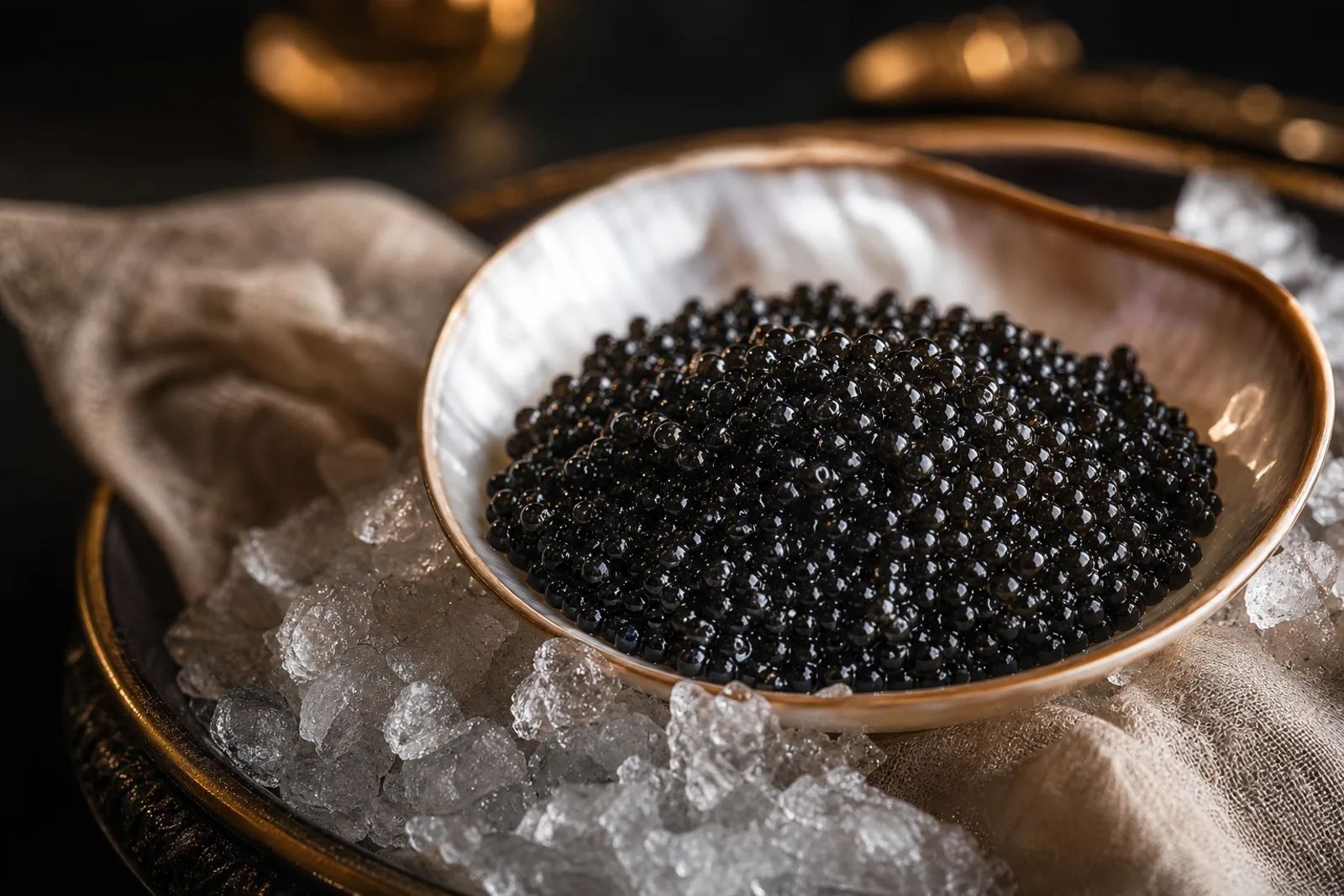
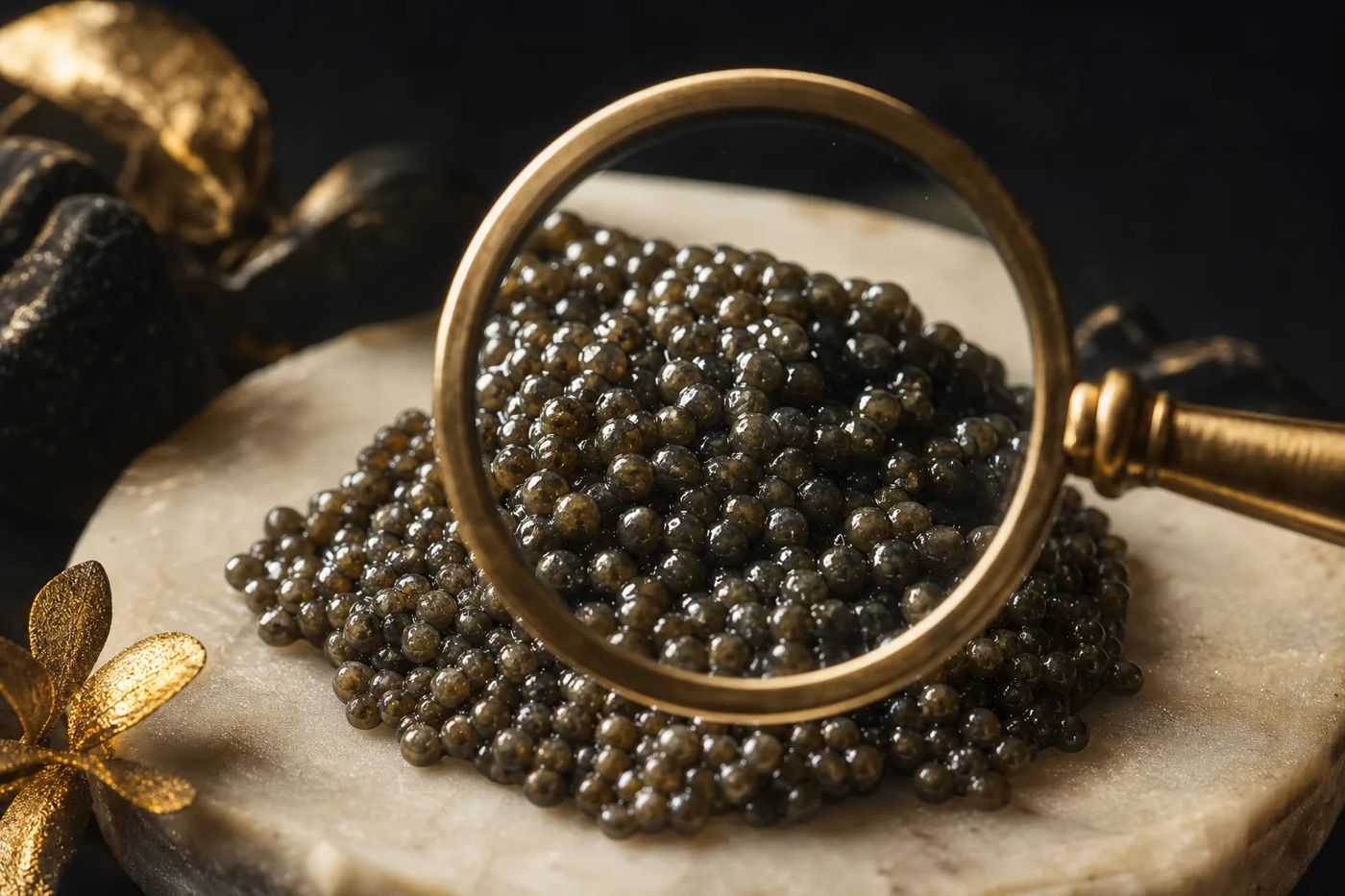
Kaluga Queen describes its hybrid roe as amber to brownish-yellow, with resilient membranes and a lingering cream-like aroma. Caviar Colony describes its own female Kaluga and male Amur product as olive-tinted, with earthy, mushroom-like notes, a gentle tang and a slightly bitter finish.
These are attributed product descriptions. Neither a golden colour nor a large bead establishes parentage: use the declared cross and traceability information to establish what the supplier is offering.
Reading Kaluga hybrid on a label
Start with the species field, then read the origin and plant details separately. The following deliberately impossible code illustrates the order of fields on an original container, without inventing a genuine shipment:
Teaching example, not a real label: XXXxYYY/Q/ZZ/0000/0000/000.
| Field | Meaning |
|---|---|
| XXXxYYY | Male species code followed by female species code. |
| Q | Placeholder for the documented source code, not a valid code. |
| ZZ | Placeholder for the country of origin. |
| First 0000 | Placeholder for the harvest year. |
| Second 0000 | Placeholder for the processing plant registration. |
| Final 000 | Placeholder for the lot identifier. |
For this documented cross, the species field should identify SCHxDAU under the CITES convention. On repacked caviar, the country of origin remains distinct from the repacking country's plant details and the repacking year; a European repacker does not make Chinese roe European in origin.
A CITES label provides a traceability declaration, not independent proof of the contents. If identity is disputed, laboratory testing needs methods validated for the relevant parents and hybrids, rather than assuming that any generic fish DNA test will settle it.
Why Kaluga is not beluga
Beluga denotes the species CITES lists as Huso huso, not either parent of this cross. Calling this product Kaluga Beluga can suggest beluga ancestry that the documented female Kaluga and male Amur cross does not have.
Pure Kaluga caviar and Kaluga hybrid caviar should also remain distinct descriptions. Kaluga alone on a menu does not tell you whether the kitchen means Huso dauricus or the hybrid, and no verified menu survey establishes how often that shorthand occurs.
Caviar Colony describes its own female Kaluga and male Amur product as olive-tinted, with earthy, mushroom-like notes, a gentle tang and a slightly bitter finish.
The supplier's species declaration or the container label is the evidence to check, rather than the familiarity of a name. Beluga vs Kaluga explains the species distinction; spotting hybrids sold as pure species follows the identity question further.
Labelling and imports in the main markets
Consumer food names and wildlife trade codes answer different questions. Customs classifications do not, by themselves, decide whether a menu or retail description is misleading.
In the EU, Article 7 of Regulation (EU) No 1169/2011 prohibits misleading food information, including about identity and composition. Regulation (EC) No 865/2006 separately implements caviar labelling requirements for wildlife trade, including containers destined for the domestic market.
In Great Britain, the assimilated version of Regulation 1169/2011 governs food information; Northern Ireland generally follows the EU version. APHA guidance explains when CITES import or export permits are needed, including movements between Great Britain and the EU.
In the US, 50 CFR 23.71 governs international caviar trade and its labelling, while FDA's nonbinding CPG 540.150 discusses food naming. The guidance associates unqualified caviar with salted sturgeon roe and calls for the fish name in the same type size for other roe; it also addresses added colour. The word caviar alone does not establish that a product is pure Kaluga or beluga.
For international movements, a correctly labelled container does not replace required permits or food import clearance. Destination rules apply, and the rules for commercial shipments and personal luggage are not interchangeable.
According to GOV.UK, personal luggage into or out of Great Britain needs no CITES permit for 125 g of caviar per person in individually marked containers. Food import restrictions still apply. Check the rules separately for Northern Ireland and for the other country involved in the journey.
Documenting hybrid provenance
Records should identify the parental species, farming country and original or repacked label details. They should also give the producer's description of bead size and texture for that product, rather than a general trade name.
A clear record identifies female Kaluga and male Amur ancestry and separate the roe's origin from its packing location. For broader context, the hybrid caviar guide explains how to compare crosses without assuming that a hybrid name denotes a lesser product or a fixed flavour.
Sources
-
CITES. Conservation of and trade in sturgeons and paddlefish, Resolution Conf. 12.7 (Rev. CoP17), 2016. Annexes 1 and 2. Retrieved copy hosted on Regulations.gov. Resolution text.
-
United States, Fish and Wildlife Service. 50 CFR § 23.71: How can I trade internationally in sturgeon caviar? Online text consulted November 2026, reproduced by Cornell Legal Information Institute. Regulation text.
-
CITES Secretariat and UNEP-WCMC. CITES Trade Database, version 2026.1 identified on the retrieved homepage, 2026. Homepage and query interface consulted, not a completed hybrid trade extract. Database.
-
Zhang, Y., Liu, X., Qu, Q. and Sun, D. The Growth Characteristics of Acipenser schrenckii (male) × Huso dauricus (female) Hybrid under Artificial Farming Conditions. Chinese Journal of Fisheries, volume 26, issue 2, 2013. Journal record.
-
Hangzhou Qiandaohu Xunlong Sci-tech Co., Ltd. Global Offering Prospectus, 22 June 2026. Business section, “Hybrid Sturgeon Caviar”. Company statements, not independent sensory or performance assessments. Prospectus.
-
Liu, X. et al. The complete mitochondrial genome of the hybrid sturgeon of Huso dauricus (female) × Acipenser schrenckii (male). Mitochondrial DNA Part B, volume 2, issue 1, pages 11 to 12, 2017. PubMed record and abstract.
-
Caviar Colony. Kaluga Hybrid, undated commercial description, consulted November 2026. Sensory claims remain attributed; the retail link is removed.
-
World Sturgeon Conservation Society, Bronzi, P. IUCN SSG summary report, 13 November 2025. Report of the joint taxonomy discussion held on 22 October 2025. Report.
-
European Commission. EU Wildlife Trade Reference Guide, Annex XIV, online edition consulted November 2026. Caviar labelling, processing and repackaging requirements under Regulation (EC) No 865/2006. Annex XIV.
-
UK Government. Packaging and labelling, online guidance consulted November 2026. Great Britain and Northern Ireland food information regimes. Guidance.
-
APHA and Defra. Check if you need a CITES permit to import or export endangered species, online guidance consulted November 2026. Permit requirements and personal effects. Guidance.
-
United States Food and Drug Administration. CPG Sec. 540.150: Caviar, Use of Term, Labeling, October 1989, online version consulted November 2026. Nonbinding guidance. Compliance policy guide.
-
Boscari, E. et al. Species and hybrid identification of sturgeon caviar: a new molecular approach to detect illegal trade. Molecular Ecology Resources, volume 14, issue 3, pages 489 to 498, 2014. PubMed record and abstract.
-
IUCN, Qiwei, W. and Mugue, N. Huso dauricus. The IUCN Red List of Threatened Species, published 2022, assessment e.T10268A146104292. Retrieved assessment record. Assessment.
-
European Parliament and Council. Regulation (EU) No 1169/2011, Article 7, 2011. UK legislative reproduction consulted November 2026. Article 7.
-
FAO and WHO, Codex Alimentarius Commission. Standard for Sturgeon Caviar, CXS 291-2010, retrieved edition amended in 2013, 2018 and 2024. Sections 7.1.3 and Annex A. Retrieved through the FAO document proxy.
-
FAO GLOBEFISH. Chinese sturgeon and caviar industry, 30 September 2019. Historical industry account, not a current production census. Industry account.
Research combined the supplied editorial reference record with retrieved legal texts, scientific abstracts, FAO material and explicitly attributed company descriptions.
Last checked: November 2026