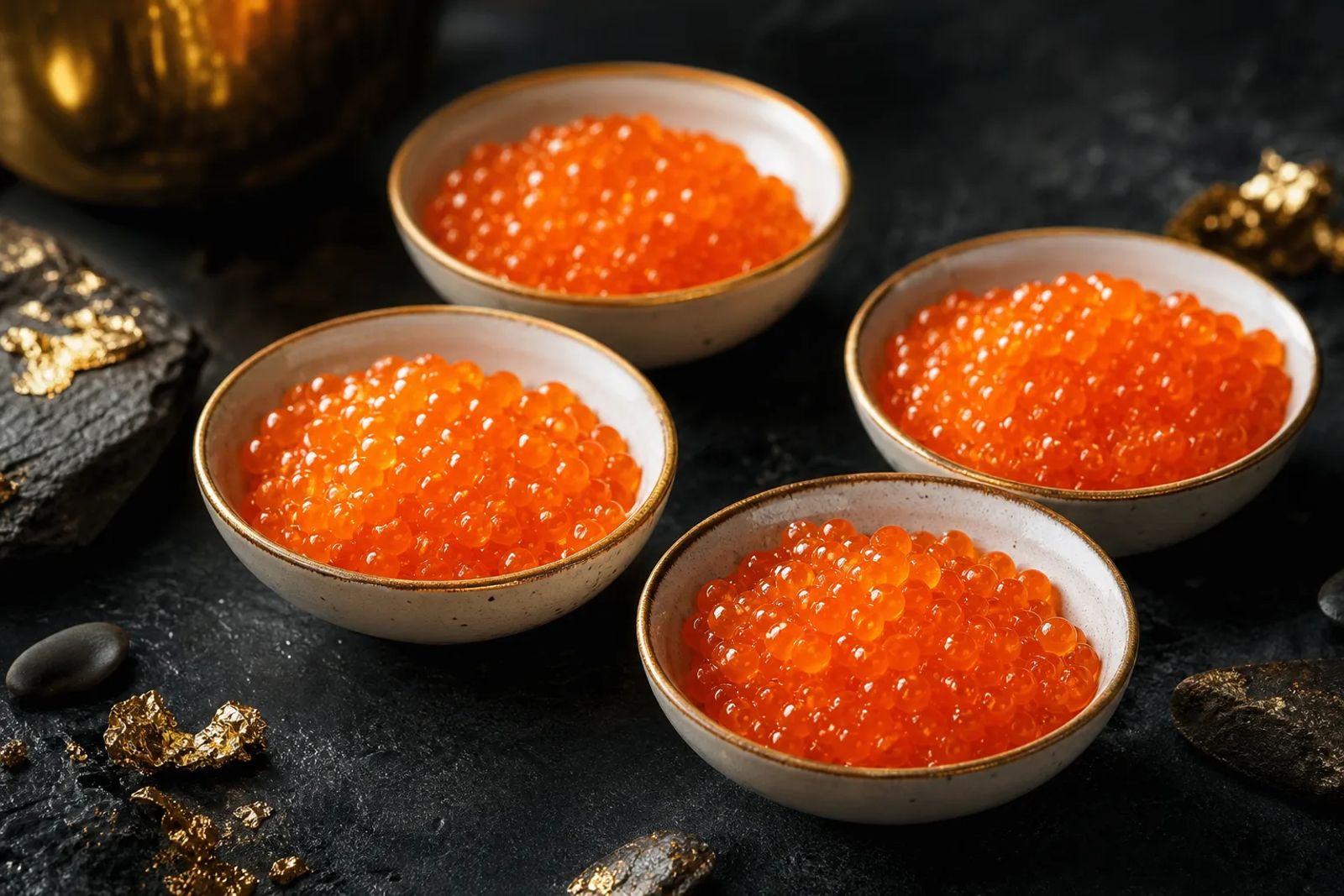
A large king salmon egg with a distinct pop; a small, bright-red sockeye bead with a slightly bitter finish. The Alaska Seafood Marketing Institute's descriptions capture how differently salmon roe can eat. Pink takes a gentler turn: the University of Alaska Fairbanks describes it as mild and sweet. Coho brings another combination, rich and slightly bitter, with a creamy texture in ASMI's account.
Start with those contrasts, then look at the product itself. Cure and batch shape the experience, and several published bead sizes are minimum specifications, not complete species ranges.
Salmon roe at a glance
All four are Pacific salmon in the genus Oncorhynchus. Their names and colours offer a useful route through salmon and trout roe. For species identity, however, you need documentation: neither a photograph nor a bead measurement settles it.
| Species | Scientific name | Documented diameter, mm | Reported colour | Documented food-roe source |
|---|---|---|---|---|
| Pink (humpback, humpy) | Oncorhynchus gorbuscha | 3 to 5 | Orange, sometimes rose-tinted | Alaska |
| Coho (silver) | Oncorhynchus kisutch | 4 and above | Red-pink to red | Alaska |
| Sockeye (red) | Oncorhynchus nerka | 2.5 and above | Bright red | Alaska |
| King (Chinook) | Oncorhynchus tshawytscha | 5 and above | Bright orange to red-pink | Alaska |
These diameters come from the Alaska Seafood Marketing Institute's (ASMI) August 2025 marketing specifications. They are trade specifications, not biological limits or legal grades. No reliable upper bound was established for commercial coho, sockeye or king beads, so those entries remain open-ended.
The colours come from the University of Alaska Fairbanks and ASMI's older roe guide. That older guide sets coho's minimum at 4.5 mm, against 4 mm in the newer guide. The practical lesson is simple: request the supplier's actual specification rather than using a trade threshold to identify a species.
What each roe tastes and feels like
These published accounts describe product categories rather than a controlled tasting of matched batches. ASMI is a seafood marketing body; its descriptions below are useful guidance, not independent tasting findings.
Pink salmon roe
Mild and sweet is the University of Alaska Fairbanks description; sweet and delicate is ASMI's. Pink is a sensible starting point if you want the eggs to register without a pronounced bitter finish. Neither guide establishes a texture profile specific to pink.
For loose eggs on sushi rice or a small cold topping, begin with simple surrounding ingredients. Decide which preparation you want before comparing a salt-only cure with a seasoned one.
Coho salmon roe
Rich, slightly bitter and creamy in texture: that is coho in ASMI's 2025 guide. The university extension guide takes a different line, grouping coho with king as mild-flavoured. Together, those descriptions leave no dependable bitterness ranking across finished products.
Consider coho when you want a redder appearance and ASMI's creamy texture description appeals. Before planning a dish around individual beads, ask whether the supplied roe comes as separate eggs or in a cured sac.
Sockeye salmon roe
Small beads and bright red colour make sockeye the clearest visual contrast in these sources. Both the university guide and ASMI describe a slightly bitter finish. ASMI also notes that much of the harvest is sold in the sac rather than separated into loose eggs; neither source gives sockeye a distinct texture profile.
Choose it for a small red accent when colour matters more than bead size, provided that reported finish appeals. Settle the form first. An intact piece of salted roe sac and a spoonful of loose ikura call for different portioning.
King salmon roe
Large eggs, robust flavour and a distinct pop are king's calling cards in ASMI's description. Its older guide gives no colour for king, while the university extension publication describes the eggs as red-pink.
Documented loose king roe is a natural choice when individual eggs are the focus of a topping. King is not another name for chum. Explore the latter in keta salmon roe Salmon Roe), rather than treating all large orange eggs as interchangeable.
Loose ikura, sujiko and other forms
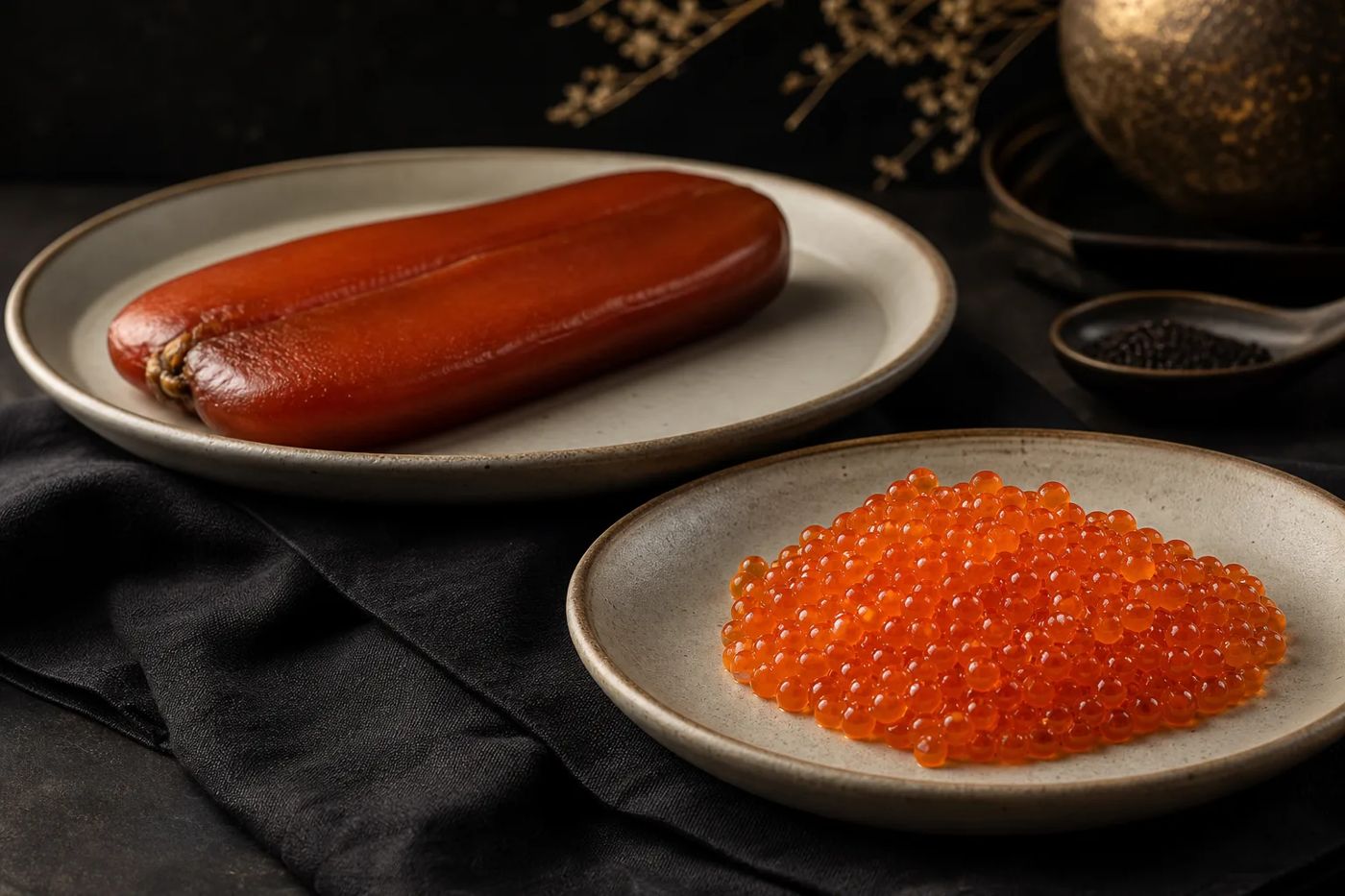
Ikura means separated eggs in this comparison; sujiko is roe retained in its natural sac or skein. Both can be cured, so the word “cured” alone tells you nothing about whether the eggs are loose. ASMI also describes green roe: unprocessed roe in the skein, destined for further processing.
Processor documentation gives a clearer picture than assuming every species comes in every form. E&E Foods documents pink ikura and sujiko made from king, sockeye and coho at its Alaskan facilities. ASMI also discusses loose caviar from all four species.
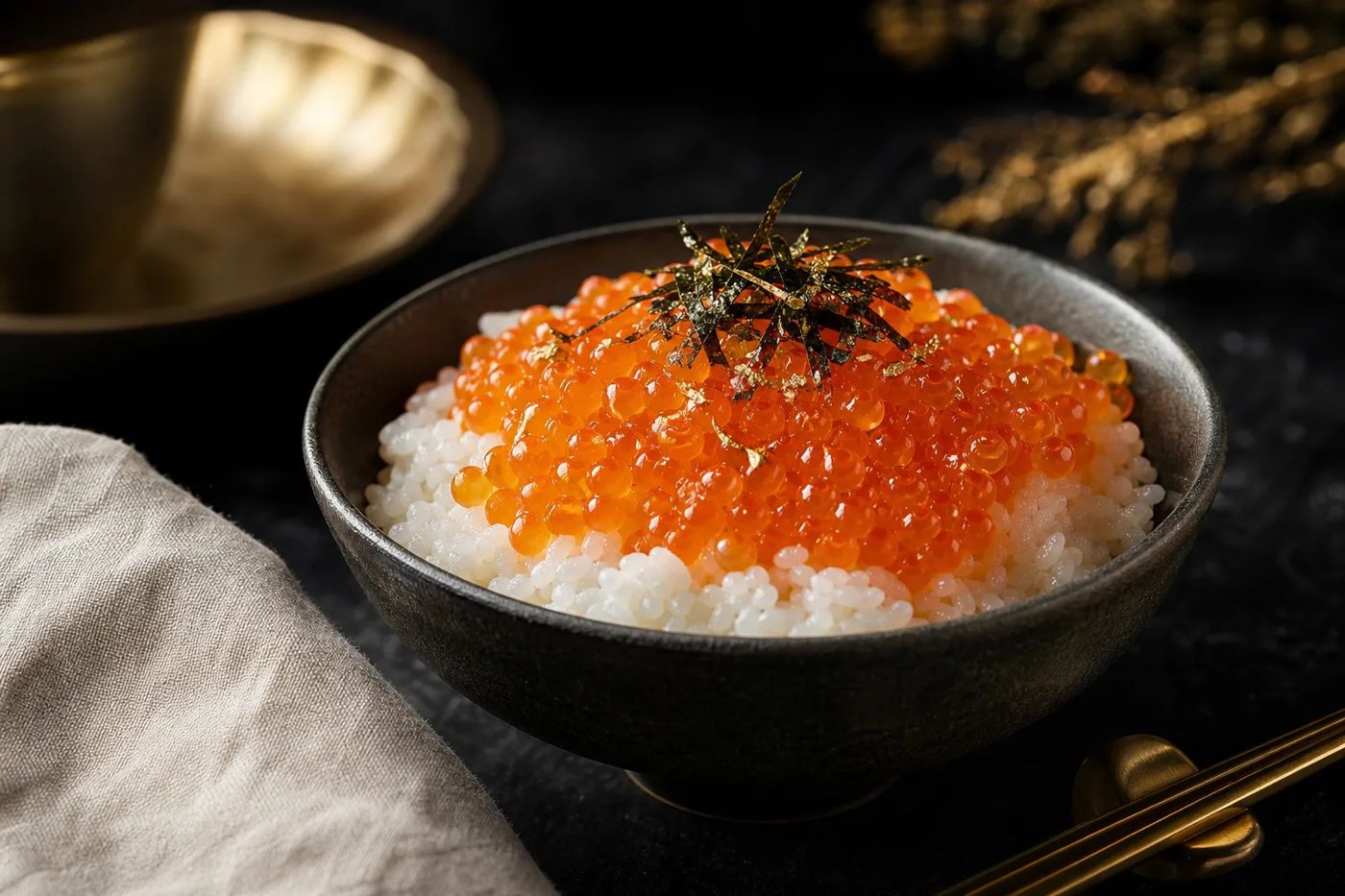
Japan's agriculture ministry describes soy-marinated ikura over steamed rice, in hand-rolled sushi and as an appetiser. These are ways to serve the preparation, rather than requirements for a particular salmon species. For the processing distinction, see ikura versus sujiko.
Where it comes from and when
Alaska supplies food roe from all four species, but the map extends well beyond it. EUMOFA's 2022 market study identifies the United States, Russia and Japan as the principal salmon-roe producing countries overall, with Canada contributing less. That market picture does not establish the origin of any particular species or lot.
ASMI's Alaska harvest calendar lists pink from June to September, sockeye from May to September, coho from June to October and king year-round. Those are fish harvest periods, not promises of fresh roe. Its roe guide places pink in late summer, sockeye in mid-summer and coho later in the season.
A Japanese preparation name does not establish Japanese catch origin. Atlantic salmon roe, from Salmo salar, also reaches the market, but it comes from a different species from these four Pacific salmon.
Wild stocks and management
The river system or management unit tells you more about stock status than the roe's colour. This summary was checked in November 2026; it does not imply that every fishery supplying a species has the same conservation record.
United States: NOAA describes Alaska coho populations as near or above target levels, while Alaska sockeye and Chinook stocks vary. Its West Coast accounts include protected coho, sockeye and Chinook populations; West Coast pink status is unknown. Alaska manages harvests through escapement goals, which require enough fish to return to spawn, and adjusts fishing using in-season assessments.
Large eggs, robust flavour and a distinct pop are king's calling cards in ASMI's description.
Canada: DFO's preliminary 2026 outlook, published before the season, forecast above-average Skeena pink returns and below-average Skeena Chinook and coho returns. These were forecasts, not final returns. DFO expressly allows in-season assessments to supersede them, so consult the latest DFO and Pacific Salmon Commission updates.
Russia and Japan: NPAFC records national catches and hatchery releases rather than assigning a single conservation rating to all stocks. Russia's regional anadromous-fish commissions publish harvest decisions, and Japan also reports hatchery activity. The commission reports that both countries conduct directed fisheries and stock enhancement within their own waters. A “wild-caught” label or national catch total cannot establish that an individual lot came from a healthy, naturally reproducing stock.
Read the label before choosing
Ask for five things: species, catch country and region, product form, ingredients, and the supplier's handling instructions. “Salmon roe” and “ikura” do not identify which of these four fish supplied the eggs. Request written species confirmation instead of trying to identify them by eye.
EU: Article 7 of Regulation (EU) No 1169/2011 prohibits misleading food information, including about identity and composition. Great Britain: the assimilated version of that regulation applies. Northern Ireland: EU food-information law applies. Switzerland, the UAE, China, Japan, Russia and Australia have their own labelling rules. Customs classifications are a separate matter: they do not, by themselves, determine permitted retail names.
US: FDA's nonbinding CPG Sec. 540.150 says unqualified “caviar” should refer to salted sturgeon roe. Other fish roe can carry a fish-qualified name, such as “salmon caviar”, with the words substantially equal in size and prominence. The guidance also addresses declaration of artificial colour.
For fuller buying and handling guidance, turn to the salmon roe guide: The Complete Guide). Choosing between orange-red salmonid eggs and sturgeon eggs instead? Salmon roe versus sturgeon caviar sets out that different comparison.
Sources
-
Alaska Seafood Marketing Institute. Wild Alaska Salmon Roe, in its seafood guide, August 2025 file version. Retrieved PDF.
-
Alaska Seafood Marketing Institute. Alaska Salmon Roe. Undated edition, archived on ASMI's regional website. Roe guide.
-
University of Alaska Fairbanks Cooperative Extension Service. Salmon Roe Caviar, publication FNH-00130. Online edition, publication year not stated. Extension publication.
-
Alaska Seafood Marketing Institute. Wild Alaska Salmon. Fact-sheet PDF, 2020 file version, hosted in 2021. Species and harvest information.
-
E&E Foods. Salmon Roe. Undated processor product documentation. Product forms and processing locations.
-
Japan Ministry of Agriculture, Forestry and Fisheries. Ikura no Shoyu-zuke (Soy Sauce-marinated Salmon Roe), Our Regional Cuisines. Undated online edition. Preparation and serving uses.
-
European Market Observatory for Fisheries and Aquaculture Products. Salmon and trout roe. 2022 market study. Report.
-
NOAA Fisheries. Pink Salmon. Online edition updated 28 September 2026. Species account.
-
NOAA Fisheries. Coho Salmon. Online edition updated 29 June 2026. Species account.
-
NOAA Fisheries. Sockeye Salmon. Online edition updated 29 June 2026. Species account.
-
NOAA Fisheries. Chinook Salmon. Online edition updated 29 June 2026. Species account.
-
Fisheries and Oceans Canada. Summary of Pacific salmon stock management units. Preliminary 2026 outlook, modified 11 February 2026. Stock outlook.
-
North Pacific Anadromous Fish Commission. Statistics. Online edition linking catch and hatchery-release datasets updated 26 June 2026. Statistics and explanatory notes.
-
Russian Federal Agency for Fisheries, Sakhalin territorial administration. Commission on anadromous fish. Register of regional harvest-regulation commission protocols, 2026. Official register.
-
European Parliament and Council. Regulation (EU) No 1169/2011 on the provision of food information to consumers. 2011, Article 7. EUR-Lex legal record.
-
UK Government. Packaging and labelling. Current online guidance, retrieved November 2026. Great Britain and Northern Ireland requirements.
-
US Food and Drug Administration. CPG Sec. 540.150 Caviar, Use of Term: Labeling. Reissued October 1989, current online guidance. FDA guidance.
The comparison was researched through government and university publications, fisheries-management accounts, attributed ASMI specifications and a processor's documented product forms.
Last checked: November 2026