
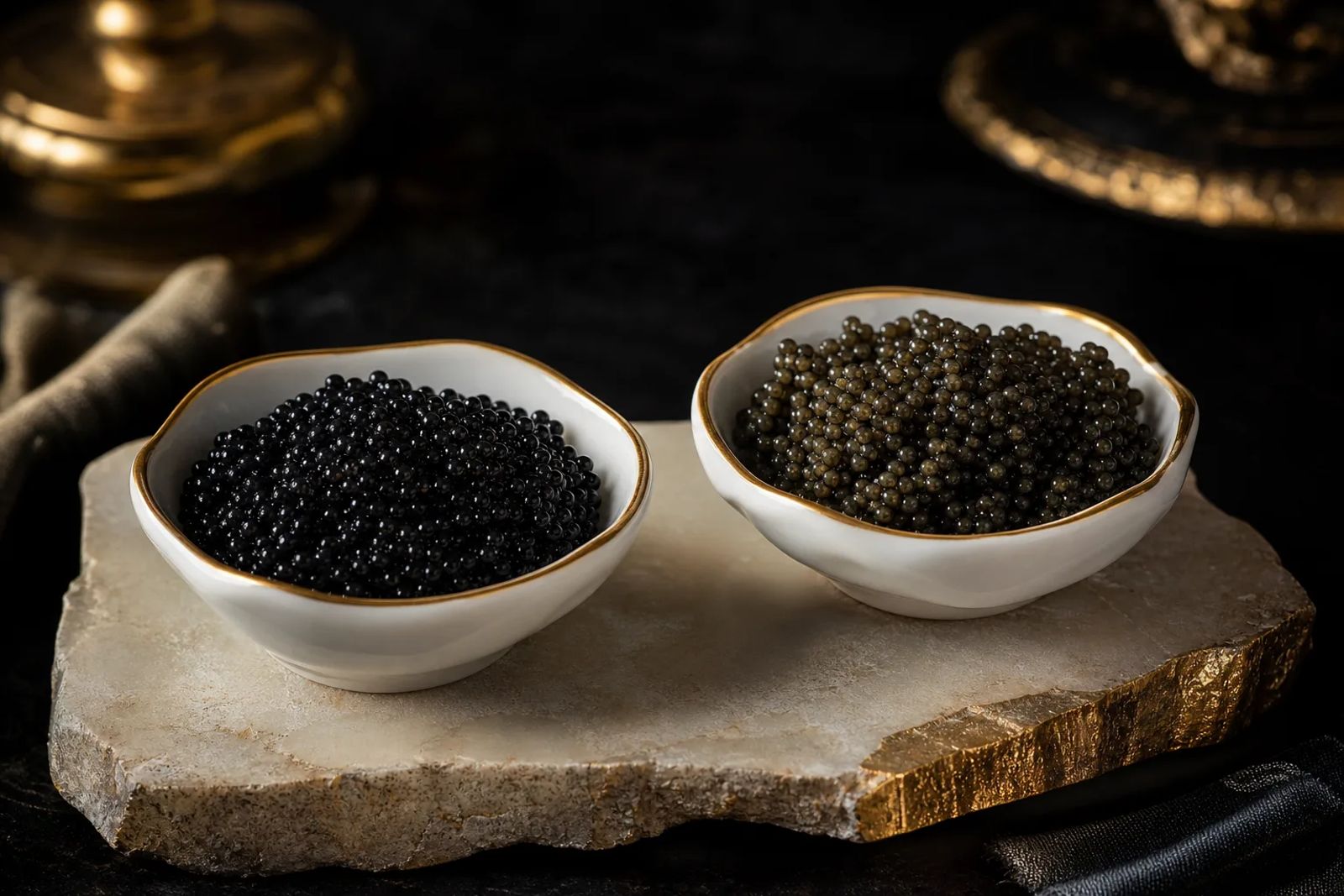
At Sturia, Prestige means Baerii roe over 3 mm. At Tsar Nicoulai, Golden describes a golden-brown selection from white sturgeon. These names sound grand, but their useful meaning lies in something concrete: the bead, the fish and the house doing the selecting.
Imperial, Royal, Reserve and similar trade names describe a seller's range or selection, not a species or a standardised legal grade. Read them as an introduction. The stated species, origin and traceability details tell you what you are comparing.
Caviar trade names decoded
Royal does not always outrank Imperial. Reserve does not always outrank Classic. A house may use its own hierarchy, and the same word can point to a different selection elsewhere.
Here is what the names suggest in documented seller usage, and what to look for behind them.
| Trade name | What it usually signals | What to check |
|---|---|---|
| Imperial | A selected tier; Caviar Court pairs it with a golden special reserve. | Species and origin, rather than an imperial certification. |
| Royal | A house selection; Petrossian ranks it above Classic. | Species, origin and responsible business, rather than royal patronage. |
| Reserve | A selected batch or upper tier; Special Reserve tops Petrossian's published hierarchy. | Identity and traceability; the name establishes no maturation period. |
| Golden | Colour; Tsar Nicoulai describes its selection as golden brown. | Species and origin; colour cannot identify the fish. |
| Classic | A house's core tier; first in Petrossian's ascending hierarchy. | The same identity details as for higher tiers. |
| Prestige | Size; Sturia uses it for Baerii roe over 3 mm. | Species and the seller's selection criteria. |
| Tsar | Imperial Russian associations; Petrossian pairs it with Imperial in a grade name. | Species and origin, rather than assumed historical court supply. |
| Almas | Caviar House's name for pale caviar associated in its description with albino sturgeon. | Exact species and producer; neither follows from the name. |
| Kaluga Beluga | A comparison with beluga, rather than a reliable species declaration. | Declared species or, for a hybrid, both parents. |
Use the final column as a reading checklist. Which details must appear on a retail label depends on the jurisdiction and the type of label.
One name, different house rules
A useful house grade tells you why one selection differs from another. Petrossian describes grading explicitly as the producer's judgement and publishes an ascending order: Classic, Royal, Tsar Imperial, President and Special Reserve.
That makes the names useful within Petrossian's range. It does not provide a conversion chart for another supplier. Caviar Court associates Imperial with a golden special reserve; Sturia uses Prestige within its Baerii range. Each belongs to its own system.
Reserve deserves a direct question: what has been selected? Bead size, colour, texture, flavour and maturation are different criteria. Until the seller explains which applies, the word tells you neither a fixed age nor whether the caviar will suit your taste.
For bead integrity, consistency and the other qualities behind a selection, see how caviar is graded. A clearly explained house grade helps you navigate a range. Its value comes from that explanation, not from the grandeur of its title.
Courtly names need a historical record
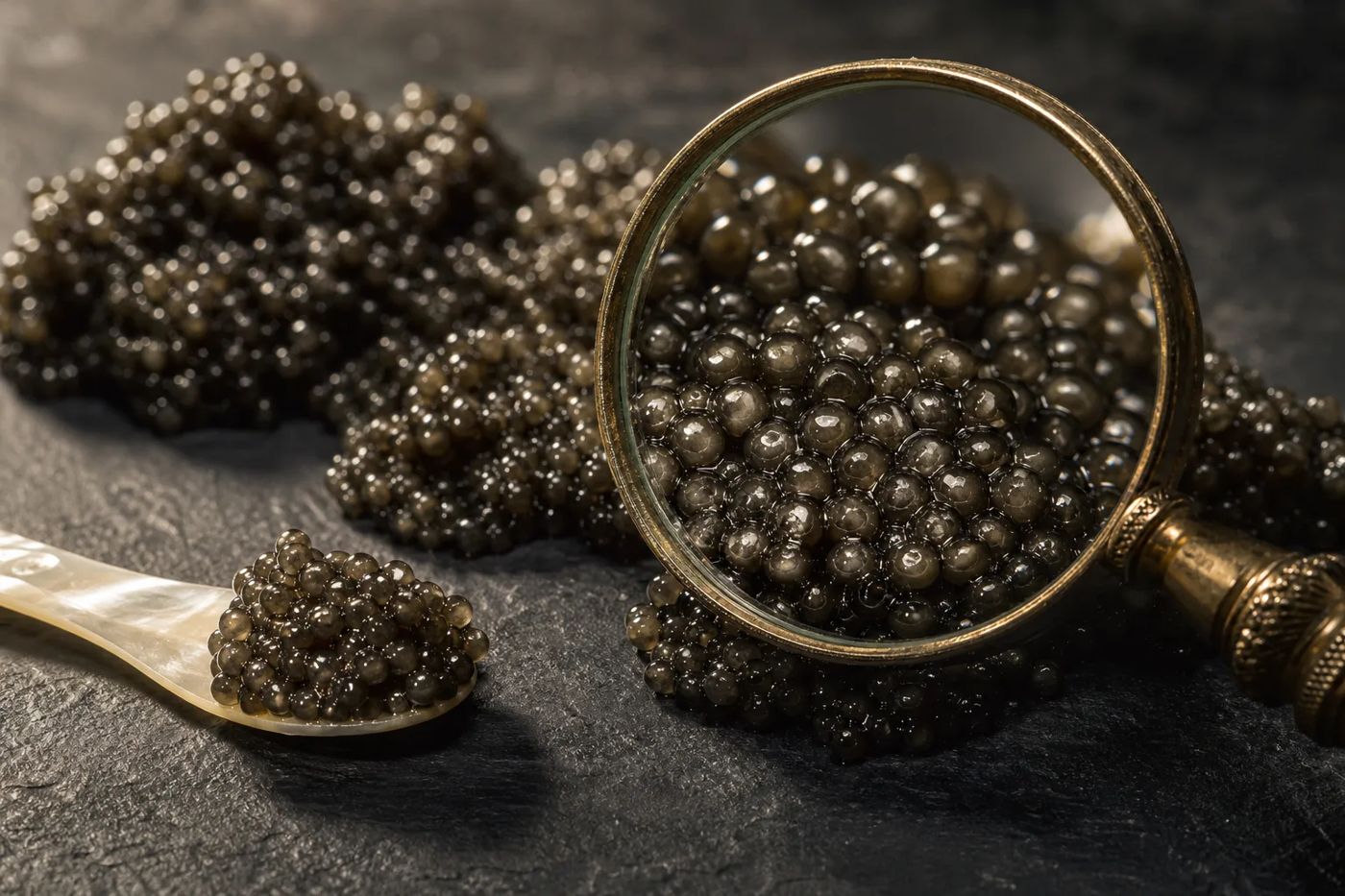
Imperial and Tsar evoke the Russian imperial court. Whether a present selection descends from an official court grade is a separate historical question. When these words were first used as standardised caviar grades is not documented.
Stories of roe reserved for a tsar or shah need records of their own. Before repeating a seller's account as documented history, look for a dated document, supplier appointment or other original evidence. A modern name cannot supply the missing history.
Royal also has a precise distinction worth knowing. In the UK, a Royal Warrant of Appointment recognises regular supply to the Royal Household and is granted to a named individual at a company. The adjective on a caviar tin establishes no such appointment.
Golden and Almas: colour before identity
Golden tells you about appearance or a seller's selection, not a separate sturgeon species. Tsar Nicoulai connects its golden-brown selection with white sturgeon. Golden, in other words, does not automatically mean Ossetra.
Caviar House uses Almas for very pale caviar associated in its description with albino sturgeon. That describes its commercial usage, rather than identifying every caviar sold under the word. Almas also appears within branded names, so the exact species and producer still matter.
Nor does Golden alone establish albinism. Do not assume pale roe is inherently preferable: colour should not make the decision for you. For the specific use of Golden and Imperial with Russian sturgeon, see Ossetra names and identity.
Kaluga Beluga: ask which fish
Kaluga Beluga is not beluga. CITES lists beluga as Huso huso (HUS) and kaluga as Huso dauricus (DAU); since October 2025 the IUCN sturgeon group places both in Acipenser.
The combined phrase is potentially misleading trade language, not a recognised species name. Beluga should not serve merely as shorthand for large beads, grey colour or a comparison of texture.
Ask whether the roe comes from pure kaluga or a hybrid, and request its scientific identity. For a hybrid, ask for the male parent and female parent separately. A comparison with beluga is no substitute for identifying the fish.
The kaluga species guide explores the fish itself. When reading a selection name, settle that identity first; only then consider what the seller's chosen tier adds.

What labelling law says about misleading names
A grand name is not automatically unlawful. A misleading overall description is the issue. Customs classifications answer a separate question and do not determine whether a retail name fairly describes the food.
European Union: Regulation (EU) No 1169/2011, Article 7, prohibits misleading food information, including about identity, composition, origin and production method. Article 17(4) says a brand or fancy name cannot replace the name of the food. The misleading-information rule also covers advertising and presentation.
Great Britain: The assimilated and amended version of Regulation 1169/2011 supplies the corresponding framework. FSA guidance confirms that food descriptions must be accurate and not misleading, including descriptions of the name, ingredients, origin and processing.
Stories of roe reserved for a tsar or shah need records of their own.
Northern Ireland: EU Regulation 1169/2011 continues to apply under the Windsor Framework. Its position is distinct from Great Britain's assimilated-law framework.
United States: Section 403 of the Federal Food, Drug, and Cosmetic Act treats food as misbranded if its labelling is false or misleading, or if it is offered under another food's name. The FTC's deception policy addresses material representations or omissions likely to mislead a reasonable consumer, including advertising claims.
FDA's nonbinding CPG 540.150 says unqualified caviar should mean salted sturgeon roe. For other fish, its policy calls for the fish name alongside caviar in substantially equal size and prominence, plus a prominent declaration of artificial colour where present.
These are rules about consumer information, not a government ranking of Imperial against Royal. The jurisdictions above were checked in November 2026. For the wider framework, see caviar labelling laws.
Find the identity behind the name
Start with the fish and the country where the roe originated. Then identify the processing or repacking operation. A brand's home address does not establish that its roe was produced in that country.
The CITES universal system gives you a structured way to follow that trail. Its label records a species code, source code, origin country and other traceability fields. The source code describes the documented category of origin, not a quality score. Repacked caviar separately identifies the repacking operation.
The system comes from Resolution Conf. 12.7 (Rev. CoP17), Annexes 1 and 2. Domestic rules implement it; the details need not be identical everywhere. Use how to read a caviar label to work through the fields.
A CITES label supplies a paper trail, not an independent check of the contents. Biological testing addresses that different question: a 2019 study of 31 commercial products from Italian markets and websites used DNA barcoding and restriction-enzyme analysis to investigate declared identity. See spotting mislabelled caviar for the limits of documentary checks.
Questions worth asking the seller
Ask about the particular batch, not simply the range. A good answer should connect the attractive name to the caviar in front of you.
- What species is this and, for a hybrid, which are the male and female parents?
- Where did the roe originate, and where was it processed or repacked?
- What measurable or described criteria distinguish this selection from your other tiers?
- Does Reserve describe maturation here, and what does that mean for this batch?
- Can you provide a clear photograph of the complete label and identify the responsible business?
For a broader route through these decisions, return to caviar grading and quality. If a seller cannot explain its own selection, choose on documented identity and handling information rather than an unexplained title.
Sources
-
European Parliament and Council. Regulation (EU) No 1169/2011 on the provision of food information to consumers, consolidated version dated 1 April 2025, particularly Articles 7 and 17. Official text.
-
Food Standards Agency. Packaging and labelling, updated 4 September 2026, particularly the sections on applicable legislation and misleading descriptions. Official guidance.
-
US Food and Drug Administration. CPG Sec. 540.150: Caviar, Use of Term, Labeling, October 1989, current published guidance retrieved November 2026. FDA guidance.
-
US House of Representatives, Office of the Law Revision Counsel. 21 USC 343: Misbranded food, current online text retrieved November 2026, particularly subsections (a) and (b). United States Code.
-
Federal Trade Commission. FTC Policy Statement on Deception, 1983, current published copy retrieved November 2026. Policy statement.
-
CITES. Resolution Conf. 12.7: Conservation of and trade in sturgeons and paddlefish, Rev. CoP17, 2016, particularly Annexes 1 and 2. Resolution.
-
CITES. Resolutions of the Conference of the Parties in effect after the 20th meeting, current index retrieved November 2026. Resolutions index.
-
US Fish and Wildlife Service, electronic Code of Federal Regulations. 50 CFR 23.71: How can I trade internationally in sturgeon caviar?, current online edition retrieved November 2026. Regulation.
-
The Royal Household. Royal warrants, undated, current page retrieved November 2026. Official explanation.
-
US Patent and Trademark Office. Official Gazette: Trademarks, 14 June 2011, entry for ALMAS ARA, application serial number 85175997. Official Gazette.
-
Petrossian. Example page, undated, particularly “What is a caviar grade?”, retrieved November 2026. Company statement used only for its own grading vocabulary. Company explanation.
-
Caviar Court. Products, undated, retrieved November 2026. Company statement used only for its association of Imperial, golden colour and Special Reserve. Company descriptions.
-
Sturia. Prestige Baerii, undated, retrieved November 2026. Company source used only to establish its naming practice. Company description
-
Tsar Nicoulai. Golden Reserve Caviar, undated, retrieved November 2026. Cited without link (retail page); used for colour and species only. Company description
-
Caviar House & Prunier. Caviar House Finest Almas, undated, retrieved November 2026. Cited without link (retail page for wild caviar); attributed use of Almas only. Company description.
-
MDPI, Molecules. From Fish Eggs to Fish Name: Caviar Species Discrimination by COIBar-RFLP, an Efficient Molecular Approach to Detect Fraud in the Caviar Trade, volume 24, issue 13, article 2468, 2019, particularly section 4.1 and the molecular methods. Research paper.
This piece was researched by comparing official food-information and wildlife-trade sources with attributed seller terminology and peer-reviewed identification research.
Last checked: November 2026