
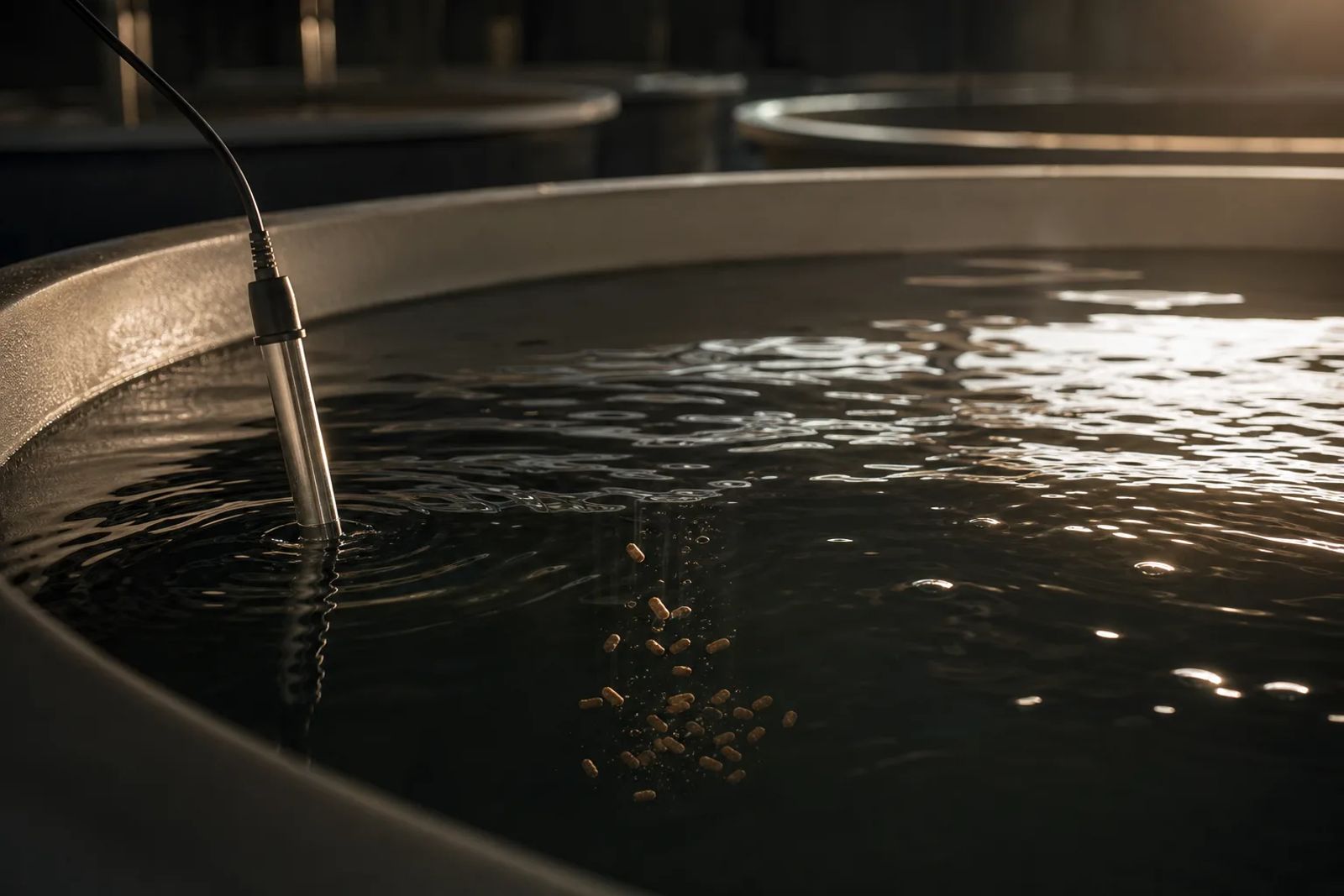
Farmed sturgeon usually eat formulated pellets, while their water must support breathing, waste removal and normal development throughout a long production cycle. Feed can influence roe composition, but neither an ingredient list nor clear water proves how finished caviar will taste.
What wild sturgeon eat
Wild sturgeon diets vary with species and age: bottom-living insect larvae, worms, crustaceans and molluscs are common prey, while some species also eat fish. A farm diet replaces that variable food supply with measured nutrients, rather than trying to reproduce a river's menu.
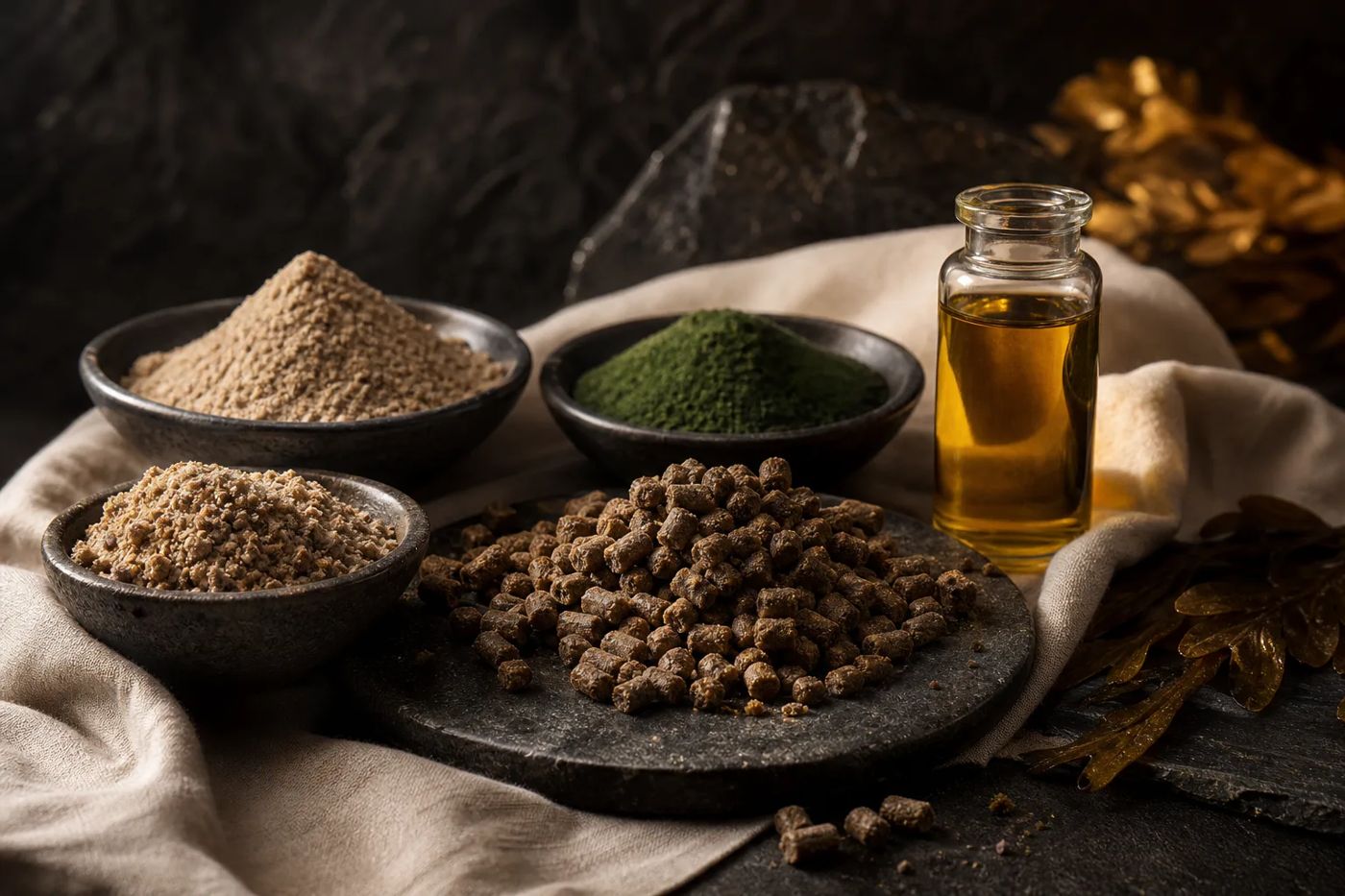
Pellets must also suit feeding behaviour. FAO's Siberian sturgeon account favours extruded pellets with good water stability, which remain available without quickly breaking apart. Protein supplies amino acids; oils supply energy and fatty acids; the formulation must also provide vitamins and minerals. The wider production context is covered in sturgeon farming.
Matching nutrients to fish size
Experimental results are starting points, not a universal feed specification. Hung's 2017 review reports growth optima of about 40% protein for Siberian juveniles initially weighing 20 to 40 g, and 40.5% for white sturgeon initially weighing 145 g.
In Persian sturgeon initially weighing about 139 g, a 21-week experiment compared 40% or 45% protein with 10% to 25% lipid; 40% protein and 25% lipid gave the best overall growth. Another Persian juvenile experiment identified a successful diet containing 40% protein and 19 MJ/kg. These are study-specific results, not interchangeable requirements.
For white sturgeon larvae, the review describes diets containing 17% to 42% lipid, without establishing a transferable optimum. These sources do not give complete protein, lipid and energy prescriptions for larvae or caviar-bearing females. A supplier should therefore state the species, size class, nutrient basis and evidence behind its recommendation.
Feeding rates and frequency
FAO describes Western European Siberian sturgeon feeding rates as rarely exceeding 1% to 1.5% of biomass per day, with lower rates for larger fish. That is a reported production practice, not a fixed ration for every temperature, pellet or stock.
In an eight-week Chinese Academy of Agricultural Sciences experiment, Siberian juveniles initially weighing about 39 g were fed to apparent satiation three times daily at 20 to 22°C (68 to 72°F). Researchers recovered uneaten pellets and corrected for leaching, rather than assuming that everything offered had been eaten.
For farm records, distinguish feed offered from estimated intake. Recalculate biomass after sampling and investigate persistent leftovers alongside oxygen readings, temperature, health observations and pellet condition, rather than automatically increasing the ration.
Fishmeal, fish oil and alternatives
Fishmeal supplies protein and fish oil supplies long-chain fatty acids, including EPA and DHA. Alternatives need to replace those nutritional functions, not merely the ingredient weight: a plant protein and an algal oil solve different formulation problems.
Plant proteins can be part of sturgeon diets, but digestibility and amino acid balance matter. The Chinese Academy experiment assessed alternative proteins using growth, nutrient digestibility and physiological measurements in juveniles. Those endpoints cannot establish the sensory quality of eggs produced years later.
A 2020 Siberian sturgeon study tested highly defatted black soldier fly meal through growth and digestibility trials. Dietary inclusion above 18.5% worsened growth performance, and insect-containing diets had lower protein digestibility. This does not set a limit for every insect meal: processing, inclusion and the remaining formulation belong to the result.
Algal oils can provide DHA without fish oil, but a successful trial in salmon or trout is not evidence of unchanged sturgeon roe. The sturgeon research reviewed here does not show a mature-female algal-oil programme that preserves both roe fatty acids and blind-panel flavour. Ask for those results separately from growth claims.
What diet changes in roe
The clearest distinction is between chemical composition and perceived flavour. In a 2008 white sturgeon study, researchers analysed 20 caviar samples from fish receiving two diets with different lipid sources. They measured composition and fatty acids, and identified 33 volatile compounds using simultaneous distillation-extraction followed by gas chromatography-mass spectrometry.
Dietary fatty acids had only a minimal influence on caviar fatty acid composition in that experiment. The reported method was chemical analysis, not a blinded tasting panel, so it does not demonstrate that one feed produced better-tasting caviar.
Read claims such as “our feed improves flavour” as the producer's claim unless supported by a controlled comparison. Useful evidence identifies the females sampled, feeding duration, harvest stage, processing, storage and sensory method. For nutritional interpretation, see omega-3 in caviar.
Sturgeon feed and water quality: working reference points
Feed management and water management belong together. The table distinguishes conservative incoming-water criteria for a white sturgeon conservation hatchery from conditions actually used in a Siberian juvenile feeding trial; neither is a universal caviar-farm operating envelope.
| Parameter | Sourced range and scope | Outside it or interpretation | Source |
|---|---|---|---|
| Dissolved oxygen | Above 90% saturation | Lower oxygen can restrict growth | CRITFC; FAO |
| Temperature | 20 to 22°C (68 to 72°F), Siberian juveniles in one trial | Trial conditions, not a tolerance range | Chinese Academy report 4 |
| Un-ionised ammonia | Below 0.01 mg/L as NH₃-N | Do not substitute total ammonia | CRITFC |
| Nitrite | Below 0.1 mg/L as NO₂-N | Blood changes are a toxicity concern | CRITFC; Nitrite study |
| Nitrate | Maximum 2 mg/L as NO₃-N, incoming water | Not a chronic RAS toxicity threshold | CRITFC |
| Carbon dioxide | Maximum 10 mg/L | Check alongside oxygen, not instead of it | CRITFC |
| pH | 6.5 to 8.0 | Changes ammonia speciation | CRITFC |
| Salinity | Fry 0 to 0.5 ppt; juveniles 0 to 3 ppt; broodstock 3 ppt | Hatchery criteria, not maximum seawater tolerance | CRITFC |
Here, “as N” means that concentration is expressed as nitrogen, not the mass of the whole ion. A farm's laboratory reports, alarms and operating procedure must use matching units, especially for ammonia, nitrite and nitrate.
Total ammonia includes ammonium and un-ionised ammonia; pH and temperature determine their proportions. Log both when interpreting a result, and do not compare an NH₃-N limit directly with a total-ammonia reading. System design and waste treatment are covered in recirculating aquaculture systems.
Health, maturation and off-flavours
Poor water quality first threatens the fish. FAO notes that Siberian sturgeon may withstand low oxygen without gaining weight, and describes tolerance of 25 to 26°C (77 to 79°F) only with feeding withheld and high oxygen. Survival at those temperatures is not a growth recommendation.
A Siberian sturgeon nitrite experiment examined mortality, blood changes and accumulation in tissues, illustrating why an acute toxicity result is not an acceptable operating target. The sources reviewed do not quantify direct links between individual water-quality excursions and finished caviar yield or sensory scores.
Managing temperature for maturation is a separate question, addressed in water temperature, light and maturation. Earthy off-flavours and depuration need their own evidence and procedures, explained in purging farmed sturgeon.
Feed safety and residues
Feed assurance needs batch traceability, ingredient specifications and risk-based checks for contaminants, not just a declared protein percentage. Keep medicine records separate from feed composition records: an ordinary feed and a medicated feed present different compliance questions.
A 2020 Siberian sturgeon study tested highly defatted black soldier fly meal through growth and digestibility trials.
In the EU, Regulation (EC) No 767/2009 governs feed marketing and use, including safety and labelling; Directive 2002/32/EC establishes controls on undesirable substances in feed. Contaminant limits depend on the substance and feed category, so a general claim that feed is “tested” needs the laboratory scope and applicable limit behind it.
In Great Britain, relevant EU-derived provisions operate as assimilated law, with national enforcement legislation. Northern Ireland remains distinct: applicable EU feed law continues under the Windsor Framework. Suppliers should identify the jurisdiction and current legal text, rather than presenting one undifferentiated “UK approval”.
In the US, FDA's Center for Veterinary Medicine oversees animal food and drugs; applicable facilities must meet the preventive-controls requirements in 21 CFR Part 507. Aquaculture drug-residue controls also require attention to authorised uses and withdrawal conditions, not an assumption that a lawful feed guarantees residue-free caviar.
In China, the State Council's Regulations on the Administration of Feed and Feed Additives require quality responsibilities and prohibit specified banned substances. Its Agricultural Product Quality and Safety Law also addresses proper use of veterinary medicines, feed and additives, including withdrawal periods. These are domestic controls, not proof of compliance with every export market.
Check the intended caviar market before agreeing a feed or treatment programme. Feed compliance, farm health records and finished-food residue testing answer related but different questions; none should be used as a substitute for the others.
What a useful farm record contains
Link each feed batch to the fish group, estimated biomass, ration, feeding observations and water measurements. Record instrument calibration, sampling location, corrective action and the time of any interruption, so an average daily value cannot conceal an important short excursion.
For a feed change, define success before starting: growth and intake for juveniles, and separately ovarian development, roe composition and blinded sensory results for mature females. That separation makes the evidence useful without turning a pellet specification or a water reading into an unsupported promise about caviar.
Sources
- FAO. Chebanov, M. S. and Galich, E. V. Sturgeon hatchery manual. FAO Technical Paper 558, 2011, reprinted 2013. Full manual.
- FAO. Cultured Aquatic Species Information Programme: Acipenser baerii. Retrieved online edition, undated. Species account.
- University of California, Davis. Hung, S. S. O. Recent advances in sturgeon nutrition. Animal Nutrition 3, 2017, pages 191 to 204. Author manuscript.
- Chinese Academy of Agricultural Sciences. Alternative protein for Siberian sturgeon [descriptive document title]. Undated research report hosted by the Fats and Proteins Research Foundation. Research report.
- Elsevier. First insights on Black Soldier Fly (Hermetia illucens L.) larvae meal dietary administration in Siberian sturgeon (Acipenser baerii Brandt) juveniles. Aquaculture 515, article 734539, 2020. Publisher abstract.
- US National Library of Medicine. Fatty acid composition and volatile compounds of caviar from farmed white sturgeon (Acipenser transmontanus). Research article abstract indexed in PubMed, 2008. Study record.
- Columbia River Inter-Tribal Fish Commission. Sturgeon Master Plan. December 2015, table 28, drawing on Freshwater Fisheries Society of British Columbia criteria from 2012. Master plan.
- Elsevier. Acute exposure of Siberian sturgeon (Acipenser baeri, Brandt) yearlings to nitrite: median-lethal concentration (LC50) determination, haematological changes and nitrite accumulation in selected tissues. Aquatic Toxicology, 2002. Publisher record.
- NOAA Fisheries. Feeds for Aquaculture. Retrieved online edition, 2026. Feed ingredients and regulation.
- US National Library of Medicine, PubMed Central. Schizochytrium sp. (T18) Oil as a Fish Oil Replacement in Diets for Juvenile Rainbow Trout (Oncorhynchus mykiss): Effects on Growth Performance, Tissue Fatty Acid Content, and Lipid-Related Transcript Expression. Research article, 2021. Full article.
- Food Standards Agency. Animal feed legislation. Published 25 June 2026. Official overview.
- Food Standards Agency. General food law. Retrieved online edition, 2026. Great Britain and Northern Ireland distinction.
- Food Standards Agency. Food and Feed Codes of Practice. Updated 22 October 2026. Assimilated law terminology.
- European Parliament and Council. Directive 2002/32/EC on undesirable substances in animal feed. Original instrument, 2002; official indexed text retrieved. EUR-Lex instrument.
- US FDA. FSMA Final Rule for Preventive Controls for Animal Food. Retrieved online edition, 2026, explaining 21 CFR Part 507. Official rule overview.
- US FDA. Fish and Fishery Products Hazards and Controls Guidance. June 2022 edition, chapter 11, aquaculture drugs. Full guidance.
- State Council of the People's Republic of China, reproduced by the State Administration for Market Regulation. Regulations on the Administration of Feed and Feed Additives. Text incorporating amendments through 1 March 2017. Official Chinese text.
- National People's Congress, reproduced by the State Administration for Market Regulation. Agricultural Product Quality and Safety Law of the People's Republic of China. Revised 2 September 2022. Official Chinese text.
Research combined FAO husbandry guidance, experimental nutrition and caviar studies, a conservation hatchery specification and official feed-safety sources, keeping growth, roe chemistry and sensory evidence separate.
Last checked: November 2026