
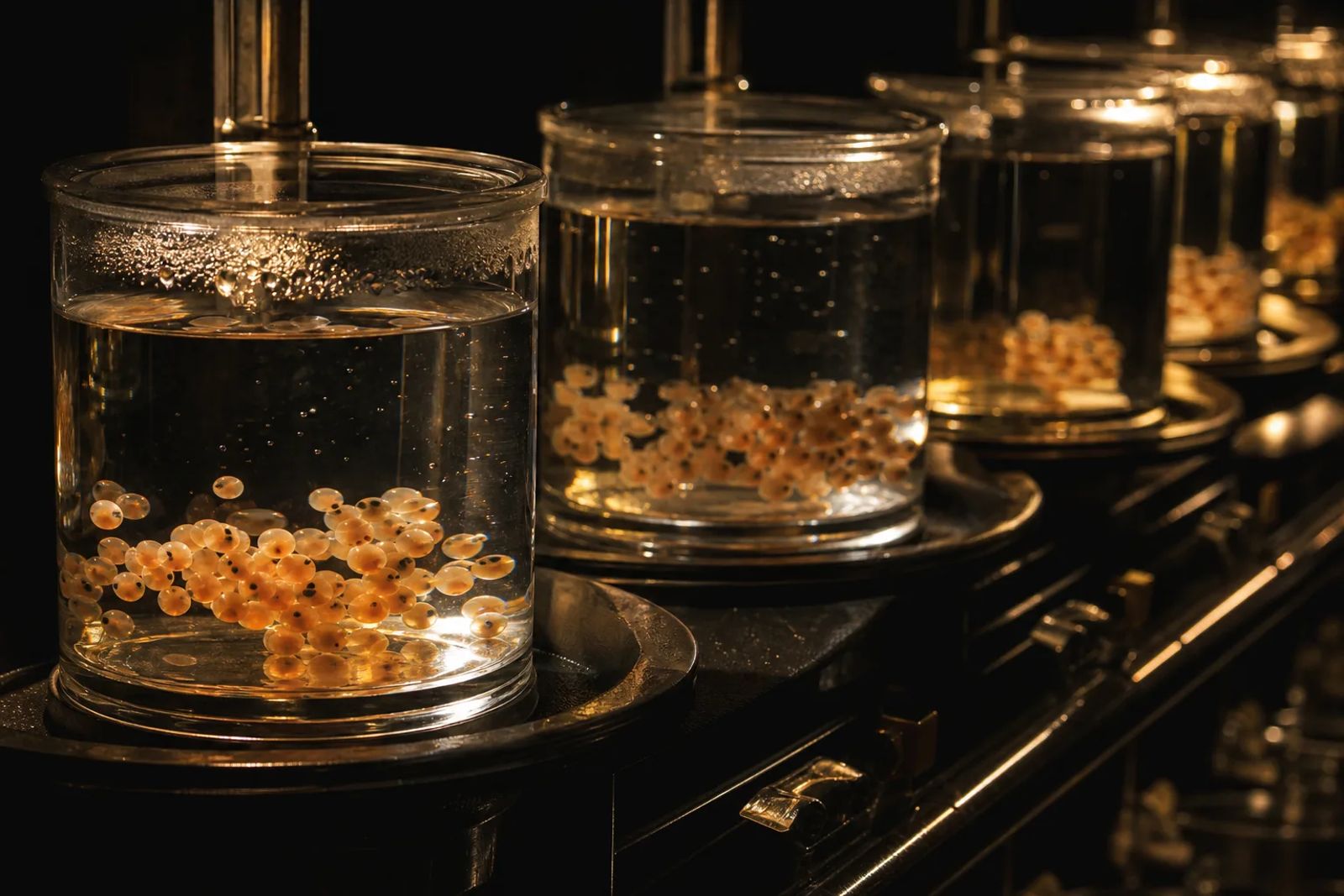
A Persian-sturgeon feeding trial produced striking experimental outcomes: 91.5% survival with the live-food control and just 7.2% with the pellet treatment. Getting an egg to hatch is only the beginning. The next challenge is a fish that feeds, grows and survives.
Sturgeon hatcheries collect mature eggs and sperm, fertilise the eggs under controlled conditions, incubate them and guide the young fish from stored yolk to external feeding. Success rests on ready broodstock, species-specific temperatures, suitable feed and biosecurity. A high hatch rate tells only part of the story.
Preparing broodstock for spawning
A large fish is not necessarily a fish ready to breed. Broodstock, the adults retained for breeding, should be healthy, individually identified and linked to recorded parentage. Plan matings to avoid close relatives.
FAO guidance pairs maturity assessment with control of seasonal temperature, feeding and holding conditions. Hormone injection cannot replace that preparation.
Keep a continuous record from parents to offspring: each spawning group, its treatments, fertilisation results and subsequent survival. Separate new arrivals under a documented health plan. Before embryos enter the system, establish the water supply, cleaning arrangements and contingency response. See farm biosecurity for the wider safeguards.
Hormonal induction and veterinary control
Spawning agents help suitably mature fish complete their final reproductive processes. Documented options include carp or sturgeon pituitary preparations and synthetic gonadotropin-releasing hormone analogues, abbreviated GnRHa. Their selection, administration and collection timing require a species-specific protocol and veterinary oversight. Copying another hatchery's dose is no substitute.
In the EU, Regulation (EU) 2019/6 governs veterinary medicines. Article 114 provides a prescribing hierarchy for food-producing aquatic species where no authorised treatment is available; the legislation also addresses residues and withdrawal requirements. Great Britain follows the Veterinary Medicines Directorate's cascade guidance, which gives Northern Ireland a separate aquatic-animal hierarchy. Research use alone does not make a hormone lawful under either route.
Fertilised eggs, larvae and juveniles travel as live breeding material, not tins of caviar.
In the US, FDA lists chorionic gonadotropin, marketed as Chorulon, as an approved spawning aid for male and female brood finfish, supplied on veterinary prescription. Research use of GnRHa does not establish FDA approval for that formulation. Check the actual product authorisation or investigational arrangements before procuring it.
Sturgeon hatcheries, stage by stage
This sequence is a process map, not a universal operating procedure. The durations below come from the cited guidance or experiments. Where no transferable duration is established, an observed developmental endpoint determines the next step.
-
Collect eggs and milt. After ovulation, when mature eggs have been released within the female, trained staff collect them by controlled stripping or another veterinary-approved method. Collect milt, the sperm-containing fluid, separately into clean, dry containers. Keep water out until deliberate activation. Assess sperm motility and egg quality before committing the batch to fertilisation.
-
Fertilise under controlled conditions. Gently mix eggs and measured milt, adding activation water according to the selected method. Dry and semi-dry techniques differ in when water and diluted sperm meet the eggs. In a documented beluga larval-feeding experiment, eggs and sperm were stirred for five minutes; that timing belongs to the study's procedure.
-
Remove egg stickiness. Adhesive eggs clump together, obstructing water exchange in the incubator. Documented treatments include kaolin suspension, or urea with sodium chloride followed by tannic acid. Follow the relevant protocol: these are different treatments, not interchangeable mixtures. The beluga experiment used kaolin for one hour. The eggs here are fertilised hatchery eggs, distinct from ovulated roe prepared as food.
-
Incubate at species-specific temperatures. FAO's manual gives differing incubation ranges. Table 14 lists 14 to 18 °C (57 to 64 °F) for Russian sturgeon and 10 to 15 °C (50 to 59 °F) for sterlet; Section 5.2.6 gives 16 to 20 °C and 13 to 16 °C respectively. Use controlled water exchange, adequate oxygen and a system that allows waste removal. Jar and tray incubators must prevent stagnant egg masses without subjecting eggs to damaging agitation.
-
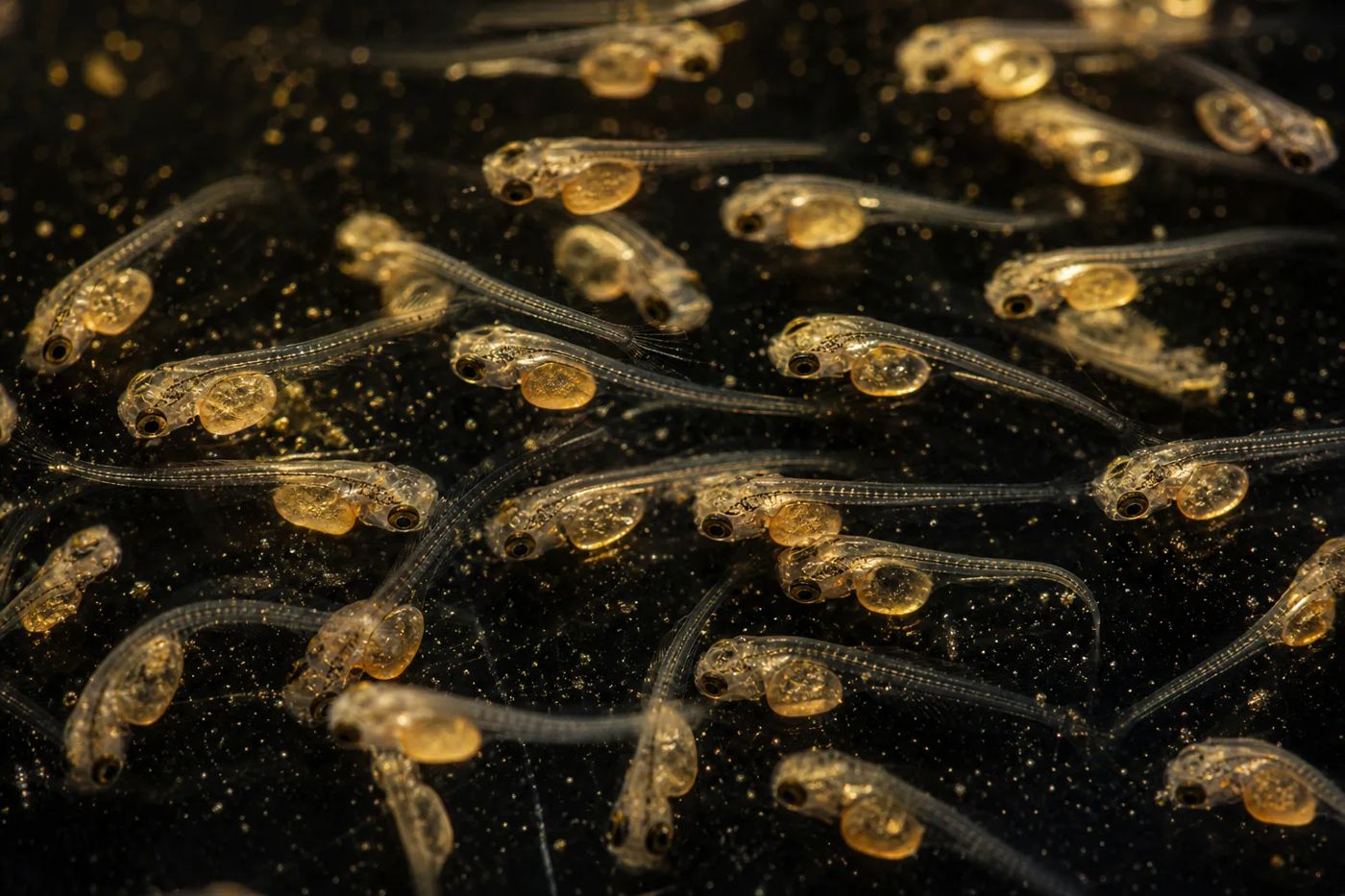
Collect hatchlings without crowding. FAO's release-hatchery guidance gives an indicative incubation total of 1,000 to 1,500 degree-hours: the sum of hourly water temperatures in degrees Celsius. Species and thermal regime determine hatch time. Newly hatched yolk-sac larvae, also called prelarvae, initially live on stored yolk. Maintain oxygen delivery and remove empty shells and dead material.
-
Begin external feeding when the larvae are ready. Watch yolk depletion, behaviour and actual food uptake, rather than counting days alone. Canada's white-sturgeon recovery strategy reports first feeding at 8 to 16 days after hatching, depending on temperature. That range describes this biological example, rather than setting a timetable for every hatchery. Live prey or a suitable formulated starter must match the rearing protocol.
-
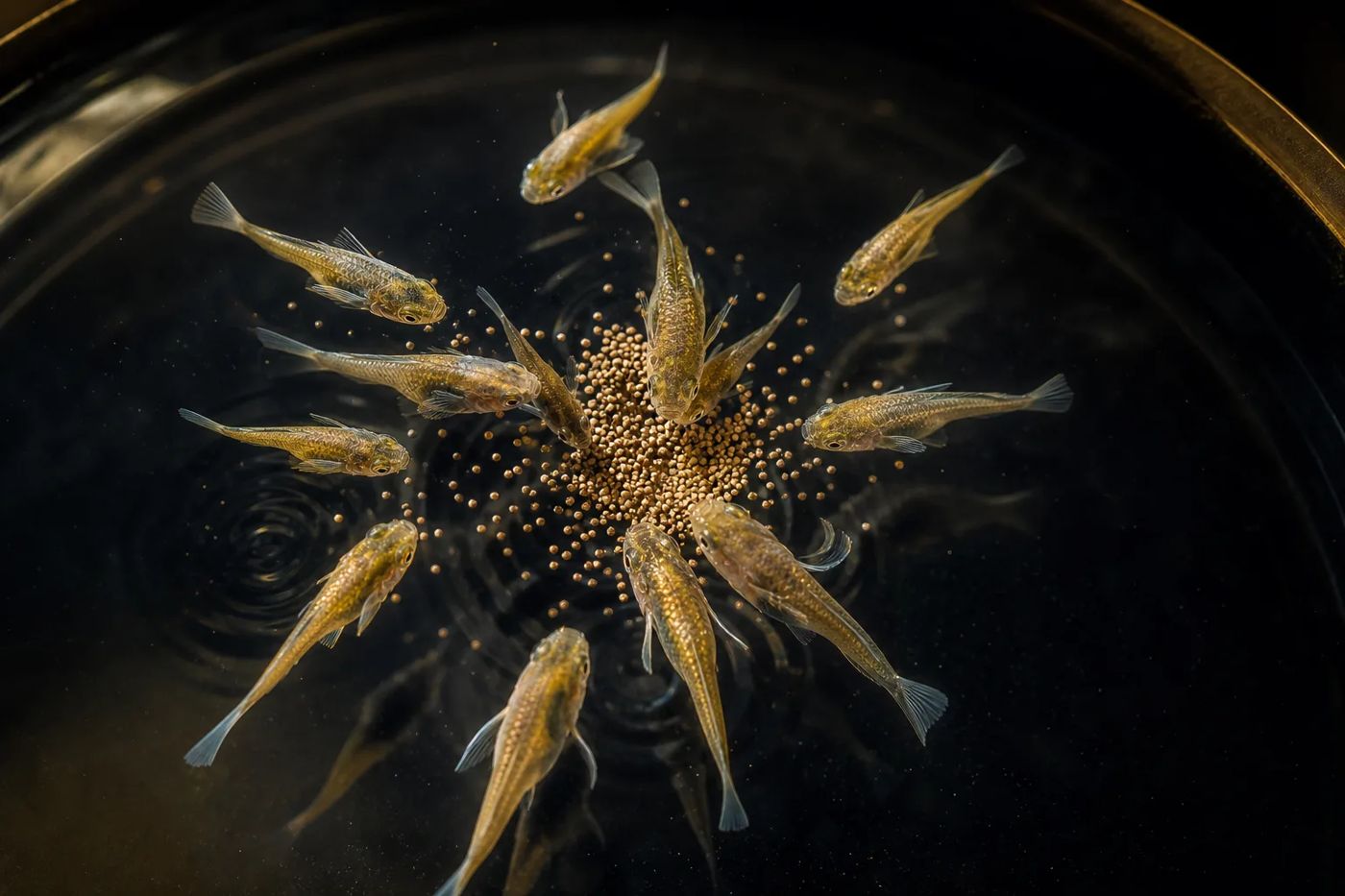
Wean and verify feeding success. Where live food is used, co-feeding introduces formulated feed before live prey is withdrawn. In the 35-day Persian-sturgeon trial involving 6,000 larvae in 12 tanks, gradual replacement supported adaptation, while survival differed sharply between diets. Inspect feeding response and growth, and remove uneaten feed. Successful weaning means sustained consumption, not simply pellets in the tank.
Temperature history matters throughout. In a controlled green-sturgeon experiment, embryos were incubated at 11 °C (52 °F) or 15 °C (59 °F), with some larvae switched between temperatures after hatching and two replicate tanks per treatment. Feed was introduced before observed consumption, and uneaten material was removed daily.
Record both incubation and larval temperatures alongside feeding behaviour. A calendar age without that thermal history gives an incomplete picture of developmental progress.
Losses, grading and early sexing
First feeding and weaning are critical loss points. Larvae may fail to accept the ration or fail to utilise it. The Persian-sturgeon survival figures above are experimental outcomes, not expected farm mortality rates. A separate beluga study compared six feeding regimes, underscoring the need to validate diets and transitions for the fish being reared.
Poor water quality, crowding and disease can deepen nutritional losses. Record mortality separately for fertilisation, incubation, first feeding and weaning. Otherwise, a strong hatch percentage can hide a later feeding failure. See feed and water quality for the wider husbandry requirements.
Grade growing juveniles by size when uneven growth creates feeding competition, retaining batch identity through every split. But grading does not identify females. A Russian-sturgeon study found no useful association between weight and sex in 100 seven-month-old fish. Its duplex PCR assay supported genetic sex identification in the studied stock; laboratory markers need validation for the population concerned.
Newly hatched fish cannot be sexed by external appearance, and ultrasound is not a routine larval sorting method. A size grade therefore says nothing reliable about whether a cohort is female.
Moving eggs and young fish across borders
Fertilised eggs, larvae and juveniles travel as live breeding material, not tins of caviar. Wildlife permits and animal health clearance are separate requirements. Check both before arranging a shipment.
Commercial international movements of Appendix II specimens ordinarily require an export permit or the appropriate re-export certificate. Captive breeding does not automatically remove that requirement. EU imports of specimens listed in Annex B normally also require an import permit. Check applicable exceptions and national wildlife rules.
EU: Regulation (EU) 2016/429, the Animal Health Law, governs aquatic-animal movements. Delegated Regulation (EU) 2020/990 supplements movements within the Union; entry from outside follows a separate framework. Certification depends on species, destination health status and purpose, with models in Implementing Regulation (EU) 2020/2236. Confirm the applicable certificate and establishment eligibility for the particular consignment before shipment.
UK: APHA handles CITES permit applications in Great Britain. Aquatic animal health requirements depend on origin, destination, species and purpose. For England and Wales, check the Fish Health Inspectorate's authorisation and certification requirements. Scotland and Northern Ireland have separate contacts and arrangements. Confirm both CITES and animal health requirements with the relevant authorities.
US: Check USFWS wildlife entry requirements and the receiving state's live-fish rules alongside CITES. USDA APHIS regulates particular susceptible species; its published import guidance identifies spring viraemia of carp and tilapia lake virus groups. Obtain a species-specific determination rather than assuming a generic health certificate satisfies federal and state requirements.
Australia: DAFF's May 2024 notice said applications for live sturgeon and reproductive material would not be considered until final import conditions were published. The risk-analysis report was not permission to import. Check BICON for current clearance. The report establishes neither shipment approval nor that Australia has no sturgeon farming.
China and Russia: China's customs guidance requires advance quarantine approval for importing animals and breeding material. Confirm current Russian requirements directly, and do the same for sturgeon hormone products in either country. Before planning a consignment, obtain written confirmation from the competent authorities for the actual species, life stage, source facility and destination.
Commercial and conservation hatcheries
Similar equipment can serve very different breeding goals. Commercial hatcheries aim to supply healthy, consistently growing juveniles for farming. Conservation hatcheries must also protect population identity, genetic diversity and suitability for release, so their breeding and rearing objectives can differ.
See hatchery releases for those decisions, and hybrid breeding for planned crosses, which fall outside this process description.
Where to go next
- Sturgeon Farming: explore the wider farming subject.
- Sturgeon Farming: The Complete Guide: follow juveniles through the rest of the production cycle.
Sources
- FAO, Chebanov and Galich. Sturgeon hatchery manual. FAO Fisheries and Aquaculture Technical Paper 558, 2011 edition, reprinted 2013.
- FAO. Sturgeon hatchery practices and management for release: Guidelines. FAO Fisheries and Aquaculture Technical Paper 570, 2011.
- Ghorbani Vaghei and colleagues, Aquaculture Research. Effects of Different Feeding Regimes on Growth Performance, Survival Rate, Carcass Composition, Fatty Acids Profile, and Digestive Enzyme Activities of Great Sturgeon (Huso huso Linnaeus, 1758) Larvae. Original research article, 2023.
- Elsevier, Aquaculture. Elimination of adhesiveness in eggs from the white sturgeon, Acipenser transmontanus: Chemical treatment of fertilized eggs. Original research article, 1986; indexed abstract retrieved.
- Government of Canada. White sturgeon (Acipenser transmontanus): amended recovery strategy. Amended online edition retrieved in 2026.
- PubMed Central, research-article repository. Effects of low temperature on growth and metabolism of larval green sturgeon (Acipenser medirostris) across early ontogeny. Original research article, 2024; indexed methods text retrieved.
- Shakourian and colleagues, Journal of Applied Ichthyology. Effects of replacing live food with formulated diets on growth and survival rates in Persian sturgeon (Acipenser persicus) larvae. Original research article, 2011.
- PubMed Central, research-article repository. Cross-species conservation of a transposase-linked element enables genetic sexing of commercial populations of Russian sturgeon (Acipenser gueldenstaedtii). Original research article, 2022.
- European Union. Regulation (EU) 2019/6 on veterinary medicinal products. Consolidated text dated 28 January 2022, hosted by the European Commission.
- Veterinary Medicines Directorate. The cascade: prescribing unauthorised medicines. Current online guidance retrieved in 2026.
- US Food and Drug Administration. Approved Aquaculture Drugs. Online list retrieved in 2026.
- DailyMed, US National Library of Medicine. Chorulon: prescribing information. Label revised August 2026, NADA 140-927.
- US Fish and Wildlife Service. Ovaplant Salmon Gonadotropin-Releasing Hormone analogue, INAD 11-375. Online investigational-drug information retrieved in 2026.
- CITES Secretariat. Convention text and How CITES works. Convention adopted 1973; official indexed text retrieved in 2026.
- European Commission. EU Wildlife Trade Reference Guide, Annex XIV. Online edition retrieved in 2026.
- European Union. Regulation (EU) 2016/429, Animal Health Law. Adopted 2016; official indexed text retrieved in 2026.
- European Commission. Delegated Regulation (EU) 2020/990. Adopted 2020, concerning intra-Union aquatic-animal movements.
- European Commission. Movements and entry into the Union of aquatic animals. Online guidance retrieved in 2026.
18a. European Commission. Implementing Regulation (EU) 2020/2236, model animal health certificates for aquatic animals, 2020. 19. Defra and Cefas. Importing or moving live fish and shellfish. England-and-Wales guidance retrieved in 2026. 20. APHA and Defra. Apply for a CITES permit. Published 2024; online edition retrieved in 2026. 21. USDA APHIS. Importing Fish, Fertilized Eggs and Gametes to the United States. Online requirements retrieved in 2026. 22. California Department of Fish and Wildlife. Importation of live aquatic plants and animals. Informational leaflet 36, February 2025. 23. Australian Department of Agriculture, Fisheries and Forestry. Animal Biosecurity Advice 2024-A08: Release of the final report on the sturgeon BIRA. Notice dated 20 May 2024. 24. General Administration of Customs of China. Entry animal and plant quarantine approval: service guide. Online Chinese-language guidance retrieved in 2026.
This article was researched from FAO hatchery manuals, original experimental studies and official regulatory guidance, with indexed extracts distinguished from fully retrieved documents.
Last checked: November 2026