
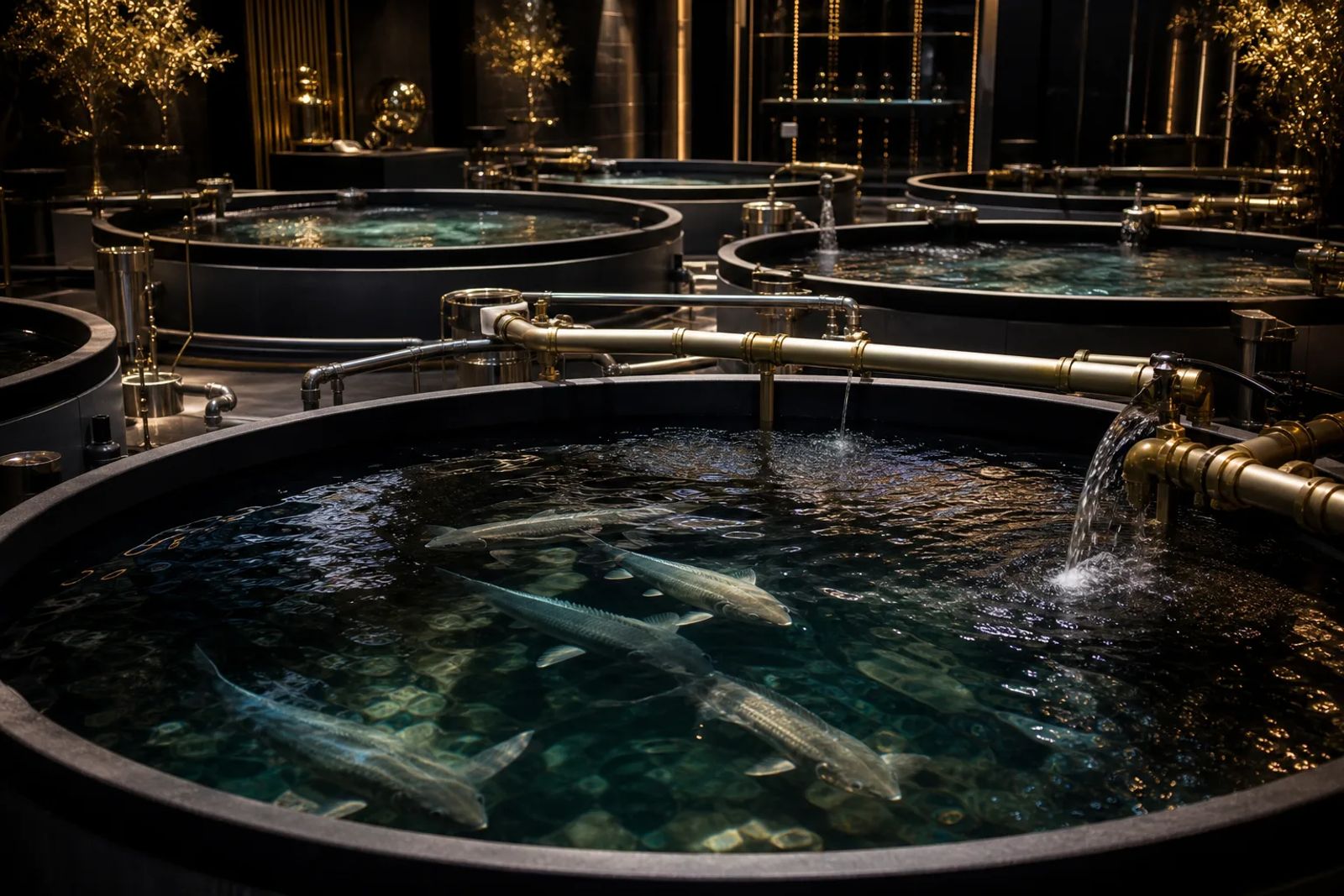
At a commercial sturgeon farm in France, researchers found earthy-smelling compounds throughout two recirculating systems, with the highest concentrations in the sludge. It is a revealing detail: the water that sustains the fish can also carry compounds that matter to flavour.
Recirculating aquaculture systems (RAS) treat and reuse water rather than send it through the farm once. For sturgeon, that brings close control over conditions governing growth and ovarian development. Turning that control into good caviar requires reliable life support, well-managed maturation and attention to earthy off-flavours.
How recirculating aquaculture systems work
A RAS keeps water moving through a treatment loop. From the fish tanks, it passes through equipment that removes solids, processes dissolved wastes and balances gases before returning conditioned water to the fish. New water replaces losses and helps control substances the treatment cannot remove. In flow-through farming, incoming water does much of that dilution and carries waste away.
RAS describes the water-management arrangement, not the shape of the tanks or the species inside them. Start with sturgeon farming for the wider picture, and farm system comparisons for the differences between single-pass and recirculating layouts.
Inside the loop: components and weak points
A running pump is only the beginning. Each treatment stage controls a different part of the water environment, and every component must be sized for the intended biomass and feeding load.
| Component | What it does | What can go wrong | Source |
|---|---|---|---|
| Mechanical filtration | Screens or drum filters catch faeces and uneaten feed before they break down. | Clogging restricts flow; retained solids release dissolved waste. | FAO/Eurofish, chapter 2 |
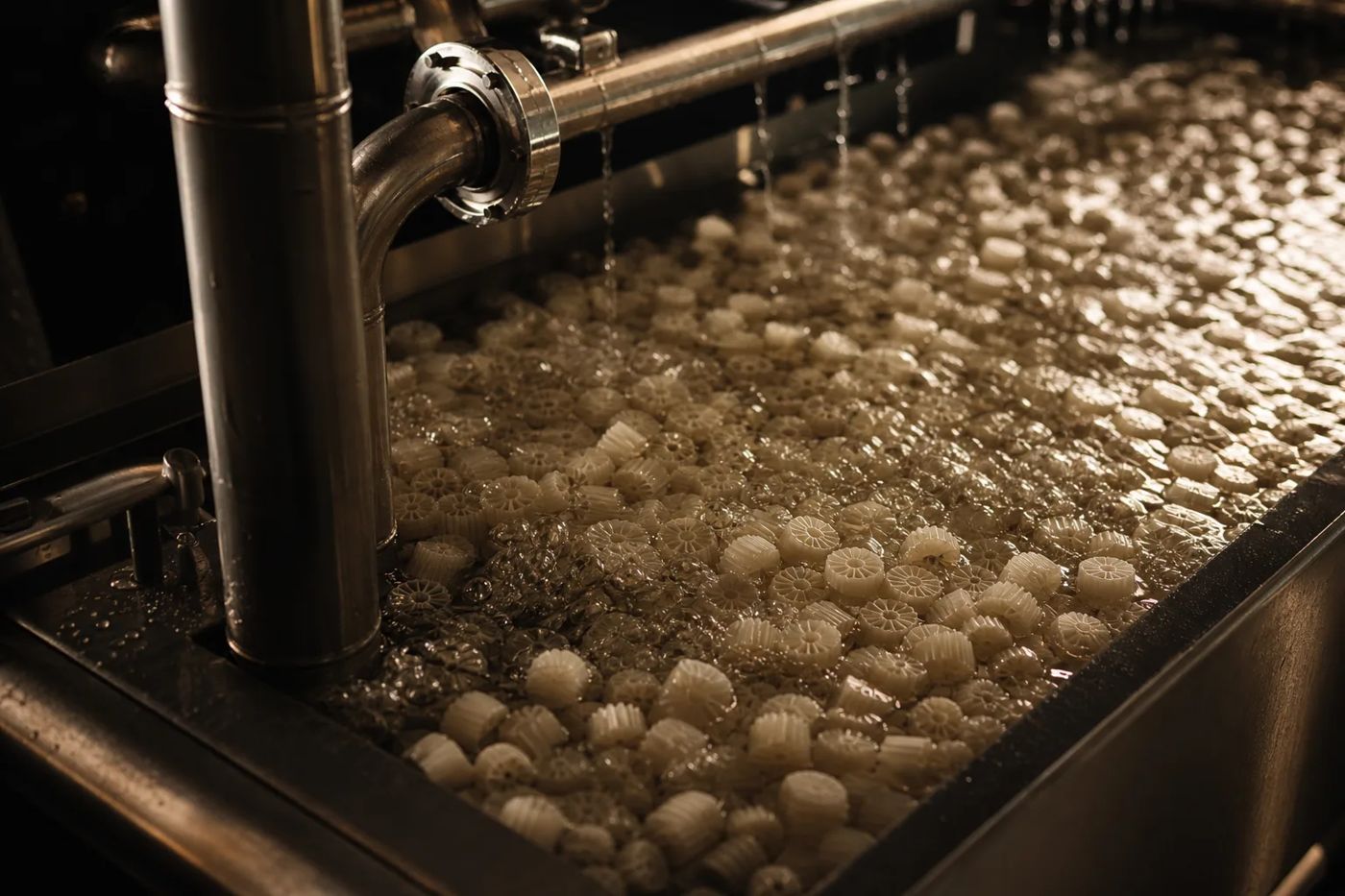
| Biofiltration | Microbes on filter media convert ammonia to nitrite, then nitrate: nitrification. | Immature or damaged filters allow toxic nitrogen compounds to rise. | SRAC 452; UF/IFAS Part 3 |
| Degassing | Air contact strips out carbon dioxide from fish and microbes. | Poor air exchange leaves carbon dioxide high even when oxygen is adequate. | SRAC 452 |
| Oxygenation | Aeration or pure oxygen replaces oxygen consumed in tanks and treatment. | Supply or delivery failure depletes oxygen. | SRAC 452 |
| Disinfection | UV inactivates susceptible microbes; ozone oxidises material and can disinfect treated water. | Too little dose weakens treatment; residual ozone can injure fish. | UF/IFAS Part 2 |
| Temperature control | Heating, cooling and insulation maintain the chosen thermal programme. | Failures or unsuitable settings disrupt growth and reproductive conditioning. | FAO/Eurofish, chapter 2 |
| Sludge handling | Backwash and settled solids leave the culture loop for collection and treatment. | Delayed removal retains organic material and potential odour hotspots. | FAO/Eurofish; da Silva et al. |
Nitrification changes nitrogen's form without removing it from the farm. Nitrate needs an exit: water replacement or additional treatment such as denitrification, which converts nitrate to nitrogen gas. Nitrification also consumes oxygen and alkalinity, the water's acid-neutralising capacity. Operators therefore need to monitor buffering as well as pH.
Disinfection treats water; it does not make a farm sterile. UV performance depends on clarity, exposure and lamp condition. Ozone needs controlled contact and removal of harmful residuals before the water reaches fish. Both belong alongside quarantine and cleaning, never in their place.
Water quality: match the number to the fish
Species and life stage give a water-quality number its meaning. The Columbia River Inter-Tribal Fish Commission's 2015 white sturgeon hatchery plan specifies water-supply criteria including pH 6.5 to 8.0, dissolved oxygen above 90% saturation, carbon dioxide no higher than 10 mg/litre, unionised ammonia below 0.01 mg/litre as nitrogen and nitrite below 0.1 mg/litre as nitrogen. Its alkalinity range is 100 to 400 mg/litre as calcium carbonate. These are white sturgeon hatchery supply criteria, rather than validated operating limits for every adult caviar RAS.
FAO's sturgeon hatchery manual gives a separate dissolved oxygen recommendation of 7 to 9 mg/litre for prelarval holding of Russian sturgeon, stellate sturgeon, beluga, ship sturgeon and sterlet. A recommendation for those earliest stages cannot simply become a grow-out alarm threshold.
Measure total ammonia nitrogen alongside pH and temperature: both change the proportion present as the more toxic unionised ammonia. Record whether nitrogen results refer to nitrogen itself or the whole chemical ion. Track nitrate, suspended solids and gas saturation too. Feed and water quality puts these measurements into their wider husbandry context.
How much water is reused?
A system can replace approximately 10% of its water daily and still have a calculated recirculation degree of 99.6%. The figures describe different things.
Both appear in FAO and Eurofish's 2022 guide, in a theoretical comparison rather than a measurement from a sturgeon farm. Its 500 tonne/year model contains 4,000 m³ of system water, with hourly recycling and a feed conversion ratio of 1.0. The intensive RAS example uses 0.3 m³ of new water per kilogram of fish produced, equivalent to that approximately 10% daily replacement.
Daily replacement measures new water against the system's water inventory. Recirculation compares reused flow with total flow. When reviewing a farm specification, ask for both measures and the production basis. A reuse percentage alone cannot tell you the actual abstraction or discharge.
Growth and maturation need different programmes
Temperature control lets a farm separate growth conditions from reproductive conditioning, rather than follow the local seasonal water cycle. The aim is not to keep females permanently warm. FAO's hatchery manual warns that constantly high temperatures combined with feeding can cause obesity and delay final maturation, including in Siberian sturgeon.
There is no single validated temperature range for adult caviar production across species and life stages. Hatchery guidance for artificial spawning describes cooler holding followed by gradual warming towards species-appropriate spawning conditions. For caviar, ovarian stage and the intended egg product must determine the programme; broodstock spawning guidance serves a different purpose. Temperature, light and maturation explores that distinction.
Biosecurity depends on separation and backup
Shared water can carry infection between tanks. Reducing dependence on incoming surface water can make intake treatment more manageable and allow a farm to sit away from a large river supply, but fish, equipment and people can still bring pathogens inside. Separate quarantine and cohort management remain essential.
Continuous circulation and oxygen delivery are life support. A power cut, failed pump or blocked supply can become a fish-health emergency, not merely a pause in production. A practical design review should examine independent emergency oxygen, standby power, spare pumps, alarms that reach staff and rehearsed responses. Test them under realistic loading, not just with empty tanks.
Biofilters need commissioning time before they can handle the planned feeding load. Build that load gradually and verify ammonia and nitrite removal, however clear the water looks. Review treatment changes with the fish-health team: disinfectants and medicines may affect the organisms doing the filtration.
Earthy off-flavours and the purpose of purging
Sludge deserves close attention. Da Silva and colleagues' 2025 study examined two independent recirculating units at one commercial sturgeon farm in France. Researchers investigated ten samples from tank and treatment outlets and drum filter sludge using sensory assessment and chromatographic methods. Geosmin and 2-methylisoborneol, or 2-MIB, occurred throughout the sampled systems, with the highest concentrations in sludge.
A system can replace approximately 10% of its water daily and still have a calculated recirculation degree of 99.6%.
The measurements captured a single sampling snapshot, with laboratory triplicates, and covered water and sludge rather than finished caviar. Their practical message is to attend to sludge and system hygiene; they neither predict every caviar's flavour nor establish a removal method.
Purging gives fish water with sufficiently low concentrations of unwanted compounds for the fish to eliminate them. Returning that water unchanged to the purge tank can undermine the process if those compounds remain. A recirculating purge system needs demonstrated compound removal and a validated endpoint. The label on the tank is not enough. See purging and off-flavour evidence.
Environmental performance and permits
Water reuse is one part of a farm's environmental footprint. Lower intake and easier capture of concentrated solids offer potential advantages, while pumping, oxygen supply and temperature control consume energy. Dissolved nutrients and sludge still need managing.
Assess electricity source and use, freshwater abstraction, discharged nutrient loads and sludge destinations together. That gives a fuller picture than reuse alone. The environmental footprint of caviar farms examines those trade-offs.
Permits follow the location and discharge arrangements, not the RAS name. In the EU, Article 11 of the Water Framework Directive 2000/60/EC requires Member States to establish controls on abstraction and relevant discharges through national systems.
In England, Environment Agency abstraction licensing and environmental permitting for discharges are separate checks. Those permissions do not cover the whole UK. In Scotland, Wales and Northern Ireland, check abstraction and discharge requirements with the relevant environmental regulator.
In the US, EPA's 40 CFR Part 451 effluent guidelines cover qualifying directly discharging flow-through and recirculating facilities producing at least approximately 45,359 kg (100,000 lb) annually. Smaller facilities can still require NPDES discharge permit coverage. Confirm the site's authorisations with the competent authority before designing intake, backwash and sludge outlets.
Sources
-
FAO and Eurofish International Organisation: Jacob Bregnballe, A guide to recirculation aquaculture, third edition, 2022. Chapters 1 and 2 and Table 1.1 support the system description, equipment functions and theoretical water-use comparison. Retrieved PDF.
-
Southern Regional Aquaculture Center: Recirculation Aquaculture Tank Production Systems: Management of Recirculating Systems, Publication 452, March 1999. Sections on oxygen, carbon dioxide, pH and nitrogen wastes support the treatment chemistry. Retrieved PDF.
-
University of Florida, IFAS Extension: Roy P. Yanong, Fish Health Management Considerations in Recirculating Aquaculture Systems, Part 1: Introduction and General Principles, Circular 120, revised July 2025. Retrieved PDF.
-
University of Florida, IFAS Extension: Roy P. E. Yanong, Fish Health Management Considerations in Recirculating Aquaculture Systems, Part 2: Pathogens, Circular 121, revised August 2009, reviewed January 2019. The retrieved edition covers pathogen circulation, UV and ozone. Retrieved PDF.
-
University of Florida, IFAS Extension: Roy P. Yanong, Fish Health Management Considerations in Recirculating Aquaculture Systems, Part 3: General Recommendations and Problem-Solving Approaches, Circular 122, retrieved PDF edition, 2026 access. Retrieved PDF.
-
Columbia River Inter-Tribal Fish Commission: White Sturgeon Hatchery Master Plan: Lower Columbia & Snake River Impoundments, Step I Revised, 15 December 2015. Table 28 provides the quoted water-supply criteria. Retrieved PDF.
-
FAO: Mikhail S. Chebanov and Elena V. Galich, Sturgeon hatchery manual, FAO Technical Paper 558, 2011, reprinted 2013. Table 28 and the broodstock-management discussion support the life-stage and maturation distinctions. Retrieved PDF.
-
Aquaculture Research: da Silva et al., Distribution of Odorant Compounds in Recirculating Aquaculture Systems Used in Sturgeon Farming, volume 2025, article 2377886, 2025. Original research on water from two independent RAS at one French farm. Research article.
-
Environment Agency: Discharges to surface water and groundwater: environmental permits, live guidance, retrieved November 2026. Applies to England. Official guidance.
-
Environment Agency: Apply for a water abstraction or impounding licence, live guidance, retrieved November 2026. Applies to England. Official guidance.
-
European Parliament and Council: Directive 2000/60/EC establishing a framework for Community action in the field of water policy, 2000, Article 11. Official EUR-Lex record retrieved through search. Official legal record.
-
US Environmental Protection Agency: Concentrated Aquatic Animal Production Effluent Guidelines, 2004 rule, current explanatory page retrieved November 2026. Describes the applicability of 40 CFR Part 451. Official guidance.
-
US Environmental Protection Agency: Aquaculture NPDES Permitting, current page retrieved November 2026. Distinguishes effluent-guideline thresholds from discharge-permit requirements. Official guidance.
-
US Environmental Protection Agency: Compliance Guide for the Concentrated Aquatic Animal Production Point Source Category, EPA-821-B-05-001, March 2006. Discusses pollutant capture, treatment and discharge from recirculating facilities. Retrieved PDF.
This piece was researched using technical manuals, university extension publications, original sturgeon research and official environmental guidance, keeping modelled performance separate from farm measurements.
Last checked: November 2026