
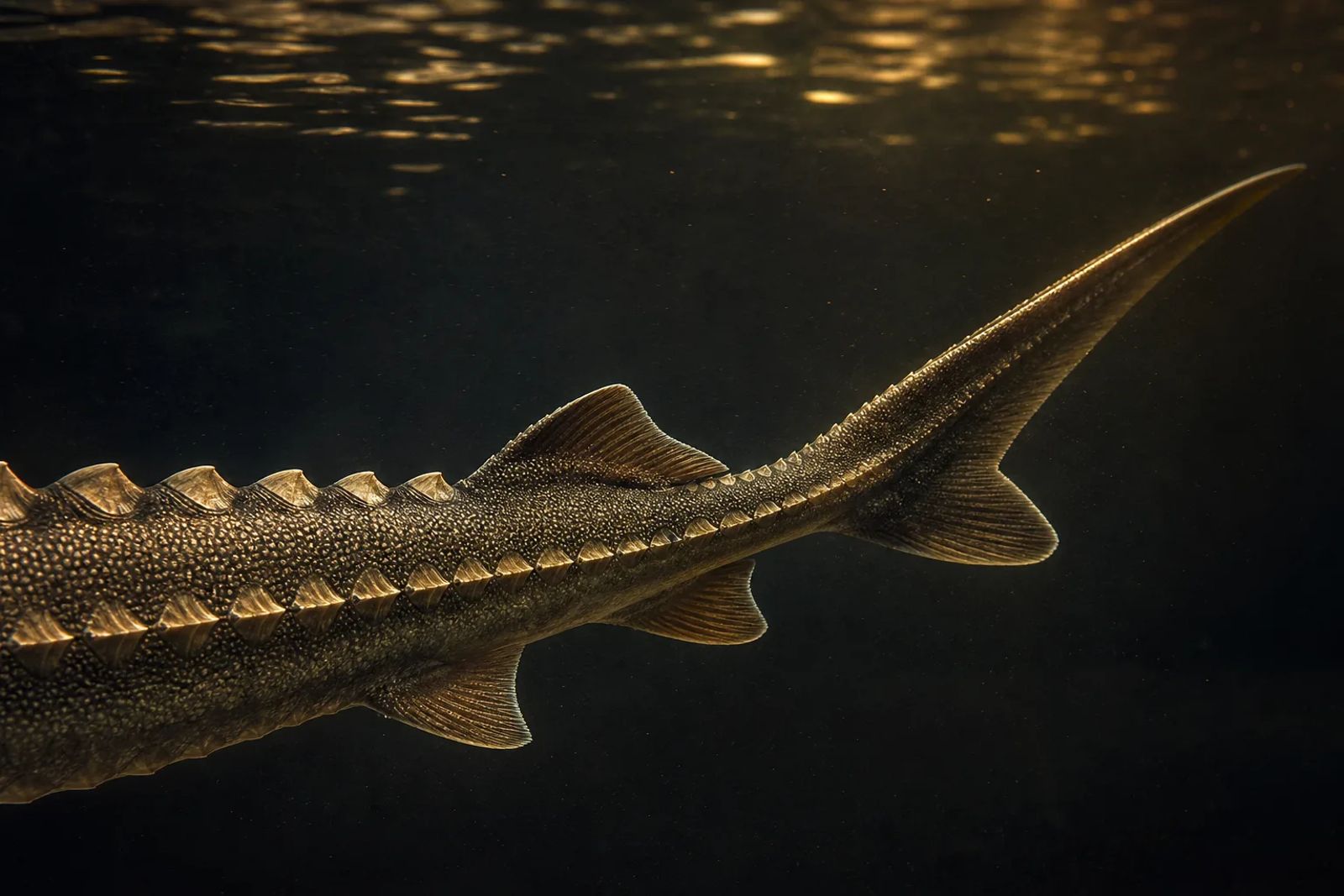
Dorset’s Blue Lias Formation preserves evidence of an early sturgeon relative from roughly 200 million years ago. Today’s sturgeons still carry features that recall distant fossil relatives. The wider acipenseriform lineage reaches securely into the Jurassic, with a proposed member older still, in the Triassic. But this is a story of long survival, not evolution standing still.
Why is the sturgeon called a living fossil?
The name captures something immediately striking: a living fish with an ancient-looking body and a deep fossil history. “Living fossil” is an informal description, not a taxonomic rank or an IUCN conservation category. It usually combines several ideas: resemblance to extinct relatives, relatively slow anatomical change and limited surviving diversity.
Those ideas are worth separating. An ancient branch of the evolutionary tree can contain much younger species. A familiar outline says little about how much an organ, gene or behaviour has changed. Scientists use morphology for an organism’s form and structure; morphological stasis means relatively little change in specified features over a specified interval.
Some biologists reject “living fossil” because it can make evolution sound like a ladder, with sturgeons stranded on a lower rung. Others find it a useful opening question. Which traits changed slowly? Compared with what? And why? Scott Lidgard and Alan Love favour this question-led approach over dividing all organisms neatly into living fossils and everything else.
Where sturgeons fit in the fish family tree
Sturgeons are ray-finned fishes, not members of the separate lineage containing sharks and rays. They belong to Acipenseridae, a family within the order Acipenseriformes. The order’s other surviving family, Polyodontidae, contains the paddlefishes, now represented by the American paddlefish following the extinction of its Chinese relative. Both families sit within Actinopterygii, the ray-finned fishes.
This family tree gives meaning to the claim that sturgeons are 200 million years old. That date can describe early members of the wider order, including extinct branches outside the two surviving families. It does not describe the age of today’s sturgeon species. Nor is every ancient relative a direct ancestor.
The distinction is simple but important: a branch, a family and an individual species each have their own history. For the wider biological picture, start with sturgeon biology.

What the fossils actually show
Dorset provides a secure early landmark. Chondrosteus, from the Lower Jurassic of England, sits near the base of Acipenseriformes in Eric Hilton and Peter Forey’s anatomical redescription. Michael Benton and colleagues’ fossil-calibration review identifies material from the Hettangian to Sinemurian Blue Lias Formation of Dorset. Together, these records support an acipenseriform history extending back roughly 200 million years.
An older candidate could push that history further back. In their 2020 redescription, Liwu Lu and colleagues placed Eochondrosteus sinensis at the base of the order and revised its geological age from Late Permian to Early Triassic, roughly 252 to 247 million years ago. Missing skull information, acknowledged in their analysis, leaves that placement proposed rather than settled.
Later fossils reveal recognisable paddlefishes and sturgeons as well as early relatives. Protopsephurus, from the Early Cretaceous of China, documents the paddlefish branch. A partial sturgeon skull described by Matthew Vavrek and colleagues in 2014 comes from Alberta’s middle Cenomanian Dunvegan Formation, in the early Late Cretaceous. Each find establishes that its lineage was present by that time, rather than pinpointing when it first arose.
Old-looking features, a changing body
Reduced bone formation is itself an evolutionary modification, not simply a relic of an ancient body plan. Roland Billard and Guillaume Lecointre’s review makes this point about reduced ossification: it is not straightforward evidence of primitiveness.
Bony plates along the body, an enlarged upper tail lobe and a largely cartilaginous internal skeleton give sturgeons their distinctive form. Those plates are called scutes; the unequal tail is heterocercal. Another feature commonly invoked in the living-fossil comparison is the spiral valve, a fold within the intestine. Their arrangement and function are explored in sturgeon anatomy.
The sturgeon’s body is a mixture of inherited characteristics and later specialisations. It offers a compelling connection with the past, but it is no model of what all early fishes looked like.
How scientists put dates on the lineage
The rocks supply the first clock. Researchers establish a fossil’s position in a rock sequence, compare layers and their associated fossils, and use radiometric dating wherever suitable material is available. That can include volcanic layers associated with fossil-bearing deposits. The age comes from the specimen’s geological context, rather than from a clock inside the fossil fish.
DNA offers another route. A molecular clock combines differences in DNA sequences with a model of evolutionary rates and fossil calibrations to estimate when branches separated. Its estimate may predate the oldest known fossil: the first specimen recovered is unlikely to represent the first member that ever lived.
Some biologists reject “living fossil” because it can make evolution sound like a ladder, with sturgeons stranded on a lower rung.
The two methods carry different uncertainties. A fossil’s position on the family tree may be disputed, or the age assigned to its rock layer revised. Molecular estimates depend on the sequences, calibrations and rate model used. Published ranges and minimum ages therefore tell the story more faithfully than a single exact year for the lineage’s beginning.

What DNA adds to the comparison
A familiar body outline does not establish slow genetic change. Measured DNA provides a separate line of evidence. In a 2024 study in Evolution, Chase Brownstein and colleagues compared 1,105 exons, the protein-coding portions of genes, across 481 vertebrate species. Sturgeons and gars showed exceptionally low rates of nucleotide substitution, meaning changes in the DNA sequence, in the protein-coding regions sampled.
The researchers found evidence of a slow rate in the genetic features they measured. That finding does not extend to evolution across the entire organism. The authors suggested efficient DNA repair as a possible explanation, rather than demonstrating a universal mechanism. Their striking evidence of fertile hybrids across exceptionally deep evolutionary separation concerned gars, not sturgeons.
Sturgeon genomes also have a history of changes involving whole sets of chromosomes. A conserved body outline can conceal considerable genetic complexity, as the guide to sturgeon genetics and hybridisation explains.
A short timeline of the evidence
The timeline runs from ancient fossils to modern research and conservation assessments. These are records and milestones, rather than a chain of direct ancestors: geological periods date the fossils, while modern dates mark publication or assessment events.
- Early Triassic, roughly 252 to 247 million years ago: Eochondrosteus, China. Proposed as an early acipenseriform; its placement remains unsettled. 5
- Early Jurassic, roughly 200 million years ago: Chondrosteus, England. An early acipenseriform outside the living families. 3,4
- Early Cretaceous: Protopsephurus, China. Evidence of the paddlefish branch. 4,5
- Middle Cenomanian, early Late Cretaceous: a sturgeon skull from Alberta records the sturgeon family in North America. 6
- 21 July 2022: an IUCN Red List update recognised the Chinese paddlefish as Extinct. 12,14
- 2024: a comparative exon study investigated slow molecular change. 9
Why an ancient lineage can still disappear
A lineage can survive for millions of years and still lose its living populations. Many sturgeons live for decades, mature late and do not spawn every year. Their life histories rely on adults surviving through repeated opportunities to reproduce. Heavy losses of mature fish can therefore leave a population depleted for a long time.
Dams can cut off access to spawning grounds. Altered flows, degraded habitat and fishing add further pressure. Because breeding adults are replaced slowly, recovery can lag well behind protective action. The problem lies in that life history, not in sturgeons being too evolutionarily primitive to cope. The fuller account is in sturgeon conservation.
The Chinese paddlefish, Psephurus gladius, brings that vulnerability into sharp focus. The IUCN Red List update published on 21 July 2022 recognised it as Extinct: a modern loss within Acipenseriformes. That recognition date does not tell us when the last Chinese paddlefish died. Its story belongs to the extinct Chinese paddlefish, not to the distant fossil record alone.
The same 2022 update placed the Yangtze sturgeon, Acipenser dabryanus, in Extinct in the Wild, a category distinct from Extinct. Its assessment records an assessment date of 14 September 2019 and publication in 2022. Here, too, the dates tell different stories: the year a status is published need not be the year the biological change occurred. Deep evolutionary history offers no protection against present-day vulnerability.
Sources
-
Oxford University Press, BioScience. Lidgard, S. and Love, A. C., “Rethinking Living Fossils”, volume 68, issue 10, 2018.
https://pmc.ncbi.nlm.nih.gov/articles/PMC6203082/ -
Springer Nature, Biology & Philosophy. Lidgard, S. and Love, A. C., “The living fossil concept: reply to Turner”, volume 36, article 13, 2021.
https://link.springer.com/article/10.1007/s10539-021-09789-z -
Cambridge University Press, Journal of Systematic Palaeontology. Hilton, E. J. and Forey, P. L., “Redescription of †Chondrosteus acipenseroides Egerton, 1858 (Acipenseriformes, †Chondrosteidae) from the lower Lias of Lyme Regis (Dorset, England), with comments on the early evolution of sturgeons and paddlefishes”, volume 7, issue 4, 2009; publisher abstract consulted.
https://www.tandfonline.com/doi/abs/10.1017/S1477201909002740 -
Palaeontologia Electronica. Benton, M. J. and colleagues, “Constraints on the timescale of animal evolutionary history”, 2015 fossil-calibration review.
https://palaeo-electronica.org/content/pdfs/424.pdf -
Earth Science Frontiers, Geological Museum of China authors. Lu, L., Tan, K. and Wang, X., “Redescription of Eochondrosteus sinensis (Acipenseriformes, Actinopterygii) and its geological age”, volume 27, issue 6, 2020; journal's indexed English abstract consulted.
https://www.earthsciencefrontiers.net.cn/EN/Y2020/V27/I6/371 -
Philip J. Currie Dinosaur Museum. “Ancient life from the Peace River”, May 2014, investigator account identifying and referencing the Vavrek, Murray and Bell fossil description.
https://dinomuseum.ca/2014/05/ancient-life-from-the-peace-river -
Yale Peabody Museum, Bulletin of the Peabody Museum of Natural History. Brownstein, C. D. and Near, T. J., “Toward a Phylogenetic Taxonomy of Sturgeons (Acipenseriformes: Acipenseridae)”, volume 66, issue 1, 2025; author-hosted paper.
https://www.nearlab.org/uploads/1/3/3/7/133700440/190_brownstein_near2025sturgons.pdf -
Kluwer Academic Publishers, Reviews in Fish Biology and Fisheries. Billard, R. and Lecointre, G., “Biology and conservation of sturgeon and paddlefish”, volume 10, 2001; WWF-hosted paper.
https://awsassets.panda.org/downloads/14_2001_biology_and_conservation_of_sturgeon_and_paddlefish_billard_lecointre_int.pdf -
Oxford University Press, Evolution. Brownstein, C. D. and colleagues, “The genomic signatures of evolutionary stasis”, volume 78, issue 5, 2024; journal abstract and PubMed record consulted.
https://pubmed.ncbi.nlm.nih.gov/38437861/ -
Springer Nature, Nature Communications. Redmond and colleagues, “Independent rediploidization masks shared whole genome duplication in the sturgeon-paddlefish ancestor”, 2023; indexed publication record consulted.
https://www.nature.com/articles/s41467-023-38714-z -
Springer Nature, Journal of Ichthyology. “Modern Concepts on the Origin and Distribution of Acipenserids (Acipenseridae)”, 2023 review; methodological discussion consulted.
https://doi.org/10.1134/S0032945223020169 -
International Union for Conservation of Nature. “Migratory monarch butterfly now Endangered: IUCN Red List”, press release, 21 July 2022; sturgeon and paddlefish reassessment passages.
https://iucn.org/press-release/202207/migratory-monarch-butterfly-now-endangered-iucn-red-list -
IUCN SSC Sturgeon Specialist Group. “Acipenser dabryanus”, The IUCN Red List of Threatened Species, assessment published 2022, assessed 14 September 2019; indexed assessment record consulted.
https://doi.org/10.2305/IUCN.UK.2022-1.RLTS.T231A61462199.en -
International Union for Conservation of Nature. IUCN Red List category changes, Table 7, release 2022-1; Psephurus gladius row.
https://nc.iucnredlist.org/redlist/content/attachment_files/2022-1_RL_Stats_Table_7.pdf
Research combined peer-reviewed fossil descriptions, comparative evolutionary studies and official IUCN records, distinguishing geological ages from assessment publication dates.
Last checked: November 2026