
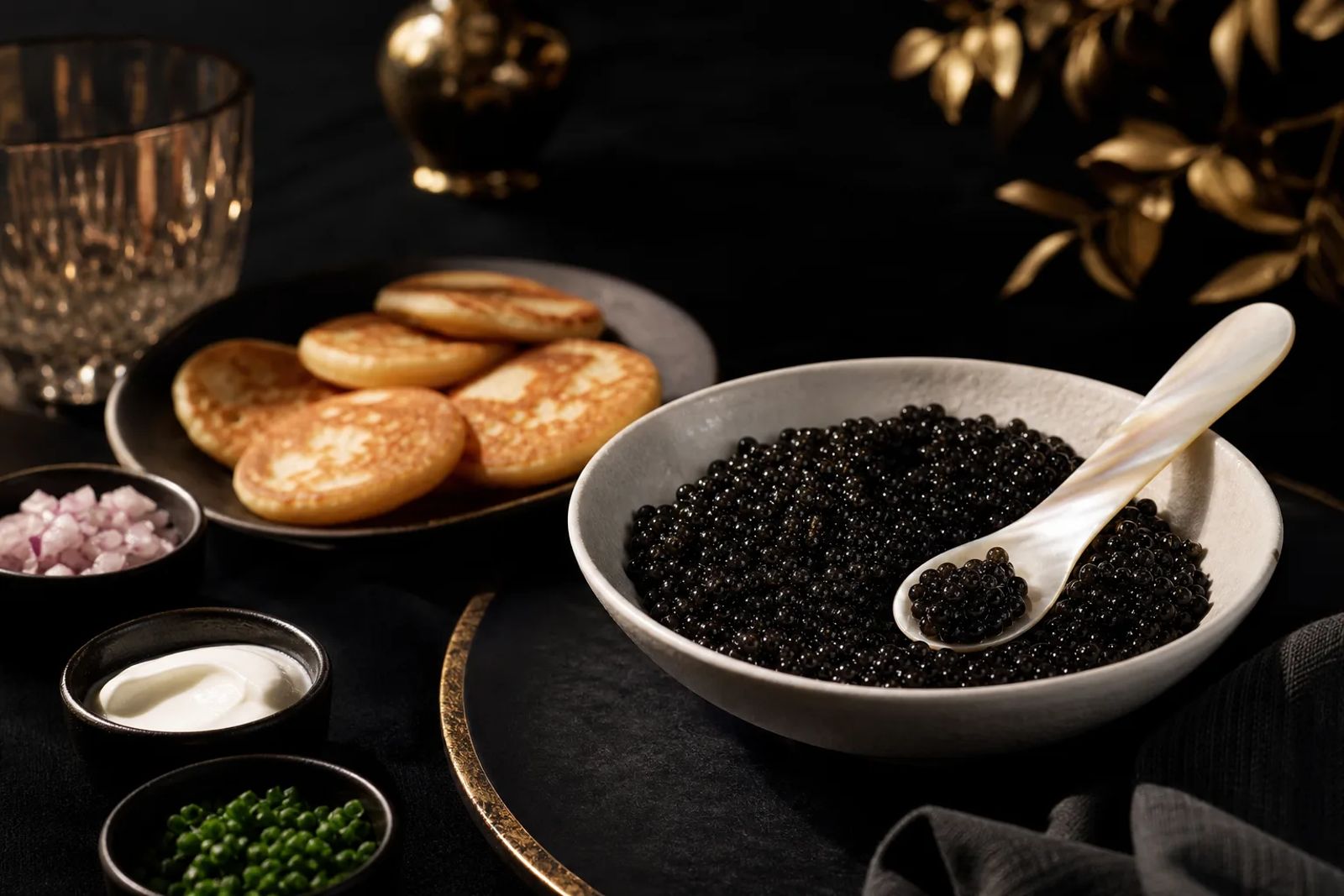
Silky grains, a delicate pop and spicy flavour: that is how Attilus describes its Siberian sturgeon caviar. Giaveri describes gentle selections from the same species. The name on the tin is only the beginning.
The best caviar for you is the one whose flavour and texture you enjoy, not the species with the grandest reputation. Start with intensity, bead size and firmness, then consider salting and processing. Species points you towards a style; the individual fish, farm and batch shape what reaches your spoon.
Which caviar is best for your preferences?
Decide what you want to feel and taste before choosing a species. These five questions turn a vague wish for “good caviar” into a useful brief.
- Flavour intensity: A quiet savoury taste or a pronounced marine finish?
- Bead size: Many small grains or fewer, larger eggs?
- Firmness and pop: Resistance before the membrane breaks, or a softer release?
- Colour: Does a dark, pale or golden appearance matter to you?
- Salt level: An assertive salt impression, or salt that sits behind the roe’s other flavours?
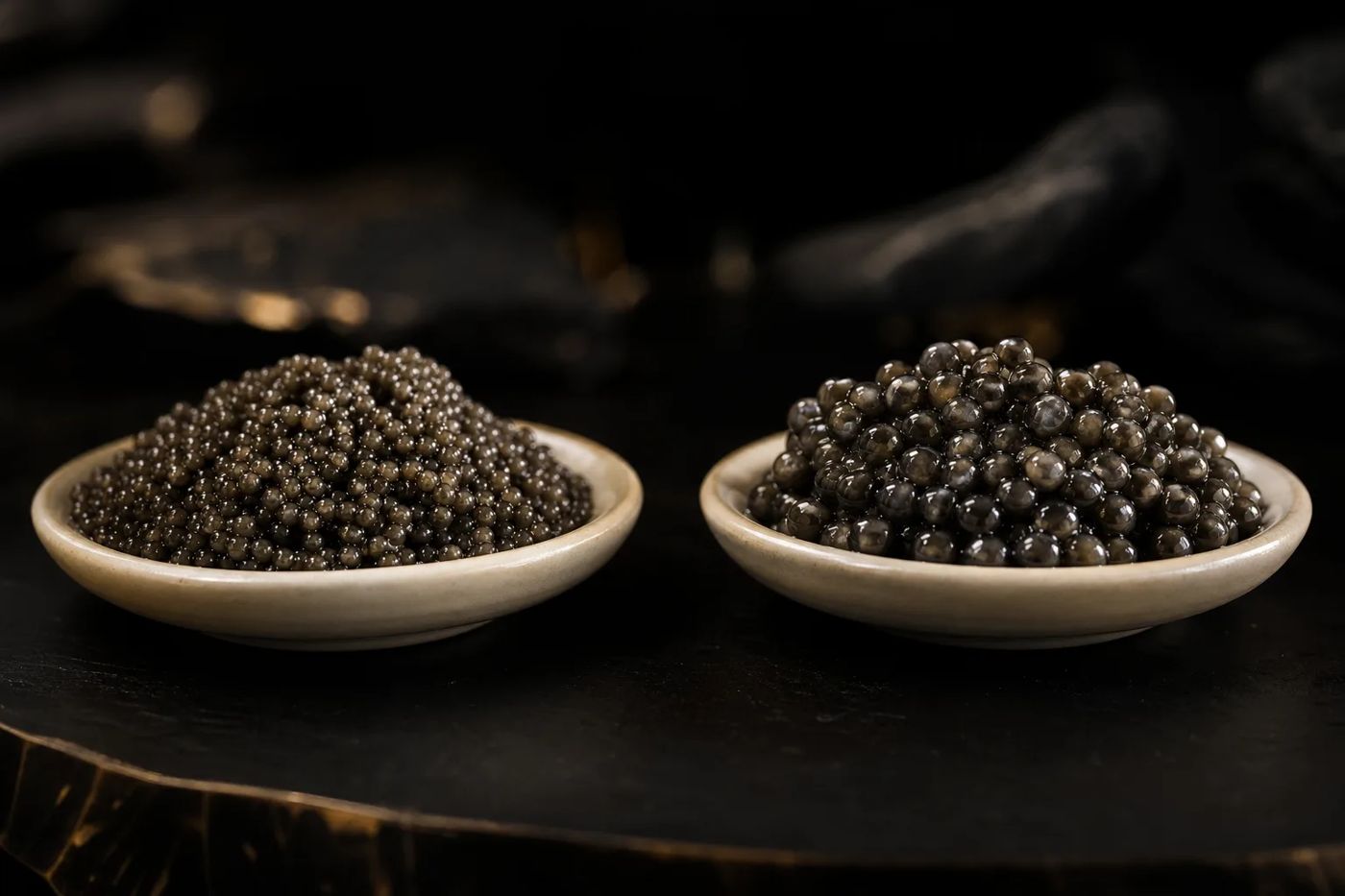
There is no correct combination. Mild flavour and a firm bead, for example, make a perfectly clear request. Keep size and firmness separate: a larger egg does not automatically deliver a stronger pop. Explore bead size and firmness, or turn to how to buy caviar for the wider purchasing checks.
A species comparison, not a league table
Use the table to compare egg dimensions, producers’ flavour and texture descriptions, and documented farming origins. Look for the characteristics you enjoy, rather than a species to put first.
The flavour and texture notes below are the named companies’ descriptions of their own caviar. Farming countries are documented examples, not a complete census. Egg diameters are biological measurements reproduced from the verified overview sheet, rather than guaranteed sizes for salted caviar. The beluga figures describe mature Volga eggs. When size matters, ask for the current batch specification.
| Species or hybrid | Scientific name | Egg diameter, mm | Producer’s flavour and texture notes | Documented farming examples |
|---|---|---|---|---|
| Beluga | Huso huso | 3.6 to 4.3 | Conservation context, not a recommendation | Belgium, Italy, China; Spain (2021) |
| Russian sturgeon | Acipenser gueldenstaedtii | 3.2 to 3.8 | Attilus: firm grains, slightly nutty, lingering mellow finish | China, Italy, Poland, Bulgaria, Belgium |
| Siberian sturgeon | Acipenser baerii | 2.4 to 3.0 | Attilus: silky grains, spicy flavour, delicate pop | China, Italy, Poland, Bulgaria, Belgium |
| White sturgeon | Acipenser transmontanus | 3.2 to 4.0 | Giaveri: mild, gentle flavour; large grains | Italy, United States |
| Stellate sturgeon (Sevruga) | Acipenser stellatus | 2.7 to 3.2 | Attilus: pronounced flavour, mildly fruity note | Not documented |
| Sterlet | Acipenser ruthenus | 1.9 to 2; or 2.0 to 2.8 | Giaveri’s golden selection: strong marine flavour | Belgium |
| Kaluga | Huso dauricus | Not documented | Kaluga Queen: smooth, firm texture, butter-like flavour | China |
| Amur sturgeon | Acipenser schrenckii | Not documented | Kaluga Queen: nut and butter notes | China |
| Amur male x Kaluga female | Acipenser schrenckii male x Huso dauricus female | Not documented | Kaluga Queen’s A&K hybrid, parent sexes unstated: balanced, delicate flavour | China |
Sterlet’s two diameter ranges come from different references; keeping them separate preserves that distinction. Export evidence alone does not verify a farm, so the country entries reflect only the farming evidence available.
Neither size nor colour identifies a species: both overlap. Beluga’s documented colours run from light to dark grey. Verified species-specific colour ranges are not documented for the other entries.
Let flavour and texture lead
For a mild introduction, ask for white sturgeon with a mild batch description. Giaveri’s gentle white sturgeon is a useful starting point, but its gentle Siberian selections also belong in that conversation. Attilus’s spicy Baerii shows how differently the same species can be described.
For texture, ask about firmness and membrane resistance. “Large grains” answers a different question. Attilus describes firm Russian sturgeon grains; Kaluga Queen describes its pure Kaluga as smooth and firm. Those are useful product descriptions, rather than a species-wide texture ranking.
With hybrids, parentage matters. The cross listed in the table has a male Amur sturgeon parent and a female Kaluga parent, while Kaluga Queen’s A&K description leaves the parent sexes unstated. A product called Kaluga need not be this cross, and hybrids need not share a taste. Understanding hybrid differences starts with the actual parents.
Read the species behind the trade name
Imperial, Royal, Golden and Reserve tell you about a commercial selection, not a species or a shared grading ladder. Ask what the term means for that particular product. Ossetra and Oscietra are trade names associated with Russian and Persian sturgeon, rather than scientific identifications.
Beluga means Huso huso, the species listed by CITES. It does not mean Kaluga or a Kaluga hybrid. “Kaluga Beluga” is potentially misleading trade language; beluga appears here for comparison and conservation context, not as encouragement to seek protected wild fish.
The table uses CITES names. Genus revisions proposed in 2025 have created conflicting names: the IUCN specialist group rejected both 2025 revisions and itself proposed dissolving Huso. The species guide explains the distinction.
Style can matter as much as species
Malossol
Malossol means “little salt”. It is a salting description, not a species, and the declared salt content is more informative than the word alone. Codex’s granular sturgeon-caviar standard specifies 3 to 5 g salt per 100 g. That is an international reference, not automatically binding national law.
Pressed
Choose pressed caviar for concentration, not the clean pop of separate eggs. The grains become a compact paste. Petrossian describes its house blend as powerful and persistent, making this a style to consider when marine intensity matters more than bead definition.
Pasteurised
Heat treatment can change both texture and flavour. Rocchetti and colleagues compared eight caviars from six sturgeon species through sensory assessment, texture testing and metabolomics. Both species and processing affected the results; the study does not reduce to a fresh-versus-pasteurised ranking.
Aged or matured
Maturation happens before release, with salted caviar held under controlled conditions. It does not mean leaving an opened container to develop. A 2024 Russian-sturgeon study tracked refrigerated caviar through sensory and chemical analyses, finding changes in flavour and membrane properties over time. More age does not automatically mean better caviar.

The farm matters too
Caviars from different diet groups tasted and felt different. Baker and colleagues used a trained sensory panel and consumer assessment to examine caviar from sturgeon fed differing diets. Differences included firmness, fresh-seafood character, earthy flavour and bitterness. Species alone could not explain the tasters’ experience.
Keep size and firmness separate: a larger egg does not automatically deliver a stronger pop.
Ask about water and farm management, too, especially the control of unwanted earthy odours. A 2026 study examined waterborne and feedborne odour compounds in twelve Russian sturgeon. It analysed fillets rather than roe, supporting the mechanism without predicting a tin’s flavour.
Use flavour descriptions to make your preferences clear, then bring the conversation back to the actual batch: its flavour, texture and how the farm manages them.
When another roe suits you better
Want a large orange egg with a distinct burst? Start with salmon roe, rather than searching for orange sturgeon caviar. The Alaska Seafood Marketing Institute describes colours and textures that vary by salmon species, including a pleasant pop in king salmon roe.
A modest quantity of a roe you already enjoy is also a sensible smaller commitment. Sturgeon is not a compulsory next step. The salmon roe comparison explains the sensory differences; fish roe simply means fish eggs.
What may be sold as “caviar” depends on jurisdiction. Nonbinding US FDA CPG 540.150 limits unqualified caviar to sturgeon roe, requires other fish names to be equally prominent and requires added colour to be declared. See the buying guide for the naming rules. Those distinctions do not make one roe better to eat. Choose the experience you want.
If you like X, try Y
Match a description to your preferences, then ask whether the current batch delivers it. These starting points come from the producer descriptions above, rather than a ranking of species.
- A gentle savoury impression: try white sturgeon described as mild, as in Giaveri’s selection.
- Firm grains and a lingering nut note: try Russian sturgeon matching Attilus’s Oscietra description.
- Pronounced flavour in smaller grains: try Sevruga, with a stated farm and CITES source code.
- A balanced, delicate hybrid: consider Kaluga Queen’s A&K hybrid. Kaluga Queen does not specify its parent sexes, so check before treating it as the listed male Amur and female Kaluga cross.
- Concentrated marine flavour without separate beads: consider pressed caviar described as intense; species is not the deciding factor.
Make your shortlist specific
Give the supplier a sentence they can answer: “I want firm grains, moderate salt and a mild finish; which current batch fits that?” Then ask for the scientific name, farm origin, processing style and declared salt content. Compare those answers with your preferences, not the decorative selection name.
After tasting, finish this sentence: “Next time, I want…” Less salt, a softer membrane, more persistence or a larger bead? Record the change, not just whether you liked “Royal” or disliked “Siberian”.
Sources
-
University of Florida, IFAS. Chapman, F. A. and Van Eenennaam, J. P. Sturgeon Aquaculture: Specialized Techniques: Determining the Stage of Sexual Maturity in Female Sturgeon for Artificial Spawning: The Egg Polarization Index or PI, FA153, 2007, reviewed August 2025. Document.
-
FAO. Chebanov, M. S. and Galich, E. V. Sturgeon Hatchery Manual, Fisheries and Aquaculture Technical Paper 558, 2013 reprint. Document.
-
FAO. Sturgeons (Acipenseriformes), undated report section, approximately 2004 according to the supplied editorial record. Report section.
-
Attilus. Tasting Guide, undated web edition retrieved November 2026. Commercial source, used only for its attributed species and sensory descriptions;
-
Caviar Giaveri. How to choose caviar, undated web edition retrieved November 2026. Producer source, used for its descriptions of white sturgeon, Siberian selections and golden sterlet. Guide.
-
Kaluga Queen. Caviar, undated US website catalogue retrieved November 2026. Commercial source, used for its descriptions of Kaluga, Amur and its Amur/Kaluga hybrid. Catalogue.
-
Rocchetti, G. and colleagues. The contribution of sturgeon species and processing conditions on caviar texture, metabolomic profile and sensory traits, Food Chemistry, article 141516, DOI 10.1016/j.foodchem.2024.141516. Published 2025, volume 463, part 4. Publisher abstract.
-
Baker and colleagues. Development of a Lexicon for Caviar and Its Usefulness for Determining Consumer Preference, Journal of Food Science, 2014, DOI 10.1111/1750-3841.12703. Publisher record.
-
Liu, L. and colleagues. Multi-omics combined approach to analyze the mechanism of flavor evolution in sturgeon caviar (Acipenser gueldenstaedtii) during refrigeration storage, Food Chemistry: X, volume 23, article 101688, 2024. Open-access article.
-
FAO and WHO, Codex Alimentarius Commission. Standard for Sturgeon Caviar, CXS 291-2010, adopted 2010, amendments through 2024 in the official PDF retrieved. Canonical document. The Codex register records a further modification in 2026.
-
World Sturgeon Conservation Society. Bronzi, P. IUCN SSG summary report, 13 November 2025, reporting the joint meeting of 22 October 2025. Report.
-
US Food and Drug Administration. CPG Sec 540.150 Caviar, Use of Term: Labeling, October 1989, current web record retrieved November 2026. Nonbinding compliance guidance. Guidance.
-
Petrossian. 1835 Pressed Caviar, undated product description retrieved November 2026. Commercial source, used only for the paste format and attributed flavour description.
-
Alaska Seafood Marketing Institute. Roe Guide, undated PDF edition retrieved November 2026. Industry source describing salmon-roe colour and texture. Guide.
-
Journal of Agriculture and Food Research. Feeding during off-flavour purging in recirculating aquaculture systems? An exploratory characterisation of waterborne and feedborne odour-active compounds in Russian sturgeon (Acipenser gueldenstaedtii), volume 26, article 102615, 2026. Research article.
-
CITES. Conservation of and trade in sturgeons and paddlefish, Resolution Conf. 12.7 (Rev. CoP17), checked after CoP20, Annex 2. Used to corroborate the supplied names, not as verification of the current resolution revision. Archived document.
Research combined live retrieval of institutional documents, research papers and attributed commercial descriptions with the supplied editorial fact sheets; no first-hand tasting was undertaken.
Last checked: November 2026