
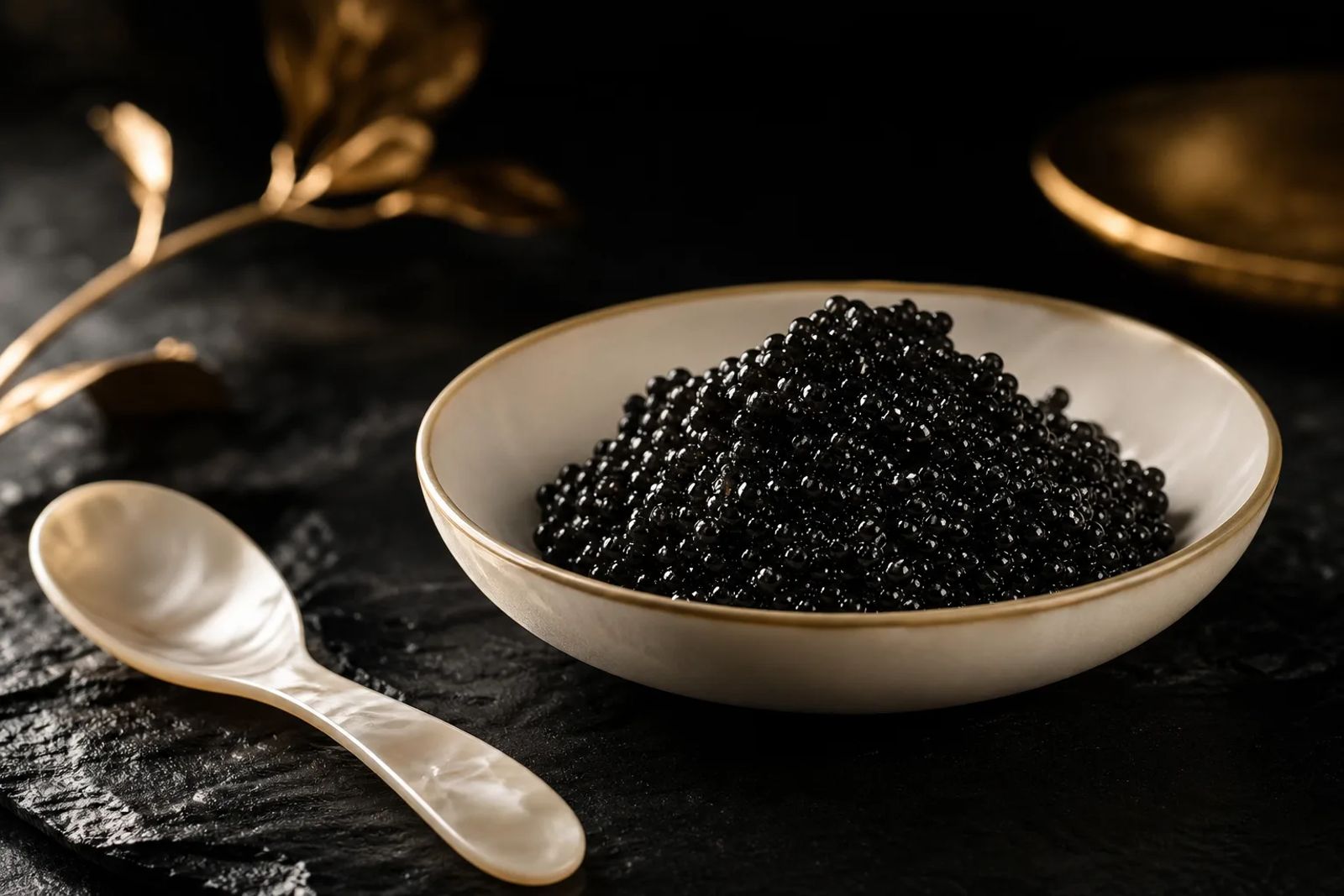
Caviar flavour profiles use familiar food comparisons to describe aroma, taste and mouthfeel: buttery suggests butter-like richness, nutty recalls nuts, briny means salt with a marine impression, creamy describes smoothness, and mineral is a less precise stone-like or saline association. Producers and tasters use these words, but species, processing and handling influence what reaches the spoon.
Reading caviar flavour profiles
A useful tasting note distinguishes saltiness on the tongue, aromas such as hazelnut or seaweed, and the physical sensation after the eggs break. Retronasal aroma means smell reaching the nose from the mouth during eating; it helps explain why something described as a flavour may not be a basic taste.
ISO 5492:2008, confirmed at its latest review and amended in 2016, supplies general sensory vocabulary, not a caviar flavour wheel. The definitions below are this site's working explanations, intended to make notes more discriminating rather than prescribe what anyone must find.
For the wider assessment of texture, appearance and condition, see caviar grading and quality. Here, the task is narrower: replace a vague impression with words another taster can understand.
What buttery, nutty, briny, creamy and mineral mean
Butter and cream
Buttery can describe a butter-like aroma, a rich coating sensation, or both. Specify which: “fresh butter on the finish” says something different from “oily mouthfeel”, and neither automatically means that the roe contains more fat than another sample.
Creamy is most useful for smoothness and the soft, cohesive sensation of the egg contents after the membrane breaks. It need not imply a distinct dairy aroma: try “silky”, “smooth” or “mouth-coating” if those fit better, reserving “cream-like aroma” for an actual aromatic resemblance.
Nuts and grains
Nutty needs a second word whenever possible: hazelnut, walnut, almond or toasted grain. These comparisons distinguish different aromatic impressions; they are not ingredients, and a resemblance to roasted nuts does not establish that the caviar has been heated.
Salt and sea
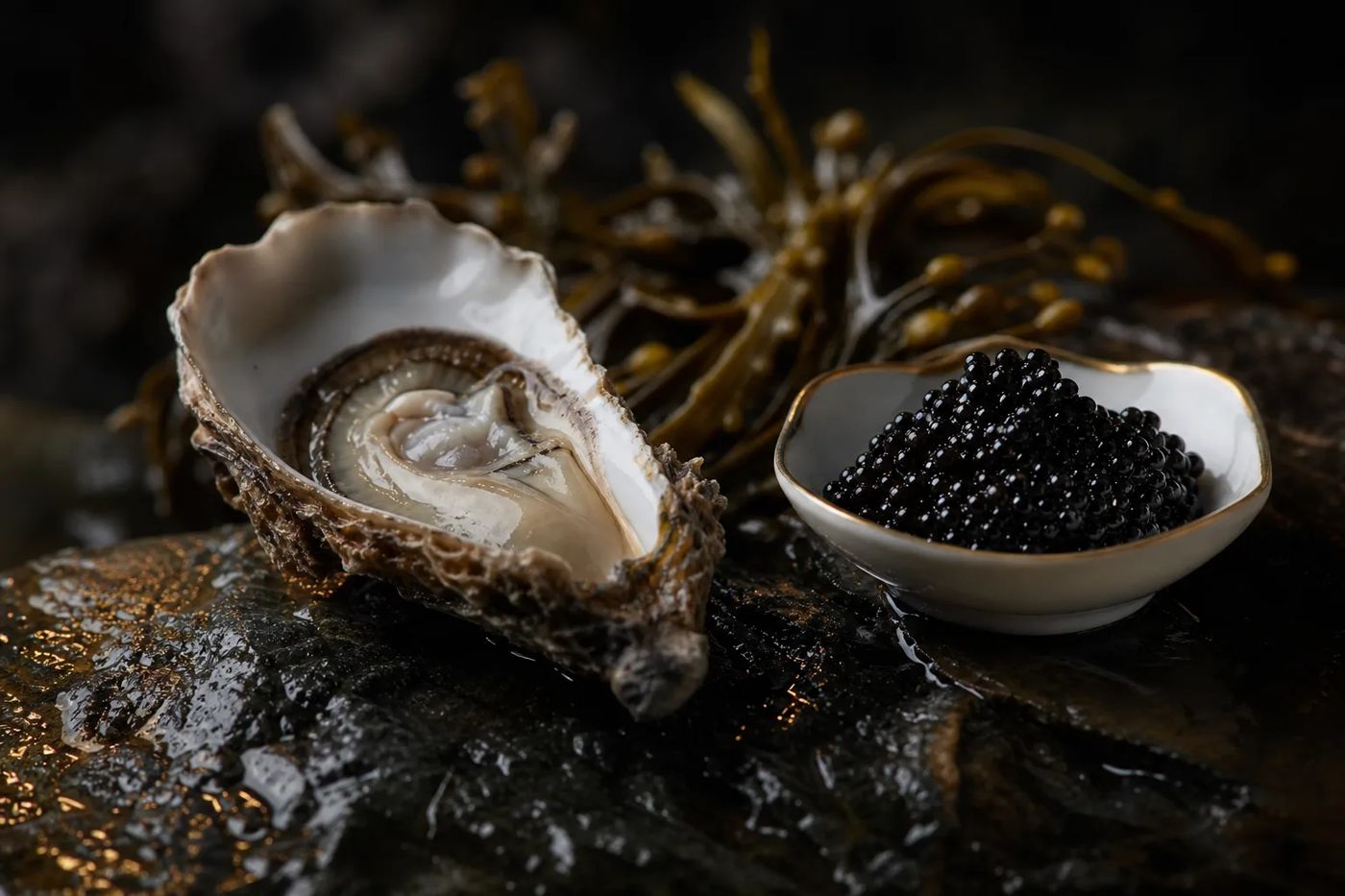
Briny combines saltiness with a marine association, rather than simply meaning “very salty”. Oyster-like suggests a shellfish resemblance, while seaweed-like or nori-like identifies a greener marine aroma; use the closest comparison instead of treating them as synonyms.
Iodine is tasting shorthand for a pungent marine or medicinal association, not a measurement of iodine in the food. Record the association only if you recognise it, and distinguish it from an unpleasant chemical smell.
Mineral and finish
Mineral is particularly ambiguous. In this guide it means an association such as wet stone, chalk or a dry saline finish, not proof that dissolved minerals from the farm water are being tasted directly.
Clean finish means that the flavour fades without an unwanted lingering note; it does not mean flavourless or necessarily brief. Separate duration from character: a persistent hazelnut note and a short saline finish can both be described precisely.
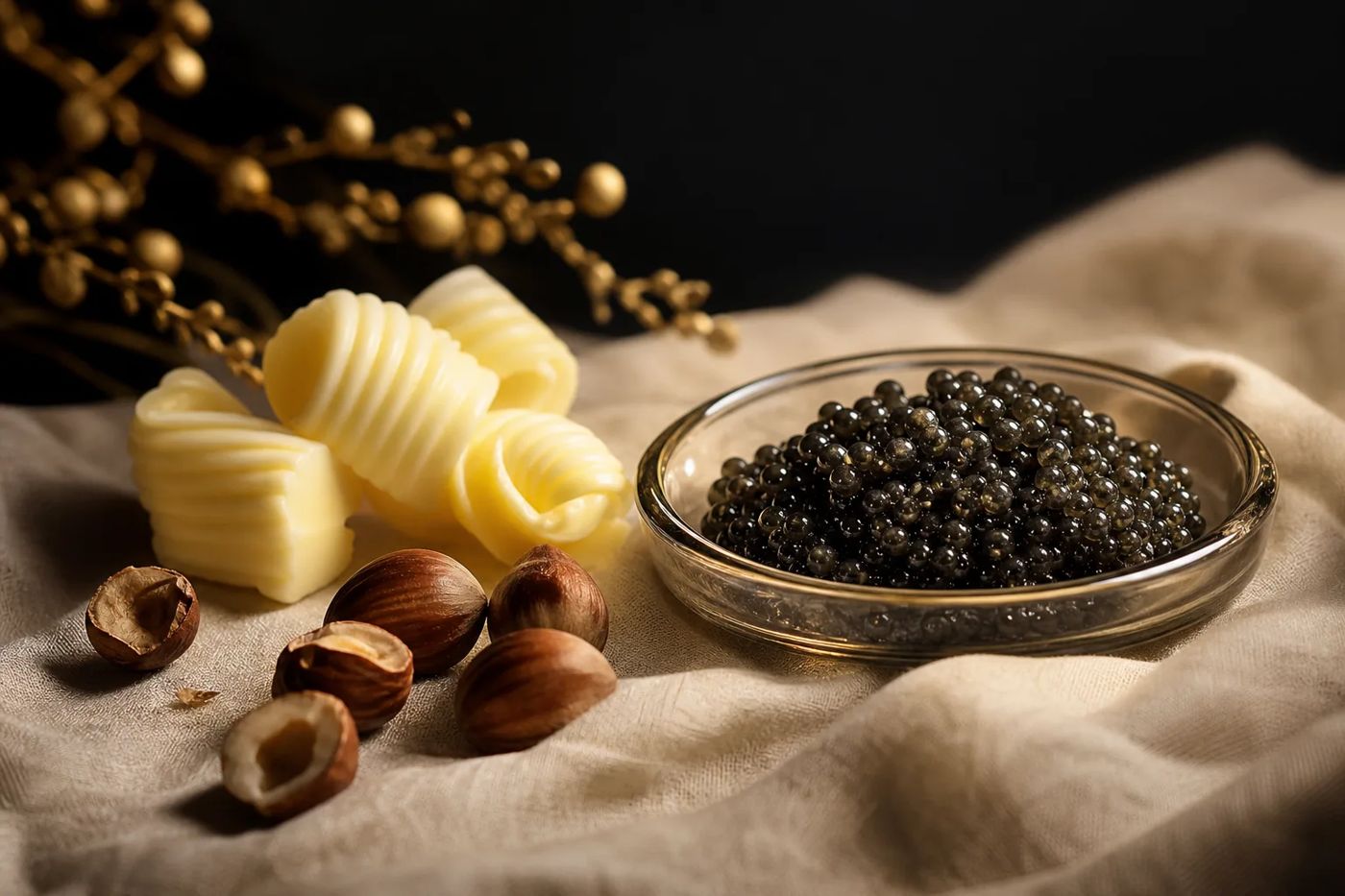
The caviar flavour wheel (an editorial tasting aid)
This is caviar.uk's editorial tasting aid, not a published scientific or industry standard. The groups organise useful comparisons, not quality grades: move from a broad family to a specific note, leaving any group blank when nothing fits.
| Family | Possible notes | What to record |
|---|---|---|
| Fresh | Green, grassy, cucumber-like | The particular fresh plant association |
| Sea | Briny, oyster-like, seaweed, iodine | Salt intensity separately from marine aroma |
| Rich | Butter, cream, silky, oily | Aroma separately from mouthfeel |
| Nutty | Hazelnut, walnut, almond, toasted grain | The closest recognisable comparison |
| Mineral | Wet stone, chalk, dry saline finish | The specific association, not just mineral |
| Off-notes | Muddy, earthy, metallic, sour, strongly fishy | Character, intensity and persistence |
Write a short sequence rather than a string of compliments: first impression, flavour after the beads break, then finish. “Moderate salt, oyster-like aroma, smooth contents, lingering hazelnut” is an illustrative note, not a report of a product tasted by this site.
Use the printable caviar tasting sheet to keep the observations separate. If a note appears only after reading the producer's description, mark that uncertainty instead of forcing agreement.
Which species are described this way
Producer descriptions show how the vocabulary is used, but they describe that producer's caviar, not an immutable species signature. Calvisius provides three useful examples, with the species stated so that trade names do not substitute for identification.
For Russian sturgeon, Acipenser gueldenstaedtii, Calvisius describes its Ars Italica Oscietra with hazelnut, butter and sea-urchin notes. Here, Oscietra is the product's trade name, while the scientific name identifies the fish; the description combines nut, rich and marine families rather than choosing only one.
No clear nut note” is a useful observation; a full vocabulary should help you notice differences, not require every spoonful to travel around the entire wheel.
For Siberian sturgeon, Acipenser baerii, its published descriptions include oyster, nori seaweed, nuts and honey, with an iodine character. This is a useful reminder that “Siberian” does not have to mean merely earthy: the producer's chosen reference points include both marine and sweet-associated aromas.
For white sturgeon, Acipenser transmontanus, Calvisius describes Tradition Prestige as creamy and buttery, with fruit, gentle nuttiness and restrained marine salinity. Read this as a suggested vocabulary for comparison, not a claim that every white-sturgeon caviar will reproduce the same balance.
What research can explain
Fat may affect mouthfeel and aroma release, but “buttery” is not a measure of fat content. The 2024 Russian sturgeon study measured lipids alongside flavour changes 6; it does not establish a simple link between fat content and a buttery note.
Free amino acids help explain savouriness. In a 2024 study of Russian sturgeon caviar followed for six weeks 6, fifteen trained panellists used a five point scale to score sensory properties while researchers measured amino acids, lipids and volatile compounds. Changes in glutamate and aspartate accompanied changes in umami, the savoury taste, which rose and then declined during storage.
Maturation changes chemistry, not simply intensity. Lopez and colleagues examined white-sturgeon eggs and caviar at five stages, from raw eggs to 240 days of controlled ripening, using headspace extraction and gas chromatography-mass spectrometry. They found changing aldehydes and alcohols, with lipid oxidation and microbial activity implicated in volatile formation.
Those experimental ripening periods are not instructions for keeping a tin at home. Oxidation can generate aroma compounds but also accompanies deterioration, so “more mature” cannot automatically be translated as “more complex” or “better”.
Salt supplies saltiness; water can influence off-flavours. Neither a briny impression nor a mineral comparison identifies the rearing water's composition. For the mechanisms beyond these practical distinctions, see the science of caviar flavour and caviar aroma compounds.
Temperature and spoons change the comparison
Temperature affects aroma release and taste perception, but there is no single verified optimum for every caviar. Compare samples at the same serving temperature, rather than attributing the difference between a newly chilled sample and a warmer one entirely to species.
Calvisius recommends serving chilled caviar over crushed ice; follow the producer's storage instructions separately, without treating a tasting temperature as a storage allowance. Avoid heating a sample to reveal aroma: let the normal warming and breakdown in the mouth do their work.
Spoon material can also influence perception. Piqueras-Fiszman and colleagues compared four metal spoon surfaces with differently flavoured creams: copper and zinc produced stronger metallic sensations than stainless steel or gold. This was not a caviar experiment and does not support the blanket claim that all metal spoons spoil caviar.
For consistency, use the same clean, odour-free spoon material throughout, with mother-of-pearl a conventional option recommended by Calvisius. A repeatable comparison is more useful than changing the spoon, accompaniment and sample temperature at once.
Recognising off-notes without overdiagnosing them
Muddy or earthy suggests wet soil, pond mud or mustiness rather than the nut and saline families. Geosmin and 2-methylisoborneol, often shortened to MIB, are established earthy and musty off-flavour compounds in aquaculture; instrumental and sensory work has linked geosmin specifically to earthy white-sturgeon fillets, not proved the cause of every earthy caviar.
Metallic suggests a coin-like or iron-like sensation; sour means an acidic impression; strongly fishy needs its intensity and character recorded. A faint fish-associated aroma is not equivalent to a dominant stale or rancid smell, and the word alone cannot diagnose a cause.
Do not rename an unpleasant earthy note “mineral” simply because the latter sounds favourable. Use caviar quality defects for investigating unwanted notes; sensory acceptability is not proof of microbiological safety, and suspect food should not be tasted as a safety test.
Finally, record what is absent as readily as what is present. “No clear nut note” is a useful observation; a full vocabulary should help you notice differences, not require every spoonful to travel around the entire wheel. For a structured comparison rather than free notes, use professional caviar tasting and scoring.
Sources
-
International Organization for Standardization. ISO 5492:2008, Sensory analysis: Vocabulary, edition 2, 2008; Amendment 1, 2016; confirmed. Official catalogue record establishes the current edition and general scope, not a caviar-specific vocabulary. Official record.
-
Calvisius. Ars Italica Oscietra Imperial, undated web edition, retrieved November 2026. Producer attribution for Russian-sturgeon caviar described with hazelnut, butter and sea-urchin notes. Producer description.
-
Calvisius USA. Calvisius Caviar Essentials: The Kit, undated web edition, retrieved November 2026. Producer attribution for Tradition Prestige, Pacific white sturgeon, and its sensory description.
-
Calvisius USA. Caviar, collection descriptions, undated web edition, retrieved November 2026. Producer attribution for Siberian caviar's iodine, oyster, nori, nut and honey vocabulary.
-
US National Library of Medicine, PubMed Central, repository. Salivary emulsification shapes flavor release and perception in sturgeon caviar during oral processing, published research article, 2025. Used for the relationship between salivary emulsification and volatile release. Research article.
-
US National Library of Medicine, PubMed Central, repository. Multi-omics combined approach to analyze the mechanism of flavor evolution in sturgeon caviar (Acipenser gueldenstaedtii) during refrigeration storage, Food Chemistry: X, volume 23, article 101688, 2024. Primary evidence for the six-week sensory and chemical study. Research article.
-
Lopez, A., and colleagues; University of Milan repository. Volatile Organic Compounds Profile in White Sturgeon (Acipenser transmontanus) Caviar at Different Stages of Ripening by Multiple Headspace Solid Phase Microextraction, Molecules, volume 25, article 1074, 2020. Primary analytical evidence for changes during controlled ripening. Research record.
-
National Research Council. Heat as a Factor in the Perception of Taste, Smell, and Oral Sensation, in Nutritional Needs in Hot Environments, 1993. General sensory account of temperature effects, not a caviar serving-temperature trial. Book chapter.
-
Piqueras-Fiszman, B., Laughlin, Z., Miodownik, M., and Spence, C.; Oxford University Research Archive. Tasting spoons: Assessing how the material of a spoon affects the taste of the food, Food Quality and Preference, volume 24, issue 1, 2012. Primary spoon-material experiment using flavoured creams. Research record.
-
Calvisius USA. How to... / FAQ, undated web edition, retrieved November 2026. Attributed serving advice on chilled presentation, crushed ice and mother-of-pearl spoons. Serving guidance.
-
American Fisheries Society, Oxford Academic archive. Geosmin and 2-Methylisoborneol Cause Off-Flavors in Cultured Largemouth Bass and White Sturgeon Reared in Recirculating-Water Systems, North American Journal of Aquaculture, volume 67, issue 3, 2005. Primary instrumental and sensory evidence, including geosmin-associated earthy flavour in white-sturgeon fillets. Research article.
-
American Fisheries Society, Oxford Academic archive. Flavor Wheel for Sensory Analysis of Fish Raised in Recirculating Aquaculture Systems, North American Journal of Aquaculture, volume 85, issue 1, 2023. Supports the established earthy and musty associations of geosmin and MIB; its published wheel is not reproduced here. Research article.
-
Rodrigues da Silva, M., and colleagues; Friedrich-Alexander-Universität Erlangen-Nürnberg research portal. Aroma profiling and volatile fingerprinting of commercial caviar (Acipenser baerii and Acipenser gueldenstaedtii), LWT, volume 230, article 118261, 2025. Primary research record documenting fish-associated, fatty, marine, grassy and wheat-like sensory descriptors. Research record.
This piece was researched using primary analytical and sensory studies, the official ISO catalogue and explicitly attributed producer descriptions; no first-hand tasting is claimed.
Last checked: November 2026