
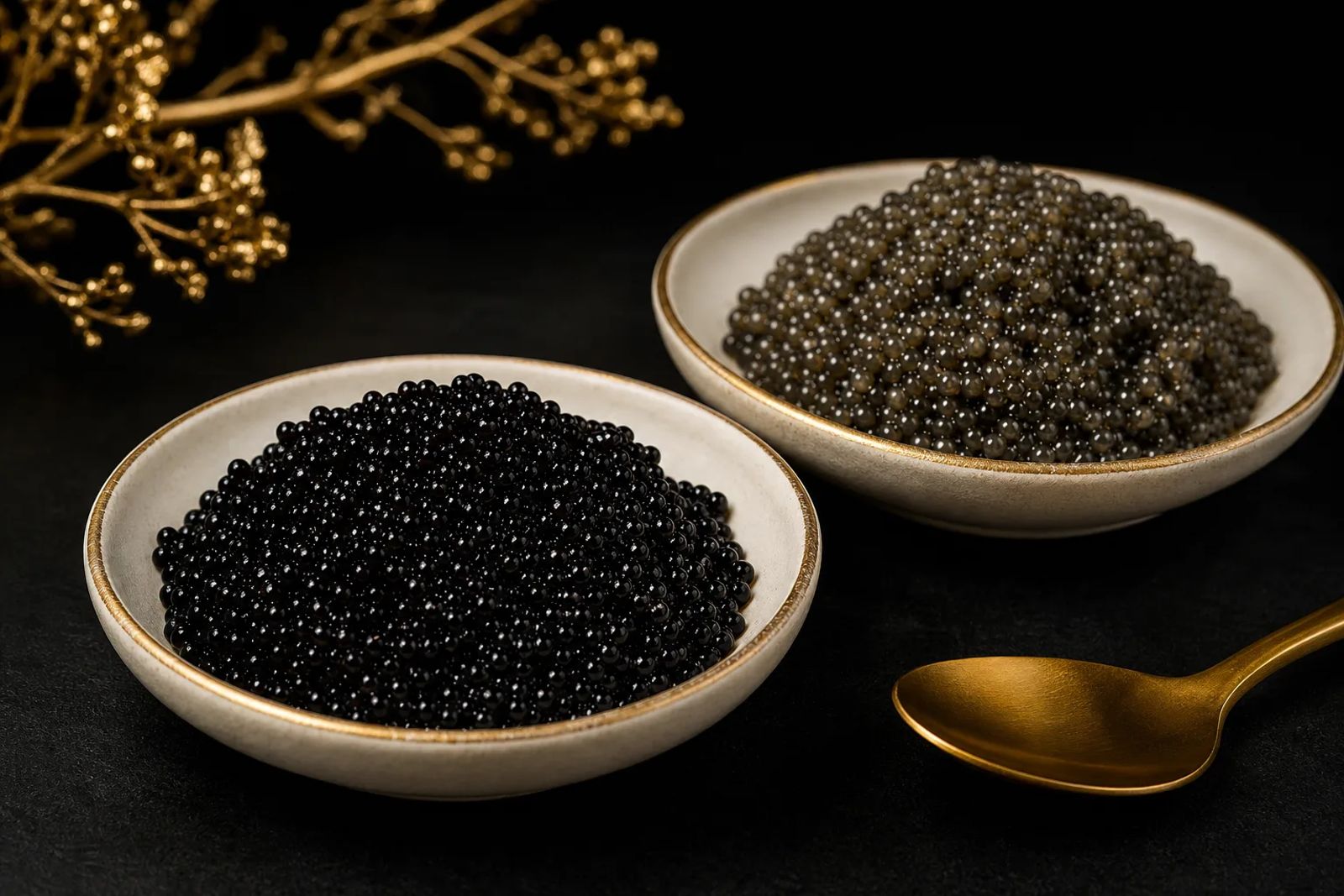
A mature beluga egg from the Volga can measure 4.3 millimetres across. Natural caviar can be tinged with green; its pop comes from outer layers yielding, not size. None of these qualities alone proves quality.
These qualities tell you different things. Size reflects species, heredity, the female's age and egg development; colour reflects pigmentation, with genetics and diet contributing; firmness reflects egg structure, ripeness and processing. Read them together. The largest, palest or hardest bead is not automatically the best.
How caviar bead size is measured
Bead size is the diameter of an individual egg, expressed in millimetres. At farms and hatcheries, specialists measure sampled eggs to assess development and readiness for reproduction or harvest. UF/IFAS describes microscopes with measuring eyepieces and digital imaging systems: precise tools for measuring a sample, rather than promising identical eggs throughout a batch.
When reading a producer's size claim, ask two questions: is the figure a minimum, an average or a range? And does it describe raw eggs or finished salted caviar? Biological measurements and commercial sorting answer different questions, so those details make a meaningful comparison possible. A photograph without a scale cannot establish diameter.
Species is a useful starting point, but the individual fish and the egg's stage of development also shape size. Age contributes, though an older female does not reliably produce larger eggs. Asking whether bigger eggs are better is therefore a different question from asking which species usually produces the largest beads.
Bead size chart: indicative ranges by species
Beluga sits at the larger end of these documented measurements, but the ranges overlap. Size alone cannot identify a species.
The figures below are indicative biological egg diameters, rather than universal specifications for finished caviar. The beluga range, for example, describes mature eggs from Volga fish.
| Species | Scientific name | Indicative diameter, mm | Typical colour range | Source |
|---|---|---|---|---|
| Beluga | Huso huso | 3.6 to 4.3 | Light to dark grey | FAO; UF/IFAS |
| Russian sturgeon (Ossetra) | Acipenser gueldenstaedtii | 3.2 to 3.8 | Not documented by species | UF/IFAS |
| Stellate sturgeon (Sevruga) | Acipenser stellatus | 2.7 to 3.2 | Not documented by species | UF/IFAS |
| Siberian sturgeon | Acipenser baerii | 2.4 to 3.0 | Not documented by species | UF/IFAS |
| Sterlet | Acipenser ruthenus | 1.9 to 2 (FAO); 2.0 to 2.8 (UF/IFAS) | Not documented by species | FAO; UF/IFAS |
| White sturgeon | Acipenser transmontanus | 3.2 to 4.0 | Not documented by species | UF/IFAS |
Species-specific colour ranges are not well documented for five of these species. Both sterlet ranges appear because the underlying sources differ.
Comparable measured ranges for kaluga, Amur sturgeon and Adriatic sturgeon are not included here. To compare species more broadly, read the caviar species chart alongside the producer's documented information for the batch.
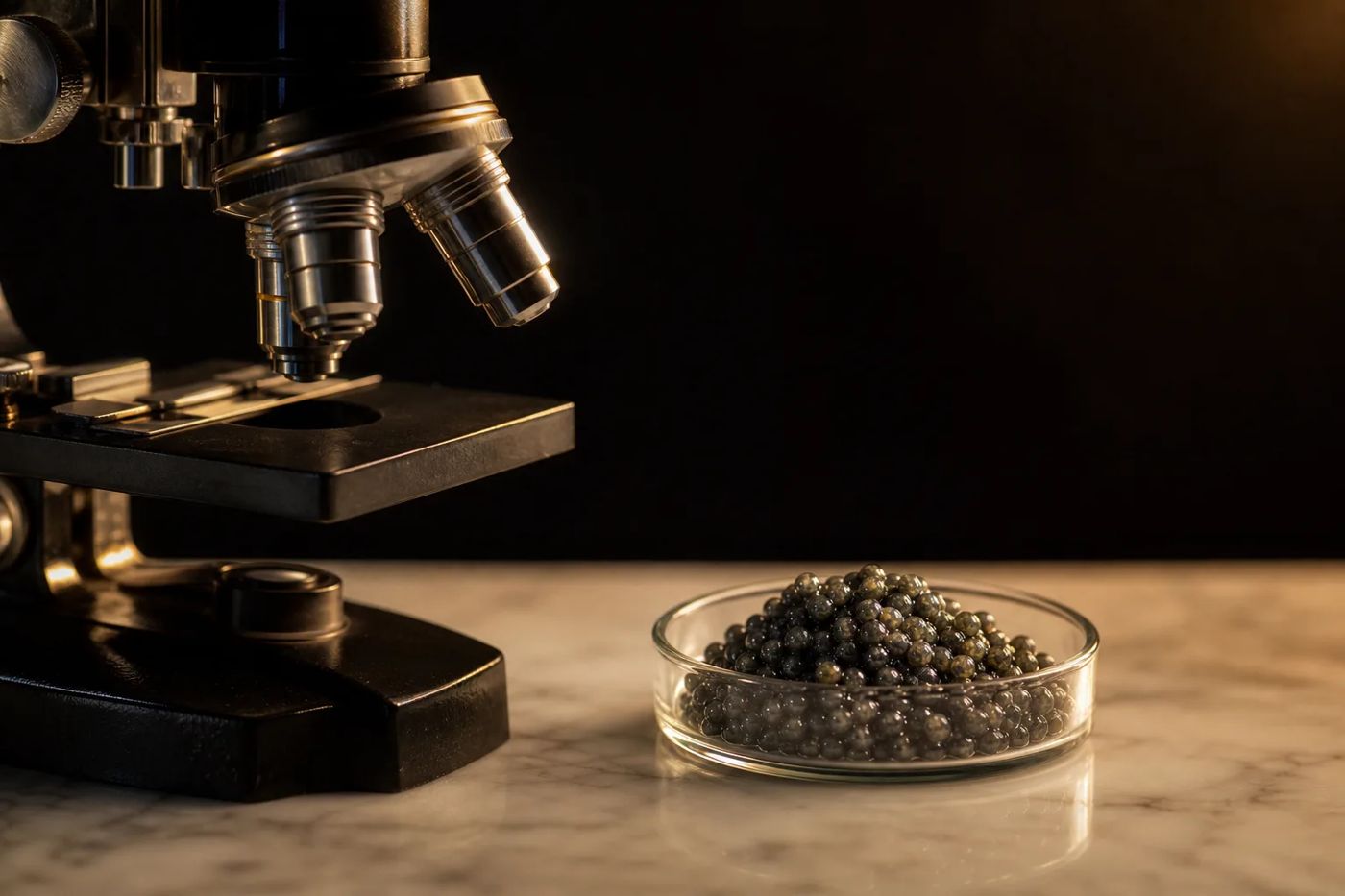
What caviar colour can tell you
Black is only part of caviar's natural palette. Codex's sturgeon caviar standard describes light grey to black and light yellow to yellowish grey, with brownish and greenish shades also allowed. This is the acceptable spectrum across the product category, rather than a chart matching each shade to a particular species.
A clean, agreeable release is a more useful personal preference than “the firmest possible egg”.
The colour begins with biology. Researchers have identified eumelanin, a dark pigment, in black sturgeon roe, while a breeding study of Siberian sturgeon found inherited variation in caviar colour. Diet can contribute too. A sensory study comparing caviar from differently fed sturgeon detected differences including a mustard colour attribute, although feed is not a reliable recipe for a particular shade.
A yellow or golden appearance does not establish that the mother was albino. Pale shades occur within the spectrum described by Codex, and FAO also describes white Almas caviar from very old beluga. Pale or white eggs alone cannot establish albinism.
Nor does Codex rank black, grey and gold in ascending order of quality. It calls for characteristic colour and relative uniformity. As an international reference standard, it is not automatically domestic law. Is black caviar better than golden explores the distinction between enjoying a particular colour and judging the quality of the caviar.
Beluga colour grades: 000, 00 and 0
In the documented trade convention, more zeros mean lighter beluga caviar. US Customs and Border Protection's March 2008 trade guide defines 000 as light grey, 00 as medium grey and 0 as dark grey.
These codes describe colour, not egg diameter or firmness. A batch still needs its own size and texture description, and there is no universal, legally recognised 000 scale. If a description reverses the convention, ask the producer to explain its code. A plainly stated colour and a representative photograph are more useful than an unexplained string of zeros.
Compare photographs taken under equivalent lighting and against equivalent backgrounds. Ideally, request an unedited image of the actual batch. Otherwise, the striking difference may be in the photography rather than the eggs. The caviar grading and quality hub places colour in the fuller picture of condition, flavour and traceability.
Firmness and the pop
The pop is the moment an egg's outer layers give way under pressure. Size alone does not create it. Traditional caviar retains follicular layers, the cells that surrounded and nourished the developing egg, as well as the egg membrane. Together, these structures shape resistance, texture and the way the bead breaks down in the mouth.
Species and ripeness help set the starting texture. UF/IFAS explains that eggs soften and swell slightly as they approach ovulation, when they are released from their surrounding follicles. Harvest timing therefore matters: a softer bead may reflect egg development rather than rough handling. Processing then changes that starting material.
Salting redistributes water within the eggs and can alter firmness during curing and storage. Brambilla and colleagues studied 75 white sturgeon caviar samples using spectroscopy, texture measurements and sensory assessment. Comparing caviar stored with borax and salt against caviar stored with salt alone, they reported quality differences during storage.
Pasteurisation brings heat into the picture. This deliberate heat treatment alters egg proteins and can change texture as well as preservation, so an otherwise comparable unheated product should not be expected to feel the same. A study of eight caviar types from six sturgeon species found differences associated with species and processing; it did not establish that pasteurisation always makes beads harder.
At a tasting, pay attention to the release rather than rewarding hardness. Does the bead resist briefly, break cleanly, or remain persistently tough? A clean, agreeable release is a more useful personal preference than “the firmest possible egg”. Why caviar pops takes a closer look at the membrane behind that sensation.
Separation and gloss: read the condition
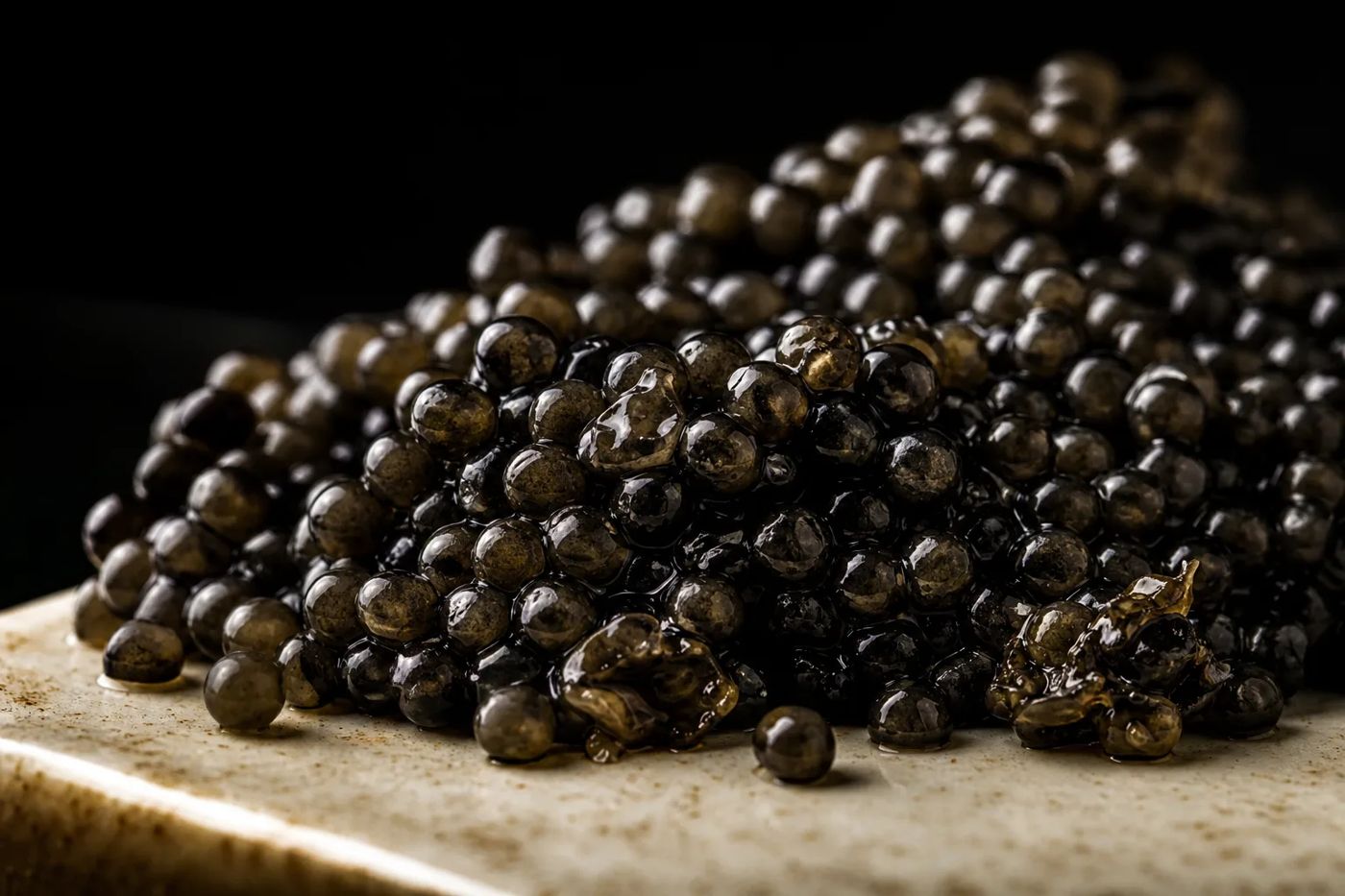
Look for mostly intact eggs that separate without their membranes breaking. In granular caviar, this is a useful sign of condition. Codex lists broken eggs, excess fluid and troublesome outer coverings among consistency defects.
A mass of damaged grains tells a different story from a naturally soft but intact bead. Handle the eggs gently rather than stirring them to test their resilience.
A reflective surface can help reveal the outlines of individual beads, but it cannot establish freshness on its own. The egg's outer cell layers influence how light is reflected and absorbed, so surface appearance has a biological component too. Intact, distinct grains and their appearance are consistent with good handling, but do not establish a particular processing history.
What these qualities cannot tell you
Size, colour and firmness cannot authenticate species, prove geographical origin or establish food safety. However attractive the beads, they do not document the fish's identity, the farm where it grew or the conditions throughout processing and distribution. For those answers, request traceable batch information and the relevant records.
Follow the producer's storage instructions and use-by information. A colour or size description cannot replace them, and glossy, firm eggs are no reason to decide that caviar must still be suitable to eat. Sensory quality and food safety are separate assessments, even when they concern the same spoonful.
When choosing between documented batches, keep three questions distinct:
- What size has actually been measured?
- How is the colour described?
- What texture should this processing style produce?
Then choose the combination you prefer. How caviar is graded shows how these observations contribute to a fuller assessment. Each has something useful to tell you; none deserves to become the entire verdict.
Sources
-
University of Florida, UF/IFAS Extension. Chapman, F. A. and Van Eenennaam, J. P. Sturgeon Aquaculture: Specialized Techniques: Determining the Stage of Sexual Maturity in Female Sturgeon for Artificial Spawning: The Egg Polarization Index or PI. FA153, originally published 2007, reviewed August 2025. Publication PDF.
-
University of Florida, UF/IFAS Extension. Chapman, F. A. and Van Eenennaam, J. P. Technically Speaking, What Is Sturgeon Caviar? FA194, originally published 2016, reviewed February 2025. Publication.
-
FAO. Chebanov, M. S. and Galich, E. V. Sturgeon Hatchery Manual. Fisheries and Aquaculture Technical Paper 558, reprinted 2013. Manual.
-
FAO. Sturgeons (Acipenseriformes). Undated report section; publication year not reliably established. Report section.
-
FAO and WHO, Codex Alimentarius Commission. Standard for Sturgeon Caviar. CXS 291-2010, adopted 2010, amended 2013, 2018 and 2024. FAO-hosted standard PDF.
-
US Customs and Border Protection. What Every Member of the Trade Community Should Know About: Caviar. Revised March 2008, historical trade guidance, retrieved from a third-party-hosted copy. Document.
-
Culinary Institute of America. Caviar. Teaching presentation, publication date unstated, hosted in June 2025. Presentation.
-
Aquaculture, Elsevier. Genetic parameters of caviar yield, color, size and firmness using parentage assignment in an octoploid fish species, the Siberian sturgeon Acipenser baerii. Volume 540, article 736725, 2021. Abstract retrieved. Article record.
-
Baker, A. K. and colleagues. Development of a lexicon for caviar and its usefulness for determining consumer preference. Journal of Food Science, volume 79, issue 12, 2014. Abstract retrieved through the US National Library of Medicine. Article record.
-
Panzella, L. and colleagues. Identification of black sturgeon caviar pigment as eumelanin. Food Chemistry, volume 373, article 131474, 2022. Accepted manuscript dated 2021, retrieved from University College London. Accepted manuscript.
-
Brambilla, M. and colleagues. The Influence of the Presence of Borax and NaCl on Water Absorption Pattern during Sturgeon Caviar (Acipenser transmontanus) Storage. Sensors, volume 20, issue 24, article 7174, 2020. Abstract retrieved through the US National Library of Medicine. Article record.
-
Rocchetti, G. and colleagues. The contribution of sturgeon species and processing conditions on caviar texture, metabolomic profile and sensory traits. Food Chemistry, volume 463, article 141516, 2025. Abstract retrieved from Università Cattolica del Sacro Cuore's research repository. Article record.
-
International Journal of Gastronomy and Food Science, Elsevier. The physics of the mouthfeel of caviar and other fish roe. Volume 19, article 100192, 2020. Abstract and indexed introductory passages retrieved. Article record.
The article was researched against the supplied verified records, FAO and university guidance, the retrieved Codex standard, historical grading guidance and peer-reviewed research, with biological measurements kept separate from finished-product specifications.
Last checked: November 2026