
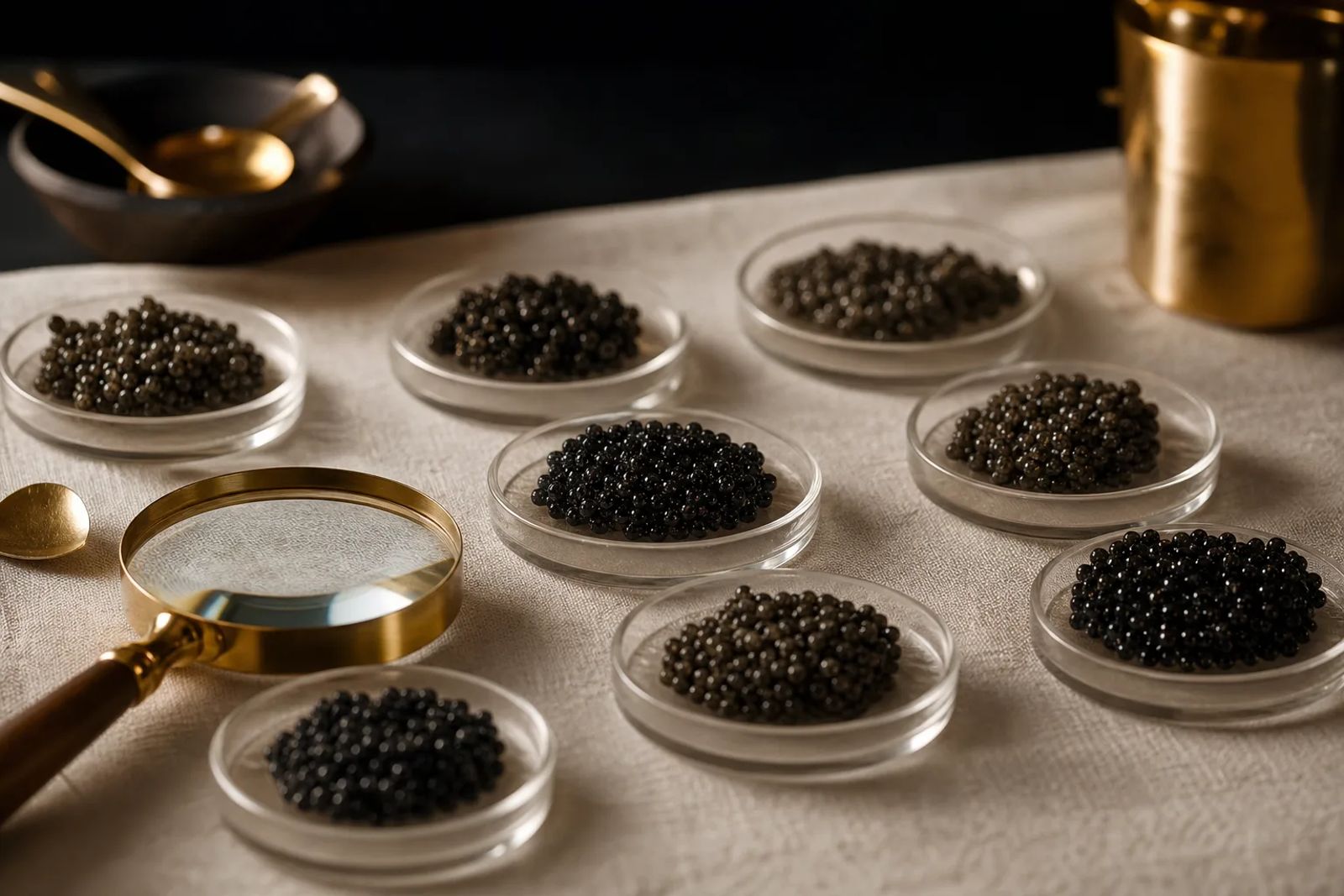
The beluga colour code 000 indicates light grey eggs. It sounds like a top score. It describes colour, not flavour, size or condition. That distinction runs through caviar grading: an impressive designation tells you little until you know what was assessed.
Producers and traders grade caviar by bead size, colour, firmness, uniformity, flavour and aroma. Their judgement usually places a batch within the supplier’s own system. Formal standards exist, but commercial names rarely reveal which standard, if any, was used.
- Ask who assigned the grade and what criteria they used.
- Compare batches within the same species and processing style.
- Read a colour selection as colour, not a complete sensory assessment.
- Keep grading, traceability and food safety separate.
Who grades caviar, and when?
At the processing stage, experienced staff assess the eggs and decide how to select and handle them. Codex’s fish-processing code includes a specific blending and grading step before packaging, followed by cooling and maturation: the controlled holding period during which salted eggs develop.
The person responsible may be called a grader or master salter. Titles and duties vary. Calvisius describes its master salters as the people caring for its manually processed caviar, a description of the producer’s working practice rather than an independent certification.
A trading house can then make its own selection from supplied batches. Petrossian says its specialists test and grade each batch, assessing texture and flavour among other qualities. The grade on the retail tin can therefore express the house’s judgement rather than the farm’s original classification. For the wider distinction between selection, condition and personal preference, start with caviar grading and quality.
How caviar is graded: the main criteria
A beautiful bead is only the beginning. Graders bring several observations together, looking beyond appearance to texture, flavour and aroma. These checks help you read a supplier’s description and assess what is in your spoon; they do not amount to home certification.
| Criterion | What graders look for | What to check at home |
|---|---|---|
| Size | Diameter and consistency, judged for the species. | Compare several beads, not just the largest. |
| Colour | The selected shade and its consistency. | Use neutral daylight; pale does not mean better tasting. |
| Firmness | Intact eggs with texture suited to the intended style. | Notice separation and how the membranes yield. |
| Uniformity | Consistent size, colour and condition. | Look below the surface for mixed textures or extensive breakage. |
| Flavour | Characteristic flavour, balanced salt and no objectionable taints. | Taste a little plain; note bitterness or dominating salt. |
| Aroma | Characteristic odour without persistent undesirable notes. | Smell gently; note persistent earthy or other objectionable odours. |
For granular caviar, the beads should be separate and intact. Firmest is not necessarily finest: a tough membrane can be less pleasant than one that yields readily. Nor does visual uniformity rescue an unbalanced flavour.
Explore bead size, colour and firmness for the physical detail, and professional tasting and scoring for structured sensory assessment. A photograph captures appearance; a single measurement captures one characteristic. Neither captures the whole experience.

Formal standards and house grades: different jobs
Codex: an international reference
Codex CXS 291-2010, the Standard for Sturgeon Caviar, covers salted eggs from the sturgeon family, Acipenseridae. Its quality and defect provisions address acceptable product characteristics and defects, including foreign material, objectionable odours and damaged product. These are questions of product quality, distinct from a preference for a particular shade.
Codex does not award a universal commercial rank such as Royal or Reserve. Meeting a product standard and earning a supplier’s highest selection are different achievements. Codex is a reference standard, not automatically binding national law; compliance also does not mean an independent grader has tasted every tin.
Russia: a named grading standard
Unlike Codex, Russia’s GOST 7442-2017 for granular sturgeon caviar defines named grades: Extra, highest and first, with sensory and chemical requirements. It is not a universal Grade 1 and Grade 2 pairing.
Read a GOST designation against that named standard rather than translating it into a foreign house’s hierarchy. The trade conventions behind numbered grades explains the distinctions.
EU, UK and US: no assumed equivalence
A named grading standard is one thing; official equivalence between commercial grades is another. No such equivalence is given in EU, Great Britain, Northern Ireland or US rules. That is a specific point about equivalence, not a claim that no relevant national standard exists.
The FDA’s caviar guidance addresses a different question again: it states that no standard of identity has been established for caviar. Identity concerns what a product is; grading concerns its assessed quality. The FDA statement therefore does not settle whether every possible federal quality standard is absent.
What commercial grade names actually mean
Royal, Imperial and Reserve mean what the business using them specifies. A supplier may set serious internal requirements for each selection, but the name alone reveals neither the criteria nor the thresholds or assessor.
Petrossian offers a useful example. Its grades distinguish batches within a caviar type, and its own specialists assign them. The names have meaning within that stated system; another company’s Royal need not represent an equivalent selection.
Beluga’s familiar colour codes serve a narrower purpose: 000 indicates light grey, 00 medium grey and 0 darker eggs. They identify colour selections, not legal quality grades or guarantees covering size, flavour and condition.
When a name arrives without an explanation, ask for one. Imperial, Royal, Reserve and other trade names separates commercial labels from species names and processing descriptions.
Why two batches receive different grades
Species provides part of the biological starting point; individual fish and egg maturity add variation. Age matters through growth and reproductive development, but older fish do not automatically produce higher grades. There is no dependable conversion from years of age to a house’s selection name.
Firmest is not necessarily finest: a tough membrane can be less pleasant than one that yields readily.
Water quality and feeding can influence off-flavours in farmed sturgeon. The cited research examined fish fillets rather than roe, so its findings do not directly establish an effect on caviar. Purging, also called depuration, involves holding fish in suitable clean water before harvest to reduce off-flavours. It is a management step, not a grade or an automatic assurance of flavour.
Then come salting and maturation. Salt distribution matters. So do handling and holding conditions: together, they shape the finished product the grader evaluates. A grade judges processed eggs, not simply the fish’s species or age.
For a buyer, the useful drivers of value are careful husbandry, controlled processing, appropriate maturation and a selection that matches its description. Large beads or a striking colour may belong in that description. They may not be the qualities you enjoy most.

What a grade cannot tell you
A grade does not establish origin, species authenticity or food safety. Those questions need their own answers.
A CITES label supplies traceability information, not laboratory verification of the contents. Equally, a brand’s headquarters or the place where caviar was repacked does not establish where the roe originated.
Use the caviar label guide to separate these details from the commercial selection name. Species verification, contaminants and microbiological testing belong to quality control and laboratory testing, rather than sensory grading.
How to judge a selection at home
Before opening the tin, ask what the grade means for that batch. Is it a size selection, a colour selection, a sensory selection or a combination? Request the species or documented hybrid, origin, ingredients and handling instructions separately. Do not expect the grade to supply those details.
Assess only caviar that has been handled according to its instructions, remains within its use-by date and gives no reason to suspect a safety problem. A pleasant smell, appealing appearance and intact seal cannot establish safety. If storage is uncertain, do not taste it to find out.
For the quality assessment, take a small sample with a clean spoon and taste it without an accompaniment first. Look at how the beads separate and how much breakage there is. Notice the aroma. Then feel how the membranes yield and consider the salt: does it support the flavour or overwhelm it?
Write down a few observations before looking again at the grade name. When comparing suppliers, choose the same species and a similar processing style, then ask each supplier for its actual specification. That gives you a useful basis for comparison, rather than a contest between impressive names.
Sources
-
FAO and WHO, Codex Alimentarius Commission. Find a Codex text, live register, entry for CXS 291-2010, Standard for Sturgeon Caviar, showing last modification in 2026. The register was retrieved; the complete amended standard was not successfully retrieved.
https://codex.fao.org/codex-texts/find-a-codex-text -
FAO and WHO, Codex Alimentarius Commission. Code of Practice for Fish and Fishery Products, CXC 52-2003, 2020 publication. Section 20, “Processing of sturgeon caviar”, particularly the processing sequence and sections on grading, maturation and handling.
https://iris.who.int/bitstream/handle/10665/336524/9789240013179-eng.pdf -
Interstate Council for Standardization, Metrology and Certification; Rosstandart. GOST 7442-2017: Granular sturgeon caviar. Specifications, official edition, reissued November 2018, introduced in Russia on 1 February 2019. Official document reproduced by a standards-document repository.
https://meganorm.ru/Data2/1/4293742/4293742559.pdf -
Culinary Institute of America. Caviar, undated teaching slides, hosted in June 2025. Sections on processing, colour categorisation and purchasing.
https://www.ciaconsulting.org/wp-content/uploads/2025/06/Day-4-Caviar-and-Game-CP-.pdf -
US Food and Drug Administration. CPG Sec. 540.150: Caviar, Use of Term, Labeling, reissued October 1989, current guidance webpage.
https://www.fda.gov/regulatory-information/search-fda-guidance-documents/cpg-sec-540150-caviar-use-term-labeling -
UK Government. Packaging and labelling: legal requirements for food businesses, guidance page last updated 4 September 2026, checked November 2026.
https://www.gov.uk/government/publications/packaging-and-labelling -
Calvisius. Calvisius, current company webpage, undated. Producer statement about its master salters and manual processing.
https://www.calvisius.com/calvisius-en/ -
Petrossian. Special Reserve Ossetra Caviar, current company webpage, undated. “Raise your caviar IQ” explanation of batch grading. Used for the company's account of its system, not as independent quality evidence.
-
Rodrigues da Silva, M., and colleagues. Aroma profiling and volatile fingerprinting of commercial caviar (Acipenser baerii and Acipenser gueldenstaedtii), LWT, volume 230, article 118261, 2025. Author manuscript held by Fraunhofer.
https://publica-rest.fraunhofer.de/server/api/core/bitstreams/a6f7a558-f768-4a22-b600-39364b46ce2b/content -
Research article, Journal of Agriculture and Food Research. Feeding during off-flavour purging in recirculating aquaculture systems? An exploratory characterisation of waterborne and feedborne odour-active compounds in Russian sturgeon (Acipenser gueldenstaedtii), volume 26, March 2026, article 102615. https://doi.org/10.1016/j.jafr.2025.102615
https://www.sciencedirect.com/science/article/pii/S266615432500986X -
FAO. Sturgeons (Acipenseriformes), report chapter, undated, containing material through 2003. Used as historical technical context, not evidence of current trade conditions.
https://www.fao.org/4/y5261e/y5261e06.htm
This piece was researched through live searches of standards, official guidance, sensory research and attributed company descriptions.
Last checked: November 2026