
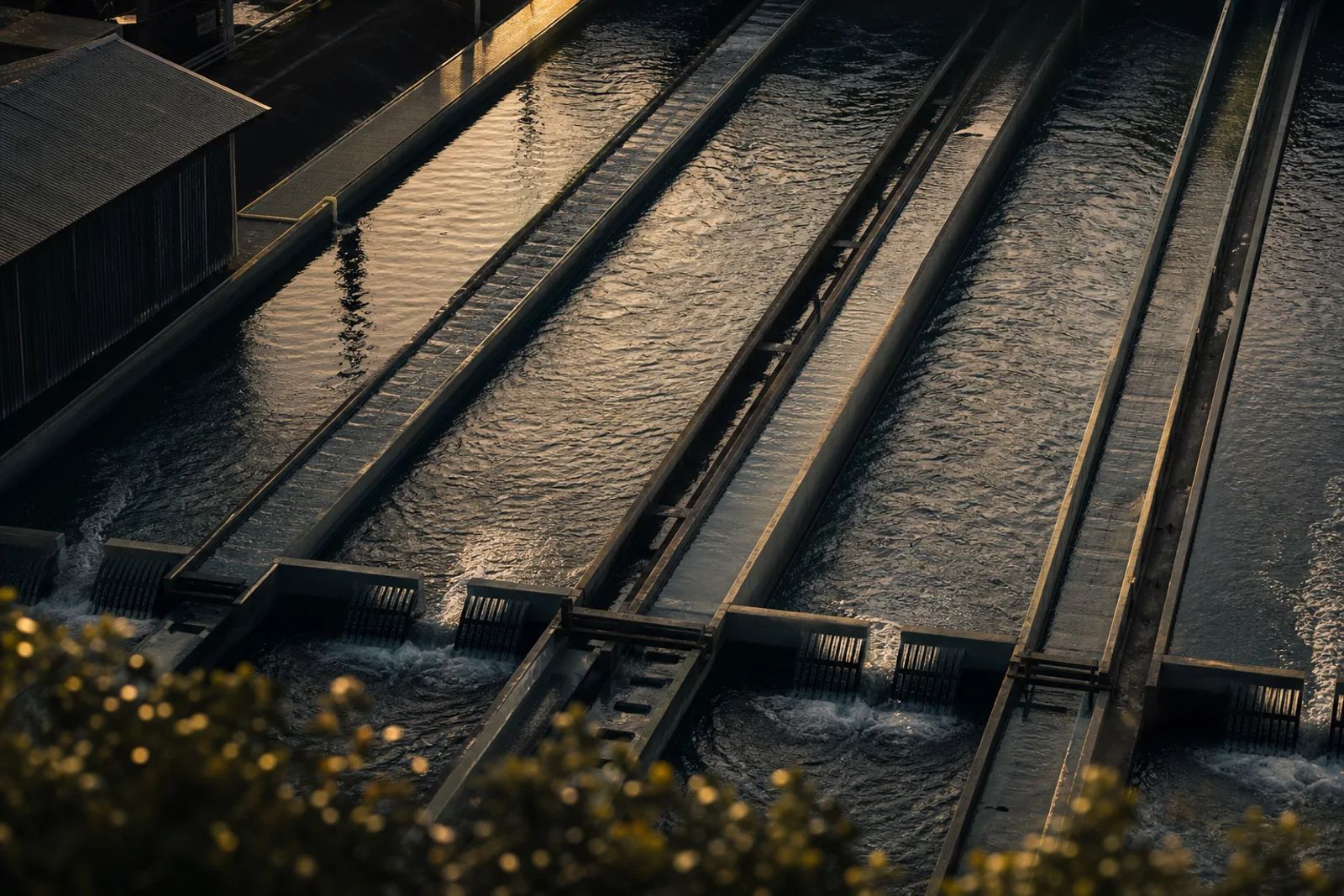
A pond, a raceway or a tank tells you where a sturgeon lives, but not the full story of how its caviar was produced. That story lies in the water: its source, its temperature through the seasons, its oxygen supply and the handling of fish before harvest.
Pond, raceway and tank describe the enclosure; flow-through describes how water moves through it. These categories overlap, and no enclosure or water system establishes caviar quality by itself. To understand their bearing on quality, look at water supply, temperature history, biomass, oxygen provision and the handling of fish before harvest.
Pond, raceway, tank and flow-through farms compared
Start with three questions: what contains the fish, where does the incoming water come from, and is that water discharged or treated and reused? A circular outdoor tank continuously supplied by a spring is both a tank system and a flow-through system. For the wider production picture, see sturgeon farming.
| System | Water source | Temperature control | Off-flavour evidence | Source |
|---|---|---|---|---|
| Earthen pond | Runoff, groundwater or supplied surface water | Ambient; influenced by inflow | Not established | FAO; Purdue |
| Raceway | Continuous supplied water | Source-led unless actively adjusted | Not established | EPA; Purdue |
| Indoor tank | Wells, springs or treated surface water | A building alone does not control water temperature | Not established | Study; Purdue |
| Outdoor tank | Supplied surface water or groundwater | Inflow and weather | Not established | FAO; Purdue |
| Lake or reservoir cage | Surrounding water passes through nets | Ambient | Not established | FAO; company prospectus |
| RAS comparator | Treated, reused water plus replacement supply | Active regulation possible | Geosmin and 2-methylisoborneol documented in sturgeon flesh | USDA; company prospectus |
“Not established” means that the sources establish no comparative off-flavour rate for that enclosure, rather than zero risk. There is no basis here for assigning low, medium or high ratings.
What each enclosure changes
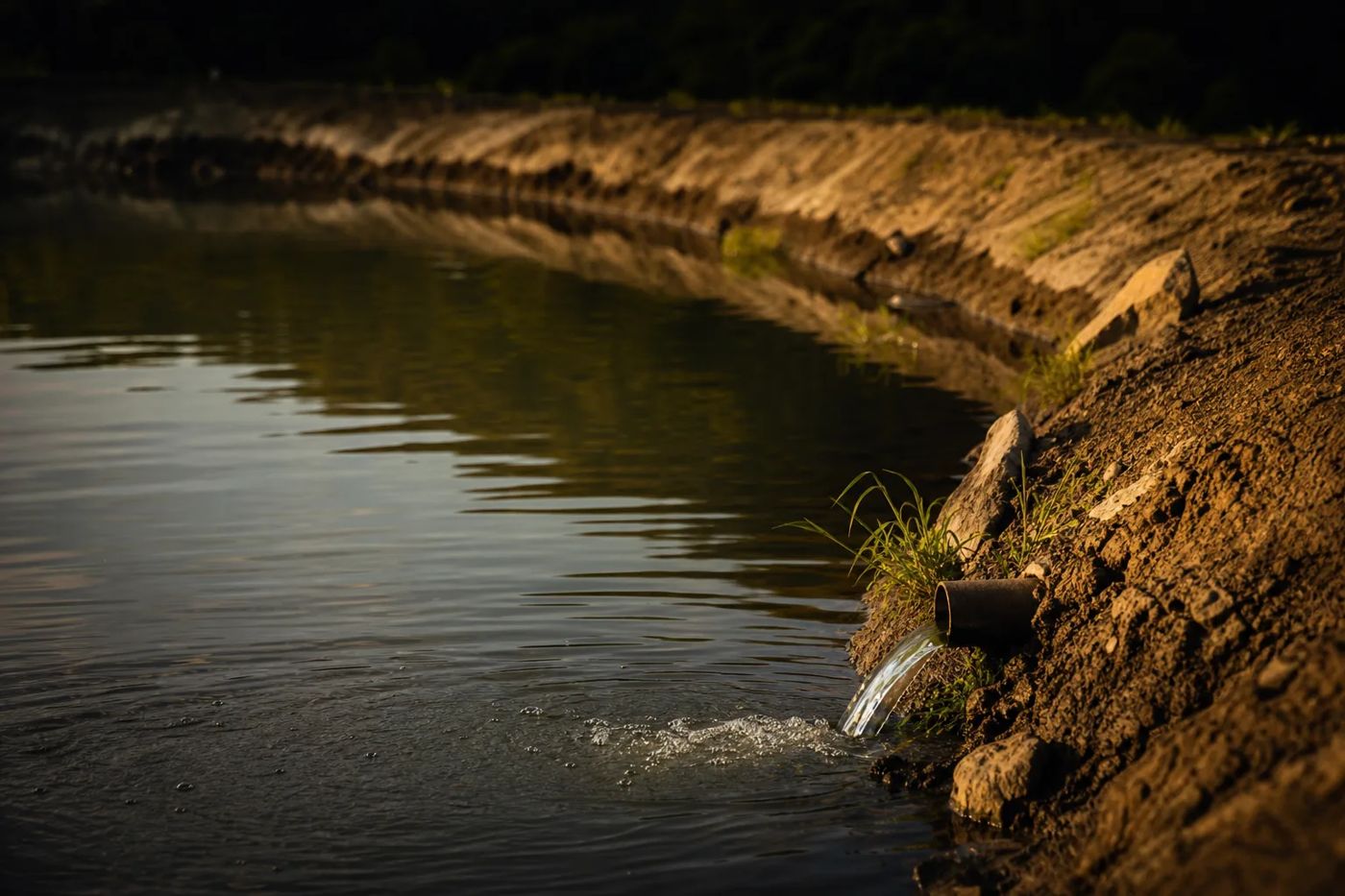
An earthen pond has a soil bottom, and its feeding areas need careful management. FAO recommends changing where feed is distributed to avoid local sediment accumulation. Water is retained rather than necessarily passing rapidly through; supplies can include runoff, groundwater or a managed inlet.
Raceways are elongated channels carrying a directed water supply. The US Environmental Protection Agency documents gravity-flow linear raceways for sturgeon, with screens and settling ponds used to prevent escape. Ask whether each group of fish receives independent inlet water or water already used upstream, and where solids are intercepted.
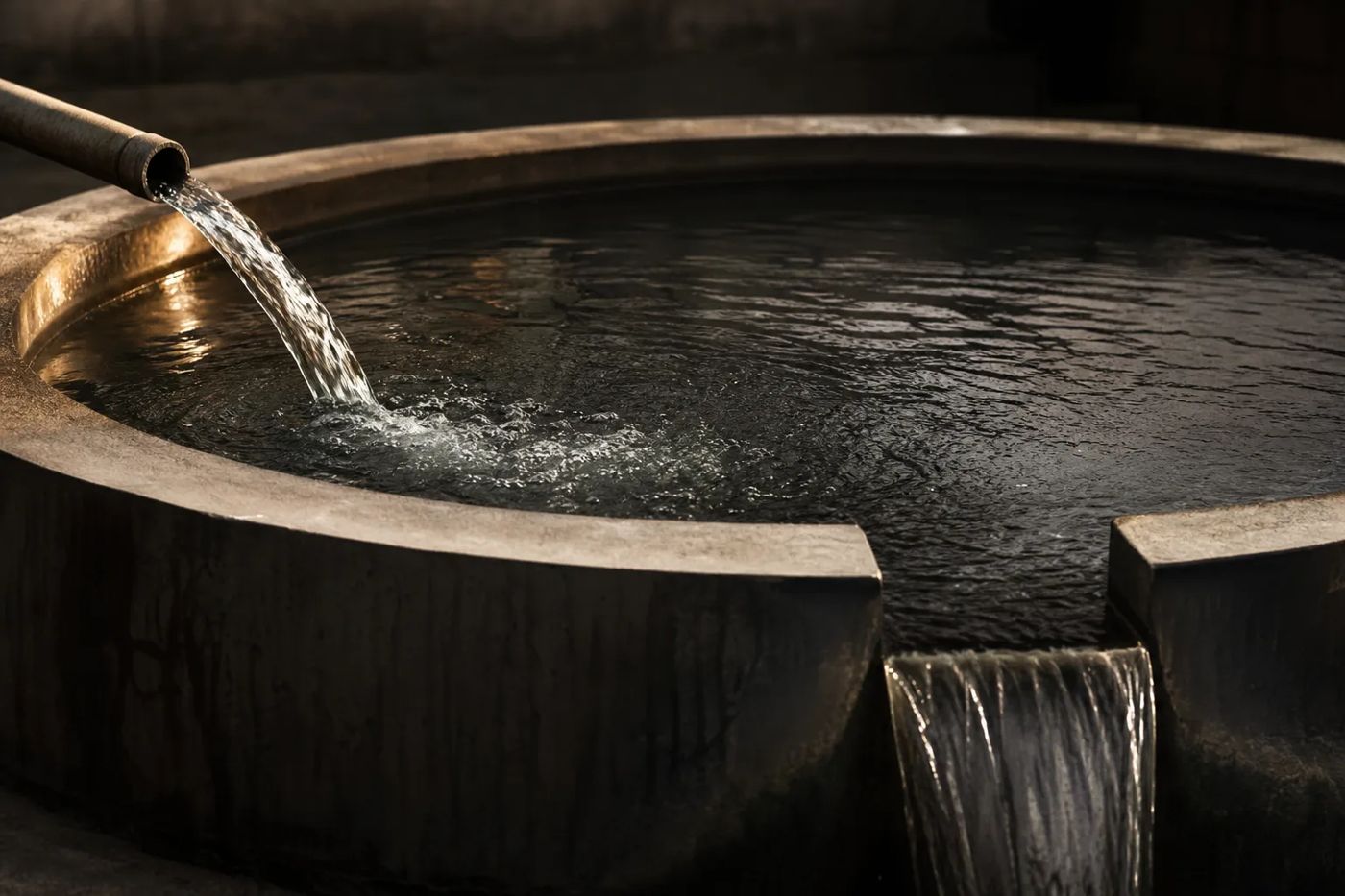
Tanks are bounded vessels, commonly circular or rectangular, rather than a particular water-treatment technology. Indoor housing permits shelter and controlled access, but a roof supplies neither heating nor a biosecurity programme. Outdoor tanks face the weather, even when their incoming water comes from a relatively stable groundwater source.
Cages and net pens hold fish in a larger lake or reservoir, with water passing through the mesh. FAO documents Siberian sturgeon cage culture in Russia and Uruguay. In China, Kaluga Queen reports a net cage base at Qiandao Lake. That description comes from the company, rather than an independent assessment comparing farm performance.
Follow the water, then the temperature
Flow-through farming keeps water moving: a continuing supply enters ponds, raceways or tanks and leaves as discharge, rather than being predominantly treated and returned. Rivers, springs and wells can all supply running-water aquaculture. Each brings its own conditions. Surface water can carry sediment, excess nutrients or contaminants from its catchment.
Springs and wells commonly provide steadier source temperatures. Groundwater still needs testing and appropriate conditioning because it can contain problematic dissolved gases. Heating or cooling a continuous inflow requires separate engineering; flow-through farming does not provide it automatically. Request measured inlet and outlet temperatures, seasonal flow records and the actual treatment train.
Recirculating systems treat and reuse water, creating a different balance between replacement supply and environmental control. A business may operate them alongside open systems. For their engineering, treatment barriers and operating demands, see recirculating aquaculture systems.
Stocking density needs its operating conditions
FAO's culture profile for Siberian sturgeon, Acipenser baerii, reports pond production at 1.5 to 3 kg/m² without added oxygen, and 50 to 80 kg/m² where oxygen is added. These figures describe different support conditions. They are not interchangeable recommendations, and the profile establishes no universal stocking standard for caviar females.
A stocking figure becomes useful only when its conditions are attached. Species, fish size, water depth, exchange rate, temperature and oxygen supply all matter. There is no single worldwide typical density for each system.
Even with those conditions recorded, check the units before comparing figures. Kilograms per square metre measure loading over floor area; kilograms per cubic metre measure loading within water volume. They cannot be compared directly.
A 2009 Iranian experiment offers a more tightly defined tank example: three-year-old Siberian sturgeon averaging 460 g, held in indoor fibreglass tanks at initial densities of 3 to 9 kg/m². Those details make the result interpretable, but do not describe normal commercial loading for mature females. Comparable species-specific norms for raceways and cages remain poorly documented.
Exposure, biosecurity and the fish
Open water is not a biosecurity barrier. Trace a farm's water connections to wild fish and upstream farms, then examine its separate barriers against risks arriving with stock, equipment and visitors. Request intake treatment specifications, quarantine arrangements and disease records. Labels such as indoor, spring-fed and lake-reared cannot answer those questions.
Predators pose a different problem. The EPA identifies bird predation as significant for small sturgeon in ponds and notes protective netting as a response. In cages, mesh condition and cleaning records deserve close attention: FAO warns that fouling restricts water exchange, compromising waste removal and oxygen conditions.
Seasonal growth is not the same as maturation
Fast body growth and readiness to produce roe are different things. Cold periods can reduce feeding and growth, while excessive warmth can also constrain production. An annual temperature record therefore reveals more than a single summer reading. For the relationship between temperature, oxygen provision and other water-quality conditions, see sturgeon feed and water quality.
Seasonality can also matter to reproductive development. In a 1999 white sturgeon experiment with five females per treatment, every fish receiving seasonal temperatures ovulated and produced fertile eggs. Constant-temperature treatments inhibited final egg development and ovulation. The study examined broodstock reproduction, rather than finished caviar from different farms.
Indoor housing permits shelter and controlled access, but a roof supplies neither heating nor a biosecurity programme.
Request growth records and ovarian assessments separately. Rapid body growth alone demonstrates neither earlier harvest readiness nor better roe. Seasonal management can be a deliberate choice in tanks, as well as a consequence of keeping fish outdoors.
Earthy flavours and the purpose of purging
Geosmin and 2-methylisoborneol, usually shortened to 2-MIB, are compounds associated with earthy or musty taints. A 2005 study used gas chromatography and mass spectrometry to identify them in white sturgeon flesh from systems that reused some water. Cyanobacteria on tank walls were identified as one source of geosmin. The accessible record does not state how many sturgeon were sampled.
Purging, or depuration, holds fish in suitable clean water to reduce unwanted compounds before harvest. A 2026 exploratory study compared four groups of three juvenile male Russian sturgeon, using chemical analysis and odour assessment of fillets. Odour profiles differed with depuration and feeding.
Neither study establishes an off-flavour ranking for farm types or a standard purge duration for caviar. The 2026 study's pooled, untested male-fillet samples cannot prescribe caviar treatment. For a caviar batch, ask what the farm measures in incoming water, fish and the finished batch, and how it determines the purge endpoint, rather than choosing a duration from the enclosure's name. For more detail, see purging farmed sturgeon and how water, climate and farm shape caviar flavour.
Mixed systems follow the fish through life
A farm can use several systems over a sturgeon's lifetime. Its description should follow that journey, rather than identify only the final holding unit. FAO documents hatchery production in which juveniles move from tanks and trays into rearing ponds. Those fish were intended for restocking: the example documents a mixed sequence, rather than a commercial caviar grow-out protocol.
Kaluga Queen describes its commercial caviar sequence in its prospectus: cage grow-out, followed by land-based flow-through rearing of older females, with recirculating facilities for broodstock. This is the company's stated production sequence; it offers no comparative evidence that the sequence outperforms alternatives. See Chinese caviar for the wider production context.
Water permissions are site-specific
Check abstraction, discharge and cage-operation permissions separately. Each concerns a different part of the farm's relationship with its water.
In England, Environment Agency guidance says taking more than 20 m³ daily is likely to require an abstraction licence. Discharging polluting effluent may require an environmental permit. In Scotland and Northern Ireland, NetRegs states that freshwater cage discharge authorisations limit fish numbers.
In the United States, EPA's NPDES programme governs qualifying pollutant discharges. Additional effluent guidelines under 40 CFR Part 451 apply to covered flow-through, recirculating and net-pen facilities.
In the EU, the Water Framework Directive, Directive 2000/60/EC, requires Member States to establish controls on water abstraction and point source discharges, subject to its exemptions. National and local rules determine the approvals needed for a particular farm and any cages. Confirm the site's requirements with the applicable authority.
Sources
-
FAO. Chebanov, M. S. and Galich, E. V. Sturgeon Hatchery Manual. FAO Fisheries and Aquaculture Technical Paper 558, 2011, reprinted 2013. Sections on juvenile pond rearing, temperature management and cage maintenance. Retrieved PDF.
-
FAO. Acipenser baerii. Cultured Aquatic Species Information Programme, 2009, retrieved online edition. Sections “Ongrowing techniques” and “Feed supply”. Retrieved profile.
-
US Environmental Protection Agency. Technical Development Document for the Final Effluent Limitations Guidelines and New Source Performance Standards for the Concentrated Aquatic Animal Production Point Source Category. 2004 edition, section 4.3.6.6, “Sturgeon”. Retrieved PDF.
-
Purdue University, Illinois-Indiana Sea Grant. Swann, L. Water Sources Used in Aquaculture. Aquaculture Extension AS-486, publication identifier IL-IN-SG-FS-93-1, retrieved online edition. Table 1 and accompanying discussion. Retrieved guidance.
-
FAO. Improving Pond Water Quality. Simple Methods for Aquaculture training material, retrieved online edition, publication year not reliably established from the retrieved chapter. Section 2.4, “Pond water temperature”. Retrieved chapter.
-
Asian Fisheries Society. Zare, R., Bahmani, M. et al. The effects of rearing density on growth performance and food conversion ratio of Siberian sturgeon (Acipenser baerii Brandt). Asian Fisheries Science 22, 2009, pages 107 to 115. Retrieved journal issue.
-
Aquaculture, Elsevier. Preliminary observations on the effects of holding temperature on reproductive performance of female white sturgeon, Acipenser transmontanus Richardson. 1999, publisher abstract. Publisher record.
-
US Department of Agriculture, Agricultural Research Service. Schrader, K. et al. Geosmin and 2-Methylisoborneol Cause Off-Flavors in Cultured Largemouth Bass and White Sturgeon Reared in Recirculating-Water Systems. North American Journal of Aquaculture 67, 2005, pages 177 to 180. Agency publication record and technical abstract. Retrieved record.
-
Fraunhofer research repository. Egiddi, M. et al. Feeding during off-flavour purging in recirculating aquaculture systems? An exploratory characterisation of waterborne and feedborne odour-active compounds in Russian sturgeon (Acipenser gueldenstaedtii). 2026, deposited article. Retrieved PDF.
-
Hangzhou Qiandaohu Xunlong Sci-tech Co., Ltd. Global Offering Prospectus. 22 June 2026. “Business”, aquaculture models and aquaculture-base table. Company statements, not independent comparative evidence. Retrieved prospectus.
-
Environment Agency. Check if you need a licence to abstract water. Current online guidance retrieved November 2026, applies to England. Retrieved guidance.
-
Environment Agency. Discharges to surface water and groundwater: environmental permits. Current online guidance retrieved November 2026, applies to England. Retrieved guidance.
-
NetRegs, SEPA and NIEA environmental guidance service. Freshwater cages for fish farming and hatcheries. Current online guidance retrieved November 2026, for Scotland and Northern Ireland. Retrieved guidance.
-
US Environmental Protection Agency. Aquaculture NPDES Permitting. Current online guidance retrieved November 2026, explaining 40 CFR 122.24, Appendix C to Part 122 and Part 451. Retrieved guidance.
-
US Environmental Protection Agency. Concentrated Aquatic Animal Production Effluent Guidelines. Current online account of the 2004 rule, 40 CFR Part 451, retrieved November 2026. Retrieved guidance.
-
European Parliament and Council. Directive 2000/60/EC establishing a framework for Community action in the field of water policy, 2000, Article 11.
This article was researched from FAO technical guidance, original research records, environmental authorities and a clearly attributed company filing, keeping experimental conditions separate from commercial norms.
Last checked: November 2026