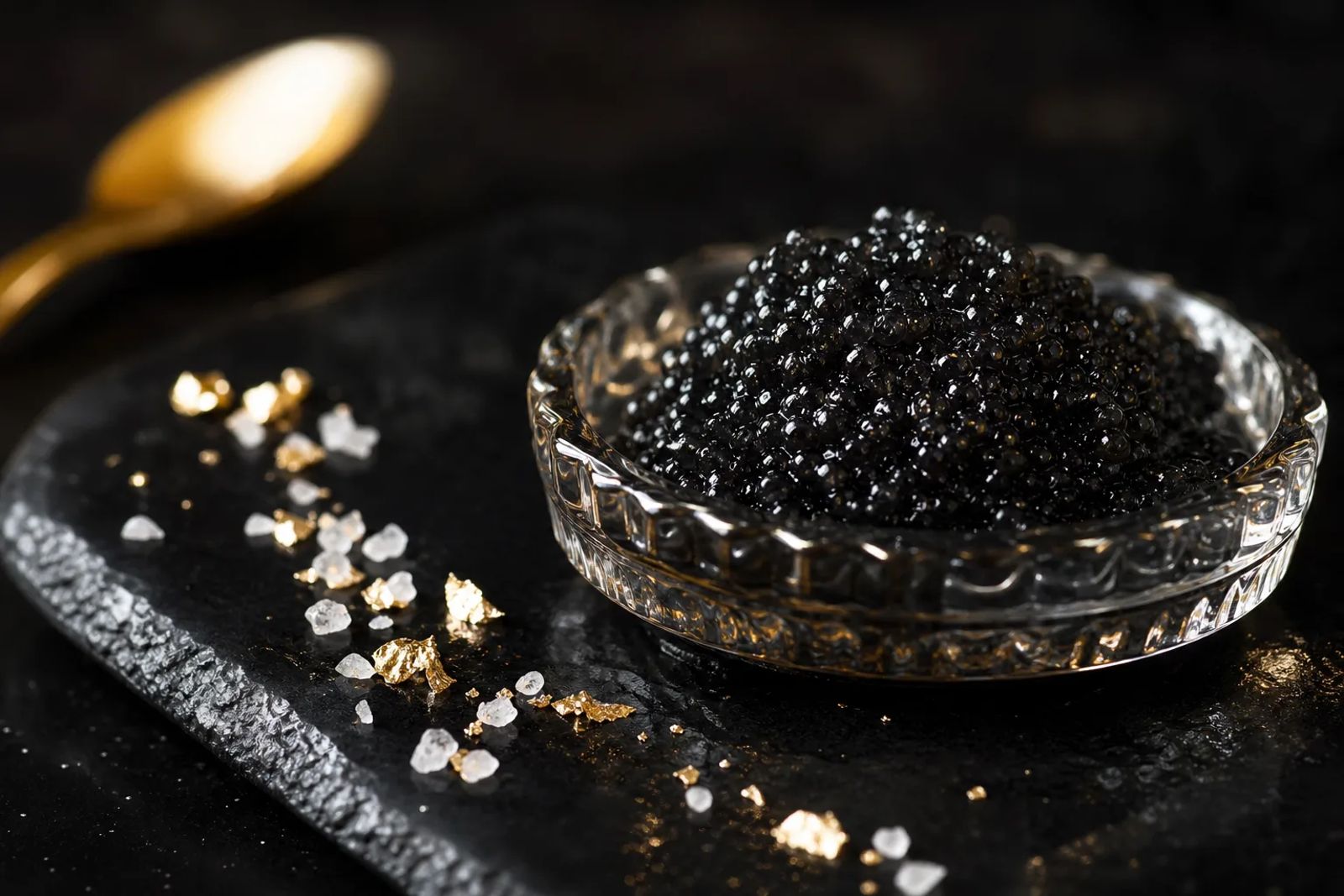
A spoonful of caviar changes as you eat it. In a 2025 experiment on Russian sturgeon caviar, researchers observed egg fat forming an emulsion with saliva, with changing physical properties and aroma release. Composition alone cannot explain the experience. Dissolved taste compounds, volatile aromas, eggs and fat work together in the mouth. Salt supplies the clearest taste; amino acids, nucleotides, lipid chemistry and processing help shape the rest. No single molecule explains a spoonful's taste.
- Waterborne compounds can give farmed fish earthy or musty notes.
- Storage changes caviar's chemistry, but studies identify no universal ideal maturation time.
- Sensory panels measure defined attributes in particular samples, rather than everyone's preferences.
- Commercial caviars differ, but those differences alone cannot establish genetic causes.
Taste: salt, amino acids and nucleotides
Salt is a flavour in its own right. Added during processing, sodium chloride contributes saltiness directly. Behind it lies a more intricate savoury chemistry. Researchers examine free amino acids, those not bound into proteins, and nucleotides, compounds that also take part in cellular energy and genetic material.
In a 2024 storage study of Russian sturgeon caviar (Acipenser gueldenstaedtii), researchers measured free amino acids with an amino acid analyser. Glutamate, associated with umami, increased enough for its calculated taste activity value to exceed one after three weeks. This value compares concentration with a published taste threshold: it suggests a contribution, rather than measuring the complete flavour.
A separate investigation, published in 2025, compared eight commercial caviars from six species: Acipenser transmontanus, A. naccarii, A. gueldenstaedtii, Huso huso, A. baerii and A. stellatus. Combining metabolite profiling, sensory assessment and texture testing, researchers identified nucleotides including AMP and inosinic acid among compounds associated with savoury taste. Identifying these candidates does not establish how much each contributes in every product.
Aroma and mouthfeel complete the picture
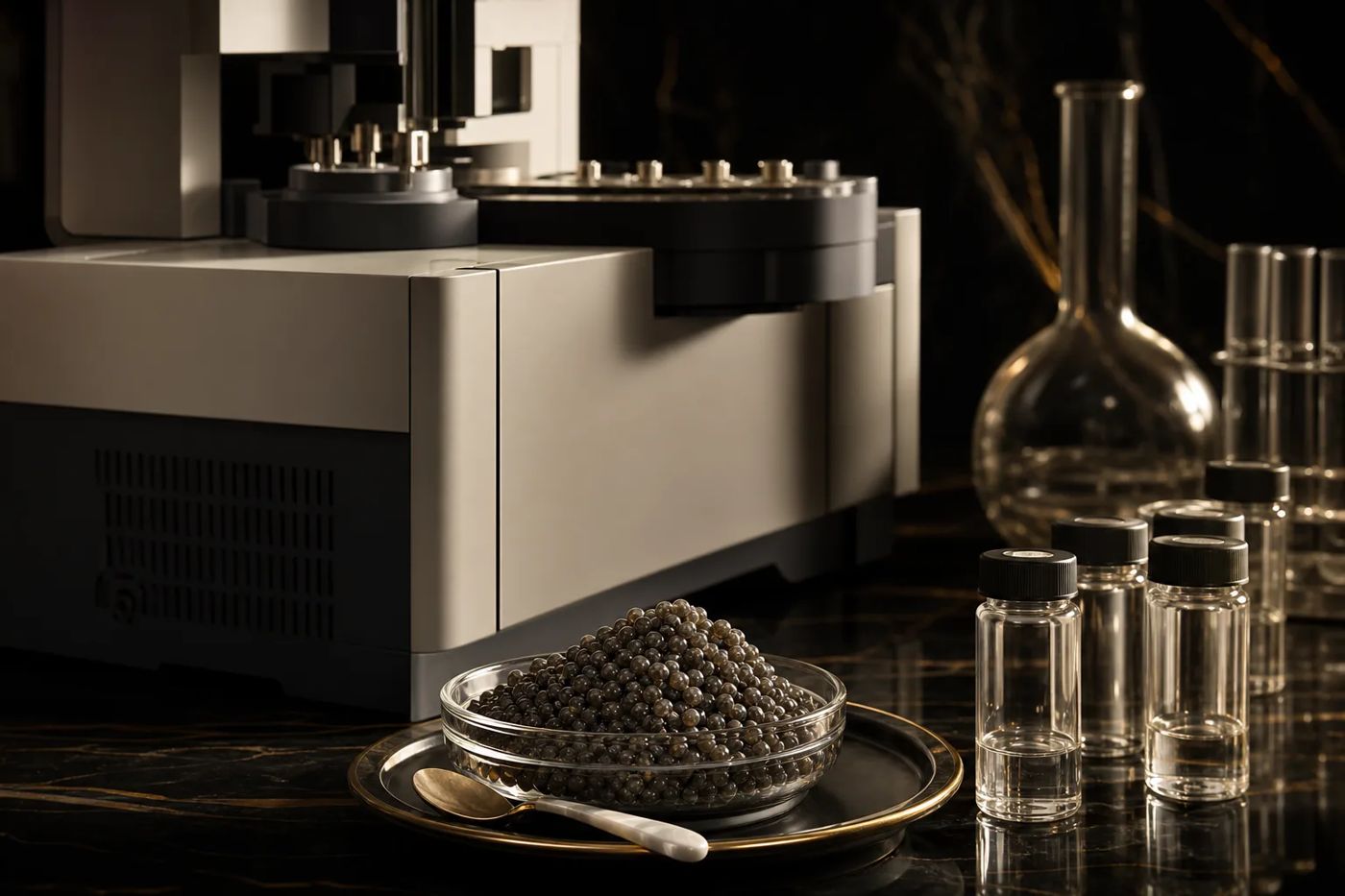
Aroma reaches the nose through volatile molecules, including during eating. In a study of white sturgeon (Acipenser transmontanus), researchers used gas chromatography and mass spectrometry to separate and identify compounds released from eggs and maturing caviar. Aldehydes and alcohols dominated the measured volatiles. The researchers proposed lipid oxidation and microbial activity as important sources.
The detailed chemistry belongs in caviar aroma compounds. The essential distinction is simple: a peak on an instrument's readout is not a smell in the nose. Detecting a molecule establishes its presence, not its sensory importance. Its concentration, the threshold at which it can be detected and its interactions within the food all matter.
Fat does more than supply richness. The 2025 Russian sturgeon experiment examined its behaviour during eating through sensory assessment, microscopy and measurements of saliva mixed with caviar. Those observations came from previously frozen, thawed caviar from one supplier, so the study's timings are not instructions for every spoonful.
Egg firmness adds another dimension, explored in why caviar pops. Composition tells only part of the story; what happens during eating helps determine how flavour unfolds.
Species is a starting point, not a flavour guarantee
Species offers a starting point for understanding flavour, but commercial caviar carries the imprint of processing too. The six-species investigation found differences in chemical profiles, including lipids and taste-related metabolites. Because processing also differed between products, it could show variation among those caviars without assigning every difference to species or inherited genetics.
A 2025 comparison of six caviar sample groups brought together sensory analysis and volatile profiling to examine differences involving rearing environment, processing and flavour intensity. These factors varied together, preventing the researchers from isolating the effect of individual fish or genetics. The authors proposed a microbial explanation for some differences, without establishing genetic causation.
No particular gene was established as the cause of a particular flavour; that would require separating species, fish history and processing.
Feed and water leave different kinds of evidence
What a sturgeon eats does not translate neatly into the flavour of its eggs. Caprino and colleagues analysed 20 white sturgeon caviar samples from fish receiving two experimental diets with different lipid sources. They measured composition, fatty acids and volatile compounds. Despite the dietary differences, the caviar's fatty acid profile changed only minimally in response.
Water can leave a more recognisable mark: earthy or musty off-flavours. Two compounds associated with these taints are geosmin and 2-methylisoborneol, often shortened to 2-MIB. In a 2005 investigation of farmed white sturgeon and largemouth bass, instrumental analysis and sensory assessment linked them with off-flavoured flesh. The researchers tested fillets, not roe.
Purging, also called depuration, gives fish time in cleaner water before harvest so accumulated off-flavour compounds can be lost. The sturgeon research included fish from culture and purge tanks, but established no universal purging duration for caviar. For the evidence behind the practice, read purging farmed sturgeon. A fixed number of days cannot guarantee the result.
Salting and maturation change the chemistry
Maturation means change, not automatic improvement. Salting establishes the starting formulation; subsequent storage allows the chemistry to develop. In the Russian sturgeon study, researchers followed caviar treated with 3.8% salt for six weeks at -4 °C (25 °F), taking repeated chemical measurements. These were experimental conditions, not home storage recommendations.
Many free amino acids rose initially, reaching higher levels around three weeks before declining later. The researchers also recorded changes in lipids and proteins associated with evolving volatile compounds. The result is a picture of a changing chemical system, not a calendar marking the ideal eating date.
A white sturgeon study traced volatile profiles from raw eggs through four ripening stages, ending at 240 days. Headspace extraction and chromatography showed that measured aroma chemistry varied with ripening. How those changes relate to the pleasure of freshness or development is explored in fresh versus aged caviar.
Oxidation can turn development into deterioration
The same chemistry that creates aroma can also signal decline. Lipid oxidation is one route from fat to volatile flavour molecules, but more oxidation does not mean better flavour. Lopez et al. stored white sturgeon caviar in three formulations, one salt only, for 14 months. They measured microbial counts, water activity, acidity and volatile compounds.
The essential distinction is simple: a peak on an instrument's readout is not a smell in the nose.
The salt-only treatment had the greatest microbial counts and presence of volatile products associated with oxidation and spoilage. A mature flavour profile therefore needs to be understood alongside its formulation and storage history. These results describe deterioration under the tested conditions, rather than a general defect in salt-only caviar.
What the evidence can tell us
The sample and method matter as much as the proposed mechanism: they define what a result can explain.
| Factor | Mechanism | Evidence and sample |
|---|---|---|
| Diet | Changes the supply of lipid precursors | Caprino et al.: 20 white sturgeon caviars, two experimental diets; small fatty acid response. |
| Storage time | Protein breakdown changes free amino acids | Russian sturgeon caviar: six-week experiment, triplicate analyses, amino acid analyser and broader molecular profiling. |
| Oral processing | Saliva emulsifies egg fat | Russian sturgeon caviar from one supplier; microscopy, physical measurements and sensory assessment during eating. |
| Waterborne taints | Off-flavour compounds accumulate in fish | White sturgeon fillets from culture and purge tanks; chromatography and sensory testing, rather than a roe trial. |
How panels measure flavour, and where they fall short
A trained descriptive panel measures how strongly a defined attribute appears. A consumer panel asks whether people like the food. These are different questions, and reference standards help descriptive assessors answer theirs with a shared vocabulary.
A 2025 study, co-authored by a producer employee, compared two Siberian sturgeon caviars using seven assessors. Training established the vocabulary before the final assessment. Samples carried anonymous three-digit codes, were evaluated in triplicate and received scores on a scale from 0 to 100.
This design reduces avoidable variation and gives a clearer account of those samples. Its reach remains specific: seven assessors tasting two products cannot represent everyone's preferences. Repeated measurements strengthen confidence in the samples tested; they do not add independently sampled farms or fish. Likewise, a statistical association between a molecule and a descriptor does not establish that the molecule causes the sensation.
Why generic descriptors can mislead
“Buttery” describes a resemblance, not an ingredient. In the Siberian sturgeon panel, the butter-related descriptor used unsalted butter as its reference. An oyster-related flavour descriptor meant a mineral flavour. These definitions gave assessors a common language; they neither demonstrated oyster ingredients nor identified a single mineral responsible for the impression.
Our guide to caviar flavour profiles translates tasting language; the caviar science hub connects those descriptions with the biology and measurements behind them.
The revealing question is not whether all caviar is nutty or briny. It is which attribute was measured, how strongly, in which samples and under what conditions.
Sources
-
Elsevier, Food Chemistry: X. Multi-omics combined approach to analyze the mechanism of flavor evolution in sturgeon caviar (Acipenser gueldenstaedtii) during refrigeration storage. Published research article, 2024. Full text.
-
Università Cattolica del Sacro Cuore; Rocchetti and colleagues. The contribution of sturgeon species and processing conditions on caviar texture, metabolomic profile and sensory traits. Food Chemistry, volume 463, article 141516, 2025; first published online in 2024. Research record.
-
University of Milan and Agroittica Lombarda; Lopez and colleagues. Volatile Organic Compounds Profile in White Sturgeon (Acipenser transmontanus) Caviar at Different Stages of Ripening by Multiple Headspace Solid Phase Microextraction. Molecules, volume 25, article 1074, 2020. Full text.
-
Elsevier, Food Chemistry: X. Salivary emulsification shapes flavor release and perception in sturgeon caviar during oral processing. Volume 29, article 102841, 2025. Full text.
-
Elsevier, Food Chemistry: X. Comparison of key odorants and sensory properties of various caviar with different breeding environments, processing conditions, and grades of quality. Volume 32, article 103272, 2025. Full text.
-
University of Milan; Caprino and colleagues. Fatty acid composition and volatile compounds of caviar from farmed white sturgeon (Acipenser transmontanus). Analytica Chimica Acta, volume 617, pages 139 to 147, 2008. Research record.
-
US Department of Agriculture Agricultural Research Service and collaborators; Schrader and colleagues. Geosmin and 2-Methylisoborneol Cause Off-Flavors in Cultured Largemouth Bass and White Sturgeon Reared in Recirculating-Water Systems. North American Journal of Aquaculture, volume 67, pages 177 to 180, 2005. Journal article.
-
University of Milan and Agroittica Lombarda; Lopez and colleagues. Evolution of Food Safety Features and Volatile Profile in White Sturgeon Caviar Treated with Different Formulations of Salt and Preservatives during a Long-Term Storage Time. Foods, volume 10, article 850, 2021. Full text.
-
Washington State University; Baker and colleagues. Development of a Lexicon for Caviar and Its Usefulness for Determining Consumer Preference. Journal of Food Science, volume 79, pages S2533 to S2541, 2014. Journal article.
-
Kristianstad University research repository; International Journal of Food Properties. Quality characteristics of Swedish black caviar from live sturgeons (Acipenser baerii): a comparison of hot-water and pH-adjusted cold-water post-harvest processing. Published article, DOI 10.1080/10942912.2025.2589574, 2025. Journal article.
This article was researched through peer-reviewed experimental studies, distinguishing measured chemistry, sensory observations and proposed explanations.
Last checked: November 2026