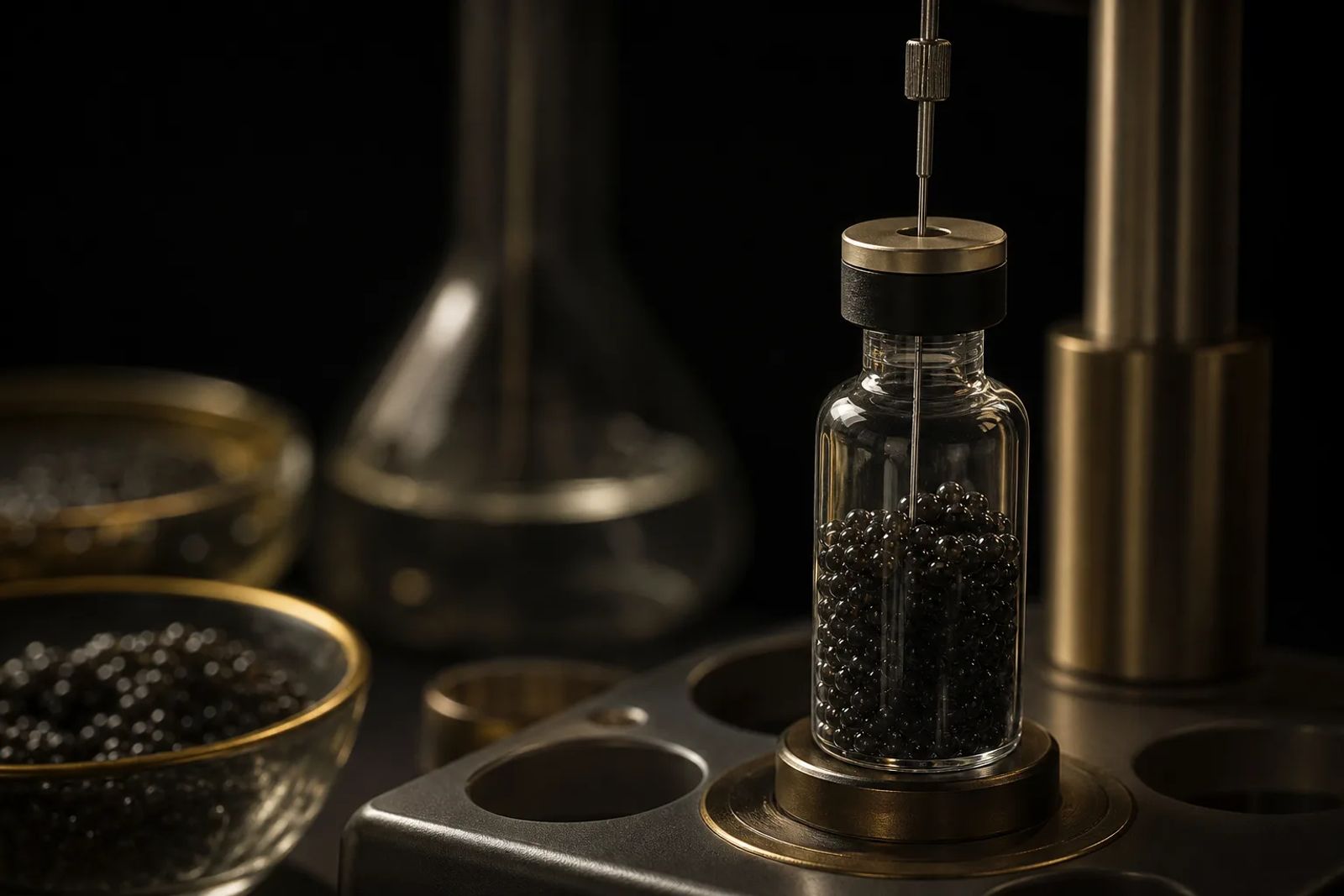
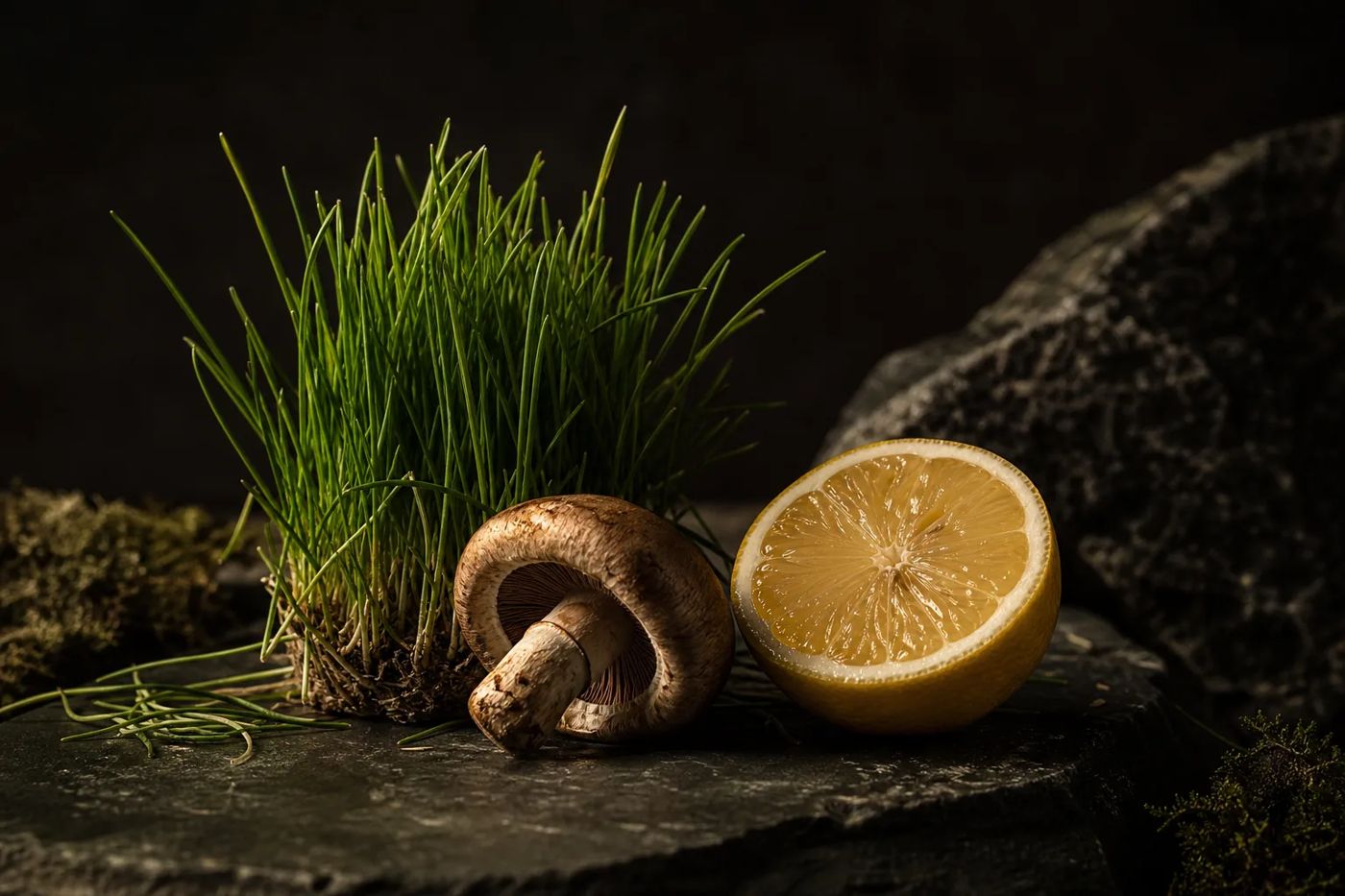
Grass, citrus, mushroom: in a 2025 caviar comparison, researchers found all three among the aromas of separated compounds. Caviar’s scent has a complex chemical cast, including aldehydes, alcohols, ketones, esters and terpenes, with different mixtures appearing in different samples. Lipid breakdown, microbial activity and compounds absorbed from farm water can all shape that mixture. Detecting a chemical does not prove that it dominates the aroma. The revealing question is not simply which chemicals are present, but which ones the nose actually notices.
- A chromatogram maps chemicals; it does not write a tasting note.
- Earthy farm-water taints and storage-related off-odours can have different origins.
- Maturation experiments describe specific products and conditions, not a schedule for ageing caviar at home.
Which aroma compounds have researchers found?
Aldehydes feature prominently in caviar research, especially hexanal, heptanal, octanal and nonanal. In 2015, Huang and colleagues detected 46 volatiles in fresh hybrid caviar using headspace extraction and gas chromatography with mass spectrometry. Those four aldehydes appeared at relatively high levels. The researchers also proposed that terpenes including limonene, longifolene and caryophyllene contributed lemon-like and woody notes.
That study and Xu and colleagues’ 2022 investigation both examined a cross between kaluga (Huso dauricus) and Amur sturgeon (Acipenser schrenckii). Xu’s paper specifies kaluga female × Amur male. Huang’s abstract does not identify parental sex, so its cross notation cannot establish which species supplied the female.
Xu’s team combined two-dimensional gas chromatography with mass spectrometry, GC-olfactometry and other analyses of fresh and stored hybrid caviar. They reported alcohols, esters, aldehydes and alkenes, along with associations between microorganisms, phospholipids and odorants. Phospholipids, important components of cell membranes, were investigated as potential aroma precursors: material from which aromatic compounds might develop, rather than smells themselves.
Compounds and their reported aromas
These are the scents of isolated odorants, not tasting notes for whole caviar. The proposed origins come from related studies; the comparison did not establish how the compounds formed in its samples.
| Compound or class | Reported aroma | Proposed origin | Study and sample |
|---|---|---|---|
| Hexanal | Grass, tallow, fat | Lipid oxidation | Yang and colleagues, 2025; six caviar groups |
| Nonanal | Fat, citrus, green | Lipid oxidation | Same six-group comparison |
| 1-Octen-3-ol | Mushroom, green | Lipid breakdown | Same six-group comparison |
| (E,E)-3,5-Octadien-2-one | Earth, mushroom | Lipid oxidation | Same six-group comparison |
| Hexanoic acid | Pungent, rancid | Exact pathway unresolved in comparison | Same six-group comparison |
These descriptions came from GC-olfactometry, supported by mass spectra and standards, in the 2025 comparison. A whole spoonful of caviar need not smell recognisably of grass, citrus or mushrooms simply because those compounds are present. For the broader distinction between aroma, taste and texture, see the science of caviar flavour.
How researchers put a name to a smell
The first task is to identify what is present. Gas chromatography with mass spectrometry, or GC-MS, separates a mixture and records chemical fragmentation patterns that help identify its components. Headspace sampling examines the vapour above a sample. Solid-phase microextraction, abbreviated SPME, collects compounds on a coated fibre before analysis. A 2021 study of white sturgeon (Acipenser transmontanus) caviar used this approach, checking library matches against retention indices and authentic standards when available.
Identifying a compound does not tell us whether the nose notices it. Gas chromatography-olfactometry, or GC-O, brings a human nose into the analysis. An assessor smells compounds as they emerge from the separation, providing evidence that a detected peak has an odour. Xu’s 2022 hybrid-caviar study used this method to describe odorants that, as a group, contributed fresh, fatty and fishy attributes.
An electronic nose compares patterns instead: an array of sensors generates a response pattern, which statistical models compare between samples. It does not necessarily identify individual molecules or reproduce human smelling. A 2019 experiment combined an electronic nose with GC-MS to distinguish differently preserved chilled sturgeon flesh. That work demonstrates an analytical approach in flesh, rather than validating a universal caviar freshness detector.
For another way to distinguish compounds, some caviar studies use gas chromatography-ion mobility spectrometry, or GC-IMS. This separates compounds chromatographically, then distinguishes their ions by movement through a gas. To assess potential aroma importance, an odour activity value compares a compound’s concentration with its detection threshold. Relative versions, calculated from relative abundance, help screen potential contributors; they are neither fully quantified concentrations nor direct measurements of the complete aroma.
What storage and maturation change
In the products studied, volatile profiles changed during ripening. Lopez and colleagues followed white sturgeon caviar through five stages: raw eggs, then 60, 120, 180 and 240 days of ripening. Their 2020 study used repeated headspace extraction with GC-MS to estimate 25 compounds. Total aldehydes increased significantly between raw eggs and the final sampling point. At the end, 3-hydroxy-2-butanone rose markedly. Alcohols, undetected in the raw eggs, appeared after processing.
Where that experiment tracked ripening stages, the 2021 white sturgeon study compared three preservative formulations over 14 months, combining headspace SPME-GC-MS with microbiological measurements. Salt-only samples had the highest viable counts and greater evidence of volatile products linked to oxidation and spoilage than the other formulations. The findings show why a maturation period means little without its processing context: they do not establish a shared window of improvement or usability for all caviar.
A shorter experiment followed a different species under specified storage conditions. In 2024, researchers examined Russian sturgeon (Acipenser gueldenstaedtii) caviar salted with 3.8% salt and stored at −4 °C (25 °F) for six weeks. GC-MS, GC-IMS and sensory analysis tracked a shifting mixture. Green-associated aldehydes featured at intermediate stages; fermented, sour or other undesirable notes increased later. The authors described 1-octen-3-ol as mushroom-like and 2-heptanone as cheesy, showing why individual compounds deserve more precise descriptions than “alcohols” or “ketones”.
Keep these experimental conditions separate from home-storage decisions. For the chemistry behind the changes, rather than an ageing schedule, see lipids, oxidation and caviar shelf life.
Earthy and musty aromas from farm water
An earthy aroma can begin in the rearing water. Geosmin and 2-methylisoborneol, or 2-MIB, are associated respectively with earthy and musty off-flavours in aquaculture. In 2005, Schrader and colleagues examined white sturgeon fillets from partial water-recirculation farms using chemical analysis and a trained sensory panel. They identified geosmin as the cause of the earthy off-flavour in those samples. Fillets from purge tanks contained less geosmin, and the panel rated them free of off-flavour.
A whole spoonful of caviar need not smell recognisably of grass, citrus or mushrooms simply because those compounds are present.
In 2025, da Silva and colleagues sampled five compartments across two independent sturgeon recirculating systems. Sensory profiling, GC-O and GC-MS found both geosmin and 2-MIB in the water. Sludge from the drum filter emerged as the main potential source; other compartments were broadly comparable. In these systems, the biofilter was not the dominant hotspot.
The evidence connects earthy off-flavour to the rearing environment, with an important boundary: these studies measured water and fillets, not finished roe. They therefore cannot establish a caviar-specific odour threshold or diagnose an earthy note in a particular tin. Read purging farmed sturgeon: earthy off-flavours and the evidence for the harvest-stage findings, and recirculating aquaculture systems for how these farms operate.
What about trimethylamine and species differences?
The cited studies do not report trimethylamine in caviar. This volatile amine, usually shortened to TMA, is associated with pungent fishy odours in seafood. A primary electronic-nose study of catfish describes its formation through bacterial reduction of trimethylamine oxide. That explains a relevant mechanism, but does not establish TMA as a dominant aroma in fresh sturgeon caviar. Total volatile basic nitrogen is a different measurement: it groups volatile nitrogenous bases together rather than measuring TMA specifically.
Species comparisons also need matching conditions. The cited studies cover white sturgeon, Russian sturgeon and kaluga-Amur hybrid caviar, but do not compare those species in a controlled head-to-head experiment. Differences between their chemical lists cannot be assigned to genetics alone because processing, storage and extraction methods also differ. The 2025 six-group comparison likewise varied breeding environment, processing and quality category alongside the samples themselves.
How much can the research tell us?
Read each chemical profile as a portrait of the samples tested, rather than a signature for an entire species. Analytical duplicates or triplicates sharpen measurement precision; they cannot replace independent fish, batches, farms and seasons. A study may distinguish its own sample groups convincingly without establishing a universal marker of quality or origin.
Even the number of compounds detected depends on what the extraction method and instrument capture. A library match, a relative abundance measurement and an odorant confirmed with a standard represent different levels of evidence. Each answers a different analytical question, and the results are not interchangeable.
Aroma measurements do not establish food safety: the storage research used separate microbiological testing. For a practical assessment, turn to should caviar smell fishy?. The wider caviar science hub connects the related methods and mechanisms.
For the connoisseur, the value is a richer vocabulary of plausible aroma contributors, not a chemical translation of every tasting note. The laboratory names the possibilities; the whole spoonful remains more than a list of compounds.
Sources
- Chinese Academy of Fishery Sciences, Huang and colleagues. “Effect of Synthetic Preservatives on Volatile Flavor Compounds in Caviar of Sturgeon (Huso dauricused × sturger schrenckii)”. Food Science, volume 36, issue 12, 2015. Species spellings reproduced from the published title. Publisher’s abstract.
- Xu and colleagues, Elsevier. “Effects of microbial diversity and phospholipids on flavor profile of caviar from hybrid sturgeon (Huso dauricus × Acipenser schrencki)”. Food Chemistry, volume 377, article 131969, 2022. Publisher’s abstract.
- Yang and colleagues, Elsevier. “Comparison of key odorants and sensory properties of various caviar with different breeding environments, processing conditions, and grades of quality”. Food Chemistry: X, published version, 2025. Publisher’s article record and indexed text.
- University of Milan, Lopez and colleagues. “Volatile Organic Compounds Profile in White Sturgeon (Acipenser transmontanus) Caviar at Different Stages of Ripening by Multiple Headspace Solid Phase Microextraction”. Molecules, volume 25, article 1074, 2020. University repository record.
- MDPI, Foods. “Evolution of Food Safety Features and Volatile Profile in White Sturgeon Caviar Treated with Different Formulations of Salt and Preservatives during a Long-Term Storage Time”. Foods, volume 10, article 850, 2021. Full text.
- Elsevier, Food Chemistry: X. “Multi-omics combined approach to analyze the mechanism of flavor evolution in sturgeon caviar (Acipenser gueldenstaedtii) during refrigeration storage”. Volume 23, article 101688, 2024. Full text.
- Royal Society of Chemistry. “Analysis of volatile compounds in fresh sturgeon with different preservation methods using electronic nose and gas chromatography/mass spectrometry”. RSC Advances, volume 9, pages 39090 to 39099, 2019. Publisher’s PDF.
- US Department of Agriculture, Schrader and colleagues. “Geosmin and 2-Methylisoborneol Cause Off-Flavors in Cultured Largemouth Bass and White Sturgeon Reared in Recirculating-Water Systems”. North American Journal of Aquaculture, volume 67, pages 177 to 180, 2005. Published article.
- Da Silva and colleagues, Wiley. “Distribution of Odorant Compounds in Recirculating Aquaculture Systems Used in Sturgeon Farming”. Aquaculture Research, article 2377886, 2025. Repository full text.
- US Forest Service repository. “Detection of Off-Flavor in Catfish Using a Conducting Polymer Electronic-Nose Technology”. Research article, 2013. Repository PDF.
This piece was researched through live retrieval of primary research papers, distinguishing finished caviar analyses from studies of fish flesh and aquaculture water.
Last checked: November 2026