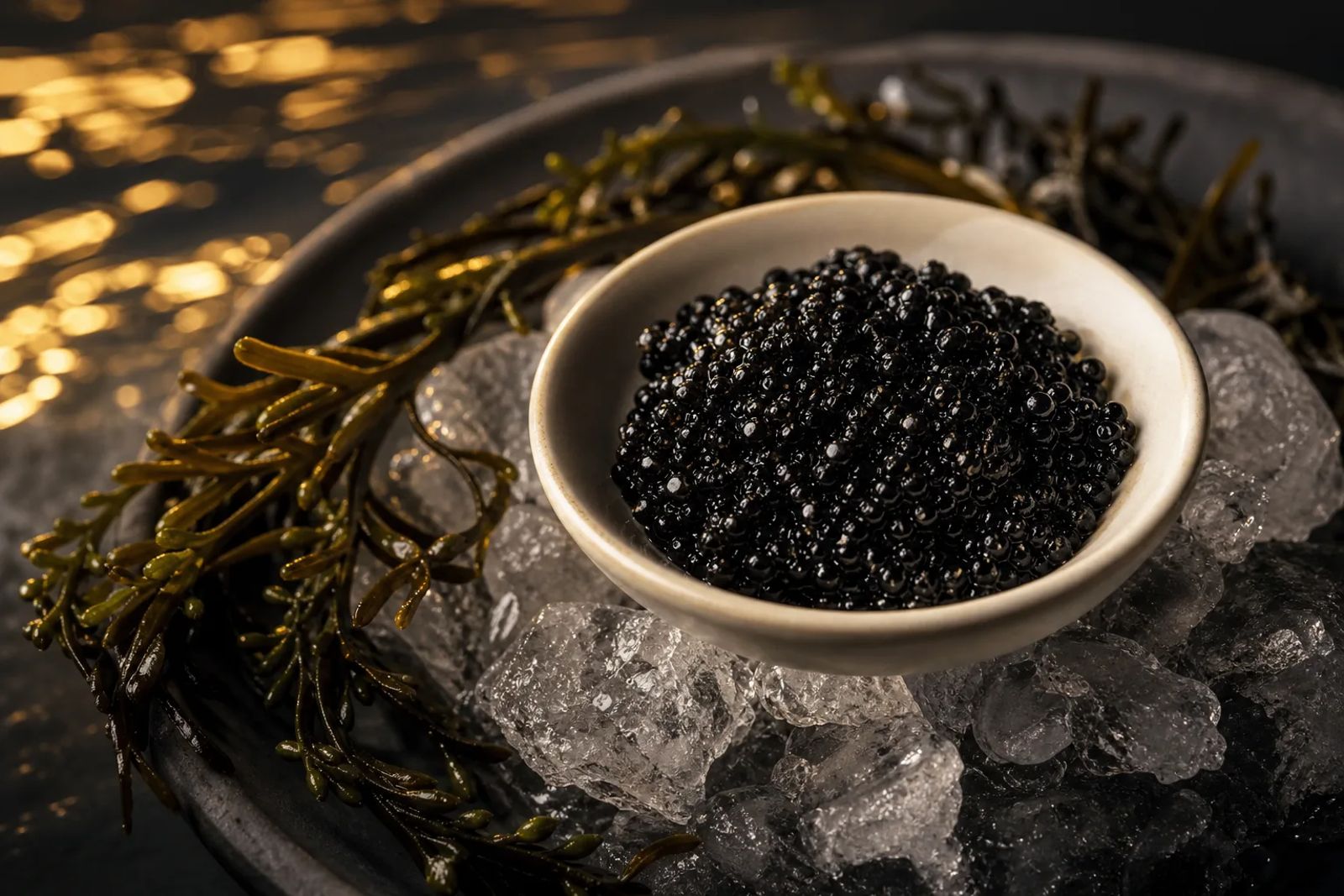
Caviar should usually have a mild aroma, often described as clean, briny or sea-like, rather than a strong smell of old fish. A pronounced fishy, sour, ammonia-like or rancid smell is a reason to stop and question the product, not a normal sign of stronger character.
What should caviar smell like?
The word “fishy” needs care: a faint seafood note and the pungent odour of deteriorating fish are not the same thing. A 2025 study of two commercial caviars described their aromas as fishy, fatty, seawater-like or algae-like, green or grassy, and wheat-like; the descriptor alone did not establish a defect.
For home assessment, think mild and recognisably seafood-like, rather than sharp or offensive. NOAA's finfish odour guide lists ocean air, briny and clean seaweed among high quality attributes, while the international Codex caviar standard identifies persistent, objectionable odours associated with decomposition or oxidation as defects.
This is an aroma check, not a full grading exercise. Our caviar grading and quality guide puts smell alongside the other features used to assess caviar.
Why caviar can smell fishy
One route is lipid oxidation, the breakdown of fats through reactions involving oxygen. Research on refrigerated caviar has linked changes in its fats to volatile compounds, meaning molecules that enter the air and contribute to aroma; some oxidation products contribute fishy or stale notes.
Time gives these reactions, and microbial activity, an opportunity to change the product. Poor temperature control and handling can also introduce contamination or unwanted oxygen during processing and repacking, so a disappointing smell may reflect the history of the roe before it reached your fridge.
“Low-quality roe” is therefore a description of the result, not a chemical explanation. Starting material, processing and storage need to be considered separately; smell alone cannot tell you which stage caused a problem.
A pleasant smell does not prove safety: food poisoning microorganisms do not change the smell, taste or appearance of food, according to Food Standards Australia New Zealand.
For the chemistry, see caviar aroma compounds. For defects involving flavour and bead condition as well as smell, see caviar quality defects.
Species, salt and pasteurisation
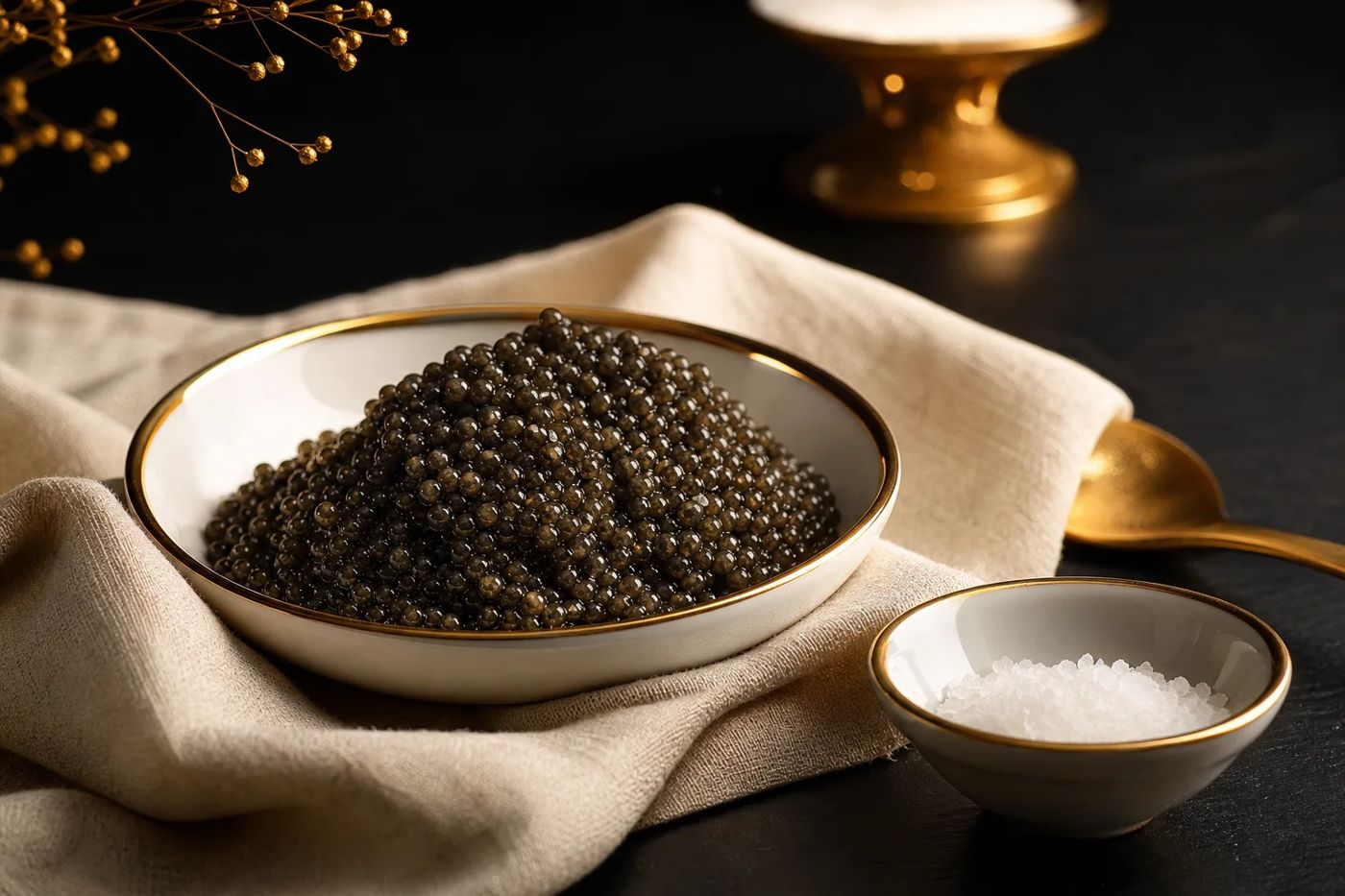
Species can influence aroma, but it does not give every tin a fixed scent. An exploratory study published in 2024 combined mass spectrometry with sensory analysis of 51 caviar samples from one producer and found associations with species, farm site, water quality and storage time.
Salt level is part of the processing picture, not a reliable scale from delicate to fishy. A storage study comparing three salt and preservative formulations found different microbial and volatile profiles, so neither stronger salting nor a particular salt percentage provides a simple aroma verdict.
Pasteurisation is a heat treatment. A 2025 study compared eight caviars from six species under different processing conditions, including pasteurisation, but did not isolate its effect on aroma or establish that pasteurised caviar must smell stronger or more fishy.
Farm water can give sturgeon flesh an earthy taint associated with geosmin or 2-methylisoborneol, known as MIB; for the distinction between flesh and roe, see purging farmed sturgeon.
What to do when a tin smells wrong
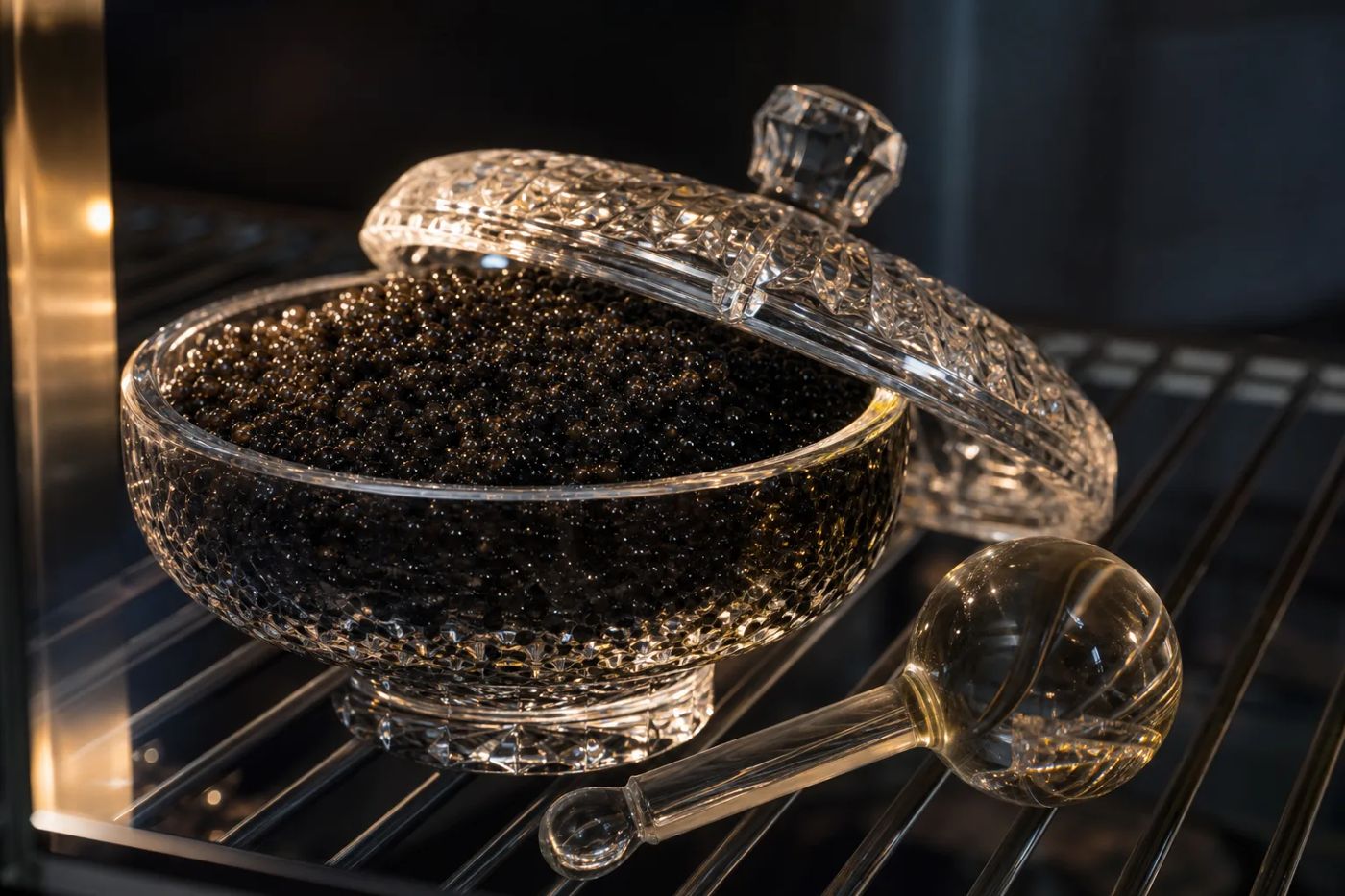
If a newly opened tin smells wrong, do not eat it or taste a bead to investigate. Contact the seller, describe the smell, and provide the batch details, opening date and any information about delivery or refrigeration.
The table separates plausible quality explanations, not laboratory diagnoses. Its action column applies when an odour is clearly objectionable, rather than merely different from a previous tin.
| What you smell | Likely cause | What to do |
|---|---|---|
| Strong, stale fishiness | Oxidative and microbial changes during storage | Do not eat; contact the seller. |
| Sour or ammonia-like odour | Decomposition is a concern; smell cannot identify the organism. | Stop serving and seek a return or disposal decision. |
| Rancid, paint-like or stale-oil smell | Lipid oxidation | Do not try to mask it with accompaniments. |
| Earthy, muddy or musty smell | The cause cannot be established by smell alone. | Raise a quality complaint; do not attempt home purging. |
A pleasant smell does not prove safety: food poisoning microorganisms do not change the smell, taste or appearance of food, according to Food Standards Australia New Zealand. Follow the product's storage instructions and use-by date, and use caviar spoilage guidance for the broader decision about whether to discard it.
Storage habits that protect aroma
Keep the cold chain intact from delivery onwards, and follow the temperature printed on the product. The Codex international reference standard specifies 2 to 4 °C (36 to 39 °F) during packaging, storage and retail, and -4 to 0 °C (25 to 32 °F) for wholesale storage and transport; these are not serving temperatures.
National home fridge advice has a different scope: FSA guidance for England, Northern Ireland and Wales recommends 0 to 5 °C (32 to 41 °F), while the US FDA recommends 4 °C (40 °F) or below for seafood refrigeration. A general fridge limit is not permission to ignore a colder temperature required on your caviar's label.
Use a fridge thermometer rather than relying on the control dial, and keep preparation time outside refrigeration short. Once opened, use clean utensils and follow the producer's specific instructions for re-covering and consumption, rather than borrowing a shelf life from another product.
For the practical arrangement of your fridge and opened container, see how to store caviar at home. Good storage is the useful intervention here, not trying to improve an objectionable aroma after it has developed.
Sources
-
Fraunhofer-Publica, Rodrigues da Silva et al. Aroma profiling and volatile fingerprinting of commercial caviar (Acipenser baerii and Acipenser gueldenstaedtii). LWT, 230, 118261, 2025.
-
US National Oceanic and Atmospheric Administration, Seafood Inspection Program. Policies, Procedures and Requirements for the Inspection of Fisheries Products on a Lot-by-Lot Basis, Part 4. July 2025 compilation, including the sensory odour and flavour guides.
-
FAO and WHO, Codex Alimentarius Commission. Standard for Sturgeon Caviar, CXS 291-2010. Retrieved edition records amendments in 2013, 2018 and 2024; sections 2.2, 7.2 and 9.2.
-
Zhang et al., published by Elsevier. The influence mechanism of phospholipids structure and composition changes caused by oxidation on the formation of flavor substances in sturgeon caviar. Food Chemistry, 460, 140585, 2024.
-
Lopez et al., University of Milan repository. Evolution of Food Safety Features and Volatile Profile in White Sturgeon Caviar Treated with Different Formulations of Salt and Preservatives during a Long-Term Storage Time. Foods, 10(4), 850, 2021; full text.
-
Le Bechec et al., published by Elsevier. Rapid analysis of VOCs with SIFT-MS as a decision-making support tool for caviar producers. Food Control, 155, 110094, 2024.
-
Rocchetti et al., published by Elsevier. The contribution of sturgeon species and processing conditions on caviar texture, metabolomic profile and sensory traits. Food Chemistry, 463, 141516, 2025.
-
US Department of Agriculture, Agricultural Research Service, Schrader et al. Geosmin and 2-Methylisoborneol Cause Off-Flavors in Cultured Largemouth Bass and White Sturgeon Reared in Recirculating-Water Systems. North American Journal of Aquaculture, 67, 177 to 180, 2005.
-
Food Standards Australia New Zealand. Microorganisms and foodborne illness. Live guidance, retrieved 2026.
-
UK Food Standards Agency. How to chill, freeze and defrost food safely. Published 2017, live edition retrieved 2026; stated geographical application: England, Northern Ireland and Wales.
-
US Food and Drug Administration. Selecting and Serving Fresh and Frozen Seafood Safely. Live consumer guidance, retrieved 2026.
This piece was researched using primary caviar aroma studies, the retrieved Codex standard and official food-handling guidance, distinguishing sensory quality assessment from microbiological safety.
Last checked: November 2026