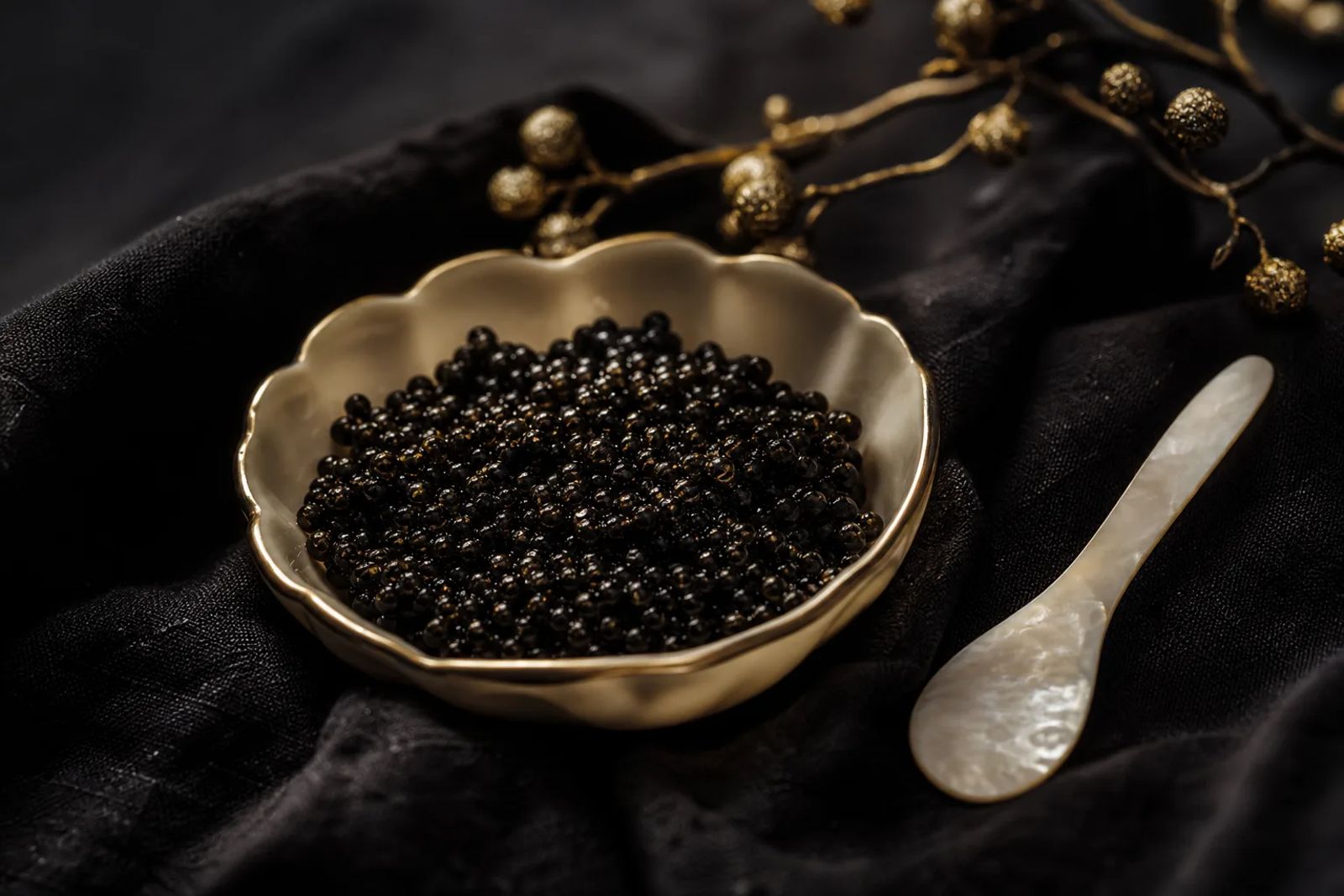
A bead gives way, a delicately briny flavour spreads, and the finish lingers. Petrossian describes its beluga in just those terms: melting in texture, with a long finish. Salt is only the beginning.
Caviar commonly tastes salty and savoury, but its marine character, richness, mouthfeel and fish notes vary between products and individual tasters. Sensory research and Petrossian's tasting notes point to an experience that unfolds: first the eggs, then their release, then the flavour left after swallowing.
What does caviar taste like on the first spoonful?
Salt may be the first thing you notice. As the eggs break, savoury flavour and a smooth coating become clearer; the finish may be gently marine, mineral or reminiscent of fresh butter. Those are tasting comparisons, not ingredients added to produce the effect.
Texture helps make the flavour compelling. In a 2014 study, Baker and colleagues asked a trained panel to describe caviar from sturgeon fed different diets, then compared those descriptions with consumer responses. Firmness, sea fresh and butter flavours, and black colour drove liking. For a beginner, that is a useful invitation: notice how the eggs feel, not just how salty they taste.
Here, caviar means salted sturgeon roe, the scope used by the Codex food standard. Roe simply means fish eggs. The guide to what caviar is explains how it differs from other roes, leaving you free to concentrate on the taste.
The texture: a gentle pop, not necessarily a crunch
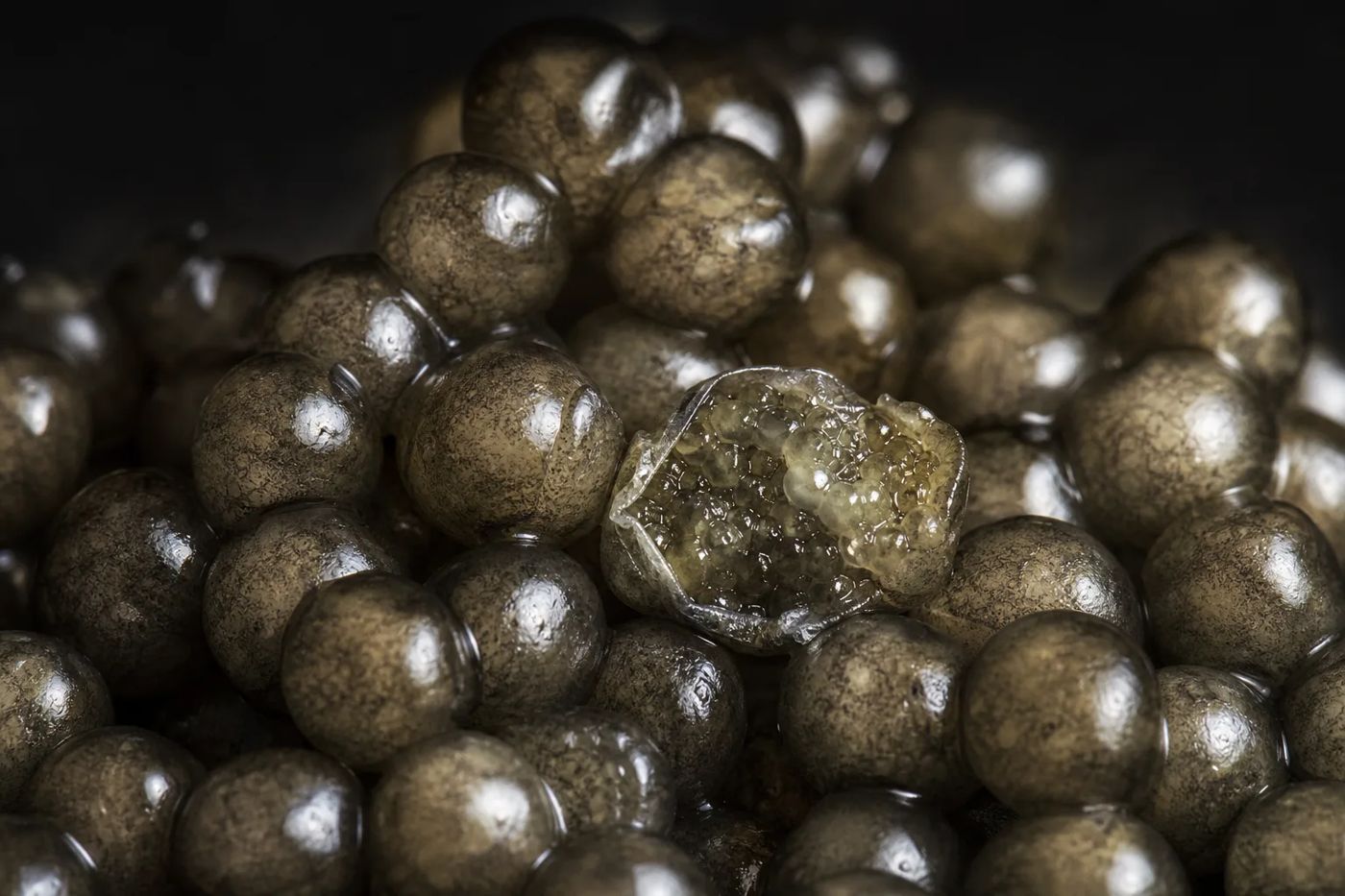
A good bead need not crunch. An intact egg offers some resistance before its outer layers give way and release the contents. That can feel like a small, gentle burst. University of Florida specialists explain that the egg membrane and surrounding follicular layers contribute to traditional caviar's firmness, texture and dissolvability.
The release can be firm or soft. Petrossian describes some selections as firm and others as melting, so softness alone is no reason for concern. A stubborn, leathery casing is another matter: Codex lists a hard covering that is not easily chewable among its consistency defects.
Flavour release also changes as you eat. A 2025 study of frozen and thawed Russian sturgeon caviar, involving ten selected participants and instrumental analysis, found that oral processing changed flavour release as the eggs mixed with saliva. Take a moment to notice it. There is no prescribed number of seconds to chew; the interest lies in noticing the change.
How the main caviars are described
Beluga can be melting; Ossetra can have firm grains. Intensity and texture do not move in lockstep. The descriptions below come from the named suppliers' selections, rather than this site's own tastings or a blind comparison across species. Use them as starting points, since a species name cannot guarantee a particular flavour.
- Beluga, Huso huso: Petrossian describes a delicately briny taste, a very melting texture and a long finish. Think softness and persistence rather than the strongest possible salt hit: the interest suggested by these notes is how gently the eggs yield and how long the flavour stays.
- Ossetra, here Russian sturgeon, Acipenser gueldenstaedtii: Petrossian's guide describes briny intensity, dried-fruit notes and firm grains. Ossetra is a trade name, not a flavour grade. Check the species rather than treating the name as a promise of one precise taste.
- Sevruga, Acipenser stellatus: Petrossian characterises its Sevruga selection as very briny and melting. These notes suggest a more assertive impression of salt and sea, without assuming that the eggs must be especially firm. Flavour intensity and resistance in the mouth are separate qualities.
- Siberian sturgeon, Acipenser baerii: Petrossian describes its Baïka selection as mineral, briny and melting; another of its guides mentions fruity notes. Look beyond the first salt impression to the character of the finish, where those descriptions suggest more than a single dominant flavour.
- Kaluga hybrids: A documented hybrid combines female Kaluga, Huso dauricus, with male Amur sturgeon, Acipenser schrenckii. Its sensory characteristics can vary. This is a hybrid, not pure Kaluga or beluga; beluga is the species CITES lists as Huso huso.
For more on the traditional names, see the classic three compared. If the vocabulary feels unfamiliar, caviar flavour profiles explains the tasting terms. There is no need to recognise every note immediately.
Why taste varies from one batch to another
The species name tells only part of the story. Research on caviar production identifies water quality, feed, processing and storage as influences on sensory quality. The fish's age matters for egg development and harvest readiness, but older does not automatically mean better-tasting caviar.
Feed can leave a discernible signature. Baker's study found differences between dietary treatments in several aroma and aftertaste attributes. Water matters too: compounds associated with earthy or musty off-flavours can occur in farming systems. Purging, also called depuration, means holding fish in clean water before harvest to reduce accumulated off-flavour compounds. It does not mean washing finished eggs until they taste neutral.
Salt changes both the immediate flavour and the eggs themselves. Maturation is the producer's controlled ageing of salted roe to develop its intended character. It is not a reason to leave an opened container longer at home. Freshness and maturation describe different things: deliberately matured caviar can still be in good condition.
Storage continues to shape the result. A 2024 experiment followed Russian sturgeon caviar stored at −4°C, using fifteen trained assessors alongside chemical and texture measurements. The sensory results changed over time, showing why storage history belongs alongside species in any account of taste. The science of caviar flavour explores the mechanisms. For a first tasting, remember that the name on the container cannot tell you everything about the caviar inside.
What good caviar should not taste like
Clean marine flavour is one thing; an aggressively fishy, sour, rancid or muddy taste is another. Codex treats persistent objectionable flavours associated with decomposition, oxidation, feed or contamination as defects. An unpleasant taste is not something you must learn to appreciate simply because caviar is unfamiliar.
As the eggs break, savoury flavour and a smooth coating become clearer; the finish may be gently marine, mineral or reminiscent of fresh butter.
Muddy and musty off-flavours in aquaculture are associated with geosmin and 2-methylisoborneol, often shortened to MIB. In a study combining sensory assessment and chemical analysis, researchers identified geosmin as the cause of earthy flavour in farmed white sturgeon fillets. That finding concerns the flesh; it does not establish the cause of every muddy flavour in caviar.
If something seems wrong, stop eating and contact the supplier. The guide to normal aroma versus quality problems explains what to look for. Smell and taste cannot establish food safety, however pleasant they seem. Follow the producer's storage instructions and use-by date rather than tasting to decide whether caviar is safe.
What to notice on your first taste
Start with a little caviar on its own. Before toast, blinis or toppings enter the picture, give yourself a clear reference point for the eggs. You do not need a catalogue of aromas, just four simple questions.
- Salt: Does it lead the first impression, or dominate the whole mouthful?
- Texture: Do the beads stay separate? Are they soft, supple or firm?
- Pop: Do they release under gentle pressure, or give a more distinct little burst?
- Finish: What remains after swallowing: clean brine, a savoury coating or another recognisable flavour?
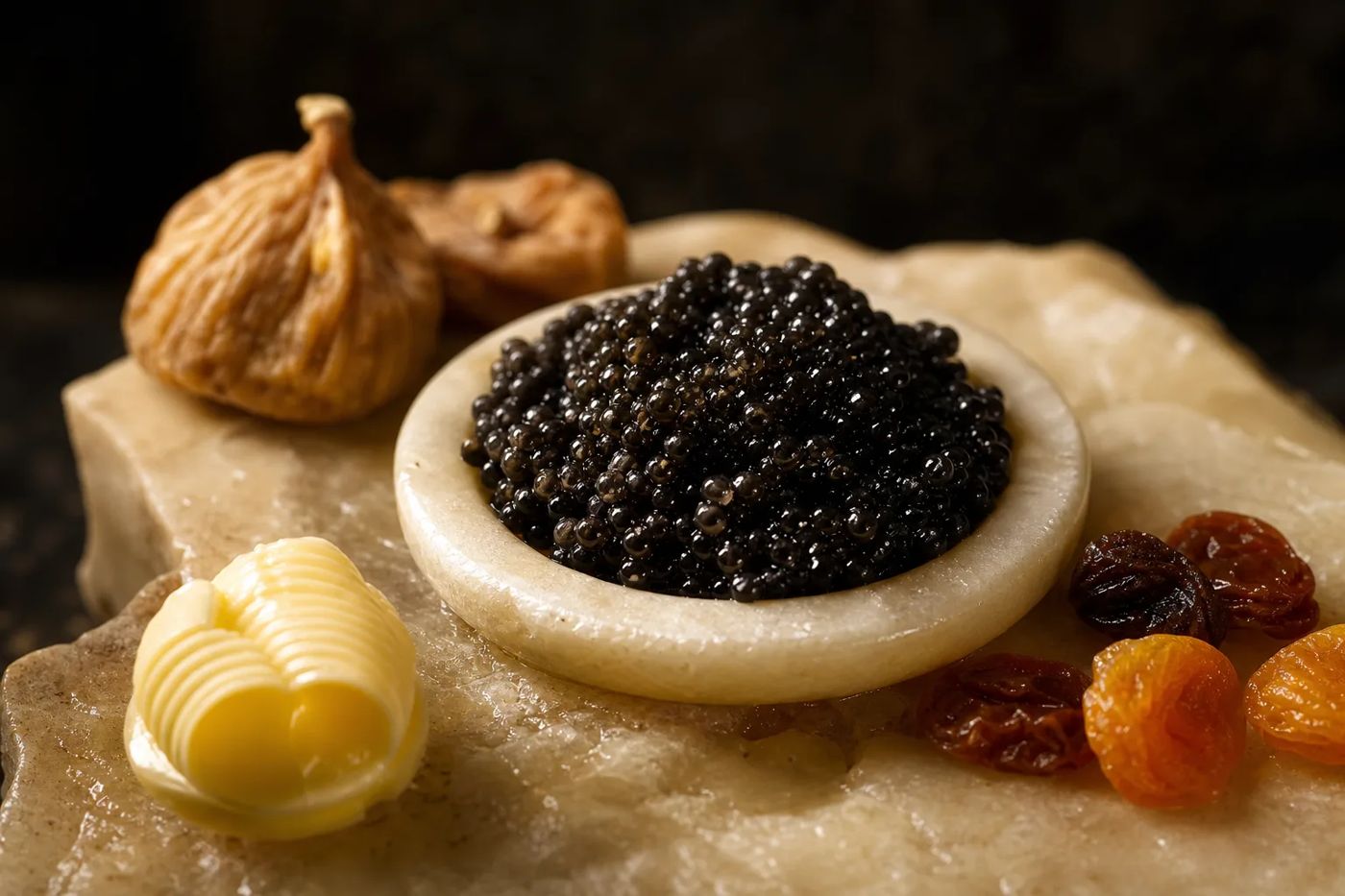
Next, try a second taste on lightly buttered toast or a blini, as Petrossian suggests. Tasting the roe plain first lets you judge what the bread adds or masks. Save strongly flavoured toppings for later if you want to understand the caviar itself rather than the assembled bite.
A mother-of-pearl spoon is a straightforward choice. Metal need not spoil the experience: Petrossian also recommends stainless steel, distinguishing it from silver. Begin with a clean utensil and handle the eggs gently. Those practical details matter more than ceremony; how to taste caviar takes you through the fuller method.
How salmon roe, trout roe and tobiko differ
The pop of sushi roe is a useful reference, but sturgeon caviar offers a different balance of membrane, richness and finish. It is not simply the same bite in another colour.
Cookery writer Namiko Hirasawa Chen describes ikura, salmon or trout roe, as having a membrane that pops around a slightly oily, salty and savoury centre, with mild fishiness. Kikkoman describes tobiko, flying fish roe, by its small eggs and popping texture. If those are the roes you know, notice how sturgeon caviar's release, richness and lingering flavour compare, rather than expecting an identical experience.
Sources
-
Washington State University researchers, Journal of Food Science. Baker, A. K., Vixie, B., Rasco, B. A., Ovissipour, M. and Ross, C. F. Development of a Lexicon for Caviar and Its Usefulness for Determining Consumer Preference. Volume 79, 2014, pages S2533 to S2541. Journal article.
-
Ocean University of China researchers, Food Chemistry: X. Salivary emulsification shapes flavor release and perception in sturgeon caviar during oral processing. Volume 29, article 102841, 2025. Open-access article.
-
University of Florida, IFAS Extension. Chapman, F. A. and Van Eenennaam, J. P. Technically Speaking, What Is Sturgeon Caviar? Publication FA194, online edition retrieved November 2026. Extension publication.
-
FAO and WHO, Codex Alimentarius. Standard for Sturgeon Caviar, CXS 291-2010, adopted 2010, last modified in 2026 according to Codex. Official PDF.
-
Petrossian. Which caviar should you choose for a first tasting? Undated online edition, retrieved November 2026. Commercial supplier's descriptions, not independent comparative evidence. Tasting guide.
-
Petrossian. Caviar type: what is the best caviar? Undated online edition, retrieved November 2026. Commercial supplier's descriptions. Selection guide.
-
Liu and colleagues. The complete mitochondrial genome of the hybrid sturgeon of Huso dauricus and Acipenser schrenckii. 2017. Research article.
-
Western Regional Aquaculture Center. Rasco, B. A. and collaborators. Optimizing Quality and Shelf-Life, project termination report, 2006. Research report.
-
USDA Agricultural Research Service and University of California, Davis researchers, North American Journal of Aquaculture. Schrader, K. K., Acuña Rubio, S., Piedrahita, R. H. and Rimando, A. M. Geosmin and 2-Methylisoborneol Cause Off-Flavors in Cultured Largemouth Bass and White Sturgeon Reared in Recirculating-Water Systems. Volume 67, 2005, pages 177 to 180. Journal article.
-
Food Chemistry: X. Multi-omics combined approach to analyze the mechanism of flavor evolution in sturgeon caviar (Acipenser gueldenstaedtii) during refrigeration storage. Volume 23, article 101688, 2024. Open-access article.
-
Petrossian. Frequently Asked Questions. Undated online edition, retrieved November 2026. Supplier guidance on maturation, accompaniments and utensils. Supplier FAQ.
-
Just One Cookbook. Hirasawa Chen, N. Ikura (Salmon Roe). Updated 21 August 2024. Author's ingredient guide.
-
Kikkoman Corporation. Tobiko / Flying Fish Roe. Undated online glossary entry, retrieved November 2026. Ingredient glossary.
This piece was researched through sensory studies, university and aquaculture research publications, the retrieved Codex standard, and explicitly attributed supplier and cookery descriptions; no first-hand tasting is claimed.
Last checked: November 2026